
1. Background
Immune thrombocytopenia (ITP) is an acquired autoimmune disease defined by isolated thrombocytopenia and normal or raised numbers of bone marrow megakaryocytes. ITP is categorized as primary or secondary in accordance with underlying etiology. Secondary ITP is related to diverse conditions that can influence the development of thrombocytopenia and includes immunodeficiency, autoimmune diseases, infection, or drugs (1). Many rheumatologic conditions are associated with thrombocytopenia due to antibody-mediated platelet destruction. Intravascular degradation and reduced platelet production are also involved in this matter. Concomitant factors, such as infections, medications, and vaccinations, can also mislead physicians in choosing the correct and quick treatment (2). A theory has been put forward that ITP is a syndrome identified by various defects in regulating the immune system. In most cases, the underlying connective tissue disease successfully treated with corticosteroids or other disease-modifying agents can improve concomitant thrombocytopenia (3). Studies show that different conditions and diseases can cause ITP, including lupus (4). In fact, thrombocytopenia is one of the common complications of lupus and among its clinical criteria (5). Some studies have shown that patients with ITP have a higher risk of developing lupus than the general public; therefore, these patients should be monitored for lupus (5, 6). Knowing the rate of ITP patients who develop vascular collagen diseases and the developed type can help predict future treatments and even take preventive measures. No study has been conducted in Iran to assess patients with thrombocytopenic purpura regarding their potential inclination to develop vascular collagen diseases. The present study was thus conducted to assess patients with ITP in terms of developing vascular collagen diseases at AJA University of Medical Sciences.
2. Objectives
This study aimed to know the frequency of immune thrombocytopenic purpura (ITP) in collagen vascular disorders.
3. Methods
The present retrospective cross-sectional study was conducted in 2020 at AJA University of Medical Sciences. The files of all patients who visited Imam Reza Hospital and a private clinic in Tehran and were diagnosed with SLE or ITP from 2010 to 2020 were examined. On the health records of 447 eligible patients selected by Census sampling to whose full records the researchers could gain access. Of these 447 patients, 336 had lupus, and 111 had ITP and were referred to Imam Reza Hospital or a private clinic in Tehran for treatment. The inclusion criteria were a diagnosis of ITP or systemic lupus erythematosus (SLE) (positive test of ANA and Anti-ds DNA), the age range of 18 to 70, and the exclusion criteria, Having another rheumatological disease, unwillingness to cooperate and lack of access to the patient’s health records or distorted records. First, the patient’s details, such as age, gender, marital status, age at diagnosis, time from the diagnosis of ITP to the development of lupus, and the patients’ ANA and anti-ds DNA test results, were extracted from their records and entered into the prepared checklist. The lupus patients were assessed for previous development of ITP, and the ITP patients for the development of vascular collagen diseases.
Finally, the data were entered into SPSS-23 and analyzed. The mean and standard deviation were recorded for the quantitative variables and absolute and percentage frequency for the qualitative variables.
4. Results
The mean age of participants was 46.7 ± 18.5 years, and their mean age at ITP diagnosis was 38.8 ± 2.1 years. Table 1 presents the other demographic details of the patients.
Table 1.
The Patients’ Demographic Details
| Variable | No. (%) |
|---|---|
| Gender | |
| Male | 121 (27) |
| Female | 326 (73) |
| Total | 447 (100) |
| Marital status | |
| Single | 98 (22) |
| Married | 349 (78) |
| Total | 447 (100) |
| Level of education | |
| High school | 85 (19) |
| Diploma | 192 (43) |
| Associate’s degree | 27 (6) |
| Bachelor’s degree | 130 (29) |
| Master’s degree | 9 (2) |
| PhD | 4 (1) |
| Total | 447 (100) |
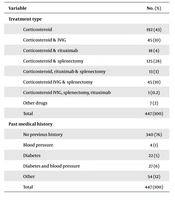
A total of 43% of the ITP patients had been treated with corticosteroids, and 76% had no previous illness history (Table 2).
Table 2.
The Treatment Type and Past Medical History
| Variable | No. (%) |
|---|---|
| Treatment type | |
| Corticosteroid | 192 (43) |
| Corticosteroid & IVIG | 45 (10) |
| Corticosteroid & rituximab | 18 (4) |
| Corticosteroid & splenectomy | 125 (28) |
| Corticosteroid, rituximab & splenectomy | 13 (3) |
| Corticosteroid IVIG & splenectomy | 45 (10) |
| Corticosteroid IVIG, splenectomy, rituximab | 1 (0.2) |
| Other drugs | 7 (2) |
| Total | 447 (100) |
| Past medical history | |
| No previous history | 340 (76) |
| Blood pressure | 4 (1) |
| Diabetes | 22 (5) |
| Diabetes and blood pressure | 27 (6) |
| Other | 54 (12) |
| Total | 447 (100) |
Of the SLE patients assessed, 92.5% were female, and 7.5% were male. Among the ITP patients assessed, 45% were female, and 55% were male.
ITP became vascular collagen disease in 3.6% of patients (Table 3).
Table 3.
The Number of ITP Patients Developing Vascular Collagen Disease
| Collagen Vascular Disease | No. (%) |
|---|---|
| SLE | 2 (1.8) |
| Rheumatoid arthritis | 1 (0.9) |
| Polymyositis | 1 (0.9) |
| Total | 4 (3.6) |
The mean interval between the initial diagnosis of ITP and vascular collagen disease diagnosis was 2.1 ± 0.9 years. The records of 336 patients with SLE were also assessed, of whom 15 (4.5%) had first developed ITP and then lupus. Hence, of the 447 patients included in the study, 17 (3.8%) with a history of ITP then developed lupus.
Of the 336 patients with lupus, 7.5% were male, 0.6% had initially developed ITP, and the remaining 92.5% were female, of whom 3.3% had initially developed ITP.
Of the ITP patients assessed, 55% were male, and none of them had developed lupus, while in the remaining 45% of female participants, 8% had developed lupus.
5. Discussion
Immune Thrombocytopenic Purpura (ITP) is an idiopathic bleeding disorder with thrombocytopenia and increased or normal bone marrow megakaryocytes. The pathogenesis of primary ITP is unknown, but secondary ITP can be associated with autoimmune diseases, immunosuppression, and infection (7). In this disease, platelets are targeted and destroyed by autoantibodies in the reticuloendothelial system (8). Some studies show that lupus's platelet system is active (9). Some studies indicate that thrombocytopenia is associated with poor prognosis, including higher mortality in SLE (10, 11). Based on the National Database in Taiwan, SLE occurred in 4.7% of patients with idiopathic ITP, and the risk of developing SLE was 26 times higher than in non-ITP patients (6). Before starting the study, our investigations showed that no study in Iran had investigated the relationship or frequency of SLE and ITP. Identifying the incidence of SLE during the disease course of ITP would be important to prevent complications in patients.
The present study examined the development of vascular collagen diseases in patients with ITP. A total of 3.6% of patients who had ITP developed vascular collagen disease, half of whom (1.8%) were cases of lupus, which is less than the figure reported in the study by Hazzan et al. (12). Nonetheless, it should be noted that the population assessed in their study consisted of children, while the present study investigated a population of adults. Other studies have shown that 3% to 18% of ITP patients are likely to develop lupus (13). In the study by Zhu et al. (6), 4.7% of ITP patients had developed lupus, which is higher than the figure reported in the present study. This disparity indicates that the rate of development of vascular collagen disease is lower in the population of Iranian patients with ITP compared to other parts of the world.
Among the lupus patients assessed, 4.5% already had ITP before the development of lupus, which is less than that reported in the study by Zhao et al., i.e., 12.8% (11).
The present findings showed that the rate of development of vascular collagen disease in patients with ITP is higher among female than male patients, and the results of other studies also confirm this finding (12).
Comparing the present findings with the results of other studies shows that Iranian patients with ITP develop vascular collagen disease at a lower rate. Consequently, other studies' results that suggest ITP can predict lupus does not apply to this study.
The limitations of this study included incomplete health records for some patients, which led to the exclusion of 20 patient records. Given the duration of the researcher's residency in select study settings, the limited time to assess healthy individuals was another limitation. Considering that in various studies, the impact of the severity of SLE disease or the duration of a person's SLE on the incidence of ITP has not been investigated, it is suggested to investigate the relationship between the severity and the duration of SLE in the development of ITP in future studies.
5.1. Conclusions
Comparing the present findings with the results of other studies shows that Iranian patients with ITP develop vascular collagen disease at a lower rate.