1. Background
Chronic immune idiopathic thrombocytopenia (CITP) is an autoimmune disease that is characterized by shortened intravascular survival of platelets due to autoantibodies-mediated destruction. These antiplatelet autoantibodies that are formed as a result of immune system stimulation against platelet membrane proteins, are mostly directed against platelet glycoprotein (GP) IIb-IIIa and/or GPIb-IX complexes (1-3). These autoantibodies bind to platelets and megakaryocytes and result in platelet destruction by reticuloendotelial cells in the spleen and liver and to a lesser extend in bone marrow, and also impair the production of platelets by interference in megakaryopoiesis (1, 2). In addition to autoantibodies, complement mediated lysis and direct T-cell cytotoxicity are also involved in pathogenesis of CITP (2). The main clinical features of the disease are low platelet count and bleeding tendency (1, 3). Although idiopathic thrombocytopenia (ITP) results from an autoimmune mechanism yet in 20% of cases the underlying disorders play an important role in pathogenesis of the disease. Several studies have focused on the association between H. pylori infection, as one of these underlying disorders, and chronic ITP (4).
Helicobacter pylori is a gram-negative microaerophilic bacteria that colonizes the stomach of 50% to 80% of the world population (5). It is involved in the pathogenesis of various diseases such as gastroduodenal diseases, including gastric and duodenal ulcers, chronic active gastritis, and mucosa-associated lymphoid tissue (MALT) lymphoma. In addition, H. pylori is implicated in extragastric disorders such as cardiovascular, respiratory, neurological and autoimmune diseases including pernicious anemia, rheumatoid arthritis, autoimmune thyroiditis, idiopathic thrombocytopenic purpura etc. (6). Although H. pylori infection is a possible cause of CITP, yet the exact pathological mechanism is obscure and needs further research. It seems that H.pylori may trigger an autoimmune event (5). Some studies have shown that eradication of H. pylori infection leads to platelet recovery in CITP patients while others have failed to show the same beneficial effects (7, 8).
2. Objectives
The purpose of the present study was to determine the efficacy of H. pylori eradication on improvement of platelet counts in subjects with chronic ITP.
3. Patients and Methods
3.1. Patients
This study was conducted on 24 children under 20 years old with chronic ITP, admitted to the pediatric ward of Ali-ebn Abitaleb hospital from September 2011 to August 2012. Idiopathic Thrombocytopenia was defined based on platelet counts below 100 × 103 μL (lasting more than six months without identified causes) according to the American society of hematology (ASH) guidelines, and was confirmed by bone marrow examinations at the time of diagnosis (9). All patients received intravenous immunoglobulin (IVIG), yet none of them received anti-D immunoglobulin. Cases who had previously received H. pylori eradication treatment or were using corticosteroid at a dosage of more than 0.5 mg/kg/day at baseline, and during the study period, subjects with secondary ITP and patients with serious illness including cardiac, hepatic and renal diseases were excluded from the study. One out of 24 patients died due to cerebral hemorrhage during the study and therefore was excluded from the study. A written consent was obtained from all parents for participation of their child in this study. This study was confirmed by the children and adolescent health research center.
3.2. Diagnosis and Treatment
At the baseline, complete blood count (CBC) was measured in all 23 patients. Analysis of H.pylori infection was carried out by the H. pylori stool antigen (HpSA) using the enzyme-linked immunosorbent assay (ELISA) and 13 C-urea breath test (UBT). Thirteen C-urea breath test (UBT) was performed as following: After an overnight fast, breath samples were collected before and 30 minute after ingestion of 13 C-urea dissolved in 100 mL water. Doses of 13 C-urea were 50 mg for children under six years old and 75 mg for older children. Detecting of 13C in breath CO2 was determined by Isotope Ratio Mass Spectrometry. A delta-over-baseline value of > 4% was considered positive (10). Four weeks before the test the use of antibiotics and proton pomp inhibitors were discontinued. The HPSA test was performed in all patients and those with positive HPSA test were positive for 13 C-UBT too.
In study, patients with confirmed H. pylori infection was treated with triple eradication therapy including clarithromycin 500 mg twice daily, amoxicillin 1000 mg twice daily and proton pump inhibitors (PPI) 40 mg twice daily for one or two weeks (7). Eradication was assessed by UBT more than four weeks after the eradication therapy.
3.3. Assessment of Response and Follow-Up
Platelet count was monitored once a month until six months after the end of eradication therapy and was compared with baseline counts. Some patients were checked more frequently depending on their platelet counts and clinical situation. Response to treatment was defined as a complete response (CR) if the platelet count was above 100 × 103 μL or when it reached the normal range (150 × 103 μL), and partial response (PR) was when the increase in platelet count was between 50 and 100 × 103 μL. Non-responders were those with an increase in platelet count of less than 50 × 103 μL or no increase in platelet count following eradication. In addition to H. pylori positive patients, the platelet counts were monitored at the mentioned intervals for uninfected individuals. The platelet count changes were compared for the following three groups; H. pylori infected patients who were successfully treated, H. pylori infected patients who were not successfully treated and uninfected individuals who had not received therapy. Other parameters including age, sex, baseline platelet count, previous splenectomy and present corticosteroid therapy were also compared between these groups.
3.4. Statistical Analysis
The data was analyzed using the SPSS software. T-student test was used for comparisons of mean values between the two groups and in cases with non-normal distribution, Mann-Whitney test was used. P values of < 0.05 were considered statistically significant. Kolmogorov-Smirnov Test and χ2 test were also used in this study.
4. Results
Out of the 24 patients with CITP, 14 (58%) were boys and 10 (42%) were girls, with the mean age of 10 ± 0.5 years (age range between 3.5 and 20 years). One boy died due to cerebral hemorrhage and was excluded from the study. Of the 23 remaining subjects, H. pylori infection was detected in 10 (43.5%) patients with mean age (mean ± standard deviation (SD)) of 9.5 ± 4.7 and 13 subjects were uninfected (mean ± SD: 10.2 ± 5). The comparison between the baseline clinical characteristics of H. pylori positive and negative CITP patients is shown in Table 1.
Table 1.
Comparison Between Some Characteristics of Helicobacter pylori Infected and Non-Infected Patients With Chronic Idiopathic Thrombocytopenic Purpura
| Characteristics | H. pylori Infected Patients (n = 10) | H. pylori-Non Infected Patients (n = 13) | df | Statistical Value | P Value |
|---|---|---|---|---|---|
| Age y a | 9.5 ± 4.7 | 10.2 ± 5 | 21 | T = -0.337 | 0.74 |
| Gender | 1 | χ2 = 0.87 | 0.7 | ||
| Female | 4 | 6 | |||
| Male | 6 | 7 | |||
| Platelet count a, × 103 μL | 54.9 ± 22.2 | 56 ± 32.2 | 0.93 | ||
| Prednisolone therapy b | 5 (50) | 6 (46.2) | 1 | χ2 = 0.034 | 0.86 |
| Previous splenectomy b | 1 (10) | 1 (7.7) | 19 | T = 0.014 | 0.85 |
a The values are presented as mean ± SD.
b The values are presented as No. (%).
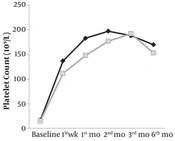
Successful eradication was achieved in eight out of ten H. pylori infected patients and also two out of eight patients (25%) achieved a partial response. There was a significant increase in platelet count during the six months follow-up (P < 0.001) compared with the baseline platelet count. The difference between the mean platelet count ± SD before and after HP eradication therapy was statistically significant (56.2 ± 22.2 × 10³ μL versus 233 ± 85.6 × 10³ μL). These patients also had a significant increase in their platelet counts compared with those in whom H. pylori was not successfully eradicated (P < 0.05) or untreated patients (P < 0.05) (Table 2).
Table 2.
Comparison Between Baselines and Secondary (After Six Months) Platelet Counts in Three Groups of Successfully Treated Patients With Chronic Idiopathic Thrombocytopenic Purpura (CITP), Unsuccessfully Treated Patients and Untreated CITP Patients
| Groups | Baseline Platelet a | Secondary Platelet a | df | Statistical Value | P Value |
|---|---|---|---|---|---|
| H. pylori infected patients with response (n = 8) b | 56.2 ± 2.2 | 233 ± 85.6 | 7 | T = -6.1 | < 0.001 |
| H. pylori infected patients no response (n = 2) b | 50 ± 49.5 | 52 ± 50.9 | 1 | T = -2.2 | 0.276 |
| Untreated patients (n = 13) b | 56 ± 32.2 | 56 ± 27.8 | 12 | T = -0.023 | < 0.98 |
| P values | |||||
| P1 | 0.82 | < 0.05 | |||
| P2 | 0.98 | = < 0.05 |
a Count × 103 μL.
b The values are presented as mean ± SD.
In patients with successful eradication of H. pylori, during the first three months of eradication therapy, platelet counts gradually increased until no increase in platelet counts was observed. On the other hand, non-responder patients to H. pylori eradication therapy did not show statistically significant increase in platelet counts during the entire follow up period of six months.
5. Discussion
Chronic Idiopathic thrombocytopenic purpura is an autoimmune disease characterized by low platelet count, due to destruction and impairment in the production of platelets mediated by auto-antibodies (1-3). In addition to the autoimmune phenomena, infectious agents such as H. pylori are involved in the pathogenesis of CITP, yet the exact role of these agents remains controversial (2-5). This study hypothesized that in HP infected chronic ITP patients, H. pylori eradication therapy may be associated with platelet recovery. The results of this study partly confirmed this theory since from ten HP infected patients (43.5%), HP was eradicated in eight (80%) and two (20%) were non-responder. We also found a significant increase in platelet count of eight patients during six months of follow-up (P < 0.001) compared with the baseline platelet count. This finding was consistent with the findings of other studies (11, 12). In the study of Ferrara et al. (11) on 24 patients with CITP, eight individuals (33.3%) were infected with H. pylori and eradication treatment was successfully achieved in six out of eight patients with significant increases in platelet count in all six cases. Our findings as well as that of Ferrara et al. (11) highlight the effect of H. pylori infection on platelet count in CITP as a basic cause or exacerbation factor. Another study by Sato et al. in Japan was performed on 53 patients with CITP (12). In this study prevalence of H. pylori infection among CITP patients was 73% (39 patients); eradication of HP in 32 cases led to suitable response in 27 patients (12). Although the above articles are in line with our study, some reports did not show any platelet recovery in the H. pylori treatment group compared to the control group (13, 14). The findings of these studies that were not consistent with our findings, suggest that eradication of co-existing H. pylori infection is not associated with platelet recovery in childhood chronic ITP (13, 14). More research with more subjects and long-term follow up in different geographical regions is highly recommended. Although a considerable number of studies were conducted investigating the effect of H. pylori infection treatment on platelet count in CITP patients yet the effect of ethnicity on treatment should always be considered when comparing the results of different studies. This study was performed on Iranian patients, which obviously have their own genetic properties that can affect treatment results. Prevalence of H. pylori infection in our study was 43.5%. Previous studies on patients with CITP have demonstrated a different prevalence rate of H. pylori infection among different countries: 74% in Japan (12), 12.9% in Iran (15), 20% in another study from Japan (16) and no cases in Finland (17). This variation in prevalence rates among subjects might be due to differences in acquisition of H. pylori infection in the general population in different countries; as repots are higher in low socioeconomic countries compared to developed countries.
There was no significant change in platelet count in our uninfected patients who had not received HP eradication therapy (P = 0.98). Six out of eight patients (75%) achieved a good response that was demonstrated by the considerable and statistically significant increase in platelet counts after eradication therapy compared with baseline platelet counts (P < 0.001). We also observed 2.8 patients (25%) with partial response after treatment. This finding is similar to the study of Tag et al. Their study performed in Korea during 2009 revealed that from 23 patients with H. pylori infection, 11 (44%) exhibited a complete response (CR) to H. pylori eradication therapy, six (24%) partial response (PR), and eight (32%) were nonresponsive (NR) (7). Russo et al. (8) in Italy in 2010 also described the efficacy of H. pylori eradication in increasing platelet count in CITP patients. Their study was done on 244 CITP patients and revealed that from 50 (20%) patients with H.pylori infection, 37 received eradication therapy and were completely followed-up for six months. In 89% of these cases, eradication therapy was successful and platelet recovery was demonstrated in 39% of patients after eradication (8). In the present study responders who were defined as patients with successful treatment of H. pylori showed a significant platelet recovery within six months after the eradication therapy. Although longer follow up duration of platelet count was better for good judgment, yet it seems that six months of monitoring was adequate to find the association. According to the results of this study and other similar studies, H. pylori infection should be considered as a potential cause or an aggravating factor of thrombocytopenia in chronic ITP; eradication therapy in positive cases of H. pylori might have a beneficial effect on platelet recovery. However, a larger scale of randomized controlled trials is required for confirming our findings.