
1. Background
At the end of January 2020, the World Health Organization (WHO) declared a pandemic due to the coronavirus disease 2019 (COVID-19) outbreak. These conditions have changed the lives of people all around the world (1). One of these changes is decreased individual and social interactions due to the highly contagious nature of the disease. Home quarantine and the concern of patients with underlying diseases about the severe consequences of COVID-19 and the fear of transmitting the infection to others have created stress and negative social consequences in individuals.
Meanwhile, the lifestyle of health workers has been changed more than others, making them the most vulnerable due to their frequent contact with patients (2). One of the aspects exposing these individuals to vulnerability is heavy stress in the workplace. Basically, a clinical environment inevitably imposes stress on caregivers (3). In this regard, Said and El-Shafei showed that nurses who were on the front lines during the COVID-19 pandemic demonstrated high occupational stress levels due to workload, dealing with death and dying, personal demands and fears, employing strict biosecurity measures, stigma, and exposure to infection risk (4). Severe or prolonged stress can lead to exacerbation and persistence of mental and physical problems (1). Evidence in previous epidemics such as severe acute respiratory syndrome (SARS), influenza, or Ebola suggests that nurses have experienced many emotional and moral distress in dealing with these crises. In this regard, Khalid et al. determined the emotions, perceived stressors, and coping strategies of healthcare providers during the Middle East respiratory syndrome coronavirus (MERS-CoV) outbreak and showed that ethical commitment pushed them to continue their job in crisis situations (5). It was while they experienced emotional turmoil, such as a sense of fear for the personal safety and well-being of colleagues and family (5). Brooks et al. identified social and job factors affecting the psychological well-being of healthcare workers during the SARS crisis, showing the psychological impacts of SARS on the job role, training/preparedness, risky work environment, quarantine, stressors related to the role, perceived risk, social support, and social isolation (6). Also, Matsuishi et al. reported more anxiety and exhaustion in environments with a high risk of infection and feelings of insecurity in hospital workers with less information about the influenza A (H1N1) pandemic (7). Such studies show that in an epidemic disease, there is a lot of distress in nurses, which can lead to anxiety, depression, and post-traumatic stress disorder (PTSD). A study showed that during the COVID-19 epidemic in China, 4679 doctors and nurses from 348 hospitals had psychological distress, anxious symptoms, and depressive symptoms and received less psychological help compared to health staff without any problem (8). Today, nurses are often under significant pressure during the current COVID-19 crisis, and it is almost impossible to remove stress completely from nurses as the work environment is often highly emotional with involvement in making difficult decisions. In such situations, nurses’ worries and personal issues might impact their mental health (9). Some researchers have argued that stress and mental health are influenced by emotional intelligence, meaning that emotional intelligence moderates the relationship between stress and mental health (10). For example, Ismail et al. showed that emotional intelligence mediated the effect of job stress on job performance (11). Another important aspect of emotional intelligence is spiritual intelligence. Spiritual intelligence plays an essential role in promoting and ensuring mental health (12). Spirituality is a form of intelligence that predicts functioning and adaptation and improves health or well-being (13). In stressful situations, spiritual intelligence makes a person better understand negative emotions and deal with them to reduce their reoccurrence (14). Spiritual intelligence is effective in reducing perceived stress among nurses. It also increases happiness, motivation, and adaptive response-ability to solve problems and ultimately helps promote mental health and reduce the stress of nurses (15). Moral distress is another aspect of nurses’ emotional problems during the COVID-19 pandemic. Moral distress is a mental imbalance and a negative emotion occurring when a person is in a situation where they are unable to make the right decision to solve the problem (16). An important source of moral distress for nurses is the conflict between their willingness to do ethical work and the organization’s rules (17). Nurses’ ambiguity in their role in the COVID-19 pandemic, insufficient knowledge and skills in managing clinical activities, and the need for simultaneous care for families and patients have posed new ethical challenges to them. On the other hand, in a pandemic, many responsibilities, such as managing the absence of beds or air conditioners, are not within the nurses’ competence, increasing their ethical challenges (18). As mentioned, spiritual intelligence has beneficial effects on mental health; in any case, however, in the COVID-19 pandemic, limited studies have focused on the relationship between nurses’ spiritual intelligence, stress, and moral distress.
2. Objectives
This study investigates the relationships between perceived stress, moral distress, and spiritual intelligence of clinical nurses in the context of COVID-19.
3. Method
This cross-sectional descriptive study was conducted in 2021 in the city of Shahroud, Iran. Participants included 285 nurses. Inclusion criteria were having at least a bachelor’s degree in nursing and one year of clinical experience. The setting was public hospitals in the city of Shahroud, Iran. After obtaining informed consent from nurses, their spiritual intelligence, perceived stress, and moral distress were examined. The Perceived Stress Scale (PSS) is the most widely used psychological instrument for measuring stress perception. This questionnaire is suitable for determining individuals’ level of awareness of their stress in the face of unpredictable and uncontrollable life events over the last month. This questionnaire has 14 items, and the answers are arranged on a 5-point frequency scale ranging from “never” to “very often”. The lowest score is zero, and the highest is 56. Items 4, 5, 6, 7, 9, 10, and 13 were reverse-coded before analysis (never = 4 and very often = 0). A higher score indicates more perceived stress (19-21). In a study by Cohen et al., Cronbach’s alpha of the PSS-14 version was reported as 0.86 (19). In studies conducted in Iran, Cronbach’s alpha coefficient obtained from this questionnaire has been reported as 0.89 (21). Maroufizadeh et al. indicated that the Persian version of the PSS-10 was positively correlated with the Depression Anxiety Stress Scales (DASS-21) and its subscales and an acceptable convergent validity in adults with asthma (22). Also, Khalili et al. determined that the Persian PSS-10 had good internal consistency and reliability in patients with chronic headaches (23). In this study, King’s Spiritual Intelligence Scale (SISRI-24) was used to assess the level of spiritual intelligence in nurses. This questionnaire has 24 items and four subscales of critical existential thinking, personal meaning production, transcendental awareness, and conscious state expansion. The five possible responses were considered for this scale from ‘0 = not at all true of me’ to ‘4 = completely true of me’ (24). Raghib et al.’s study on Iranian students showed that the SISRI-24 was a valid scale for measuring spiritual intelligence and reported its reliability of Cronbach’s alpha equal to 0.88 (25). Also, using a four-choice Likert scale, Corley’s Moral Distress Scale (MDS) was used to assess the frequency and severity of moral distress. The reliability and validity of this scale have been established in Iranian nurses in Vaziri et al.’s study (26). The MDS items on “intensity” were scored from 0 to 4 (0 = not at all to 4 = very high), and on “frequency” from 0 to 4 (0 = never to 4 = frequent). The scores of 21 items were between 0 and 84. A higher score indicated higher moral distress. In a study on nurses working in intensive care units (ICUs), the Cronbach’s alpha coefficient was reported to be 92%, and its content validity (content validity index (CVI) and content validity ratio (CVR)) was confirmed by more than 90% of the panel of experts (27). Descriptive statistics, the independent t-test, Pearson correlation coefficient, and logistic regression analysis were used for data analysis using SPSS (ver., 22).
4. Results
Of the 285 nurses who participated in the study, 80% (n = 228) were female. The mean age of nurses was 33 ± 8.70 years, their clinical experience was 9.12 ± 8.52 years, and their average monthly working hours was 209.15 ± 42.8 hours (Table 1).
Table 1.
Demographic Characteristics of Clinical Nurses
| Variable | Frequency (%) |
|---|---|
| Age | |
| > 35 | 183 (64.21) |
| ≥ 35 | 102 (35.79) |
| Work experience | |
| > 5 | 74 (25.97) |
| 5 - 10 | 86 (30.17) |
| < 10 | 125 (43.86) |
| Education | |
| BSc | 247 (86.67) |
| MSc | 38 (13.33) |
| Marital status | |
| Single | 136 (47.72) |
| Married | 149 (52.28) |
| Working hours per month | |
| > 250 | 122 (42.81) |
| ≥ 250 | 163 (57.19) |
The mean score of perceived stress in nurses was 36.12 ± 5.14. Also, the mean scores of spiritual intelligence and moral distress were 50.16 ± 11.41 and 49.15 ± 14.04, respectively. The results of Pearson correlation coefficient analysis showed a significant correlation between perceived stress and moral distress (frequency and intensity). As the moral distress increased, the perceived stress intensity increased significantly (P = 0.001, r = 0.09) (Table 2).
Table 2.
The Relationship Between Perceived Stress and the Frequency and Severity of Moral Distress in Clinical Nurses
| Variables | Moral Distress | |
|---|---|---|
| Frequency | Severity | |
| Perceived stress | ||
| r | 0.06 | 0.090 |
| P | 0.02 | 0.001 |
The analysis of the relationship between perceived stress and spiritual intelligence in nurses showed a negative correlation between these two variables (P = 0.09, r = -0.68) (Table 3).
Table 3.
The Relationship Between Perceived Stress and Spiritual Intelligence in Clinical Nurses
| Variables | Mean ± Standard Deviation | Pearson Correlation |
|---|---|---|
| Perceived stress | 36.12 ± 5.14 | r = -0.680; P = 0.09 |
| Spiritual intelligence | 50.16 ± 0.88 |
The results showed a positive and significant correlation between age and perceived stress (P < 0.001). Clinical work experience and perceived stress were related (P < 0.001) (Table 4). Also, the results of the study showed no significant difference between perceived stress and the variables of education (P = 0.27) and marital status (P = 0.16).
Table 4.
The Correlations of Perceived Stress with Age, Work Experience, and Working Hours of Clinical Nurses
| Variables | μ ± SD | Resilience | |
|---|---|---|---|
| r | P | ||
| Age | 8.70 ± 33 | 0.29 | 0.01 |
| Work experience | 8.52 ± 9.12 | 0.26 | 0.001 |
| Working hours per month | 42.38 ± 209.15 | -0.85 | 0.27 |
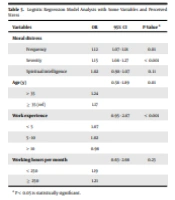
A one-unit increase in the frequency and severity of moral distress increased the risk of perceived stress by 1.12 and 1.15 times, and a one-unit increase in the spiritual intelligence score increased the risk of perceived stress by 1.02 times (Table 5).
Table 5.
Logistic Regression Model Analysis with Some Variables and Perceived Stress
| Variables | OR | 95% CI | P-Value a |
|---|---|---|---|
| Moral distress | |||
| Frequency | 1.12 | 1.07 - 1.18 | 0.01 |
| Severity | 1.15 | 1.08 - 1.27 | < 0.001 |
| Spiritual intelligence | 1.02 | 0.98 - 1.07 | 0. 11 |
| Age (y) | 0.58 - 1.89 | 0.01 | |
| > 35 | 1.24 | ||
| ≥ 35 (ref) | 1.17 | ||
| Work experience | 0.95 - 2.87 | < 0.001 | |
| < 5 | 1.07 | ||
| 5 - 10 | 1.02 | ||
| > 10 | 0.98 | ||
| Working hours per month | 0.63 - 2.66 | 0.23 | |
| < 250 | 1.19 | ||
| ≥ 250 | 1.21 |
a P < 0.05 is statistically significant.
5. Discussion
In the present study, the perceived stress level of nurses was higher than the average. In this regard, Teshome et al. have found that among healthcare professionals working in the context of COVID-19 in Southern Ethiopia, nearly two-thirds of healthcare professionals had much-perceived stress (28). This study considers it vital to update the information of the medical staff about COVID-19 and to adopt wide-ranging measures to support psychological well-being (28).
A study in China on nurses in emergency departments and fever clinics during the COVID-19 pandemic showed that the fear of infecting family members, regretting being a nurse, and the number of night shifts in a week was positively correlated with reporting stress. In some studies, the perceived stress level has been reported to be lower than the results of the present study. This difference is predictable because these studies were conducted before the COVID-19 pandemic (29, 30). Consistent with this finding, studies have been conducted during the pandemic showing that the perceived stress level of nurses is at a high level (31, 32). Regarding the mentioned finding during the pandemic, studies indicate that workload, shortage of staff, observing patients’ suffering and death, and conflict in the role cause a lot of psychological stress to nurses (33). In this study, there was no significant relationship between nurses’ gender and level of stress. In this regard, by investigating perceived stress among emergency nurses in Turkey during the COVID-19 pandemic, Cinar et al. reported that nearly half of the emergency nurses perceived stress above average during the pandemic and female nurses perceived more stress (34). Similarly, in a study in China, a considerable proportion of healthcare workers providing nursing care to patients with suspected or confirmed COVID-19, particularly women, reported experiencing symptoms of depression, anxiety, insomnia, and distress (35). In this study, nurses’ age and work experience were significantly associated with perceived stress, which is the case in most similar studies (35, 36). Of course, it is reasonable to expect that younger nurses with less clinical experience would experience more stress with events such as the COVID-19 pandemic. Similar to this study, research studies show that nurses caring for patients with COVID-19 experience high moral distress. The reasons for such high moral distress include empathic concern and arousal in moral decision-making, and confronting severely ill patients with COVID-19 puts nurses under increasing professional responsibilities (37). Also, lack of knowledge and uncertainty regarding how to treat a new illness, being overwhelmed by the depth and breadth of COVID-19, intra-professional tensions, cumbersome rules that prevent nurses from caring roles (such as visitation policies), and medical resource scarcity have been cited as causes of moral distress in nurses related to the COVID-19 pandemic (38). The relationship between moral distress and job stress has also been observed in previous studies. In this regard, Dodek et al. suggested that higher moral distress in ICU nurses was associated with higher psychological stressors and psychological strain (39). Jeon and Park suggested that nurses working in ICU wards suffered from moral distress due to difficulties at the end of life care and realist support in the workplace (40). Recent studies also indicate high levels of moral distress in nurses responsible for caring for COVID-19 patients. Nurses attributed moral distress to reasons such as insufficient knowledge and uncertainty about how to treat patients, the increased workload in epidemic peaks, minimal communication with the client because of the fear of infection, lack of medical equipment, and continuous work in crisis situations (38, 41). In the early phase of the COVID-19 pandemic in Western Norway, Miljeteig et al. suggested that distress levels were generally low among 1606 physicians and nurses (42). In the present study, the level of spiritual intelligence of nurses was 50.16. Shahrokhi et al. reported similar levels of spiritual intelligence in ICU nurses (43). In this study, an inverse but no significant correlation was observed between nurses’ spiritual intelligence and perceived stress. One of the reasons for this finding is the specific condition of the pandemic predictably increases the perceived stress level of spiritual intelligence. In other words, the higher the spiritual intelligence, the less stress is expected among nurses.
One of the limitations of the present study is completing the questionnaires by a self-reporting method that mental readiness, fatigue, and environmental conditions can affect the responses to the questionnaire items.
5.1. Conclusions
Due to the direct relationship between moral distress and perceived stress in nurses, it is recommended that nurses become familiar with the concept of moral distress and job stress and the related factors. It is also essential that clinical and academic committees provide operational solutions to reduce moral distress and resolve this problem in pandemic crises. Psychosocial support, improvement of welfare facilities, and development of stress management training courses for nurses are essential.