
1. Background
Nurses in intensive care units (ICUs) care for critically ill and highly vulnerable patients and experience some of the highest levels of occupational stress in health care (1). Continuous exposure to life-threatening conditions, high mortality, patient suffering, ethical dilemmas, staff shortages, workplace conflicts, and inadequate emotional support are major stressors (2). In addition, the ICU environment, including advanced technologies, frequent alarms, and fluorescent lighting, can be inherently stressful (3). Stress, defined as a response to perceived threats, may impair nurses’ performance and clinical decision-making (4), leading to adverse outcomes such as sleep disturbances, psychological disorders, and suicidal ideation (5, 6) and ultimately compromising the quality of nursing care (7).
Depression is common among ICU nurses and is driven by excessive workload, long shifts, role conflict, poor communication, frequent exposure to death, high responsibility, and interdisciplinary demands (8, 9). It reduces job satisfaction and increases absenteeism, fatigue, irritability, hopelessness, and poorer care quality (10). Anxiety is also prevalent and is often exacerbated by the unpredictability of patients’ conditions and treatment-related risks (11). It impairs performance and communication and is associated with occupational adverse events, musculoskeletal disorders, and job turnover (12).
An understudied factor affecting ICU nurses’ mental health is moral distress, which arises when nurses know the ethically appropriate action but cannot act because of organizational constraints. In ICUs, moral distress commonly stems from organizational, team-related, and patient- or family-related challenges (13). Moral distress is associated with lower job satisfaction, higher stress and burnout, a greater intention to leave nursing, reduced self-confidence and learning motivation, and poorer care quality (14). Villagran et al. (15) found that greater frequency and intensity of moral distress were associated with higher emotional exhaustion and lower personal accomplishment among nurses.
Although many studies have explored the relationship between moral distress and psychological problems, these associations may not always be linear or direct. Positive psychological constructs such as self-compassion may mediate these relationships. Self-compassion, which consists of self-kindness, a sense of common humanity, and mindfulness (16), contributes substantially to mental health, resilience, emotional regulation, and stress management. It is also associated with reduced occupational burnout (17). McCade et al. (18) demonstrated that greater self-compassion was correlated with reduced burnout and depression and may moderate these associations. In addition, Chang et al. (19) reported that greater self-compassion significantly improves nurses’ work engagement.
Despite this evidence, most previous studies have focused on the direct relationship between moral distress and adverse psychological outcomes, with limited attention to mediating mechanisms that may explain this association. In particular, the statistical mediating role of self-compassion between moral distress and mental health symptoms, including stress, anxiety, and depression, among ICU nurses has received limited empirical attention. To our knowledge, no study has examined this mediation model using SEM, and it has not been investigated in the Iranian context. Addressing this gap is important for clarifying whether self-compassion operates similarly across different cultural and health care settings.
2. Objectives
The current study aimed to examine whether self-compassion statistically mediates the relationship between moral distress and mental health symptoms, namely stress, anxiety, and depression, among nurses working in the ICU.
3. Methods
3.1. Study Design
This cross-sectional descriptive-analytical study used SEM to examine the mediating role of self-compassion in the relationship between moral distress and mental health symptoms, including stress, anxiety, and depression, among ICU nurses between April to September 2025.
3.2. Recruitment and Eligibility
All ICU nurses employed in teaching hospitals affiliated with Ahvaz Jundishapur University of Medical Sciences, Ahvaz, Iran, between April and September 2025 constituted the study population. In SEM studies, approximately 20 participants per latent variable are generally recommended for obtaining stable parameter estimates (20). In addition, mediation models with multiple variables and indirect effects typically require sample sizes above 200 to ensure adequate statistical power and model stability (21). Considering the study variables and the 3 mediation models examined, a sample of 220 ICU nurses was considered adequate and was therefore recruited.
A stratified random sampling approach with proportional allocation was used to ensure a representative sample. Each hospital with an ICU served as an independent stratum. The required number of participants from each hospital was calculated proportionally according to its ICU nursing staff, yielding the following distribution: Imam Khomeini Hospital (n = 72), Golestan Hospital (n = 66), Razi Hospital (n = 23), Karami Hospital (n = 20), Sina Hospital (n = 21), and Taleghani Hospital (n = 18). Within each stratum, eligible nurses were selected by simple random sampling using a random number generation method.
The eligibility criteria included signed informed consent, voluntary participation, at least 6 months of work experience in an ICU, a bachelor's degree in nursing, and the absence of any self-reported psychiatric history. Participants were excluded if they had a serious physical illness, withdrew consent at any stage, or left the questionnaire partially unanswered.
3.3. Data Collection Tools and Procedures
After ethical approval was obtained from the Ethics Committee of Ahvaz Jundishapur University of Medical Sciences, the researcher visited the study sites with an official letter of introduction. After coordination with hospital matrons and ICU head nurses, eligible nurses were identified and invited to participate. The researcher provided detailed information about the study, assured confidentiality, and obtained written informed consent from all participants.
Data were collected from Saturday to Thursday from April to September 2025. The instruments included a demographic questionnaire and validated self-report measures: the SCS-SF, MDS-R, and DASS-21. The researcher was present in the ICU during data collection to answer participants' questions. Because not all nurses were available during morning shifts, data collection was rotated across different shifts.
The SCS-SF was developed by Neff (2003) and later revised by Raes et al. (22). It includes 12 items across 6 subscales: self-kindness, self-judgment, common humanity, isolation, mindfulness, and over-identification, with 2 items each. Responses are rated on a 5-point Likert scale, from 1 (almost never) to 5 (almost always), and 5 items (1, 4, 8, 11, and 12) are reverse scored. The scale assesses 3 bipolar dimensions: self-kindness vs self-judgment, mindfulness vs over-identification, and common humanity vs isolation. Total scores are obtained by reverse scoring negatively worded items and summing or averaging all items, with higher scores indicating greater self-compassion. The SCS-SF shows good psychometric properties, including internal consistency (Cronbach alpha = 0.86) and validity (22).
The MDS-R was developed by Jameton (1984) and revised by Corley (2001, 2007) and Hamric (2007) to assess moral distress in health care professionals (23). It contains 21 items measuring the frequency and intensity of morally distressing situations on 2 separate 5-point Likert scales. Frequency is rated from 0 (never) to 4 (very frequently/daily), and intensity is rated from 0 (none) to 4 (very high). Item scores are calculated by multiplying frequency by intensity, and the total score is the sum of all items, with higher scores indicating greater moral distress. Mean frequency and intensity may also be reported (23). In Iran, Karimollahi et al. (24) confirmed the scale's content validity (content validity index = 0.89) and good reliability (Cronbach alpha = 0.87).
The DASS-21 was created by Lovibond and Lovibond (1995) and includes 3 subscales: depression, anxiety, and stress, each with 7 items (21 total) rated on a 4-point Likert scale. The depression subscale (items 3, 5, 10, 13, 16, 17, and 21) assesses dysphoria, hopelessness, and anhedonia; the anxiety subscale (items 2, 4, 7, 9, 15, 19, and 20) measures autonomic arousal and situational anxiety; and the stress subscale (items 1, 6, 8, 11, 12, 14, and 18) evaluates irritability, tension, and nervous arousal. Subscale scores are multiplied by 2 to obtain final scores, which are interpreted using the following severity cutoffs: depression (0 - 9, normal; 10 - 13, mild; 14 - 20, moderate; 21 - 27, severe; and 28 or higher, extremely severe), anxiety (0 - 7, 8 - 9, 10 - 14, 15 - 19, and 20 or higher), and stress (0 - 14, 15 - 18, 19 - 25, 26 - 33, and 34 or higher). The Persian version of the DASS-21, used by Khani et al. (25), was applied in this study. Kakemam et al. (26) reported good psychometric properties, including Cronbach alpha values of 0.93 for depression, 0.91 for stress, and 0.79 for anxiety; acceptable test-retest reliability (intraclass correlation coefficient = 0.75 - 0.86); and model fit indices (Comparative Fit Index = 0.917, Tucker-Lewis Index = 0.906, root mean square error of approximation = 0.078, and standardized root mean square residual = 0.047), supporting validity in Iranian nurses.
3.4. Data Analysis
Statistical analyses were performed using SPSS version 24, with P < 0.05 considered statistically significant. Normality was assessed using the Shapiro-Wilk test, skewness and kurtosis (acceptable limits: ± 2 and ± 7, respectively), and Mardia's normalized coefficient for multivariate normality (value = 2.14). Outliers were screened using Mahalanobis distance (P < 0.001). No missing data were found; therefore, imputation was not required.
Path analysis within SEM was performed using LISREL version 8.8. Maximum likelihood estimation was applied because it is robust to mild non-normality and appropriate for sample sizes greater than 200. Model fit was evaluated using χ2/df, comparative fit index (CFI), goodness-of-fit index (GFI), adjusted goodness-of-fit index (AGFI), incremental fit index (IFI), relative fit index (RFI), normed fit index (NFI), nonnormed fit index (NNFI), standardized root mean square residual (SRMR), and root mean square error of approximation (RMSEA). Acceptable fit was defined as χ2/df < 3, RMSEA < 0.08, SRMR < 0.09, and values > 0.90 for CFI, GFI, IFI, RFI, NFI, and NNFI (> 0.85 for AGFI). Mediation effects were tested using bootstrapping with 5000 resamples and the Preacher and Hayes macro in SPSS. Indirect effects were considered significant if the 95% CI excluded zero.
4. Results
Participants had a mean age of 34.55 ± 6.87 years, indicating that the sample comprised predominantly young to middle-aged individuals. Their mean work experience was 10.26 ± 6.69 years, indicating substantial diversity in professional background. Most participants were female (174 individuals, 79.1%).
Variable characteristics are shown in Table 1. Mean DASS-21 scores were 7.60 ± 7.84 for depression, 8.11 ± 6.66 for anxiety, and 13.42 ± 7.03 for stress (maximum = 42), all within the normal-to-mild range. Mean moral distress was 90.14 ± 61.32, indicating relatively high levels. Mean self-compassion was 37.26 ± 7.46, reflecting a moderate level; across its 6 dimensions (2-10), scores ranged from 5.77 for self-judgment to 6.58 for isolation. Normality checks (skewness < 2 and kurtosis < 7) indicated that most variables were suitable for parametric analysis. Depression slightly deviated from normality (skewness = 1.479; kurtosis = 2.116) but remained acceptable for SEM with maximum likelihood estimation. Therefore, no data transformation was applied, and Pearson correlation was considered appropriate given the sample size (> 200).
Table 1.
Descriptive Findings for the Main Variables (N = 220)
| Variables and Dimensions | Minimum | Maximum | Mean ± SD | Skewness | Kurtosis |
|---|---|---|---|---|---|
| Mental health problems | |||||
| Depression | 0.00 | 36 | 7.60 ± 7.84 | 1.479 | 2.116 |
| Anxiety | 0.00 | 28 | 8.11 ± 6.66 | 0.600 | -0.202 |
| Stress | 0.00 | 42 | 13.42 ± 7.03 | 0.853 | 1.027 |
| Moral distress | |||||
| Total | 0.00 | 266.00 | 90.14 ± 61.32 | 0.622 | -0.647 |
| Self-compassion | |||||
| Total | 17.00 | 58.00 | 37.26 ± 7.46 | -0.129 | -0.431 |
| Self-kindness | 2.00 | 10.00 | 6.05 ± 1.71 | 0.189 | -0.814 |
| Self-judgment | 2.00 | 10.00 | 5.77 ± 1.97 | 0.353 | -0.767 |
| Common humanity | 2.00 | 10.00 | 5.88 ± 1.81 | -0.108 | -0.821 |
| Isolation | 2.00 | 10.00 | 6.58 ± 2.10 | -0.317 | -1.136 |
| Mindfulness | 2.00 | 10.00 | 6.35 ± 1.83 | 0.079 | -0.693 |
| Over-identification | 3.00 | 10.00 | 6.47 ± 1.91 | -0.166 | -0.960 |
The Pearson correlation matrix (Table 2) shows significant associations among the main variables. Based on Cohen's (1988) guidelines, r ≥ 0.50 was considered strong, 0.30 - 0.49 moderate, and 0.10 - 0.29 weak. Stress, anxiety, and depression were strongly and positively intercorrelated (r = 0.683 - 0.730; P < 0.001), with the strongest association between anxiety and depression (r = 0.730). Self-compassion was moderately and negatively correlated with stress (r = -0.377), anxiety (r = -0.426), and depression (r = -0.456; all P < 0.001), indicating that greater self-compassion was associated with lower psychological distress. Moral distress showed moderate positive correlations with stress (r = 0.536), anxiety (r = 0.604), and depression (r = 0.557; all P < 0.001), with the strongest association observed for anxiety. In addition, a strong negative correlation was found between moral distress and self-compassion (r = -0.640; P < 0.001). These findings support testing the proposed mediation model using SEM.
Table 2.
Pearson Correlation Matrix Among Main Variables in ICU Nurses (N = 220)
| Variables and Statistics | Stress | Anxiety | Depression | Self-compassion | Moral distress |
|---|---|---|---|---|---|
| Stress | |||||
| Pearson correlation | 1 | 0.683 a | 0.692 a | -0.377 a | 0.536 a |
| P-value (2-tailed) | - | 0.000 | 0.000 | 0.000 | 0.000 |
| N | 220 | 220 | 220 | 220 | 220 |
| Anxiety | |||||
| Pearson correlation | 0.683 a | 1 | 0.730 a | -0.426 a | 0.604 a |
| P-value (2-tailed) | 0.000 | - | 0.000 | 0.000 | 0.000 |
| N | 220 | 220 | 220 | 220 | 220 |
| Depression | |||||
| Pearson correlation | 0.692 a | 0.730 a | 1 | -0.456 a | 0.557 a |
| P-value (2-tailed) | 0.000 | 0.000 | - | 0.000 | 0.000 |
| N | 220 | 220 | 220 | 220 | 220 |
| Self-compassion | |||||
| Pearson correlation | -0.377 a | -0.426 a | -0.456 a | 1 | -0.640 a |
| P-value (2-tailed) | 0.000 | 0.000 | 0.000 | - | 0.000 |
| N | 220 | 220 | 220 | 220 | 220 |
| Moral distress | |||||
| Pearson correlation | 0.536 a | 0.604 a | 0.557 a | -0.640 a | 1 |
| P-value (2-tailed) | 0.000 | 0.000 | 0.000 | 0.000 | - |
| N | 220 | 220 | 220 | 220 | 220 |
a P < 0.01.
Using LISREL, 3 models were tested to examine the mediating role of self-compassion between moral distress and mental health symptoms, including depression, anxiety, and stress. Fit indices are presented in Table 3. Although GFI and AGFI were below the conventional threshold of 0.90, these indices are known to be influenced by model complexity and sample size. Because CFI, IFI, NNFI, RMSEA, and SRMR were within acceptable ranges, overall model fit was considered marginal-to-acceptable. Therefore, the results should be interpreted with caution. No post hoc modifications were performed to avoid capitalizing on chance. Nevertheless, fit indices should be interpreted cautiously because GFI and AGFI were below conventional thresholds, suggesting only marginal-to-acceptable fit for some models.
Table 3.
Fit Indices for the Mediation Model Testing Self-compassion Between Moral Distress and Mental Health Problems a
| Model | χ2 | df | χ2/df | SRMR | GFI | RFI | IFI | CFI | AGFI | NNFI | NFI | RMSEA |
|---|---|---|---|---|---|---|---|---|---|---|---|---|
| Depression model | 1671.76 | 626 | 2.67 | 0.08 | 0.80 | 0.89 | 0.90 | 0.91 | 0.82 | 0.93 | 0.92 | 0.08 |
| Anxiety model | 1877.86 | 626 | 2.99 | 0.07 | 0.84 | 0.93 | 0.95 | 0.94 | 0.85 | 0.95 | 0.94 | 0.08 |
| Stress model | 1743.75 | 626 | 2.78 | 0.08 | 0.79 | 0.88 | 0.90 | 0.89 | 0.80 | 0.90 | 0.89 | 0.08 |
a Abbreviations: AGFI, adjusted goodness-of-fit index; CFI, comparative fit index; df, degrees of freedom; GFI, goodness-of-fit index; IFI, incremental fit index; NFI, normed fit index; NNFI, nonnormed fit index; RFI, relative fit index; RMSEA, root mean square error of approximation; SRMR, standardized root mean square residual; χ2, chi-square.
In SEM, a t value > |1.96| indicates a significant relationship between 2 constructs. As shown in Figure 1, moral distress had a significant direct association with depression (t = 3.96; β = 0.44) and a significant inverse association with self-compassion (t = -7.60; β = -0.72). Self-compassion also had a significant inverse association with depression (t = -2.03; β = -0.22). However, based on bootstrapping mediation analysis, the lower and upper limits were -0.05 and 0.10, respectively. Because these limits straddled zero, the indirect path from moral distress to depression through self-compassion (standardized indirect effect = 0.03) was not significant at P < 0.05 (Table 4).
Table 4.
Bootstrapping Test Results for Mediating Variables of Self-compassion
| Independent Variables | Mediator Variables | Dependent Variables | Resamples | 95% CI lower | 95% CI upper | SE | Standardized Indirect Effect | Significance Level |
|---|---|---|---|---|---|---|---|---|
| Moral distress | Self-compassion | Anxiety | 5000 | 0.12 | 0.24 | 0.03 | 0.18 | 0.05 |
| Moral distress | Self-compassion | Depression | 5000 | -0.05 | 0.10 | 0.04 | 0.03 | 0.05 |
| Moral distress | Self-compassion | Stress | 5000 | -0.04 | 0.13 | 0.04 | 0.04 | 0.05 |
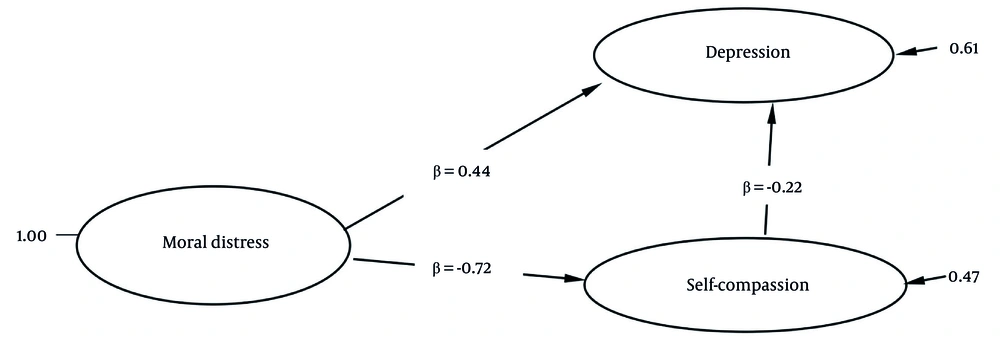
Figure 1.
The mediating model of self-compassion in the relationship between moral distress and depression.
As shown in Figure 2, the proposed model showed that moral distress had a significant direct association with anxiety (t = 4.44; β = 0.58) and a significant inverse association with self-compassion (t = -7.91; β = -0.73). Self-compassion also had a significant inverse association with anxiety (t = -2.00; β = -0.22). Based on bootstrapping mediation analysis, the lower and upper limits were 0.12 and 0.24, respectively. Because these limits had the same sign and did not straddle zero, the indirect path from moral distress to anxiety through self-compassion (standardized indirect effect = 0.18) was significant at P < 0.05 (Table 4).
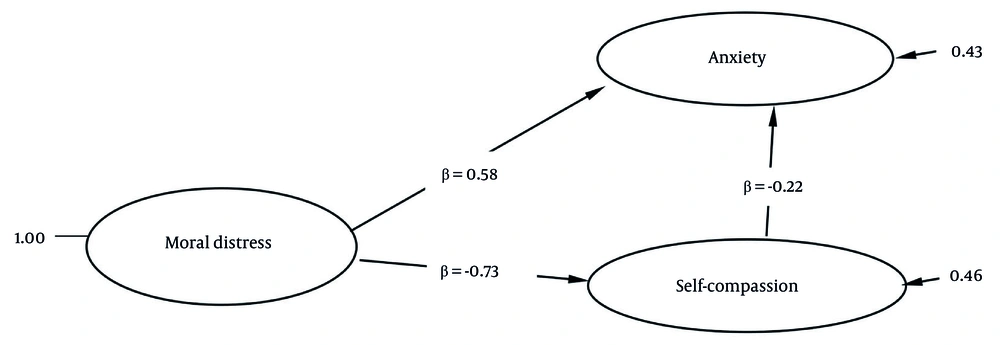
Figure 2.
The mediating model of self-compassion in the relationship between moral distress and anxiety.
As shown in Figure 3, the proposed model showed that moral distress had a significant direct positive association with stress (β = 0.56; t = 3.09) and a significant inverse association with self-compassion (β = -0.72; t = -7.69). However, self-compassion did not have a significant association with stress (β = -0.17; t = -1.38). Based on bootstrap mediation analysis, the lower and upper confidence limits were -0.04 and 0.13, respectively. Because these limits had opposite signs and included zero, the indirect path from moral distress to stress through self-compassion (standardized indirect effect = 0.04) was not significant at P < 0.05 (Table 4).
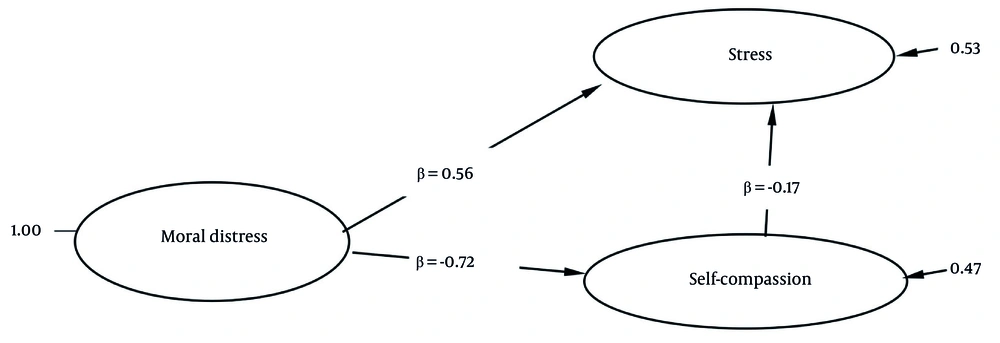
Figure 3.
The mediating model of self-compassion in the relationship between moral distress and stress.
5. Discussion
This study statistically investigated whether self-compassion mediates the association between moral distress and mental health symptoms, including stress, anxiety, and depression, among ICU nurses.
A key finding was that, despite relatively high moral distress scores, levels of depression, anxiety, and stress remained within the normal-to-mild range. This finding indicates a mismatch between occupational ethical distress and clinically measured symptoms. Moral distress and psychological symptoms may represent distinct constructs that do not co-occur at the same severity level in cross-sectional assessments. Differences in measurement time frames may also contribute, as the DASS-21 assesses symptoms during the previous week, whereas moral distress reflects sustained occupational experiences. Nevertheless, these findings align with prior research on ICU nurses' exposure to ethical dilemmas, high workload, and emotional burden (27, 28).
Correlational analyses showed that moral distress was positively and moderately-to-strongly associated with mental health problems, whereas self-compassion was negatively correlated with all psychological outcomes. This pattern is consistent with previous studies (29-32) highlighting the protective role of self-compassion against adverse mental health outcomes in nurses. Thus, moral distress may be linked to greater psychological symptoms through negative self-evaluation and poor emotion regulation, whereas self-compassion functions as an internal protective resource associated with lower psychological distress.
In the depression model, moral distress was directly associated with depression and negatively related to self-compassion, but a mediating role of self-compassion was not supported. This suggests that depressive symptoms are more cumulative and less explained by emotion-regulation processes (33). Prolonged exposure to moral conflict and perceived moral failure may foster helplessness, reduced professional meaning, and low motivation, which are core features of depression (34). Although self-compassion is generally protective, the severity and chronicity of moral pressures may limit its effect. This is consistent with Dev et al. (35), who found that self-compassion does not fully account for the impact of occupational stressors. Therefore, preventing depression in ICU nurses may require multilevel interventions targeting both individual coping and organizational factors, including ethical support systems and reducing persistent moral distress.
In the anxiety model, moral distress was strongly associated with anxiety, whereas self-compassion was inversely related to anxiety. Bootstrapping confirmed a significant mediating role of self-compassion, suggesting that it may reduce anxiety in the context of moral conflict through lower self-criticism and improved emotion regulation. These findings align with Yu et al. (30) and Soltani et al. (36), who reported similar mediation effects involving distress tolerance. The significant mediation indicates that anxiety may be more closely tied to immediate emotional responses to ethical stressors than depression. Thus, emotion-regulation resources such as self-compassion may play a key role. Consistent with prior studies (37-39), interventions targeting self-compassion, mindfulness, and moral resilience may help reduce anxiety and improve nurses' well-being.
In the stress model, moral distress was significantly associated with stress, whereas self-compassion showed no direct or mediating effect. This contrasts with Abdollahi et al. (29), who reported a moderating role of self-compassion in the association between stress and burnout, possibly due to differences in measures and settings. However, it aligns with Albaqawi and Alshammari (40), who highlighted the role of organizational and contextual factors in nurses' stress. The lack of mediation suggests that stress is more situational and driven by external working conditions, making it less dependent on individual resources in the short term. Under persistent structural pressures, even self-compassionate nurses may experience high stress unless workload, staffing, and managerial support improve. This finding supports multilevel stress-management strategies that combine individual and organizational interventions.
Overall, self-compassion mediated the moral distress-anxiety relationship but not the associations of moral distress with depression or stress, reflecting differences among outcomes. Anxiety involves threat sensitivity, uncertainty, and physiological arousal. Because moral distress includes uncertainty about ethical actions and consequences, self-compassion may buffer anxiety through mindfulness, which reduces reactivity, and common humanity, which reduces isolation and self-blame, thereby lowering rumination. In contrast, depression involves stable cognitive patterns such as hopelessness and negative self-schemas (41), and moral distress may affect depression through reduced meaning and self-worth, which self-compassion alone may not offset without organizational change. Similarly, stress reflects perceived demands exceeding resources (42) and is largely driven by structural ICU factors such as workload and understaffing, making it less responsive to individual resources.
These findings suggest a domain-specific role for self-compassion, with stronger relevance for anxiety as a more reactive and situational response, whereas depression and stress, which may be more chronic or structurally driven, may require organizational-level interventions. Thus, self-compassion should be viewed as a targeted rather than universal protective factor.
5.1. Study Limitations
Several limitations should be noted. First, although SEM was used, the cross-sectional design precludes conclusions about causality. Second, all data were derived from self-report measures collected at 1 time point, raising concerns about common method variance and social desirability bias. Third, the sample was limited to ICU nurses from teaching hospitals affiliated with 1 university, limiting generalizability. Fourth, although most fit indices for the depression and stress models were acceptable, some indices, such as GFI and AGFI, were below the 0.90 threshold, possibly reflecting model complexity and sample size. Larger samples are recommended to validate these findings. Fifth, the high intercorrelations among the DASS-21 subscales (r = 0.683 - 0.730) suggest considerable symptom overlap, potentially reflecting a general psychological distress factor. However, variance inflation factors were below 2.5, indicating no problematic multicollinearity. Future studies using bifactor or higher-order models could further disentangle unique and shared variance among these symptoms. In addition, demographic and occupational variables, such as age, gender, ICU type, work experience, shift patterns, and organizational support, were not controlled for in the SEM models because of sample size and model parsimony considerations. This may have introduced residual confounding, and future studies with larger samples should examine these covariates.
5.2. Conclusions
This study demonstrated that moral distress was positively associated with mental health symptoms, whereas self-compassion was inversely related to depression, anxiety, and stress. Self-compassion significantly mediated the moral distress-anxiety relationship, but not the associations of moral distress with depression or stress, suggesting a domain-specific protective role, particularly for anxiety-related mechanisms. Although fostering self-compassion through mindfulness-based interventions may help reduce anxiety among ICU nurses, organizational strategies remain essential for addressing depression and stress, which appear less responsive to individual psychological resources. Future longitudinal studies are needed to clarify causality and to examine whether these findings are replicated across different health care settings. Overall, the results underscore the need for tailored, multilevel approaches that combine individual and organizational interventions to support ICU nurses' mental well-being.