
1. Background
The carpal tunnel syndrome (CTS), caused by compression of the median nerve at the wrist, is the most common compression neuropathy, which occurs in 3% to 6% of the general population between the ages of 30 - 60 years old (1).
Patients with CTS have symptoms of pain, numbness, paresthesia, and tingling of the first three fingers as well as radial side of the ring finger, which may cause nocturnal awakening and interference with daily activities (2, 3). Thenar muscles atrophy and weakness may be found in severe cases (4). CTS diagnosis is based on medical history, physical exams, and can be confirmed by electrodiagnostic test (EDX).
There are several treatment options, both surgical and conservative, for CTS treatment. The surgical method is mostly used for severe cases of CTS, whereas in mild and moderate CTS cases, the treatment option is often conservative including activity modification, wrist splint, non-steroidal anti-inflammatory drugs, pyridoxine, mobilization, and oral or local injection of corticosteroids (5). One of the most common conservative treatments of CTS is wrist splinting and local corticosteroid injection. The efficacy of CTS treatment by wrist splint, local corticosteroids injection, oral corticosteroids, and anti-inflammatory drugs and surgery have been more evaluated by several studies, while limited studies have assessed the value of wrist mobilization in conservative management of CTS (6). Butler explains the efficacy of carpal bone and median nerve mobilization by decreasing the pressure and edema, normalizing the blood flow, and improving nervous system conduction at carpal tunnel level (7).
2. Objectives
The present study aims to evaluate the clinical and therapeutic efficacy of two conservative combination therapies in treatment of moderate CTS; the wrist mobilization compared with local corticosteroid injection, both in combination with wrist splinting and oral medication.
3. Methods
We conducted a prospective clinical trial study authorized by the local Research Ethics Committee of AJA University of Medical Sciences (AJAUMS). It was also registered in the Iranian Registry of Clinical Trials (IRCT20180511039611N1). Patients who had been diagnosed with moderate idiopathic CTS in the physical medicine and rehabilitation clinic of Imam Reza Hospital from October 2016 to September 2017 were selected for this study. Patients included in this study were 30 to 60 years old, house wives or retired, had classic symptoms of CTS for at least 6 months, and their moderate CTS diagnosis being confirmed by EDX (median sensory peak latency above 3.6 ms and median onset motor latency above 4.2 ms).
Those patients who had history or documented medical evidence of polyneuropathy, cervical radiculopathy, myelopathy, inflammatory arthritis, diabetes, thyroid disease, prior corticosteroid injection or surgery at carpal tunnel site, history of treatment by anti-inflammatory drugs or physical therapy modalities, thenar atrophy, and mild or severe CTS were excluded.
Demographic data including age, sex, occupation, dominant or non-dominant hand involvement, disease duration, and body mass index (BMI) were documented.
Patients were given a Boston carpal tunnel questionnaire, which consisted of the symptom severity scale (SSS) including 11 questions, and functional status scale (FSS) including 8 functions. The answers were rated from 1 point (mildest pain or no difficulty with activity) to 5 points (most severe pain or cannot perform activity at all). This questionnaire has been validated and is reliable for CTS in Iranian patients (8).
To evaluate pain intensity score, visual analogue scale (VAS) was used.
Then patients with moderate CTS were randomly assigned into one of the two groups of treatment and referred to our second clinician to start treatment courses. Patients in group 1 (n = 32) were treated by local corticosteroid injection into the carpal tunnel. Patients in group 2 (n = 33) were treated by wrist mobilization for 10 sessions every other day (about three weeks). All patients in two groups were also treated with oral medication (including gabapentin capsule 100 mg and vitamin B6 tablet 40 mg per day) and wrist splint in a 0 - 5 degree of extension during the whole night and as much as tolerable during the day for two months.
If a patient had moderate CTS in both hands each hand was treated by a different treatment protocol.
3.1. Corticosteroid Injection
In order to do Corticosteroid injections in group 1, 1 cc methylprednisolone acetate 40 mg + 0.5 cc lidocaine 2% was inserted proximal to distal wrist crease between flexor carpi radialis and palmaris longus tendon, the needle was inserted with an angle of 30° (9).
3.2. Wrist Mobilization
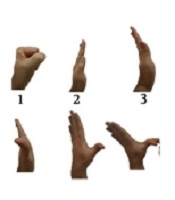
Wrist mobilization in this study was done through carpal bone and median nerve mobilization at the wrist in group 2 and was performed by an expert physiotherapist for 10 sessions (one hour for each session) every other day (about three weeks). Each session started with applying a hot pack to the wrist for 20 minutes, then carpal bone mobilization, like the Maitland technique, including pisiform bone mobilization and anterior-posterior, posterior-anterior gliding, and distractions of all carpal bones were performed by a physiotherapist (10) for 25 minutes. Subsequently, patients were instructed to perform nerve and tendon gliding exercises (as median nerve mobilization) developed by Totten and Hunter (11) under supervision of our physiotherapist for 15 minutes. The nerve gliding exercise was performed by putting the hand and wrist in six different positions whiles the neck and the shoulder were in neutral positions and the elbow in supination and 90 degrees of flexion. The 6 positions were as follows: (1) Wrist in neutral position, fingers and thumb in flexion; (2) wrist in neutral position, the fingers and thumb in extension; (3) wrist and fingers in extension, thumb in neutral position; (4) wrist, fingers and thumb in extension; (5) elbow in supination; and (6) gentle traction of the thumb applied by the opposite hand. During the tendon-gliding exercises, the fingers were placed in five discrete positions including straight, hook, fist, table top, and straight fist. Each position was maintained for 5 to 7 seconds in three to five sets. Patients continue the same nerve and tendon gliding exercises therapy at home for two months.
To evaluate the outcomes we recorded electrodiagnostic parameters of the median nerve (sensory peak latency and motor onset latency and amplitudes) before and two months after treatment; pain intensity (based on VAS), SSS, and FSS (based on Boston questionnaire) before, one, and two months after treatment. In addition, in long-term evaluation, patient satisfaction was monitored by telephone 6 months after treatment (excellent = symptom free; good = often symptomatic; fair = only symptomatic by more than usual activities; poor = persistent symptoms).
This single-blind study was performed by two experienced physical medicine specialists and one expert physiotherapist. The first clinician was responsible for evaluating pain intensity, severity of symptoms, functional status of the patients, performing EDX (all EDX through this study were done by Medtronic DK-2740 (Denmark) device), and not being aware of the treatment process. The second clinician and our physiotherapist were responsible for treatment courses and had no information about the patients’ clinical conditions.
3.3. Statistical Analysis
Data analysis was performed using the SPSS version 22 software (SPSS Inc, Chicago, IL). Chi-square test and Fisher’s exact test were used for qualitative data.
As the Shapiro-Wilk test indicated the normal distribution of data, comparison of quantitative data was performed by using the student’s t-test and paired t-test. Repeated measures ANOVA and Bonferroni test were used to compare the quantitative variables with repeated measures.
A statistically significant difference was considered by a P value less than 0.05.
4. Results
A total of 50 patients (65 wrists with moderate CTS) were included in this study. All included CTS wrists were randomly assigned to two groups of 32 and 33 wrists, respectively. There was no significant difference between the patients of two treatment groups (P > 0.05) (Table 1). In addition, all the patients were retired or house wives.
Table 1.
Demographic Data and Based Variables Findings in Each Group
| Variablea | Treatment Groupsb | P Value | |
|---|---|---|---|
| Group I | Group II | ||
| Female | 25 (86.20) | 26 (89.65) | 0.686 |
| Male | 4 (13.80) | 3 (15.35) | 0.686 |
| Age (y) | 54.17 ± 9.08 | 53.27 ± 8.97 | 0.707 |
| Body mass index (Kg/m2) | 27.88 ± 0.62 | 28.31 ± 0.7 | 0.299 |
| Dominant hand involvement | 17 (65.38) | 15 (51.72) | 0.361 |
| Non-dominant hand involvement | 12 (34.62) | 14 (48.28) | 0.361 |
| Duration of symptoms (mo) | 21.8 ± 3.50 | 19.33 ± 3.10 | 0.701 |
| Visual analogue score | 5.41 ± 2.06 | 5.79 ± 1.82 | 0.461 |
| SSS | 27.03 ± 9.24 | 27.62 ± 5.91 | 0.775 |
| FSS | 19.38 ± 6.25 | 17.69 ± 5.13 | 0.266 |
| Median sensory latency | 5.12 ± 0.21 | 4.98 ± 0.13 | 0.514 |
| Median sensory amplitude | 20.88 ± 1.81 | 22.51 ± 2.02 | 0.429 |
| Median motor latency | 5.19 ± 0.17 | 5.32 ± 0.23 | 0.184 |
| Median motor amplitude | 7.04 ± 0.53 | 7.21 ± 0.60 | 0.439 |
a Variable are expressed as No. (%) or mean ± SD.
b Group I, local corticosteroid injection + wrist splint + oral medication; group II, wrist mobilization + wrist splint + oral medication.
Of the 50 patients, 45 patients (58 wrists with moderate CTS) continued the treatment courses over two months and were available for the final analysis (Figure 1).
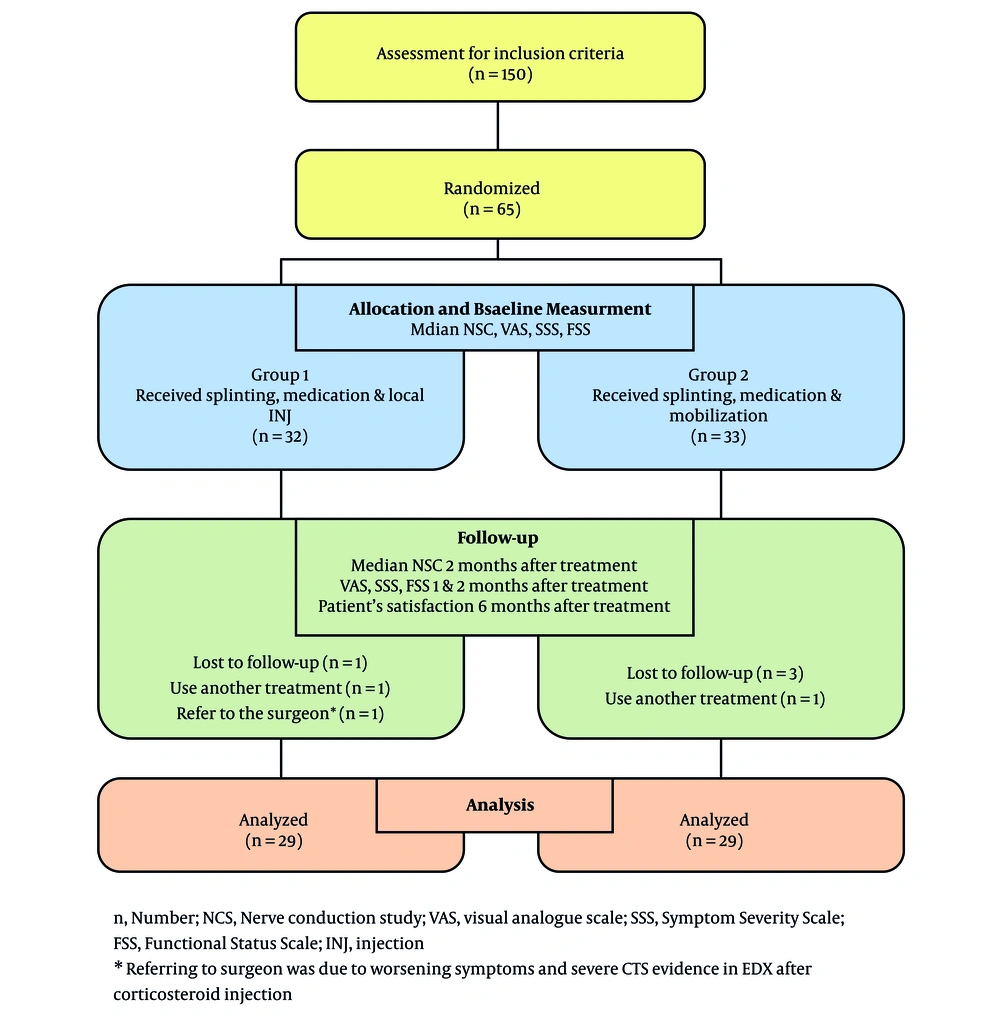
Figure 1.
Design and protocol of the study
Statistical analysis established a significant difference between the average of pain intensity score, SSS, and FSS before and after the 1st and 2nd month of therapy in each group (P < 0.05) (Table 2).
Repeated measures ANOVA and Bonferroni test showed that these three items were significantly different before and after treatment in each group (P < 0.05), however, there was no significant difference between the first and second month of therapy (P > 0.05) as well as between group 1 and 2 (P > 0.05) (Table 3).
Table 2.
Comparison of Pain Intensity, SSS, and FSS in Each Group Before and After 1 and 2 Months of Treatment
| Variable | Group I | Group II | ||||||
|---|---|---|---|---|---|---|---|---|
| Before T | 1 Month After T | 2 Months After T | P Value | Before T | 1 Month After T | 2 Months After T | P Value | |
| Pain intensity | 5.41 ± 2.06 | 2.76 ± 1.43 | 3.07 ± 1.44 | > 0.05 | 5.79 ± 1.82 | 3.17 ± 1.44 | 3.37 ± 1.43 | > 0.05 |
| SSS | 27.03 ± 9.24 | 17.07 ± 7.07 | 18.27 ± 6.29 | > 0.05 | 27.62 ± 5.91 | 19.31 ± 5.23 | 19.62 ± 5.44 | > 0.05 |
| FSS | 19.38 ± 6.25 | 11.27 ± 4.23 | 12.10 ± 3.80 | > 0.05 | 17.69 ± 5.13 | 12.31 ± 5.86 | 13.17 ± 5.06 | > 0.05 |
Abbreviation: T, treatment.
Table 3.
Analysis of Variance, Comparison of Pain Intensity, SSS, and FSS Based on Type of Treatment
| Source of Variation | SS | DF | MS | F | P Value |
|---|---|---|---|---|---|
| Pain intensity | 0.877 | ||||
| Type of T | 0.34 | 1 | 0.34 | ||
| Error | 79.79 | 56 | 1.42 | 0.024 | |
| SSS | 0.641 | ||||
| Type of T | 4.17 | 1 | 4.17 | 0.220 | |
| Error | 10660.65 | 56 | 18.94 | ||
| FSS | 3.92 | 0.052 | |||
| Type of T | 55.48 | 1 | 55.17 | ||
| Error | 786.51 | 56 | 14.04 |
Abbreviation: T, treatment.
Median sensory and motor latency had significantly decreased; in addition, median sensory and motor amplitude had significantly increased after 2 months of therapy in both groups (P < 0.05), however, these changes were not significantly different between two groups (P > 0.05) (Table 4).
Based on Fisher’s exact test, comparison of patient satisfaction assessment from 6 month treatment course did not show any significant difference between two groups (Table 5).
Table 4.
Comparison of Electrodiagnostic Findings in Each Group Before and After 2 Months of Treatmenta
| Variable | Group I | Group II | |||||
|---|---|---|---|---|---|---|---|
| Before T | 2 Months After T | P Value | Before T | 2 Months After T | P Value* | P Value** | |
| Median sensory peak latency | 5.12 ± 0.17 | 4.14 ± 0.13 | 0.036 | 4.98 ± 0.13 | 4.23 ± 0.12 | 0.047 | 0.313 |
| Median sensory amplitude | 20.88 ± 1.77 | 36.25 ± 2.43 | > 0.001 | 22.51 ± 2.00 | 35.62 ± 2.33 | > 0.001 | 0.167 |
| Median motor onset latency | 5.19 ± 0.17 | 4.3 ± 0.15 | 0.041 | 5.32 ± 0.23 | 4.54 ± 0.13 | 0.039 | 0.283 |
| Median motor amplitude | 7.04 ± 0.48 | 8.41 ± 0.22 | 0.033 | 7.21 ± 0.61 | 8.23 ± 0.20 | 0.038 | 0.335 |
Abbreviation: T, treatment.
a* Paired t-test; ** independent t-test.
Table 5.
Patient Satisfaction After 6 Months of Therapya
| Level of Satisfaction | Group I, No. (%) | Group II, No. (%) |
|---|---|---|
| Excellent (symptom free) | 5 (17.24) | 0 (0) |
| Good (often symptomatic) | 12 (41.38) | 11 (37.93) |
| Fair (symptomatic by more than usual activities) | 9 (31.04) | 14 (48.28) |
| Poor (persistent symptoms) | 3 (10.34) | 4 (13.79) |
a P value = 0.742.
5. Discussion
In this study we aimed to determine the usefulness of wrist mobilization in comparison with local corticosteroid injection into carpal tunnel in moderate CTS by means of clinical findings and electrodiagnostic studies.
Statistical analysis established a significant difference between the electrodiagnostic parameters, pain intensity score, SSS, and FSS before and after 2 months of therapy in each group (P > 0.05), however, there was no statistically significant difference in these findings between the two groups (P > 0.05). There were no significant difference in patient satisfaction after 6 months between two groups of therapy (P > 0.05).
In this study, we used the Maitland technique to perform carpal bone mobilization, which had been used by several studies (6, 12, 13).
Akalin et al. (14), compared the efficacy wrist splint in the first group with combination of wrist splint and nerve- and tendon-gliding in the second group (each group n = 14) after 4 weeks of therapy. Significant improvement in clinical parameters, SSS, and FSS was seen in both groups in which the outcomes were slightly better in second group, however, without statistically significant difference between two groups (14). As our patients in group 2, had significant improvement in clinical parameters, SSS, FSS, and electrodiagnostic findings.
In a study by Bardak et al. (15), corticosteroid injection into carpal tunnel with wrist splint, which was considered as the standard treatment, was compared with median nerve mobilization through 3 groups of patients with mild to moderate CTS. Patients in the first group received the standard treatment, the third group received nerve- and tendon-gliding exercises, and cases in second group were treated by combination of both treatment methods for six weeks. Patient response to the treatment was evaluated through the Boston questionnaire and physical examination after 8 weeks. Unlike our study, electrodiagnostic parameters were not evaluated in this study. Significant improvement was seen in all three groups of therapy, which was significantly different in the 1st and 2nd group compared to the 3rd group. In this study, patient satisfaction was monitored by telephone in 11 months and patients with excellent satisfaction in groups 1, 2, and 3 were 73.2%, 71.4%, and 48.6%, respectively. In our study, the patients with excellent satisfaction after 6 months were 17.24% and 0% in group 1 and 2, respectively. The reasons for such different findings compared to our study may arise from differences in patient population of two studies. CTS severity in our study was just moderate, however, this study included both mild and moderate CTS; averaged age and duration of CTS in our patients were higher (53.72 years and 20.56 months respectively) than this study (27 years and 15.06 months).
Gunay and Alp, studied the efficacy of carpal bone mobilization in combination with wrist splint compared to wrist splint (n = 20 in each group) and evaluated pain intensity, SSS, FSS, hand, and pinch grip EDX parameters after three months of therapy. The first group showed significant improvement in all clinical parameters and Median nerve sensory latency and amplitude (the same as our findings in group 2), however, the latter one had improvement only in pain intensity and SSS (13).
In a study by Dinarvand et al., 18 patients with mild and moderate CTS who were treated by scaphoid and hamate bone mobilization in combination with wrist splint were compared to 19 patients under wrist splint only therapy. There was a statically significant difference in VAS, SSS, and FSS between two groups (12).
These two studies show that carpal bone mobilization in combination with wrist splint is significantly more effective than wrist splint only. In our study, we used wrist splint in both groups as a complementary treatment to the main treatment courses to improve the effectiveness of treatment for moderate CTS.
5.1. Conclusions
In conclusion, both conservative combination therapies we used in our study were clinically and electrodiagnostically effective (with no significant difference between two methods) in our cases of idiopathic moderate CTS and can be beneficial to be used before investigating an invasive procedure like surgery, except in conditions when surgery is inevitable.
Finally, in addition to CTS severity, other factors such as patient’s preference and access to an expert clinician and physiotherapist should be considered when the treatment method is supposed to be chosen for a patient with moderate CTS.