1. Background
Primary hyperhidrosis is a sympathetic disorder characterized by prolonged and uncontrollable sweating. It is associated with emotional stress or psychological causes that preferably affects the axillae, palms, feet, and face. Its prevalence is estimated to be 0.6% to 1% of the population, occurring more often in young patients (1) and particularly around 3% in Asia. Also, 57% of patients have positive family histories (2). Various treatment procedures range from topical agents and medical devices to surgical therapies, given the significant impact on their quality of life. However, as a last-line alternative, surgery is reserved and being used after less invasive intervention failure (3). Video-assisted thoracoscopic sympathetic surgery is currently a globally recognized treatment for primary palmar hyperhidrosis (PH). Different techniques consist of resection (sympathectomy), transection (sympathicotomy), or clipping. Notwithstanding, it remains unclear which the optimal procedure is, and whether some patients still have a postoperative complication of compensatory sweating (CS) or recurrence after surgery (4). Compensatory sweating is the most prominent long-term adverse effect of thoracoscopic sympathectomy (3).
2. Objectives
Here, we shared our initial experience with the use of selective sympathetic ramicotomy for primary palmar hyperhidrosis patients, which was conducted via a bilateral thoracoscopic video-assisted method. In addition, we showed the clinical outcomes of satisfaction, as well as the effect on the frequency, location, and severity of compensatory sweating.
3. Methods
In our single-arm trial study, 24 sympathectomies were performed on 12 patients with primary palmar hyperhidrosis who were candidates for bilateral thoracoscopic selective sympathectomy (ramicotomy) based on inclusion criteria at Imam Khomeini Hospital. All patients had excessive sweating in the palms and axillae, which severely interfered with their work and social activities. Hyperhidrosis was ruled out due to other reasons, such as hormonal causes. The patients were admitted one day before surgery, and their demographic information was interviewed using a questionnaire (2). In a single operation, they underwent ramicotomy by the same surgeon after obtaining informed consent preoperatively. None of the patients received antibiotics before and after the surgery. They were assessed and followed up by telephone questionnaires in the clinic one week postoperatively. The rate of compensatory sweating (mild, moderate, severe), and satisfaction (very satisfied, satisfied, dissatisfied), as well as the failure or recurrence (more than 40% palmar perspiration), were recorded.
3.1. Surgical Technique
Thoracoscopic selective sympathectomy (ramicotomy) was conducted with the patient in the semi-Fowler’s position with both arms elevated and abducted 90°. Tracheal intubation was performed using a single-lumen endotracheal tube (SLT). The first port was placed for insertion of the endoscopic instrument in the anterior axillary line and in the third intercostal space. The second port was embedded in the middle axillary line and the fifth intercostal space for entering the 5-mm, 0° thoracoscope, and the third port was located in the posterior axillary line equivalent to the first port. Then, 1500 to1700 mL of CO2 gas was installed into the thoracic cavity to deflate the lung. The parietal pleura which overlying the sympathetic chain was opened by a hook electrocautery instrument, and the sympathetic chain was dissected with scissors. The sympathetic chains of T3 and T4 are then explored, and the rami communicantes T3 to T4 were divided, preserving the main sympathetic chain (The ligatures of the sympathetic ramus were performed on these two levels and not on the main trunk). Therefore, sympathetic ramus ligatures of T3 and T4, not the main trunk, were performed. Finally, the anesthesia service provided manual ventilation to inflate the lungs, and after the lungs were fully opened, the ports were removed, and the incision was closed. The same procedure was carried out on the opposite side.
3.2. Statistical Analysis
Statistical analyses were performed by SPSS software version 23. Descriptive statistics were expressed as the mean ± standard deviation (SD) and median for continuous variables compared by student t-test. The chi-square test was used to compare qualitative variables, and the Pearson correlation analysis was used to evaluate the consistency of pain score and quantitative variables. P-value < 0.05 was considered statistically significant.
4. Results
Twelve patients six men and women were included in the study. The mean age was 27.7 ± 6.9 years (range, 15 - 39 years), and the mean weight was 77.4 ± 11.6 kg (range, 53 - 90). The mean height was 173.2 ± 9.5 cm (range, 158 - 190). Five patients were overweight (BMI > 25), and none of them had morbid obesity (BMI > 40). The mean BMI was 25.5 ± 4.1 (kg/m2) (range, 36.05 - 19.95). None of the patients mentioned smoking, and only 1 (8.3%) of the patient occasionally drank alcohol. Ten (83.3%) patients had no history of other diseases. One patient had migraine who received medical treatment, and one patient had depression who was treated by a psychiatrist. Four patients had a family history of primary palmar hyperhidrosis. The disease onset of 5 (41.7%) patients was from childhood, 6 (50%) patients from adolescence, and 1 (8.3%) patients in adulthood. According to the question asked for the patients about the quality of life, 3 (25%) patients were good. On the other hand, 5 (41.7%) patients considered it poor, and in 4 (33.3%) patients were very poor. Then, the quality of life was calculated with a questionnaire in various aspects, including performance, emotional, and special circumstances. Based on the questionnaire scores, the quality of life was poor and very poor in 5 (41.7%) patients, respectively and good in 2 (16.6%) patients. The mean score of the patient’s quality of life was 75.4 ± 11.3 (52 - 90). All patients reported excessive sweating on their palms; 10 (83.3%) patients in axillae and feet, and 3 (25%) in the head and face (Table 1). Before surgery, 8 (66.6%) patients had received non-surgical therapies, which the most common was ammonium chloride, experienced by 7 (58.3%) patients. Other treatments included botulinum toxin (Botox) in 3 (25%) patients and iontophoresis in 1 (8.3%) patient (Figure 1). Patients had no postoperative complications and recurrence of the initial symptoms. Only one patient sought treatment for excessive dry hands. Postoperative mean satisfaction levels were 94.5 ± 7.8% (range,75 - 100). According to the numerical rating scale (NRS), the mean postoperative pain was 4.5 ± 3.4 (range, 0 - 9). Based on the frequency of compensatory sweating region, the most common site was at the lower back (Figure 2). Compensatory sweating occurred in 8 (66.7%) patients. Regarding the compensatory sweating scale, 4 (33.3%) patients without compensatory sweating; 6 (50%) patients had mild, 2 (16.7%) patients had moderate, and no intolerable compensatory sweating was reported. The severity of compensatory sweating was analyzed according to gender, age, BMI, weight, and height of the patients who underwent ramicotomy (Table 2). All-female patients had experienced compensatory sweating and male patients were seen in 33.3% of the patients, but there was no significant relationship. Likewise, there was no significant association between age, weight, BMI, and compensatory sweating. Remarkably, the severity of compensatory sweating was substantially higher in shorter patients (P = 0.016).
Table 1.
Demographics and Preoperative Characteristics in Primary Hyperhidrosis Patientsa
| Variables | Patients (N = 12) |
|---|---|
| Age | 27.75 ± 6.9 (15 - 39) |
| Weight | 77.41 ± 11.6 (53 - 90) |
| Height | 174.25 ± 9.5 (158 - 190) |
| BMI | 25.55 ± 4.1 (19.9 - 36) |
| Onset of symptoms | |
| Childhood | 5 (41.7) |
| Youth | 6 (50) |
| Adulthood | 1 (8.3) |
| Quality of life | |
| Good | 3 (25) |
| Poor | 5 (41.7) |
| Very poor | 4 (33.3) |
| Family history of PH | 4 (33.3) |
| History of other diseases | |
| None | 10 (83.3) |
| Migraine | 1 (8.35) |
| Depression | 1 (8.35) |
| Hyperhidrosis location | |
| Palm | 12 |
| Left/right | 8.8 ± 2.7 (2 - 10) |
| Axilla | 10 |
| Left/right | 4.3 ± 3.6 (0 - 10) |
| Foot | 10 |
| Left/right | 7.6 ± 3.7 (0 - 10) |
| Head and face (n = 10) | 0.8 ± 1.8 (0 - 6) |
Abbreviations: BMI, body mass index; PH, primary hyperhidrosis;
aValues are expressed as mean ± SD and range or No. (%).
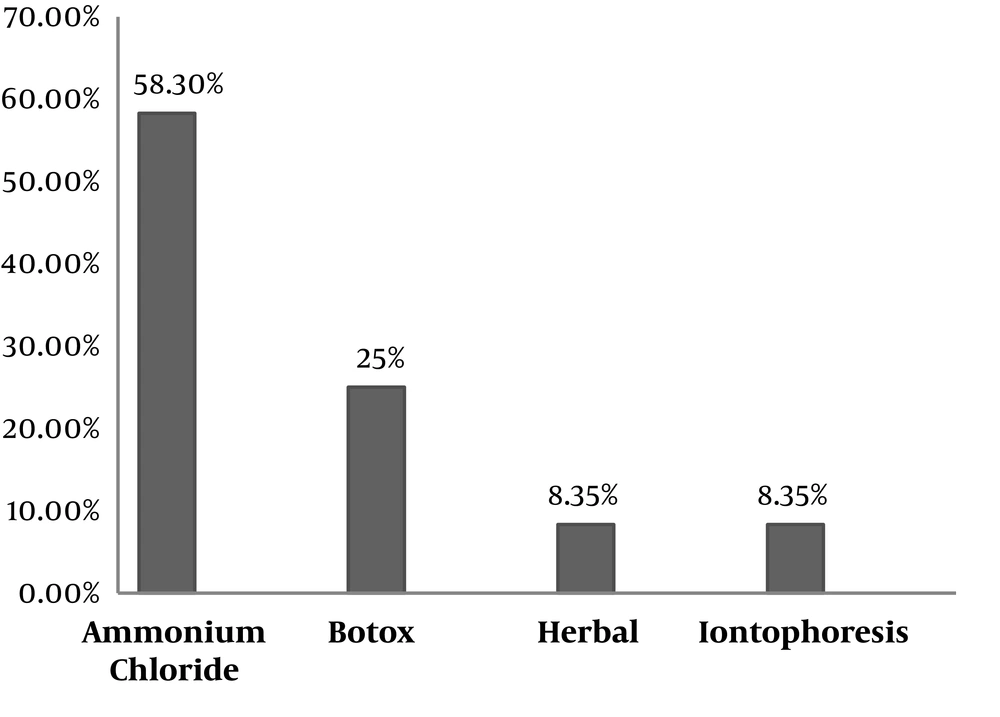
Figure 1.
Distribution of non-operative treatments in patients with primary hyperhidrosis.
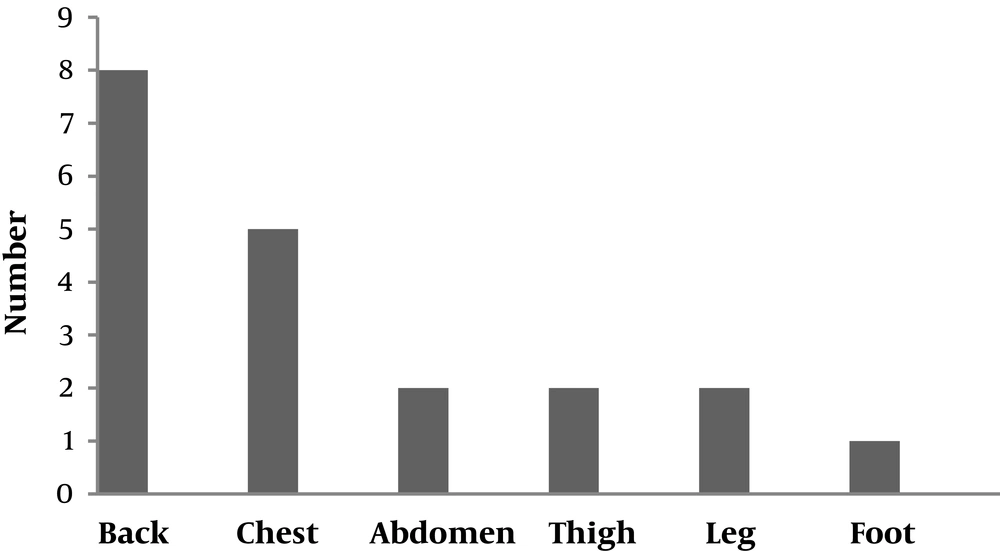
Figure 2.
Distribution of compensatory sweating region in patients with primary hyperhidrosis.
Table 2.
Comparisons the Severity of Compensatory Sweating with Gender, Age, Weight, Height, and BMI in Patients with Primary Palmar Hyperhidrosis Who Underwent Ramicotomya
| Variables | Compensatory Sweating | Total | P-Value | |
|---|---|---|---|---|
| Yes | No | |||
| Gender | ||||
| Male | 4 (66.7) | 2 (25) | ||
| Mild | 2 (33.3) | |||
| Moderate | - | |||
| Female | - | 6 (75) | ||
| Mild | 4 (66.7) | |||
| Moderate | 2 (33.3) | |||
| Age | 28.3 ± 8.3 | 26.5 ± 3.3 | 27.7 ± 6.9 | 0.68 |
| Weight | 76.7 ± 13.9 | 78.7 ± 6.2 | 77.4 ± 11.6 | 0.79 |
| Height | 169.8 ± 8 | 183 ± 5.5 | 174.2 ± 9.5 | 0.016b |
| BMI | 26.5 ± 4.7 | 23.4 ± 1.1 | 25.5 ± 4.1 | 0.23 |
Abbreviations: BMI, body mass index.
aValues are expressed as mean ± SD or No. (%).
bP-value < 0.05 indicates statistical significance.
5. Discussion
The main limitation of sympathectomy surgery is the occurrence of compensatory sweating. In several studies, sympathectomy at different levels of T2, T3, and T4 has been used frequently and had excellent results in the compensatory sweating treatments, but in terms of postoperative complications, the outcomes have varied. A meta-analysis performed by Zhang et al. (5) indicated that the incidence of severe compensatory sweating was 25.8% in T2 sympathectomy, 19.2% in the T3, and 7.8% in the T4, respectively. Licht et al. (6) research found that after Th2-4 sympathectomy in patients with axillary hyperhidrosis, severe sweating was substantially more frequent. Additionally, Leseche et al. (7) study showed the most common long-term complication of thoracodorsal sympathectomy in primary hyperhidrosis was compensatory sweating, which had no relationship with the extent of sympathectomy. However, during the follow-up period, compensatory sweating might be improved with a higher recovery rate by two-stage unilateral versus one-stage bilateral sympathectomy in patients with palmar and axillary hyperhidrosis (8). In line with our study, compensatory sweating occurred in 66.7% of the patients in which 50% of the patients had mild, 16.7% of the patients had moderate, and none of them were reported to need change for clothes.
Sympathectomy involves dissection of the upper thoracic sympathetic chain by cauterization (electrocautery) or clipping. In Findikcioglu et al. (9) investigation, clipping and cauterization surgical techniques were compared in patients who underwent bilateral thoracic sympathectomy for palmar hyperhidrosis. They observed that the recurrence rate was higher in the cauterization group. Noticeably, the rate of compensatory sweating was substantially reduced in selective T3 sympathicotomy compared with conventional T2, T3 sympathicotomy, which was shown to be an effective procedure for palmar hyperhidrosis treatment with decreased complications and no recurrence (10). Nevertheless, Joo et al. (11) noticed the only risk factor for patient dissatisfaction was sympathetic surgery at the R3 level among the types of R4 sympathicotomy, R4, and R3 sympathetic clipping in patients with palmar hyperhidrosis. Lower levels of compensatory sweating, recurrence rates, and higher satisfaction levels were seen in R4 sympathicotomy. In our procedure surgery, the sympathetic chain was opened by electrocautery, and sympathetic ramus ligatures of T3 and T4, not the main trunk, were performed, and no recurrence rate of compensatory sweating was seen.
Covelier et al. (12) examined patients who underwent selective thoracic sympathectomy (ramicotomy) through robotic surgery that was used for pleural dissection and division of the communicating rami and postganglionic sympathetic fibers. They demonstrated that robotic ramicotomy is a successful technique with paramount hyperhidrosis relief and low compensated sweating rates (12). Consistently, in a porcine model, robotic-assisted thoracoscopic ramicotomy T2-T5 was shown to be an effective procedure, and the sympathetic chain was remained intact (13). Interestingly, T3 ramicotomy resulted in a lower rate of compensatory sweating compared to T3 sympathetic clipping, and there was no significant difference in the rate of satisfaction for palmar hyperhidrosis treatment (14). Furthermore, due to the high rate of ramicotomy recurrence but less adverse effects than conventional sympathectomy, sympathetic regeneration is the key factor associated with the recurrence of symptoms after ramicotomy in humans (15). In Kim et al. study, video-assisted thoracoscopic (VAT) T2 sympathetic clipping and VAT ramicotomy were performed in patients with craniofacial hyperhidrosis to reduce the incidence of compensatory sweating and were shown to be significantly lower than T2 sympathetic clipping despite the high operating failure rates (16). Moreover, Hwang et al. found that, compared to T3 sympathicotomy, the unexpected lower extremity sweating that occurred after T3, 4 ramicotomy resulted in lower satisfaction levels, and there were no significant differences between the two groups in age and gender distribution. While ramicotomy was considered an efficient procedure for the treatment of palmar hyperhidrosis and had the potential benefit of enabling greater anatomical resection; it took longer operating time and contributed to more severe compensatory sweating (17). In the present study, we conducted 24 sympathectomies on 12 patients with primary palmar hyperhidrosis who underwent thoracoscopic bilateral selective sympathectomy (ramicotomy) and there was no significant difference between age, gender, weight, BMI, and compensatory sweating. Remarkably, the severity of compensatory sweating was substantially higher in shorter patients, and all patients were satisfied postoperatively.
5.1. Conclusions
In the current study, we found that selective sympathectomy (Ramicotomy) was safe and effective for primary palmar hyperhidrosis. All patients were satisfied, and severe compensatory sweating has been much lower than conventional sympathectomy procedures. However, more validation through further investigations is required due to some limitations.