
1. Background
The term "job burnout" is used to describe negative changes in the attitude, mood, and behavior of individuals who face work-related stress (1). Job burnout was introduced by Maslach and Leiter as a psychological syndrome consisting of 3 subscales of emotional exhaustion, depersonalization, and personal accomplishment (2). Emotional exhaustion is a feeling of depletion in emotional resources and an inability to be emotionally involved in ongoing daily activities at work. Depersonalization refers to a detached and cynical attitude toward clients receiving one's services, whereas a sense of personal accomplishment is associated with a perceived decline in occupational achievement and competence (2).
Burnout is a manifestation of a negative reaction to work, manifested by various psychological and physical symptoms such as fatigue, loss of appetite, headache, loss of energy, reduced productivity, and changes in sleep cycles; it is a result of accumulation of fatigue based on different work-related pressure periods. Other symptoms include non-specific pain, difficulty in concentration on work, feeling meaningless, absence of attachment, and apathy (2, 3).
The progression of burnout can indeed lead to various negative outcomes for health care providers. These can include feelings of being overwhelmed, detachment from their job, and even dehumanization of patients (4). In addition to personal issues, burnout, as a major concern in all health systems, impacts job satisfaction and organizational function (5, 6).
One of the pillars of sustainable development in human society is the public health system. To that end, it is essential to have healthy, enthusiastic, and highly motivated health care professionals. Nurses play a vital role in the healthcare system, and their contribution is indeed significant. Nursing is a physically and emotionally demanding profession, placing nurses at a higher risk of experiencing burnout. Burnout, which ultimately leads to poorer patient care and an increase in medical errors, is one of the major causes of absenteeism or intention to retire among nurses (7, 8).
The motivation of nurses to enter the field of non-nursing work is diminishing due to high workload, insufficient support, lack of employment security, low income, excessive working hours, stress, excess duties, and a sense of responsibility (9, 10).
Given the working conditions of nurses in hospitals and problems due to various work stresses, neglecting burnout in this cluster of health care providers can end up in the deterioration of providing care to patients and the health status of nurses themselves. To promote the mental and physical well-being of a nurse and to improve the care for patients, it is therefore necessary to identify and prevent burnout. In order to further investigate the challenges for nurses and the occurrence of burnout among them, various studies have been conducted with the aim of investigating the incidence of this problem in nurses working in more critical departments such as the surgical department (11, 12).
In Iran, many studies have been conducted on burnout and largely focus on professionals in specialty areas, such as nurses, occupational therapists, or psychologists. The findings in the field of nurses' burnout can indeed vary, and there are different perspectives regarding the prevalence and factors contributing to burnout among nurses. Studies have shown mixed results when comparing nurses working in different wards. For example, in a comparison between surgery, psychiatric, and burn units, a study found significantly higher levels of emotional exhaustion and depersonalization among nurses in the psychiatry ward. On the other hand, it was found that nurses working in burn units had significantly higher levels of personal accomplishment (13).
2. Objectives
To date, no study has been conducted directly comparing the group of nurses involved in the operating room with nurses working in surgical wards. Thus, we aimed to evaluate and compare burnout and its associated risk factors in nurses working in operating rooms and surgical wards to determine related risk factors.
3. Methods
3.1. Study Design
This cross-sectional study was conducted between March 2017 and May 2018 at Vali-Asr Hospital, affiliated with Tehran University of Medical Sciences. Participants in this study were nurses of all working shifts in the operating rooms and surgical wards of Vali-Asr Hospital. Nurses working in non-nursing positions were not included in the study. A total of 100 nurses from operating rooms and 100 nurses from surgical wards were selected by convenience sampling in different working shifts according to the number of working nurses in each shift. After a complete explanation of the study and its process, questionnaires related to the study parameters were distributed among the nurses. It was emphasized that the data would be kept secret. Completed questionnaires were then collected. The questionnaires used in this study were a demographic data form, the questionnaire of probable causes of job burnout (which was prepared based on previous studies), and Maslach Burnout Inventory (MBI).
3.2. Maslach Burnout Inventory
The main scale used in our study was MBI (16). Evaluation of the Persian version of MBI revealed Cronbach's alpha indices of 0.78, 0.72, and 0.69 for cynicism, emotional exhaustion, and professional efficacy factors, respectively (17). These indices suggest that the Persian version of MBI is valid and reliable in the Iranian population. This questionnaire consists of 22 items (9 items for emotional exhaustion, 5 items for cynicism, and 8 for professional efficacy subscales), which are rated from 0 (never) to 6 (daily). The score of each subscale was then converted to percentages, and scores from 0% - 33.33%, 33.33% - 66.66%, and 66.66% - 100% were categorized as low, moderate, and high, respectively. High scores of emotional exhaustion and cynicism and low scores of professional efficacies represent high levels of burnout.
3.3. Statistical Analysis
Data analysis was performed using SPSS version 22 (SPSS Inc, Chicago, IL, USA). A t-test was used to compare the subscales of MBI between nurses working in operating rooms and nurses working in surgical wards. For comparison of subscales and total scores in relation to other parameters, analysis of variance (ANOVA) and t-tests were used whenever appropriate. Statistical significance was considered as P < 0.05.
4. Results
A total of 200 nurses participated in our study; 169 nurses (84.5%) were females, while 31 nurses (15.5%) were males. The majority of participants were younger than 40 years (167 subjects, 83.5%). Details of demographic data are presented in Table 1.
Table 1.
Demographics and Occupational Features of Participants
| Parameter | Frequency | P-Value | |
|---|---|---|---|
| Surgical Ward | Operating Room | ||
| Gender | 0.435 | ||
| Female | 87 | 82 | |
| Male | 13 | 18 | |
| Age (y) | 0.085 | ||
| < 30 | 39 | 51 | |
| 30 - 40 | 43 | 34 | |
| > 40 | 18 | 15 | |
| Education level | 0.515 | ||
| Master’s degree and higher | 14 | 10 | |
| Bachelor’s degree and lower | 86 | 90 | |
| Work experience (y) | 0.937 | ||
| < 2 | 40 | 45 | |
| 2 - 5 | 18 | 18 | |
| 5 - 10 | 18 | 13 | |
| 10 - 15 | 15 | 14 | |
| > 15 | 9 | 10 | |
| Working shift | 0.002 a | ||
| Night | 29 | 12 | |
| Evening | 33 | 54 | |
| Morning | 38 | 34 | |
| Consumption of analgesics | 0.100 | ||
| No | 87 | 78 | |
| Yes | 13 | 22 | |
| Sedatives consumption | 0.602 | ||
| No | 93 | 91 | |
| Yes | 7 | 9 | |
| Satisfaction with income | 0.047 a | ||
| Yes | 18 | 30 | |
| No | 82 | 70 | |
| Other sources of income | 0.053 | ||
| Yes | 21 | 18 | |
| No | 79 | 82 | |
a P-value < 0.05 was considered to be statistically significant.
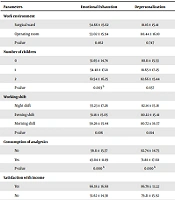
Evaluation of subscales of MBI based on demographic and occupational parameters showed that emotional exhaustion was significantly associated with having one or more children (P = 0.003). Additionally, emotional exhaustion and depersonalization levels were significantly correlated with satisfaction with income levels (P = 0.000 and P = 0.037). Job burnout score was high in both operating rooms and surgical wards. Emotional exhaustion subscale scores were the lowest, while the score in the depersonalization subscale was the highest. The burnout score was relatively similar in the different working shifts. Nurses who had a source of income other than nursing had lower job burnout scores compared to other nurses. Scores of job burnout, depersonalization, and professional efficacy subscales were higher in married nurses and nurses with education levels of master's degree and higher. Nurses who consume analgesics had lower levels of job burnout (P = 0.000). Details of job burnout and its subscales based on demographic and occupational parameters are presented in Table 2.
Table 2.
Burnout and Its Subscales Based on Demographic and Occupational Parameters a
| Parameters | Emotional Exhaustion | Depersonalization | Professional Efficacy | Job Burnout |
|---|---|---|---|---|
| Work environment | ||||
| Surgical ward | 54.66 ± 15.62 | 81.16 ± 15.41 | 71.85 ± 13.31 | 69.22 ± 11.01 |
| Operating room | 53.02 ± 15.94 | 80.44 ± 16.10 | 70.47 ± 12.61 | 67.97 ± 12.21 |
| P-value | 0.462 | 0.747 | 0.454 | 0.449 |
| Number of children | ||||
| 0 | 51.65 ± 14.74 | 80.11 ± 15.53 | 70.72 ± 11.92 | 67.49 ± 11.31 |
| 1 | 54.48 ± 17.21 | 81.65 ± 17.25 | 73.36 ± 12.57 | 69.83 ± 12.69 |
| 2 | 61.54 ± 16.25 | 82.66 ± 15.44 | 71.04 ± 16.70 | 71.75 ± 11.49 |
| P-value | 0.003 b | 0.657 | 0.610 | 0.123 |
| Working shift | ||||
| Night shift | 55.23 ± 17.26 | 82.14 ± 15.18 | 70.79 ± 12.44 | 69.38 ± 13.26 |
| Evening shift | 51.18 ± 15.05 | 80.22 ± 15.41 | 71.58 ± 11.73 | 67.66 ± 10.89 |
| Morning shift | 56.26 ± 15.44 | 80.72 ± 16.57 | 70.86 ± 14.69 | 69.28 ± 11.55 |
| P-value | 0.106 | 0.814 | 0.923 | 0.608 |
| Consumption of analgesics | ||||
| No | 56.11 ± 15.37 | 82.74 ± 14.75 | 71.67 ± 12.43 | 70.17 ± 10.98 |
| Yes | 43.04 ± 11.89 | 71.88 ± 17.60 | 67.85 ± 14.75 | 60.93 ± 11.63 |
| P-value | 0.000 b | 0.000 b | 0.113 | 0.000 b |
| Satisfaction with income | ||||
| Yes | 66.18 ± 16.68 | 86.79 ± 13.22 | 73.59 ± 11.40 | 75.02 ± 11.64 |
| No | 51.62 ± 14.38 | 79.21 ± 15.92 | 70.87 ± 13.17 | 67.23 ± 11.24 |
| P-value | 0.000 b | 0.037 b | 0.704 | 0.006 b |
| Other sources of income | ||||
| Another job | 53.33 ± 24.67 | 72.57 ± 19.10 | 66.07 ± 16.38 | 63.99 ± 18.30 |
| Nursing at another place | 46.31 ± 14.69 | 79.04 ± 17.17 | 71.10 ± 11.96 | 65.48 ± 11.66 |
| Nursing at another ward | 55.23 ± 14.13 | 81.71 ± 17.25 | 72.50 ± 12.82 | 69.81 ± 13.84 |
| No | 54.97 ± 15.36 | 81.39 ± 15.32 | 71.33 ± 13.03 | 69.23 ± 11.16 |
| P-value | 0.085 | 0.482 | 0.759 | 0.328 |
a Values are expressed as mean ± standard deviation (SD).
b P-value < 0.05 was considered to be statistically significant.
Several quantitative variables were also analyzed according to the work environment. In this analysis, only age was significantly different between nurses working in surgical wards and operating rooms (P = 0.03). The details of these associations are presented in Table 3.
Table 3.
Association of Quantitative Variables with Job Burnout and Its Subscales
| Variables | Age | Work Experience | Sleeping Hours | Weekly Overtime Hours | Weekly Working Hours |
|---|---|---|---|---|---|
| Emotional exhaustion subscale | |||||
| Pearson correlation | 0.152 | 0.044 | 0.048 | -0.099 | -0.048 |
| Sig (2-tailed) | 0.032 | 0.533 | 0.496 | 0.164 | 0.502 |
| Depersonalization subscale | |||||
| Pearson correlation | 0.056 | -0.016 | -0.251 | 0.031 | -0.035 |
| Sig (2-tailed) | 0.431 | 0.818 | 0.474 | 0.660 | 0.619 |
| Personal accomplishment subscale | |||||
| Pearson correlation | 0.056 | 0.029 | 0.061 | -0.081 | -0.101 |
| Sig (2-tailed) | 0.433 | 0.681 | 0.388 | 0.251 | 0.155 |
| Total job burnout score | |||||
| Pearson correlation | 0.115 | 0.023 | 0.022 | -0.061 | -0.075 |
| Sig (2-tailed) | 0.106 | 0.741 | 0.760 | 0.392 | 0.291 |
The association of these quantitative variables with job burnout was also analyzed. The analysis revealed that emotional exhaustion was significantly associated with weekly overtime hours of operating room nurses (P = 0.04). The details of these associations are presented in Table 4.
Table 4.
Association of Quantitative Variables with Job Burnout a
| Variables | Mean ± SD | P-Value |
|---|---|---|
| Age | 32.49 ± 7.49 | 0.337 |
| Surgical wards | 33 ± 7.03 | |
| Operating room | 31.98 ± 7.92 | |
| Work experience | 6.07 ± 6.27 | 0.548 |
| Surgical wards | 6.22 ± 6.18 | |
| Operating room | 5.92 ± 6.38 | |
| Sleeping hours | 6.21 ± 1.23 | 0.731 |
| Surgical wards | 6.24 ± 1.33 | |
| Operating room | 6.18 ± 1.12 | |
| Weekly overtime hours | 15.12 ± 15.29 | 0.049 b |
| Surgical wards | 17.74 ± 17.66 | |
| Operating room | 12.51 ± 12.03 | |
| Weekly working hours | 50.04 ± 14.62 | 0.366 |
| Surgical wards | 49.11 ± 16.81 | |
| Operating room | 50.98 ± 12.05 |
a Values are expressed as mean ± standard deviation (SD).
b P-value < 0.05 was considered to be statistically significant.
After ruling out the impact of all independent variables, only the number of children and consumption of analgesics can predict the development of emotional exhaustion in nurses working in surgical wards (P = 0.001 and P = 0.004) while in operating room nurses, only the consumption of analgesics remained significantly correlated with emotional exhaustion (P = 0.000).
5. Discussion
In this study, we evaluated the levels of job burnout in nurses in operating rooms and surgical wards and their associated risk factors. The levels of burnout were high and similar in nurses in both operating rooms and surgical wards. The overall burnout score in surgical ward nurses was 69.22, while it was 67.97 in nurses working in operating rooms. The scores of emotional exhaustion, depersonalization, and personal accomplishment subscales in nurses of surgical wards were 54.66, 81.16, and 71.85, respectively. These rates for operating room nurses were 53.02, 80.44, and 70.47. Thus, the subscales were also similar between the 2 groups of nurses. A study by Zahiri et al. (11) reported that 45.9%, 40.9%, and 70.4% of nurses experience high levels of emotional exhaustion, depersonalization, and personal inefficacy. Another study showed that nurses reported low, moderate, and high levels of emotional exhaustion, depersonalization, and personal inefficacy, respectively (18). Another study also reported that emotional exhaustion was low in nurses, while the levels of depersonalization and personal inefficacy were high (17). Pourreza et al. (19) reported a burnout score of 60.8% with the majority of nurses reporting moderate levels of all 3 subscales. Massoudi et al. (20) reported that 36.6% of nurses had high levels of emotional exhaustion, 81.8% had high levels of depersonalization, and 63.23% experienced high levels of personal inefficacy; these results are consistent with our findings. In Kong et al.’s study, the prevalence of emotional exhaustion, depersonalization, and reduced personal accomplishment was reported to be 47.1%, 32.2%, and 43.5% (21). These high levels of burnout subscales are essentially attributable to the demanding and stressful nature of nursing. Discrepancies in the results of these studies are due to associated risk factors influencing the levels of burnout.
In our study, no association was found between nursing environment (surgical ward or operating room) with age, gender, marital status, number of children, work experience, consumption of analgesics, consumption of sedatives, other sources of income, weekly overtime hours, weekly working hours, and sleeping hours. Zahiri et al. (11) reported that nurses in surgical wards experienced higher levels of burnout compared to internal ward nurses.
There was a significant correlation between working shifts and burnout (P = 0.002). The highest scores of burnout were seen in night-shift nurses, while the lowest score was observed in evening-shift ones. We speculate that higher levels of burnout in night-shift nurses can be attributed to unpredictable emergent cases during overnight shifts, lower number of working nurses on the night shift with the subsequent higher workload, and interference with the sleep cycle. Satisfaction with income was significantly associated with the working environment (P = 0.047). Satisfaction with income was lower in surgical wards. Different levels of income, longer exposure to critically ill patients, and work difficulties can be the underlying reasons for these findings, but further studies are needed.
The scores of MBI subscales did not show any significant association with the parameters of the study except for age (P = 0.032) and weekly overtime hours (P = 0.043). Lasebikan and Oyetunde (22) also reported a significant relationship between age and subscales of burnout. Pourreza et al. (19) also reported that burnout was significantly associated with age and work experience, but there was no correlation found with gender. Khaghanizade et al. (23) also revealed a significant impact of age and work experience on job burnout in nurses. Higher age can probably lower the capacity to cope with stress; thus, prolonged stressful conditions can cause fatigue and apathy in individuals. However, further analysis ruling out the influence of independent variables showed that only the number of children and consumption of analgesics could predict emotional exhaustion in nurses. Zahiri et al. (11) also reported that the number of children significantly influences the nurses' burnout. The study suggests an association between burnout in female nurses and behavioral problems in their children, with evidence of a bidirectional relationship. Burnout in mothers increases behavioral problems in children, and behavioral problems of children put a psychological burden on mothers, which impairs their emotional and functional capacity and leads to the elevation of burnout feelings.
Based on the necessity of surveying the risk factors related to burnout formation, education via peers could be placed at the top of policy makers' priorities for managing intensive care providers' well-being (24). It is ideal for health professionals to receive psychological support in addition to strong mental health support. It would be worthwhile to investigate policies implemented to reduce the burnout levels of hospital professionals in the future (25). Nurse Managers and nurse leaders can help lower the risk in their workplace through flexible timetables and the implementation of specific interventional and training programs to learn how to control heightened stress, unusual fear, and exhaustion when facing unpredictable crises (26). The improvement of knowledge among health workers and encouragement of more active and problem-based coping mechanisms can reduce mental disorder rates and improve the efficiency of health care services (15). It has been demonstrated that social support, the facilitation of communication through social media, and planning for the reduction of perceived stigma, as well as immunization awareness programs, especially during a pandemic, can help reduce burnout's psychological consequences (27, 28).
Strengthening support systems in academic organizations is vital for decreasing the risk of mental health problems. Greater efforts to empower staff in different fields, planning for effective education for them, and motivating staff might play a role in promoting their behavior and insight in clinical settings. Theoretical and practical training should be considered at the entrance into every new academic system (29).
In a recent systematic review and meta-analysis a wide range of interventions, individual-focused (self-care workshop, meditation, stress management skills, communication skills, training, yoga, massage, mindfulness, and emotion regulation), structural or organizational interventions (stress management training program, group face-to-face delivery, teamwork/transitions, workload or schedule-rotation, debriefing sessions, and a focus group) and combine interventions (stress management and resiliency training, workshops for stress management and better interaction with colleagues) were used to improve the complications of this challenge and prevent its occurrence (30).
5.1. Limitations
As a result of the cross-sectional nature of this one center based study, an absence of a comprehensive clinical interview, inability to prove causality in the obtained results, and a lack of evaluation of other probable related risk factors (such as physical health and well-being), and organizational parameters are the limitations of this study.
5.2. Conclusions
The levels of burnout were high and similar in nurses of both operating rooms and surgical wards. Due to nurses' pivotal role in the health system, the identification and elimination of burnout and the causes of this phenomenon in nurses are highly crucial. Burnout is primarily caused by working long hours during the week, especially night shifts, and dissatisfaction with income. Health providers should increase salaries and benefits to prevent burnout or modify night shifts for their medical staff to protect them and prevent burnout. The management of hospitals must take immediate steps to address the systemic and professional problems that contribute to an inadequate level of nurse mental health.