Arch Neurosci

Image Credit:Arch Neurosci

Tractography-guided EMG Biofeedback in Stroke: An Exploratory Study of Plasticity and Motor Outcomes

Author(s):
Shiva JanmohamamdiShiva JanmohamamdiShiva Janmohamamdi ORCID1, Seyed Amirhossein BatouliSeyed Amirhossein BatouliSeyed Amirhossein Batouli ORCID1, 2, Mojdeh GhabaeeMojdeh GhabaeeMojdeh Ghabaee ORCID3, Ali YoonessiAli YoonessiAli Yoonessi ORCID1, Mahmoudreza HadjighassemMahmoudreza HadjighassemMahmoudreza Hadjighassem ORCID4, 1, Nazila AkbarfahimiNazila AkbarfahimiNazila Akbarfahimi ORCID5, Lida ShafaghiLida ShafaghiLida Shafaghi ORCID1, Mohammad Javad ZiaaMohammad Javad ZiaaMohammad Javad Ziaa ORCID6, Anahita Torkaman-BoutorabiAnahita Torkaman-BoutorabiAnahita Torkaman-Boutorabi ORCID6, 2,*
1Department of Neuroscience and Addiction Studies, School of Advanced Technologies in Medicine, Tehran University of Medical Sciences, Tehran, Iran
2Research Center for Cognitive and Behavioral Studies, Tehran University of Medical Sciences, Tehran, Iran
3Iranian Center of Neurological Research, Neuroscience Institute, Tehran University of Medical Sciences, Tehran, Iran
4Brain and Spinal Cord Injury Research Center, Neuroscience Institute, Tehran University of Medical Sciences, Tehran, Iran
5Department of Occupational Therapy, School of Rehabilitation Sciences, Rofeideh Rehabilitation Hospital, University of Social Welfare and Rehabilitation Sciences, Tehran, Iran
6Department of Biology, Faculty of Science, Tehran University, Tehran, Iran

Archives of Neuroscience:Vol. 12, issue 4; e164682
Published online:Sep 08, 2025
Article type:Research Article
Received:Aug 09, 2025
Accepted:Aug 30, 2025
How to Cite:Janmohamamdi S, Batouli SA, Ghabaee M, Yoonessi A, Hadjighassem M, et al. Tractography-guided EMG Biofeedback in Stroke: An Exploratory Study of Plasticity and Motor Outcomes. Arch Neurosci. 2025;12(4):e164682. doi: https://doi.org/10.5812/ans-164682

Abstract

Background:

Upper limb dysfunction in stroke reflects layered impairments — from impaired motor execution to maladaptive plasticity and disrupted white matter architecture. Unlike the more resilient recovery of lower limbs, fine motor restoration remains limited. Although electromyographic (EMG) biofeedback is clinically validated, its influence on central structural substrates of motor recovery remains poorly understood.

Objectives:

This exploratory feasibility study examined EMG biofeedback as a potential neuromodulatory input influencing white matter architecture, assessed with diffusion tensor imaging (DTI). The findings are hypothesis-generating and provide preliminary indications rather than definitive evidence of structural change.

Methods:

Twelve individuals (aged 50 - 70) with ischemic stroke (6 - 22 months post-onset) and upper limb spasticity [Modified Ashworth Scale (MAS) ≥ 3] underwent an 8-week EMG biofeedback intervention targeting distal extensor activation. In this single-arm, exploratory assessment, functional outcomes were measured using the Fugl-Meyer Assessment for Upper Extremity (FMA-UE), MAS, and Barthel Index. Microstructural plasticity was assessed via DTI, with extraction of fractional anisotropy (FA), mean diffusivity (MD), and radial diffusivity (RD) across motor pathways. Due to the limited sample size and exploratory nature of the study, we employed both frequentist and Bayesian methods to assess pre-post changes and brain-behavior associations, allowing for prior-informed estimation and improved uncertainty characterization.

Results:

Motor performance showed improvement (FMA-UE: +12.4; P < 0.01), accompanied by increases in EMG tension amplitudes (P < 0.001), consistent with enhanced motor unit activation. The DTI analyses indicated a marginal FA increase in the corticospinal tract [CST, P = 0.05; posterior mean: 0.045 (CI: 0.0039 - 0.0877)] and an RD increase in the internal capsule [P < 0.01; posterior mean: 0.027 (CI: -0.0034 - 0.0584)], which appeared to correlate with motor gains. By contrast, functional independence measured by the Barthel Index showed no clear improvements in this cohort.

Conclusions:

The current preliminary findings suggest that EMG biofeedback may modulate motor function and corticospinal microstructure in stroke. Observed clinical, electrophysiological, and imaging trends warrant cautious interpretation given the pilot design. Larger, controlled studies are required to validate efficacy and clarify underlying neuroplastic mechanisms.

1. Background

Despite substantial advances in acute stroke management, long-term disability remains common (1), with persistent upper limb dysfunction representing one of the most debilitating and treatment-resistant outcomes (2-5). While locomotor recovery often follows a more predictable course, bolstered by the redundancy of lower limb control, fine motor restoration in the upper extremity remains elusive, particularly in chronic recovery phases (3, 6, 7). These impairments affect grasp, reach, and bimanual coordination, compromising functional autonomy, psychosocial reintegration, and quality of life (8-10). The asymmetry in rehabilitation outcomes between upper and lower limbs underscores a critical limitation in standard motor therapy (11): It addresses visible impairment without sufficiently engaging the latent potential of neural systems to reorganize and adapt (12-14).
Neuroplasticity is at the core of meaningful recovery — the brain’s intrinsic capacity to rewire its architecture in response to injury and experience (15-17). Post-stroke plasticity spans a continuum of processes, including cortical remapping, synaptic strengthening, axonal regeneration, and interhemispheric compensation (18-20). However, this potential is not intrinsically therapeutic. Without structured, goal-directed input, neuroplasticity may reinforce maladaptive movement patterns, such as spastic synergies or learned non-use (1, 7, 21, 22). The clinical challenge, therefore, is not simply to stimulate plasticity, but to shape it — channeling neural reorganization toward pathways that support voluntary, functionally relevant control (6, 23, 24).
Electromyographic (EMG) biofeedback offers a neurophysiologically grounded yet underutilized pathway for guiding post-stroke neuroplasticity. Transforming residual or volitional muscle activity into real-time sensory feedback creates a closed-loop sensorimotor interface that engages patients in purposeful motor control (6, 23, 25). This interactive framework promotes the reactivation of spared corticomotor pathways and aligns with Hebbian and spike-timing-dependent plasticity principles, wherein temporally coupled motor intent and sensory reinforcement strengthen synaptic connectivity (15, 18, 24, 26). Unlike passive modalities, EMG biofeedback demands volitional effort, enabling targeted recruitment of muscle groups and precision modulation of motor output (23, 27, 28). Though clinical trials have demonstrated its efficacy in improving motor performance and reducing spasticity (29), its capacity to induce structural remodeling within descending white matter tracts remains largely unexamined — a gap neuroimaging techniques such as diffusion tensor imaging (DTI) are uniquely positioned to address (11-13, 30-33).
The DTI provides a uniquely sensitive method for probing white matter microstructure, enabling researchers to quantify changes in axonal organization, density, and coherence (30-32, 34). Metrics such as fractional anisotropy (FA) and radial diffusivity (RD) serve as indirect biomarkers of myelination, tract integrity, and neural conduction efficiency (20, 35). In stroke populations, reductions in FA within key pathways — especially the corticospinal tract (CST) and internal capsule — have been consistently linked to motor impairment severity and poorer recovery trajectories (11, 13, 33). Despite the growing utility of DTI in stroke research, few, if any, studies have explored whether EMG biofeedback, a peripherally driven intervention, can induce measurable changes in central white matter architecture (26, 36).

2. Objectives

This study addressed a conceptual and methodological gap in post-stroke rehabilitation research (30). While EMG biofeedback has demonstrated behavioral efficacy in improving motor function, its potential as a neurorestorative — not merely compensatory — intervention remains insufficiently explored (6, 23, 25, 37). Aside from one Chinese-language study, no prior research has systematically examined the effects of EMG biofeedback on white matter plasticity using DTI in stroke. This absence reflects more than a technical limitation — it underscores a broader gap in how neuromuscular interventions are understood to drive brain-based mechanisms of recovery (1, 12, 16)
To examine the relationship between peripheral motor training and central neural adaptation in individuals with stroke, we implemented an 8-week EMG biofeedback intervention targeting distal upper limb extensors. Participants underwent pre- and post-intervention evaluations, including DTI to assess white matter integrity across a range of motor-relevant pathways, alongside standardized clinical assessments: The Fugl-Meyer Assessment (motor function), the Modified Ashworth Scale (MAS, spasticity), and the Barthel Index [activities of daily living (ADLs)]. We hypothesize that repeated, targeted peripheral activation may facilitate activity-dependent plasticity within distributed white matter tracts involved in motor control.

3. Methods

3.1. Participants

Between September 2022 and April 2023, 36 individuals with a clinical history of ischemic stroke were screened for eligibility at two rehabilitation centers affiliated with a medical university. Twelve completed the full 8-week EMG biofeedback intervention, including pre- and post-intervention behavioral and neuroimaging assessments. This exploratory study targeted individuals in the chronic phase of recovery. Inclusion criteria were: (1) Ischemic stroke [chronic middle cerebral artery (MCA-Related)] involving motor pathways 6 - 24 months prior; (2) upper limb spasticity graded ≥ 3 on the MAS (38, 39); (3) a mini-mental state examination (MMSE) score > 22; and (4) absence of hemispatial neglect. Mild to moderate mood disturbances were permitted to enhance ecological validity. At the same time, exclusion criteria included severe psychiatric illness, pontine lesions, uncontrolled epilepsy, severe aphasia, significant musculoskeletal deformities, and contraindications to MRI (e.g., metallic implants, claustrophobia, or excessive head motion).
Participants committed to 8 weeks of EMG biofeedback training and had not undergone brain stimulation but had received prior conventional rehabilitation, including physical or occupational therapy (40, 41). Consecutive recruitment was conducted by trained clinical personnel using standardized criteria to minimize selection bias. Baseline demographic and clinical variables were reviewed to ensure relative homogeneity within this cohort. This table summarizes individual-level characteristics across key domains relevant to stroke recovery, including demographic data (age, gender, marital status, education, socioeconomic status), lesion laterality, and prior rehabilitation exposure (OT, PT, ST). Cognitive status is stratified by MMSE subdomains (orientation, registration, attention/calculation, recall, language) and Luton score, enabling domain-specific profiling. Mood state, medication usage (CV- and CNS-related), and comorbidities are also reported (Table 1). The Tehran University of Medical Sciences Ethics Committee approved the study protocol and registered it with the Iranian Registry of Clinical Trials (IRCT20240918063086N1), (Figure 1).
Table 1.Baseline Demographical and Clinical Characteristics of Patients with Stroke (N = 12) a, b, c
VariablesN (%)Range (Min - Max)/95% CIMean ± Std. EStd. DVarianceSkewnessKurtosis
Statistic (95% CI)Statistic (95% CI)Std. EStatistic (95% CI)Std. E
Age-17 (53 - 70)61.08 ± 1.595.8634.44 (16.08 - 48.26)-0.60 (-1.12 - 1.07)0.63-1.49 (-2.06 - 1.24)1.23
Gender1.41 ± 0.140.510.265 (0.15 - 0.27)0.388 (-0.81 - 2.05)0.63-2.26 (-2.44 - 2.64)1.23
Men7 (58.3)33.3 - 83.3
Women5 (41.7)16.7 - 66.7
Marital status1.16 ± 0.110.380.15 (0.00 - 0.26)2.05 (0.38 - 3.46)0.632.64 (-2.26 - 12.0)1.23
Married10 (83.3)58.3 - 100
Not-married2 (16.7)0.0 - 41.7
Education level (y)12 (100)11 (6 - 17)12.25 ± 1.254.3318.75 (7.54 - 26.60)-0.486 (-1.60 - 0.51)0.63-1.25 (-2.21 - 2.22)1.23
Socioeconomic status3.58 ± 0.451.562.44 (1.17 - 3.17)-0.35 (-1.93 - 0.98)0.63-1.75 (-2.32 - 2.64)1.23
Low1 (8.3)0.0 - 25.0
Lower-middle3 (25.0)0.0 - 50.0
Middle2 (16.7)0.0 - 41.7
High6 (50.0)16.7 - 75.0
Duration12 (100)16 (6 - 22)11.66 ± 1.5811.6630.06 (9.91 - 47.05)0.701 (-0.39 - 1.75)0.63-0.533 (-2.05 - 3.08)1.23
Laterality1.33 ± 0.140.490.24 (0.08 - 0.27)0.81 (-.081 - 3.46)0.63-1.65 (-2.44 - 12.0)1.23
Right8 (66.3)33.5 - 91.7
Left4 (33.3)8.3 - 66.5
Medications
CV-related drugs7 (58.3)33.3 - 83.31.41 ± 0.140.510.265 (0.15 - 0.27)0.388 (-0.81 - 2.05)0.63-2.26 (-2.44 - 2.64)1.23
CNS related drugs8 (66.7)41.7 - 91.71.33 ± 0.140.490.242 (0.08 - 0.27)0.812 (-0.38 - 3.46)0.63-1.65 (-2.44 - 12.0)1.23
IQ level12 (100)20 (90 - 110)99.16 ± 1.926.3644.69 (15.15 - 72.72)0.08 (-1.32 - 0.81)0.63-0.19 (-2.23 - 5.5)1.23
MMSE
Orientation12 (100)8 (2 - 10)7.58 ± 0.923.2010.26 (4.02 - 14.0)-0.77 (-2.32 - 0.46)0.63-1.25 (-2.19 - 4.58)1.23
Registration12 (100)2 (1 - 3)2.75 ± 0.170.620.38 (0.00 - 0.90)-2.55 (-3.46 - -0.79)0.636.24 (-1.65 - 12.0)1.23
Attention and calculation12 (100)5 (1 - 6)4.16 ± 0.511.803.24 (0.79 - 4.81)-1.08 (-2.72 - 0.32)0.63-0.30 (-2.12 - 8.61)1.23
Recall12 (100)2 (1 - 3)2.41 ± 0.220.790.62 (0.15 - 0.93)-0.98 (-2.55 - 0.00)0.63-0.464 (-2.26 - 6.24)1.23
Language12 (100)3 (3 - 6)5.50 ± 0.281.001.00 (0.08 - 1.84)-1.96 (-3.46 - -0.38)0.633.01 (-1.75 - 12.0)1.23
Cognitive state2.33 ± 0.220.770.606 (0.20 - 0.87)-0.71 (-1.93 - 0.35)0.63-0.79 (-2.26 - 3.16)1.23
Below average2 (16.7)0.0 - 41.7
Average4 (33.3)8.3 - 58.3
Above average6 (50.0)16.7 - 75.0
Mood state1.25 ± 0.130.450.20 (0.00 - 0.52)1.32 (0.00 - 3.46)0.63-0.32 (-2.4 - 12.0)1.23
Stable9 (75)50.0 - 100.0
Depressed/anxious3 (25)0.0 - 50.0
Luton12 (100)7 (1 - 8)5.25 ± 0.742.707.29 (3.47 - 10.06)-0.25 (-1.32 - 0.81)0.63-1.54 (-2.16 - 0.87)1.23
Medical history1.33 ± 0.140.490.24 (0.28 - 0.52)0.81 (-0.38 - 3.46)0.63-1.65 (-2.44 - 12.0)1.23
CV-related diseases8 (66.7)41.7 - 91.7
Healthy state4 (33.3)8.3 - 58.3
Rehabilitation
Occupation therapy10 (83.3)58.3 - 1001.16 ± 0.110.380.15 (0.00 - 0.26)2.05 (0.38 - 3.46)0.632.64 (-2.26 - 12.0)1.23
Physiotherapy11 (91.7)75.0 - 1001.08 ± 0.080.280.8 (0.00 - 0.20)3.46 (1.32 - 3.46)0.6312.00 (-0.32 - 12.0)1.23
Speech therapy5 (41.7)16.7 - 66.71.58 ± 0.140.510.26 (0.15 - 0.27)-0.38 (-2.05 - 0.81)0.63-2.26 (-2.44 - 2.64)1.23

Abbreviations: MMSE, mini-mental state examination; CV, Cardiovascular; CNS, Central Nervous System.

a For each variable, central tendency (mean ± SE), dispersion [standard deviation (SD), variance], and distributional properties (skewness, kurtosis with 95% CI) are presented.

b No imputation was performed.

c All data reflect observed values.

Overview of study design, electromyographic (EMG) intervention protocol, and multimodal analysis pipeline: A, overview of the experimental procedure – individuals with ischemic stroke (6 months to 2 years post-onset) were recruited based on cognitive and motor inclusion criteria. Baseline and post-intervention assessments included standardized motor scales (Fugl-Meyer, manual function test), spasticity [Modified Ashworth Scale (MAS)], activities of daily living (ADLs, Barthel Index), joint mobility (goniometry), and diffusion tensor imaging (DTI); B, temporal structure of the 8-Week EMG Neurofeedback Intervention – participants completed three sessions per week, targeting wrist (Wr) extensor muscles using real-time visual and auditory feedback. Surface electromyography (sEMG) features included root mean square (RMS), a measure of instantaneous muscle activation; integrated root mean square (iRMS), total activation per contraction epoch (µV·s); cumulative root mean square (cRMS), total activation across all sessions; peak-to-peak (PP) amplitude; and median frequency as additional frequency- and amplitude-based indices; C, multimodal analytic pipeline – EMG signals were rectified, smoothed, segmented, and quantified. The DTI data were preprocessed (motion and distortion correction, registration, tensor fitting) to derive microstructural metrics, including fractional anisotropy (FA) and radial diffusivity (RD). Statistical analyses examined associations among EMG-derived motor engagement, clinical outcomes, and neuroimaging-based markers of plasticity. The design enables integrative modeling of functional and structural recovery mechanisms in post-stroke rehabilitation. D, the statistics (mean, SD, SEM, range, and frequency) were calculated per APA guidelines. Normality assessments informed the choice of inferential tests. To evaluate pre–post intervention effects, both parametric (paired-samples t-test, Pearson correlation) and non-parametric tests (Wilcoxon signed-rank, sign test, and Spearman) were applied based on data characteristics. All analyses were performed using both frequentist and Bayesian approaches for greater analytical depth. Partial correlations (controlling for age and sex) examined associations between clinical outcomes and diffusion tensor imaging metrics specifically fractional anisotropy and mean diffusivity within motor tracts. Linear mixed-effects models assessed the predictive value of tract-specific parameters on motor and functional recovery, incorporating both fixed effects (biomarkers) and random effects (subject variability) to model structure–function relationships comprehensively.
Figure 1.

Overview of study design, electromyographic (EMG) intervention protocol, and multimodal analysis pipeline: A, overview of the experimental procedure – individuals with ischemic stroke (6 months to 2 years post-onset) were recruited based on cognitive and motor inclusion criteria. Baseline and post-intervention assessments included standardized motor scales (Fugl-Meyer, manual function test), spasticity [Modified Ashworth Scale (MAS)], activities of daily living (ADLs, Barthel Index), joint mobility (goniometry), and diffusion tensor imaging (DTI); B, temporal structure of the 8-Week EMG Neurofeedback Intervention – participants completed three sessions per week, targeting wrist (Wr) extensor muscles using real-time visual and auditory feedback. Surface electromyography (sEMG) features included root mean square (RMS), a measure of instantaneous muscle activation; integrated root mean square (iRMS), total activation per contraction epoch (µV·s); cumulative root mean square (cRMS), total activation across all sessions; peak-to-peak (PP) amplitude; and median frequency as additional frequency- and amplitude-based indices; C, multimodal analytic pipeline – EMG signals were rectified, smoothed, segmented, and quantified. The DTI data were preprocessed (motion and distortion correction, registration, tensor fitting) to derive microstructural metrics, including fractional anisotropy (FA) and radial diffusivity (RD). Statistical analyses examined associations among EMG-derived motor engagement, clinical outcomes, and neuroimaging-based markers of plasticity. The design enables integrative modeling of functional and structural recovery mechanisms in post-stroke rehabilitation. D, the statistics (mean, SD, SEM, range, and frequency) were calculated per APA guidelines. Normality assessments informed the choice of inferential tests. To evaluate pre–post intervention effects, both parametric (paired-samples t-test, Pearson correlation) and non-parametric tests (Wilcoxon signed-rank, sign test, and Spearman) were applied based on data characteristics. All analyses were performed using both frequentist and Bayesian approaches for greater analytical depth. Partial correlations (controlling for age and sex) examined associations between clinical outcomes and diffusion tensor imaging metrics specifically fractional anisotropy and mean diffusivity within motor tracts. Linear mixed-effects models assessed the predictive value of tract-specific parameters on motor and functional recovery, incorporating both fixed effects (biomarkers) and random effects (subject variability) to model structure–function relationships comprehensively.

3.2. Procedure

The current study was conducted in accordance with the ethical standards of the institutional and national research committees, as well as the 1964 Declaration of Helsinki and its subsequent amendments. Prior to enrollment, all participants and their primary caregivers received both written and verbal explanations of the study’s objectives, procedures, duration, and potential risks — including those related to MRI and repeated EMG biofeedback sessions. Particular attention was given to ensuring that participants fully understood the potential physical and psychological burdens of multiple intervention sessions, such as fatigue, frustration, or reduced motivation. Participation was entirely voluntary, and individuals were explicitly informed of their right to decline or withdraw from the study at any time without any consequences for their ongoing clinical care. Ample time was provided for participants and caregivers to ask questions, and written informed consent was obtained only after confirming comprehension of the information provided.
Ethical approval was granted by the Ethics Committee of Tehran University of Medical Sciences (approval code: IR.TUMS.VCR.REC.1398.358). All personal data were handled with strict confidentiality, and identifying information was anonymized throughout data handling, analysis, and reporting to ensure privacy and adherence to institutional data protection regulations. A pre-post interventional design was implemented. Each participant completed standardized assessments and neurophysiological recordings at two time points: Prior to the intervention's initiation and immediately after its completion. Assessments included DTI to evaluate white matter microstructure, surface electromyography (sEMG) to quantify muscle activation patterns, and behavioral scales to assess motor and functional outcomes. The intervention consisted of an eight-week EMG biofeedback training program, delivered thrice weekly (24 total sessions). Each session employed a single-channel EMG protocol targeting the extensor musculature of the impaired upper limb, specifically wrist (Wr) and finger extensors. Training was performed using the Bioline biofeedback system with surface electrodes placed over the target muscles. Real-time feedback was provided through the BIOSEES Evo software platform, which translated EMG signals into visual cues displayed on-screen, allowing participants to actively modulate muscle activity during task-oriented exercises. To ensure consistency in outcome measurement, the interval between EMG recordings, behavioral testing, and neuroimaging was restricted to no more than 48 hours at both pre- and post-intervention stages. All EMG recordings adhered to standardized skin preparation protocols and electrode placement procedures as per SENIAM guidelines (Figure 1).

3.3. Clinical, Behavioral, and Physiological Measurements

Comprehensive baseline profiling was conducted to document participants’ neurological, orthopedic, and rheumatological histories, including prior surgical interventions, using a customized, clinician-administered medical history questionnaire. This ensured the exclusion of confounding comorbidities and facilitated individualized interpretation of functional outcomes. A multimodal battery of standardized clinical and behavioral assessments was employed to evaluate motor function, spasticity, and functional independence.
Spasticity was evaluated using the MAS (38), a clinician-rated measure of resistance to passive movement, providing insight into hypertonic responses across muscle groups. Functional independence and performance of ADLs were assessed using the Barthel Index (42), which scores ten basic self-care and mobility functions, with higher values indicating greater autonomy.
Upper limb motor performance was quantified using the Fugl-Meyer Assessment for Upper Extremity (FMA-UE) (43-45), which comprises 33 items spanning domains such as volitional movement (VM), reflex integrity, coordination, and sensation. Each item is scored on a 3-point Ordinal Scale (0 = cannot perform; 1 = performs partially; 2 = performs fully), yielding a maximum score of 66, with higher scores reflecting greater motor integrity. To capture psychosocial and emotional dimensions relevant to rehabilitation efficacy, participants’ mood states were evaluated using the Luton Mood Scale, enabling insight into the potential modulatory influence of affective state on motor recovery trajectories.
In parallel, electrophysiological parameters were continuously recorded throughout the eight-week intervention using sEMG. Quantitative EMG features included peak-to-peak (PP) amplitude (maximum muscle recruitment), root mean square (RMS) values (overall activation), instantaneous root mean square (iRMS), cumulative root mean square (cRMS), mean and median frequencies (indices of muscle fatigue), and contraction duration (reflecting sustained voluntary control). These metrics provided granular insights into neuromuscular engagement patterns over time. Session complexity and resistance thresholds were progressively modulated based on real-time EMG feedback and participant performance, ensuring a tailored, adaptive rehabilitation trajectory optimized for each individual’s evolving capacity.

3.4. Neuronal Correlates Measurement: Diffusion Tensor Imaging (Acquisition, Preprocessing, and Analysis)

Prior to neuroimaging, participants received standardized instructions regarding the scanning protocol, including the need for head stability and eye closure to minimize motion artifacts and visual confounds. To reduce acoustic discomfort and head movement, foam padding and cotton earplugs were used throughout the scan. The DTI data were acquired using a Siemens 3.0 Tesla MRI scanner. The diffusion-weighted sequence parameters were as follows: Repetition time (TR) = 12,000 ms, echo time (TE) = 95.5 ms, flip angle = 90°, acquisition matrix = 256 × 256, and 59 contiguous axial slices with a voxel size of 1 × 1 × 2 mm3. Diffusion gradients were applied in 34 non-collinear directions with two B-values (b = 0 s/mm2, n = 4; B = 1000 s/mm2, n = 30), and the pixel bandwidth was 1953.12 Hz/pixel. These parameters yielded high spatial resolution and signal fidelity suitable for assessing white matter microstructural integrity.
T1-weighted anatomical images were also acquired for co-registration and normalization, using the following parameters: TR = 8.3 ms, TE = 3.2 ms, pixel bandwidth = 244.14 Hz/pixel, matrix size = 256 × 256, 156 sagittal slices, and field of view (FOV) = 25.6 cm, with an isotropic voxel resolution of 1 mm3. All raw imaging data were converted into neuroimaging informatics technology initiative (NIfTI) format for preprocessing and analysis. The DTI preprocessing and tractography were conducted using ExploreDTI (version 4.8.6). Preprocessing steps included correction for eddy current-induced distortions, motion artifacts, and EPI susceptibility artifacts. Time-delayed integration (TDI) and edge-preserving denoising algorithms were applied to optimize signal quality and spatial continuity (Figure 1).
Deterministic whole-brain tractography was performed with the following parameters: The FA threshold ≥ 0.20, minimum fiber length = 50 mm, maximum fiber length = 500 mm, and curvature threshold = 30°. Regions of interest (ROIs) were manually delineated to isolate specific tracts based on neuroanatomical landmarks. Targeted pathways included the CST, internal capsule, arcuate fasciculus, U-fibers connecting the precentral and premotor cortices, rubrospinal tract, and middle cerebellar peduncle. These tracts were selected a priori based on their relevance to motor function, sensorimotor integration, and post-stroke neuroplasticity.

3.5. Statistical Analyses

Descriptive statistics [mean, standard deviation (SD), SEM, range, and frequency] were calculated per APA guidelines. Normality assessments informed the choice of inferential tests. To evaluate pre-post intervention effects, both parametric (paired-samples t-test, Pearson correlation) and non-parametric tests (Wilcoxon signed-rank, sign test, Spearman and Kendall’s tau) were applied based on data characteristics. Given the limited sample size, all analyses were performed using both frequentist and Bayesian approaches for greater analytical depth. Partial correlations (controlling for age and sex) examined associations between clinical outcomes and DTI metrics — specifically FA and mean diffusivity (MD) — within motor tracts. Linear mixed-effects models assessed the predictive value of tract-specific FA/MD on motor and functional recovery, incorporating both fixed effects (biomarkers) and random effects (subject variability) to comprehensively model structure-function relationships.

4. Results

4.1. Cohort Overview: Demographics and Clinical Characteristics

Twelve patients with ischemic stroke (mean age 61 years) participated, most of them men with average education and IQ. Cognitive performance ranged from below to above average, with about one-quarter reporting depression or anxiety (Table 1). Cardiovascular disease and CNS-active medication use were common, lesions were predominantly right-hemispheric, and nearly all had prior physiotherapy or occupational therapy. Hypertension was present in all, two had diabetes, and none were current smokers. These vascular risk factors, though not systematically analyzed, likely contributed to variability.
As shown in Figure 2 and Appendix 1 in Supplementary File, participants demonstrated reduced spasticity on the Ashworth Scale (P = 0.054; Cohen’s d = 0.62), reflecting a moderate effect despite the small sample size. The Fugl-Meyer Assessment indicated significant improvements in upper extremity function, particularly in the Wr and hand subdomains (all P < 0.05), while the total score showed a positive trend that did not reach statistical significance. By contrast, functional independence measured by the Barthel Index showed only modest change, with daily routine scores increasing slightly from 56 to 58 (P = 0.36) and total scores from 114 to 117 (P = 0.25), indicating limited functional gains over the 8-week intervention.
Multidimensional behavioral outcomes following 8-week electromyographic (EMG) neurofeedback in ischemic stroke: This figure illustrates pre- and post-intervention changes across four key outcome domains following an 8-week surface electromyography (sEMG) neurofeedback protocol in individuals (n = 12). Statistical analyses employed both frequentist and Bayesian approaches to account for limited sample size and increase inferential robustness [significance thresholds were set at P &lt; 0.05 and Bayes factor (BF<sub>10</sub>) &gt; 3]. Top panel: Item-level results from the Fugl-Meyer Assessment for Upper Extremity (FMA-UE) are presented as bar plots. Improvements were observed across most domains, including reflex activity (RA), volitional movement within (VM) and out of synergy (VLS), wrist (Wr) and hand function (Hd), and grasp types (Gr). Post-intervention gains were evident in Wr flexion-extension (P = 0.012, BF<sub>10</sub> = 5.3), synergy patterns (P = 0.019, BF<sub>10</sub> = 4.8), and fine grasp (e.g., spherical and pincer grip; P &lt; 0.05, BF<sub>10</sub> &gt; 3). Bottom-left: Goniometry radar plot showing improved active range of motion (ROM) in wrist flexion-extension (WF, WE), metacarpophalangeal flexion (MPF), and proximal interphalangeal flexion (PIPF, all P &lt; 0.05). Smaller gains were seen in thumb abduction-adduction (ThAb) and distal interphalangeal joints (DIPF). Bottom-center: Barthel Index radar plot demonstrating functional recovery in activities of daily living (ADLs). Notable improvements were seen in grooming, feeding, bathing, and toileting domains (P &lt; 0.05, BF<sub>10</sub> &gt; 3), indicating enhanced independence and real-world functional transfer. Bottom-right: Modified Ashworth Scale (MAS) radar plot showing a shift in muscle tone distribution post-intervention. Reductions in moderate to severe spasticity and increased proportions of normal tone were observed across the elbow, Wr, and finger flexors (P = 0.022, BF<sub>10</sub> = 4.1), reflecting a meaningful neuromotor modulation of hypertonicity. Statistical significance was determined. * P &lt; 0.05 , ** P &lt; 0.01  were considered statistically significant.
Figure 2.

Multidimensional behavioral outcomes following 8-week electromyographic (EMG) neurofeedback in ischemic stroke: This figure illustrates pre- and post-intervention changes across four key outcome domains following an 8-week surface electromyography (sEMG) neurofeedback protocol in individuals (n = 12). Statistical analyses employed both frequentist and Bayesian approaches to account for limited sample size and increase inferential robustness [significance thresholds were set at P < 0.05 and Bayes factor (BF10) > 3]. Top panel: Item-level results from the Fugl-Meyer Assessment for Upper Extremity (FMA-UE) are presented as bar plots. Improvements were observed across most domains, including reflex activity (RA), volitional movement within (VM) and out of synergy (VLS), wrist (Wr) and hand function (Hd), and grasp types (Gr). Post-intervention gains were evident in Wr flexion-extension (P = 0.012, BF10 = 5.3), synergy patterns (P = 0.019, BF10 = 4.8), and fine grasp (e.g., spherical and pincer grip; P < 0.05, BF10 > 3). Bottom-left: Goniometry radar plot showing improved active range of motion (ROM) in wrist flexion-extension (WF, WE), metacarpophalangeal flexion (MPF), and proximal interphalangeal flexion (PIPF, all P < 0.05). Smaller gains were seen in thumb abduction-adduction (ThAb) and distal interphalangeal joints (DIPF). Bottom-center: Barthel Index radar plot demonstrating functional recovery in activities of daily living (ADLs). Notable improvements were seen in grooming, feeding, bathing, and toileting domains (P < 0.05, BF10 > 3), indicating enhanced independence and real-world functional transfer. Bottom-right: Modified Ashworth Scale (MAS) radar plot showing a shift in muscle tone distribution post-intervention. Reductions in moderate to severe spasticity and increased proportions of normal tone were observed across the elbow, Wr, and finger flexors (P = 0.022, BF10 = 4.1), reflecting a meaningful neuromotor modulation of hypertonicity. Statistical significance was determined. * P < 0.05 , ** P < 0.01 were considered statistically significant.

4.2. Electromyographic Patterns Before and After Training: Muscle Signals Amplified
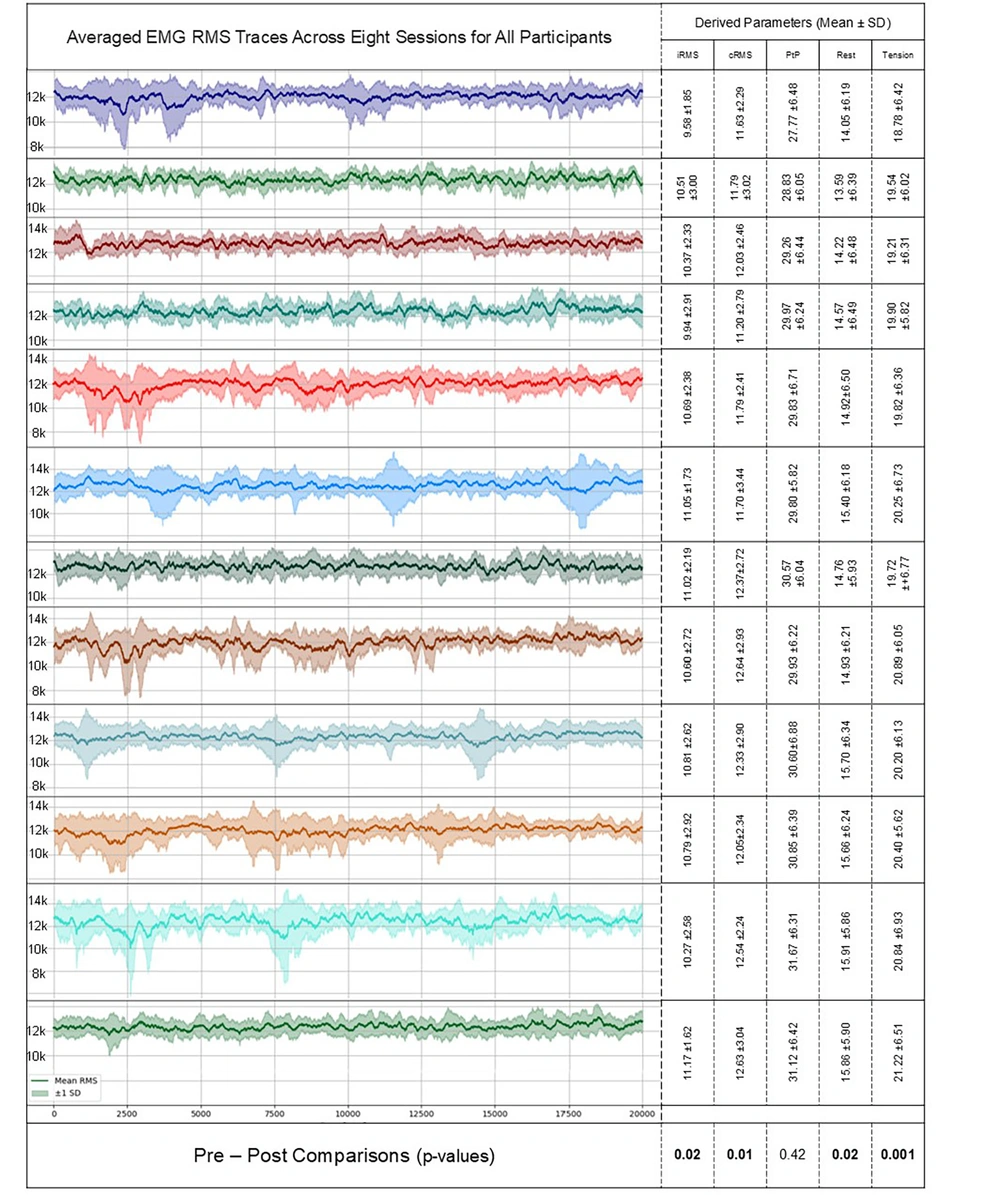
The EMG recordings indicated a substantial increase in tension-phase EMG amplitude, rising from 30.75 ± 1.51 µV to 63.83 ± 20.22 µV (P < 0.001). Resting-phase EMG amplitude decreased from 14.83 ± 6.67 µV to 9.08 ± 5.48 µV; however, this change was not statistically significant (P = 0.599). Additional EMG-derived parameters showed increases in PP amplitude and RMS values following the intervention. The PP values reflected changes in the range of muscle activation during contractions, and RMS values indicated the average signal power. All EMG data are presented in Appendix 1 in Supplementary File (Figure 3).
Temporal electromyographic (EMG) profiles and feature-level signal modulation across eight neurofeedback sessions: This figure presents the mean root mean square (RMS) surface electromyography (sEMG) signal per participant (n = 12) across eight neurofeedback sessions. For each individual, RMS time series were calculated for every session during a standardized motor task, then averaged across sessions 1 - 8 to generate a composite mean signal (solid line), with shaded bands indicating ± 1 standard deviation (SD), reflecting intra-individual variability. Each participant is plotted in a distinct color for visual differentiation. The table on the right summarizes five derived signal features, calculated as the difference between session 8 and session 1: Integrated root mean square (iRMS), contrastive root mean square (cRMS), peak-to-peak (PP) amplitude, baseline RMS during rest periods (rest), and task-phase RMS during active muscle contraction (tension). These metrics capture changes in spontaneous and volitional motor activity. Statistical analyses were performed using both frequentist (paired <i>t</i>-tests or Wilcoxon signed-rank, where appropriate) and Bayesian approaches to accommodate the limited sample size. Measurable changes were observed in cRMS (P &lt; 0.05; BF<sub>10</sub> &gt; 3), tension RMS (P = 0.018; BF<sub>10</sub> = 4.6), and reductions in rest RMS (P = 0.032; BF<sub>10</sub> = 3.8), indicating enhanced neuromuscular regulation post-intervention. These results support improved EMG modulation and task-specific motor recruitment following neurofeedback training.
Figure 3.

Temporal electromyographic (EMG) profiles and feature-level signal modulation across eight neurofeedback sessions: This figure presents the mean root mean square (RMS) surface electromyography (sEMG) signal per participant (n = 12) across eight neurofeedback sessions. For each individual, RMS time series were calculated for every session during a standardized motor task, then averaged across sessions 1 - 8 to generate a composite mean signal (solid line), with shaded bands indicating ± 1 standard deviation (SD), reflecting intra-individual variability. Each participant is plotted in a distinct color for visual differentiation. The table on the right summarizes five derived signal features, calculated as the difference between session 8 and session 1: Integrated root mean square (iRMS), contrastive root mean square (cRMS), peak-to-peak (PP) amplitude, baseline RMS during rest periods (rest), and task-phase RMS during active muscle contraction (tension). These metrics capture changes in spontaneous and volitional motor activity. Statistical analyses were performed using both frequentist (paired t-tests or Wilcoxon signed-rank, where appropriate) and Bayesian approaches to accommodate the limited sample size. Measurable changes were observed in cRMS (P < 0.05; BF10 > 3), tension RMS (P = 0.018; BF10 = 4.6), and reductions in rest RMS (P = 0.032; BF10 = 3.8), indicating enhanced neuromuscular regulation post-intervention. These results support improved EMG modulation and task-specific motor recruitment following neurofeedback training.

4.3. Microstructural Changes in Corticospinal Tract Post-training
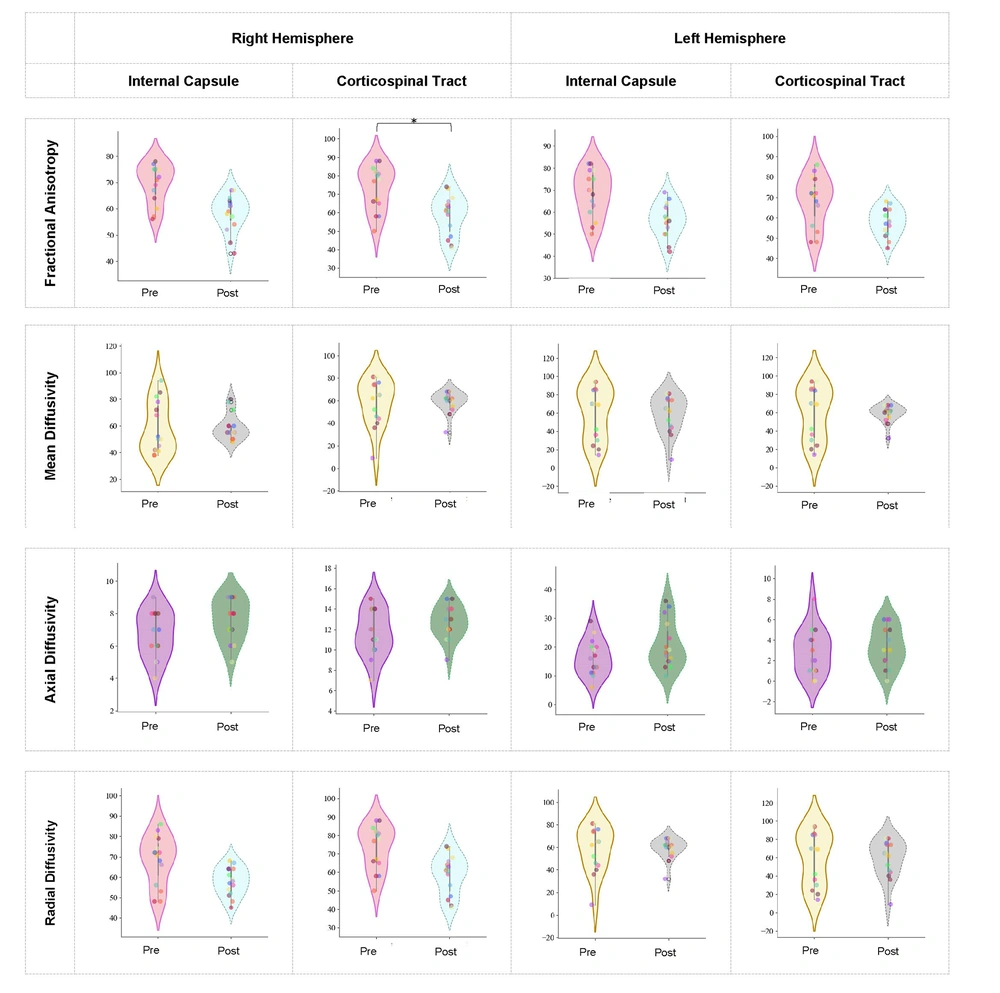
Among the DTI findings, FA in the right CST showed a post-intervention increase that appeared consistent across participants (P = 0.05), accompanied by a moderate effect size (Cohen’s d = 0.62, Appendix 3 in Supplementary File). This result suggests enhanced axonal alignment and structural coherence within a pathway critically involved in voluntary motor control. Although other white matter tracts — such as the uncinate fasciculus and internal capsule — did not show statistically significant changes, small-to-moderate effect sizes and consistent directional trends (e.g., increases in anisotropy or reductions in RD) suggest the possibility of emerging microstructural adaptation that may not have reached statistical threshold due to limited statistical power. Comparable trends were also observed in mean and axial diffusivity (AD) metrics, particularly within the arcuate fasciculus and the anterior segment of the left arcuate nucleus illustrated in Figure 4 (Appendices 2, 4 and 5 in Supplementary File).
Pre- and post-intervention diffusion tensor imaging (DTI) metrics in bilateral internal capsule and corticospinal tract (CST). This figure illustrates the changes in white matter microstructure before and after the 8-week electromyographic (EMG) neurofeedback intervention, as measured by DTI across two anatomically and functionally critical tracts: The internal capsule and the CST, separately for the right and left hemispheres. Each subplot shows individual-level data overlaid on violin plots representing the group distribution for each tract and hemisphere at two time points: Pre- and post-intervention. The figure is organized into four rows corresponding to distinct DTI-derived metrics. Fractional anisotropy (FA) captures the degree of directional water diffusion and reflects axonal coherence and microstructural integrity. Mean diffusivity (MD) reflects the overall magnitude of water diffusion within tissue and is sensitive to changes in cellular density and integrity. Axial diffusivity (AD) reflects diffusion along the principal fiber direction and is associated with axonal injury, while radial diffusivity (RD) reflects diffusion perpendicular to axons and is particularly sensitive to changes in myelin.
Figure 4.

Pre- and post-intervention diffusion tensor imaging (DTI) metrics in bilateral internal capsule and corticospinal tract (CST). This figure illustrates the changes in white matter microstructure before and after the 8-week electromyographic (EMG) neurofeedback intervention, as measured by DTI across two anatomically and functionally critical tracts: The internal capsule and the CST, separately for the right and left hemispheres. Each subplot shows individual-level data overlaid on violin plots representing the group distribution for each tract and hemisphere at two time points: Pre- and post-intervention. The figure is organized into four rows corresponding to distinct DTI-derived metrics. Fractional anisotropy (FA) captures the degree of directional water diffusion and reflects axonal coherence and microstructural integrity. Mean diffusivity (MD) reflects the overall magnitude of water diffusion within tissue and is sensitive to changes in cellular density and integrity. Axial diffusivity (AD) reflects diffusion along the principal fiber direction and is associated with axonal injury, while radial diffusivity (RD) reflects diffusion perpendicular to axons and is particularly sensitive to changes in myelin.

4.4. Associations Between White Matter Microstructure and Clinical/Physiological Outcomes

Mixed-effects modeling and correlation analysis revealed observable associations between DTI metrics and both clinical and electrophysiological measures. The MD and AD in the middle cerebellar peduncle and uncinate fasciculus were negatively associated with Ashworth scores, while higher RD in the uncinate fasciculus was positively associated with spasticity. In contrast, elevated MD and AD in these same tracts were positively associated with Barthel Index scores, and increased RD in the internal capsule was negatively associated with Barthel performance (Appendices 7 and 8 in Supplementary File).
In relation to EMG measures, MD and RD in the CST were positively correlated with resting-state EMG amplitude, and AD in the anterior segment of the left arcuate nucleus also showed a positive correlation with resting activity. During tension-phase contraction, both MD and AD in the arcuate fasciculus and middle cerebellar peduncle were positively associated with EMG output. Additionally, FA and MD in the CST and internal capsule were associated with Fugl-Meyer upper extremity scores, while increased RD in the CST was negatively associated with motor performance (Figure 5 and Appendix 6 in Supplementary File).
Multimodal analysis of rehabilitation-induced neuroplasticity and motor recovery using frequentist and Bayesian frameworks: This figure illustrates an integrated analysis of post-stroke patients undergoing electromyographic (EMG) biofeedback rehabilitation, combining diffusion tensor imaging (DTI), Fugl-Meyer Assessment (FMA), and surface electromyography (sEMG) to examine pre-post intervention changes and inter-domain relationships. Top panel: Summarizes outcome measures that showed measurable pre-post differences using both frequentist and Bayesian (posterior means, Bayes Factors, 95% credible intervals) approaches. These include DTI-derived metrics [fractional anisotropy (FA) and mean diffusivity (MD)], FMA scores reflecting motor performance, and EMG features indexing amplitude modulation, recruitment dynamics, and task-specific activation. Middle panel: Provides a schematic integration of these parameters, illustrating their potential interdependence and contribution to motor recovery. Bottom panel: Shows pairwise associations using linear regression (R<sup>2</sup> values) and Bayesian modeling (posterior distributions), with patterns such as internal capsule diffusivity appearing to correlate with EMG and FMA changes (R<sup>2</sup> = 0.49 - 0.53). Together, the figure illustrates how multimodal assessment and complementary statistical frameworks may reveal patterns of neuroplastic adaptation and motor change in stroke rehabilitation.
Figure 5.

Multimodal analysis of rehabilitation-induced neuroplasticity and motor recovery using frequentist and Bayesian frameworks: This figure illustrates an integrated analysis of post-stroke patients undergoing electromyographic (EMG) biofeedback rehabilitation, combining diffusion tensor imaging (DTI), Fugl-Meyer Assessment (FMA), and surface electromyography (sEMG) to examine pre-post intervention changes and inter-domain relationships. Top panel: Summarizes outcome measures that showed measurable pre-post differences using both frequentist and Bayesian (posterior means, Bayes Factors, 95% credible intervals) approaches. These include DTI-derived metrics [fractional anisotropy (FA) and mean diffusivity (MD)], FMA scores reflecting motor performance, and EMG features indexing amplitude modulation, recruitment dynamics, and task-specific activation. Middle panel: Provides a schematic integration of these parameters, illustrating their potential interdependence and contribution to motor recovery. Bottom panel: Shows pairwise associations using linear regression (R2 values) and Bayesian modeling (posterior distributions), with patterns such as internal capsule diffusivity appearing to correlate with EMG and FMA changes (R2 = 0.49 - 0.53). Together, the figure illustrates how multimodal assessment and complementary statistical frameworks may reveal patterns of neuroplastic adaptation and motor change in stroke rehabilitation.

5. Discussion

This study investigated the neurophysiological and structural correlates of EMG biofeedback in individuals with ischemic stroke. By combining clinical assessments, sEMG recordings, and DTI, we sought to understand how feedback-guided training may influence spasticity, motor performance, and white matter integrity. Given the small sample size and relatively brief intervention, these findings should be considered preliminary and interpreted with caution, serving primarily to inform hypotheses for future trials.

5.1. Functional and Neuromuscular Outcomes: Specificity Without Generalization

We observed reductions in muscle tone on the MAS and improvements in Wr range of motion (ROM), suggesting gains in segmental motor control likely mediated by corticospinal and spinal circuit plasticity (38, 39, 46). Elevated EMG amplitudes further indicated enhanced voluntary activation, consistent with improved motor unit recruitment and reduced reflex hyperexcitability (22, 23).
However, these neuromuscular improvements did not translate into gains in functional independence on the Barthel Index (42, 47). This dissociation reflects a common challenge in stroke rehabilitation: Localized motor recovery does not automatically generalize to the complex behaviors required for daily living (1, 2, 40). The modest upward trend in Barthel scores may represent early neuroplastic changes insufficient to influence higher-order independence within the short intervention period (15, 17). These findings highlight the need for rehabilitation paradigms that couple segmental training with task-specific, cognitively engaging activities to promote transfer and generalization into meaningful functional outcomes (24, 41).

5.2. Structural Signatures of Change

Post-intervention increases in FA within the right CST suggest activity-dependent white matter plasticity in a pathway critical for voluntary motor control (11, 30, 32, 33). The presence of such changes in the chronic phase challenges the traditional view that neuroplasticity is confined to early recovery windows, and instead supports the possibility of structural remodeling long after the initial injury when targeted, use-dependent interventions are applied (1, 14, 17). Mechanistically, these FA increases may reflect processes such as remyelination, axonal sprouting, or improved axonal coherence that facilitate more efficient signal transmission (15, 20, 35).
Trends toward decreased RD and increased AD in the middle cerebellar peduncle, arcuate fasciculus, and internal capsule provide further indications of broader network-level plasticity, even if not all effects reached statistical significance (12, 13, 26). These patterns align with evidence that feedback-based motor training can engage cortico-cerebellar and associative tracts, supporting motor learning and sensorimotor integration (16, 18, 48, 49). Together, these findings suggest that EMG biofeedback may act not only locally on corticospinal output but also across distributed networks critical for functional relearning (27, 36, 41).

5.3. Structure-Function Coupling: A Multi-scale View of Recovery

Associations between DTI metrics and behavioral outcomes further clarify the interplay between structural and functional changes. The FA within the CST and internal capsule correlated positively with Fugl-Meyer scores (33, 43-45), while mean and RD values in the same regions were associated with resting EMG amplitudes (22, 23). These findings suggest that microstructural integrity influences both baseline excitability and overt motor capacity (11, 13). Correlations between diffusivity metrics in associative tracts, such as the arcuate fasciculus, and EMG measures also point toward a role for higher-order networks in sustaining voluntary control and movement precision (16, 18, 26). Notably, increased RD in the internal capsule was negatively associated with Barthel scores (42, 47), indicating that microstructural disorganization in this region may act as a bottleneck for translating motor gains into functional independence (1, 30).

5.4. Mechanistic Implications and Theoretical Synthesis

Taken together, these findings suggest that EMG biofeedback may operate through dual mechanisms: (1) Enhancing corticomuscular coherence and voluntary drive, as reflected in EMG and clinical improvements (22, 23, 25), and (2) promoting white matter remodeling within corticospinal and integrative pathways, as suggested by DTI metrics (11, 30, 32, 33). This dual action aligns with contemporary neurorehabilitation models emphasizing intentionality, salience of feedback, and sensorimotor coupling as critical drivers of recovery — beyond simple repetition or training intensity (1, 24, 40, 41). Importantly, the convergence of electrophysiological, clinical, and imaging measures in this study supports the feasibility of multimodal approaches to capture different layers of stroke recovery and to provide mechanistic insights into how functional improvements may emerge (15-17).

5.5. Conclusions

In summary, EMG biofeedback in ischemic stroke was associated with reduced spasticity, some improvement in muscle activation, and signs of microstructural change in corticospinal pathways. While clear gains in functional independence were not observed, the findings suggest that plasticity may remain accessible in the chronic phase. These preliminary observations support further controlled studies to clarify efficacy and optimize rehabilitation strategies.

5.6. Limitations

Several limitations must be acknowledged. The small sample size reduced statistical power and generalizability, raising the risk of both false positives and false negatives. Limited consistency in participant demographics further complicates interpretation, as variability in age and baseline motor function may have influenced outcomes and reduced comparability. The absence of a control group is another important limitation, as it prevents firm causal inference and makes it difficult to disentangle the effects of EMG biofeedback from spontaneous recovery or concurrent therapies.
The short, eight-week intervention restricts conclusions about durability, and without long-term follow-up, it remains unclear whether observed changes persist or translate into lasting functional gains. Recruitment was constrained by MRI compatibility, and retention was challenged by the physical and cognitive demands of the intervention, introducing possible selection bias toward participants with greater resilience or motivation. The Barthel Index may underestimate subtle functional gains, while DTI offers only indirect estimates of white matter integrity and is susceptible to confounds such as crossing fibers, partial volume effects, and inflammation. Finally, while the multimodal framework is a strength, it did not allow examination of temporal sequencing between electrophysiological and structural changes, limiting conclusions about causal pathways of recovery.

5.7. Future Directions

Future studies should address these issues by enrolling larger and more demographically consistent cohorts, incorporating well-matched control groups, extending follow-up periods to evaluate long-term effects, and employing more sensitive behavioral and imaging measures. Such efforts will be critical to clarify the robustness, durability, and mechanisms of EMG biofeedback-induced recovery.

Acknowledgments

Footnotes

References

  • 1.
    Stinear CM, Lang CE, Zeiler S, Byblow WD. Advances and challenges in stroke rehabilitation. Lancet Neurol. 2020;19(4):348-60. [PubMed ID: 32004440]. https://doi.org/10.1016/S1474-4422(19)30415-6.
  • 2.
    Langhorne P, Bernhardt J, Kwakkel G. Stroke rehabilitation. Lancet. 2011;377(9778):1693-702. [PubMed ID: 21571152]. https://doi.org/10.1016/S0140-6736(11)60325-5.
  • 3.
    Saini V, Guada L, Yavagal DR. Global Epidemiology of Stroke and Access to Acute Ischemic Stroke Interventions. Neurology. 2021;97(20 Suppl 2):S6-S16. [PubMed ID: 34785599]. https://doi.org/10.1212/WNL.0000000000012781.
  • 4.
    Raghavan P. Upper Limb Motor Impairment After Stroke. Phys Med Rehabil Clin N Am. 2015;26(4):599-610. [PubMed ID: 26522900]. [PubMed Central ID: PMC4844548]. https://doi.org/10.1016/j.pmr.2015.06.008.
  • 5.
    Dobkin BH. Strategies for stroke rehabilitation. Lancet Neurol. 2004;3(9):528-36. [PubMed ID: 15324721]. [PubMed Central ID: PMC4164204]. https://doi.org/10.1016/S1474-4422(04)00851-8.
  • 6.
    Wang R, Zhang S, Zhang J, Tong Q, Ye X, Wang K, et al. Electromyographic biofeedback therapy for improving limb function after stroke: A systematic review and meta-analysis. PLoS One. 2024;19(1). e0289572. [PubMed ID: 38206927]. [PubMed Central ID: PMC10783731]. https://doi.org/10.1371/journal.pone.0289572.
  • 7.
    Kwakkel G, Kollen B, Lindeman E. Understanding the pattern of functional recovery after stroke: facts and theories. Restor Neurol Neurosci. 2004;22(3-5):281-99. [PubMed ID: 15502272].
  • 8.
    Bartlova S, Sedova L, Haviernikova L, Hudackova A, Dolak F, Sadilek P. Quality of Life of Post-stroke Patients. Zdr Varst. 2022;61(2):101-8. [PubMed ID: 35432611]. [PubMed Central ID: PMC8937589]. https://doi.org/10.2478/sjph-2022-0014.
  • 9.
    Steinle B, Corbaley J. Rehabilitation of stroke: a new horizon. Mo Med. 2011;108(4):284-8. [PubMed ID: 21905447]. [PubMed Central ID: PMC6188430].
  • 10.
    Abubakar SA, Isezuo SA. Health related quality of life of stroke survivors: experience of a stroke unit. Int J Biomed Sci. 2012;8(3):183-7. [PubMed ID: 23675271]. [PubMed Central ID: PMC3615283].
  • 11.
    Stinear CM, Barber PA, Smale PR, Coxon JP, Fleming MK, Byblow WD. Functional potential in chronic stroke patients depends on corticospinal tract integrity. Brain. 2007;130(Pt 1):170-80. [PubMed ID: 17148468]. https://doi.org/10.1093/brain/awl333.
  • 12.
    Christidi F, Tsiptsios D, Fotiadou A, Kitmeridou S, Karatzetzou S, Tsamakis K, et al. Diffusion Tensor Imaging as a Prognostic Tool for Recovery in Acute and Hyperacute Stroke. Neurol Int. 2022;14(4):841-74. [PubMed ID: 36278693]. [PubMed Central ID: PMC9589952]. https://doi.org/10.3390/neurolint14040069.
  • 13.
    Paul T, Wiemer VM, Hensel L, Cieslak M, Tscherpel C, Grefkes C, et al. Interhemispheric Structural Connectivity Underlies Motor Recovery after Stroke. Ann Neurol. 2023;94(4):785-97. [PubMed ID: 37402647]. https://doi.org/10.1002/ana.26737.
  • 14.
    Langhorne P, Coupar F, Pollock A. Motor recovery after stroke: a systematic review. Lancet Neurol. 2009;8(8):741-54. [PubMed ID: 19608100]. https://doi.org/10.1016/S1474-4422(09)70150-4.
  • 15.
    Carmichael ST. Cellular and molecular mechanisms of neural repair after stroke: making waves. Ann Neurol. 2006;59(5):735-42. [PubMed ID: 16634041]. https://doi.org/10.1002/ana.20845.
  • 16.
    Grefkes C, Ward NS. Cortical reorganization after stroke: how much and how functional? Neuroscientist. 2014;20(1):56-70. [PubMed ID: 23774218]. https://doi.org/10.1177/1073858413491147.
  • 17.
    Murphy TH, Corbett D. Plasticity during stroke recovery: from synapse to behaviour. Nat Rev Neurosci. 2009;10(12):861-72. [PubMed ID: 19888284]. https://doi.org/10.1038/nrn2735.
  • 18.
    Alia C, Spalletti C, Lai S, Panarese A, Lamola G, Bertolucci F, et al. Neuroplastic Changes Following Brain Ischemia and their Contribution to Stroke Recovery: Novel Approaches in Neurorehabilitation. Front Cell Neurosci. 2017;11:76. [PubMed ID: 28360842]. [PubMed Central ID: PMC5352696]. https://doi.org/10.3389/fncel.2017.00076.
  • 19.
    Aderinto N, AbdulBasit MO, Olatunji G, Adejumo T. Exploring the transformative influence of neuroplasticity on stroke rehabilitation: a narrative review of current evidence. Ann Med Surg (Lond). 2023;85(9):4425-32. [PubMed ID: 37663728]. [PubMed Central ID: PMC10473303]. https://doi.org/10.1097/MS9.0000000000001137.
  • 20.
    Freitas-Andrade M, Raman-Nair J, Lacoste B. Structural and Functional Remodeling of the Brain Vasculature Following Stroke. Front Physiol. 2020;11:948. [PubMed ID: 32848875]. [PubMed Central ID: PMC7433746]. https://doi.org/10.3389/fphys.2020.00948.
  • 21.
    Takeuchi N, Izumi S. Rehabilitation with poststroke motor recovery: a review with a focus on neural plasticity. Stroke Res Treat. 2013;2013:128641. [PubMed ID: 23738231]. [PubMed Central ID: PMC3659508]. https://doi.org/10.1155/2013/128641.
  • 22.
    Mahmoud W, Hultborn H, Zuluaga J, Zrenner C, Zrenner B, Ziemann U, et al. Testing spasticity mechanisms in chronic stroke before and after intervention with contralesional motor cortex 1 Hz rTMS and physiotherapy. J Neuroeng Rehabil. 2023;20(1):150. [PubMed ID: 37941036]. [PubMed Central ID: PMC10631065]. https://doi.org/10.1186/s12984-023-01275-9.
  • 23.
    Rayegani SM, Raeissadat SA, Sedighipour L, Rezazadeh IM, Bahrami MH, Eliaspour D, et al. Effect of neurofeedback and electromyographic-biofeedback therapy on improving hand function in stroke patients. Top Stroke Rehabil. 2014;21(2):137-51. [PubMed ID: 24710974]. https://doi.org/10.1310/tsr2102-137.
  • 24.
    Kleim JA, Jones TA. Principles of experience-dependent neural plasticity: implications for rehabilitation after brain damage. J Speech Lang Hear Res. 2008;51(1):S225-39. [PubMed ID: 18230848]. https://doi.org/10.1044/1092-4388(2008/018).
  • 25.
    Dang R, Wang H. Effect of somatosensory simulation training combined with EMG biofeedback on upper limb dysfunction in stroke patients. Am J Transl Res. 2023;15(3):1842-51. [PubMed ID: 37056829]. [PubMed Central ID: PMC10086867].
  • 26.
    Mane R, Chouhan T, Guan C. BCI for stroke rehabilitation: motor and beyond. J Neural Eng. 2020;17(4):41001. [PubMed ID: 32613947]. https://doi.org/10.1088/1741-2552/aba162.
  • 27.
    Pillette L, Lotte F, N'Kaoua B, Joseph PA, Jeunet C, Glize B. Why we should systematically assess, control and report somatosensory impairments in BCI-based motor rehabilitation after stroke studies. Neuroimage Clin. 2020;28:102417. [PubMed ID: 33039972]. [PubMed Central ID: PMC7551360]. https://doi.org/10.1016/j.nicl.2020.102417.
  • 28.
    Garcia DA, Arredondo R, Morris M, Tosunoglu S. A review of rehabilitation strategies for stroke recovery. Proceedings of the. 2012. p. 24-31.
  • 29.
    Woodford H, Price C. EMG biofeedback for the recovery of motor function after stroke. Cochrane Database Syst Rev. 2007;2007(2). CD004585. [PubMed ID: 17443550]. [PubMed Central ID: PMC6464966]. https://doi.org/10.1002/14651858.CD004585.pub2.
  • 30.
    Puig J, Blasco G, Schlaug G, Stinear CM, Daunis IP, Biarnes C, et al. Diffusion tensor imaging as a prognostic biomarker for motor recovery and rehabilitation after stroke. Neuroradiol. 2017;59(4):343-51. [PubMed ID: 28293701]. https://doi.org/10.1007/s00234-017-1816-0.
  • 31.
    Mukherjee P. Diffusion tensor imaging and fiber tractography in acute stroke. Neuroimaging Clin N Am. 2005;15(3):655-65. xii. [PubMed ID: 16360595]. https://doi.org/10.1016/j.nic.2005.08.010.
  • 32.
    Jang SH. The role of the corticospinal tract in motor recovery in patients with a stroke: a review. NeuroRehabilitation. 2009;24(3):285-90. [PubMed ID: 19458437]. https://doi.org/10.3233/NRE-2009-0480.
  • 33.
    Lindenberg R, Renga V, Zhu LL, Betzler F, Alsop D, Schlaug G. Structural integrity of corticospinal motor fibers predicts motor impairment in chronic stroke. Neurology. 2010;74(4):280-7. [PubMed ID: 20101033]. [PubMed Central ID: PMC3122304]. https://doi.org/10.1212/WNL.0b013e3181ccc6d9.
  • 34.
    Jones DK, Knosche TR, Turner R. White matter integrity, fiber count, and other fallacies: the do's and don'ts of diffusion MRI. Neuroimage. 2013;73:239-54. [PubMed ID: 22846632]. https://doi.org/10.1016/j.neuroimage.2012.06.081.
  • 35.
    Welniarz Q, Dusart I, Roze E. The corticospinal tract: Evolution, development, and human disorders. Dev Neurobiol. 2017;77(7):810-29. [PubMed ID: 27706924]. https://doi.org/10.1002/dneu.22455.
  • 36.
    Caria A, da Rocha JLD, Gallitto G, Birbaumer N, Sitaram R, Murguialday AR. Brain-Machine Interface Induced Morpho-Functional Remodeling of the Neural Motor System in Severe Chronic Stroke. Neurotherapeutics. 2020;17(2):635-50. [PubMed ID: 31802435]. [PubMed Central ID: PMC7283440]. https://doi.org/10.1007/s13311-019-00816-2.
  • 37.
    Feng S, Tang M, Huang G, Wang J, He S, Liu D, et al. EMG biofeedback combined with rehabilitation training may be the best physical therapy for improving upper limb motor function and relieving pain in patients with the post-stroke shoulder-hand syndrome: A Bayesian network meta-analysis. Front Neurol. 2022;13:1056156. [PubMed ID: 36703623]. [PubMed Central ID: PMC9873378]. https://doi.org/10.3389/fneur.2022.1056156.
  • 38.
    Pandyan AD, Johnson GR, Price CI, Curless RH, Barnes MP, Rodgers H. A review of the properties and limitations of the Ashworth and modified Ashworth Scales as measures of spasticity. Clin Rehabil. 1999;13(5):373-83. [PubMed ID: 10498344]. https://doi.org/10.1191/026921599677595404.
  • 39.
    Chen CL, Chen CY, Chen HC, Wu CY, Lin KC, Hsieh YW, et al. Responsiveness and minimal clinically important difference of Modified Ashworth Scale in patients with stroke. Eur J Phys Rehabil Med. 2019;55(6):754-60. [PubMed ID: 30868834]. https://doi.org/10.23736/S1973-9087.19.05545-X.
  • 40.
    Carr JH, Shepherd RB. Neurological rehabilitation: optimizing motor performance. Edinburgh, London: Elsevier Health Sciences; 2010.
  • 41.
    Winstein CJ, Wolf SL, Dromerick AW, Lane CJ, Nelsen MA, Lewthwaite R, et al. Effect of a Task-Oriented Rehabilitation Program on Upper Extremity Recovery Following Motor Stroke: The ICARE Randomized Clinical Trial. JAMA. 2016;315(6):571-81. [PubMed ID: 26864411]. [PubMed Central ID: PMC4795962]. https://doi.org/10.1001/jama.2016.0276.
  • 42.
    Ohura T, Hase K, Nakajima Y, Nakayama T. Validity and reliability of a performance evaluation tool based on the modified Barthel Index for stroke patients. BMC Med Res Methodol. 2017;17(1):131. [PubMed ID: 28841846]. [PubMed Central ID: PMC6389202]. https://doi.org/10.1186/s12874-017-0409-2.
  • 43.
    Woodbury ML, Velozo CA, Richards LG, Duncan PW, Studenski S, Lai SM. Dimensionality and construct validity of the Fugl-Meyer Assessment of the upper extremity. Arch Phys Med Rehabil. 2007;88(6):715-23. [PubMed ID: 17532892]. https://doi.org/10.1016/j.apmr.2007.02.036.
  • 44.
    Sanford J, Moreland J, Swanson LR, Stratford PW, Gowland C. Reliability of the Fugl-Meyer assessment for testing motor performance in patients following stroke. Phys Ther. 1993;73(7):447-54. [PubMed ID: 8316578]. https://doi.org/10.1093/ptj/73.7.447.
  • 45.
    Gladstone DJ, Danells CJ, Black SE. The fugl-meyer assessment of motor recovery after stroke: a critical review of its measurement properties. Neurorehabil Neural Repair. 2002;16(3):232-40. [PubMed ID: 12234086]. https://doi.org/10.1177/154596802401105171.
  • 46.
    Nielsen JB, Crone C, Hultborn H. The spinal pathophysiology of spasticity--from a basic science point of view. Acta Physiol (Oxf). 2007;189(2):171-80. [PubMed ID: 17250567]. https://doi.org/10.1111/j.1748-1716.2006.01652.x.
  • 47.
    de Oliveira R, Cacho EW, Borges G. Post-stroke motor and functional evaluations: a clinical correlation using Fugl-Meyer assessment scale, Berg balance scale and Barthel index. Arq Neuropsiquiatr. 2006;64(3B):731-5. [PubMed ID: 17057876]. https://doi.org/10.1590/s0004-282x2006000500006.
  • 48.
    Doyon J, Benali H. Reorganization and plasticity in the adult brain during learning of motor skills. Curr Opin Neurobiol. 2005;15(2):161-7. [PubMed ID: 15831397]. https://doi.org/10.1016/j.conb.2005.03.004.
  • 49.
    Bastian AJ. Understanding sensorimotor adaptation and learning for rehabilitation. Curr Opin Neurol. 2008;21(6):628-33. [PubMed ID: 18989103]. [PubMed Central ID: PMC2954436]. https://doi.org/10.1097/WCO.0b013e328315a293.

Crossmark
Crossmark
Checking
Share on
Cited by
Metrics

Purchasing Reprints

  • Copyright Clearance Center (CCC) handles bulk orders for article reprints for Brieflands. To place an order for reprints, please click here (   https://www.copyright.com/landing/reprintsinquiryform/ ). Clicking this link will bring you to a CCC request form where you can provide the details of your order. Once complete, please click the ‘Submit Request’ button and CCC’s Reprints Services team will generate a quote for your review.
Search Relations

Author(s):

Related Articles

