
1. Background
Organophosphates (OPs) and carbamates were primarily used as pesticides in agriculture (1). Some types of OPs have shown therapeutic properties and have been used for the treatment of some neurologic disorders, including Alzheimer’s disease (2). Both agricultural and medical applications of OPs and carbamates are attributed to their capacity to disrupt the function of the cholinergic nervous system by inhibiting acetylcholinesterase (AChE) (3). This enzyme is responsible for the hydrolysis of acetylcholine (ACh) under physiological conditions; therefore, its blockade leads to ACh accumulation in the nervous system (2).
In humans, poisoning with OPs/carbamates may result in convulsions (4). The cellular mechanisms through which these agents induce seizure are not fully understood (5). Consequently, there is no efficient treatment to manage patients with OP or carbamate-induced seizures. Although previous studies, by relying on the induced disruption of the cholinergic system, have suggested the use of atropine, oximes, and benzodiazepines to control this type of seizure, all these treatments are insufficient and have severe adverse effects (6, 7). Therefore, the mechanisms of seizure induction by OPs and carbamates should be explained, and the importance of studies to discover new therapies and drugs with favorable pharmacological properties and side effect profiles is unquestionable.
Potassium (K+) channels may play an important role in the control of all features of neuronal excitability, including resting membrane potential (8). The opening of K+ channels is expected to hyperpolarize neurons, inhibit action-potential firing, and prevent hypersynchronous neuronal discharge during a seizure (9, 10). K+ channel opening is one of the potential antiepileptic mechanisms (11, 12). On the other hand, previous reports have shown that adenosine triphosphate (ATP)-sensitive K+ channels (KATP), one of different types of K+ channel family, play an important role in the management of seizure threshold in several in vitro and in vivo models (13, 14). These findings have been confirmed by other clinical trials (15). However, no study has shown the protective effects of K+ channel openers on seizure induced by OPs and carbamates.
This study was performed to investigate the possible effects of cromakalim (a K+ channel opener) on OP- and carbamate-induced seizures in mice. We aimed to present possible anticonvulsant agents with specific targets to manage this type of seizure. Therefore, dichlorvos and physostigmine sulfate were used as an OP and carbamate, respectively to induce seizure in mice. Furthermore, the possible effects of K channel openers on convulsion were examined using cromakalim.
2. Methods
2.1. Animals
In total, 120 male NMRI mice, weighing 20 - 26 g, were used in the experiments. The animals were housed in a room with controlled temperature (21 - 22°C) in a 12-hour light-dark cycle at humidity of 50 ± 10%. The animals were allowed free access to standard laboratory food and water. Assignment of subjects to the experimental groups (n, 10 per group) was randomized. The tests were performed between 9 am and 1 pm. The experimental procedures throughout the study were in compliance with the guidelines for the care and use of animals and were approved by the local ethics committee for animal experiments of Tehran University, Tehran, Iran.
2.2. Drugs
The following drugs were used in the experiments: dichlorvos (50 mg/kg) as an OP; physostigmine sulfate (2 mg/kg) as a carbamate; cromakalim (0.1, 10, and 30 µg/kg) as a K channel opener; and glibenclamide (1 mg/kg) as a K channel blocker. As previously reported, the dose of glibenclamide (1 mg/kg) and its solvent (DMSO), administered by the same route, did not significantly change the plasma glucose level (9).
Dichlorvos (2, 2-dichlorovinyl dimethyl phosphate) was obtained from the institute of organic chemistry (Waster green, Iran). Physostigmine sulfate, cromakalim, and glibenclamide were purchased from sigma chemical company. Dichlorvos was mixed with acacia powder and distilled water in a dry mortar at a ratio of 2:1:1.5 (weight/weight/ volume), as previously described (16). Afterwards, saline was added to obtain the desired concentrations. Glibenclamide was dissolved in DMSO, while physostigmine and cromakalim were dissolved in saline. The doses of all drugs were based on the weight of their salt forms.
2.3. Experimental Design
Dichlorvos and physostigmine were administrated intraperitoneally to animals to induce seizures. The 2 experimental groups (dichlorvos- and physostigmine-treated) were divided into 3 classes. To investigate the possible role of K channels in OP- and carbamate-induced seizures, we used cromakalim and glibenclamide:
a, Cromakalim (0.1, 10, and 30 µg/kg) was administrated intraperitoneally at 30 minutes before carbamate/OP administration.
b, Glibenclamide (1 mg/kg) was administrated intraperitoneally at 30 minutes before carbamate/OP injection.
c, To determine the effect of cromakalim on seizure induced by OP/carbamate, 30 µg/kg of cromakalim (effective dose) was administrated 5 minutes before glibenclamide (10).
2.4. Behavioral Assessments
The animals were monitored for 120 minutes after drug injections. Seizures were evaluated and scored based on the staging system by McLean et al. (5, 17): stage 0, no abnormal behavior; stage 1, some abnormal behaviors including salivation, chewing, and pawing at the mouth; stage 2, dazed appearance, intermittent motionlessness, tremor, and/or bobbing of the head; stage 3, random and/or generalized jerks, similar to stage 2; stage 4, intermittent rearing on hind legs with forepaws extended without falling; stage 5, falling to the side or rear, same as stage 4; and stage 6, status epilepticus.
Stages 1 - 3 and 4 - 6 were considered as subconvulsive and convulsive behaviors, respectively. The latency of seizures after drug injection (in seconds), latency until the onset of death within 1 hour (in seconds), mortality after injection within 1 hour (in percentage), and stages of seizures induced by drug injection (in percentage) were recorded.
2.5. Data Analysis
Comparisons between the experimental and control groups were performed by one-way ANOVA, followed by Tukey’s post hoc test when appropriate. P value < 0.05 was considered to be significant.
3. Results
3.1. Dichlorvos and Physostigmine Administration Causes Convulsion and Death in Mice
Both dichlorvos (50 mg/kg, ip) and physostigmine (2 mg/kg, ip) triggered seizure activity in mice (Table 1). In these groups, convulsion and death occurred in 100% of the animals (Table 1).
Table 1.
Effects of different doses of cromakalim and glibenclamide on the stages of seizure, induced by dichlorvos (50 mg/kg) and physostigmine (2 mg/kg). Data are shown as percentage in mice (𝑛, 10). The definition of each stage is described in section 2.4.
| Treatment | Organophosphate | Stage of Seizure | ||
|---|---|---|---|---|
| Stage 0 | Stage 1 - 3 | Stage 4 - 6 | ||
| Cromakalim 0 | Dichlorvos | 0 | 0 | 100 |
| Physostigmine | 0 | 0 | 100 | |
| Cromakalim 0.1 | Dichlorvos | 10 | 10 | 80 |
| Physostigmine | 10 | 20 | 70 | |
| Cromakalim 10 | Dichlorvos | 40 | 20 | 40 |
| Physostigmine | 50 | 20 | 30 | |
| Cromakalim 30 | Dichlorvos | 80 | 10 | 10 |
| Physostigmine | 80 | 10 | 10 | |
| Glibenclamide 1 | Dichlorvos | 0 | 0 | 100 |
| Physostigmine | 0 | 0 | 100 | |
| Glibenclamide 1 + cromakalim 30 | Dichlorvos | 0 | 10 | 90 |
| Physostigmine | 10 | 10 | 80 | |
3.2. Effect of Cromakalim on the Onset of Seizure/Death Induced by Dichlorvos and Physostigmine
Pretreatment with cromakalim at doses of 10 µ/kg (P < 0.05 for physostigmine; P < 0.01 for divhlorvos) and 30 µ/kg (P < 0.01 for divhlorvos and physostigmine) increased the latency of clonic seizure (Figure 1) and prevented dichlorvos-induced seizures in mice (Table 1). Also, cromakalim at doses of 0.1 µg/kg (P < 0.01), 10 µg/kg (P < 0.001), and 30 µg/kg (P < 0.001) significantly increased the onset of death after both OP and carbamate administration (Figure 2).
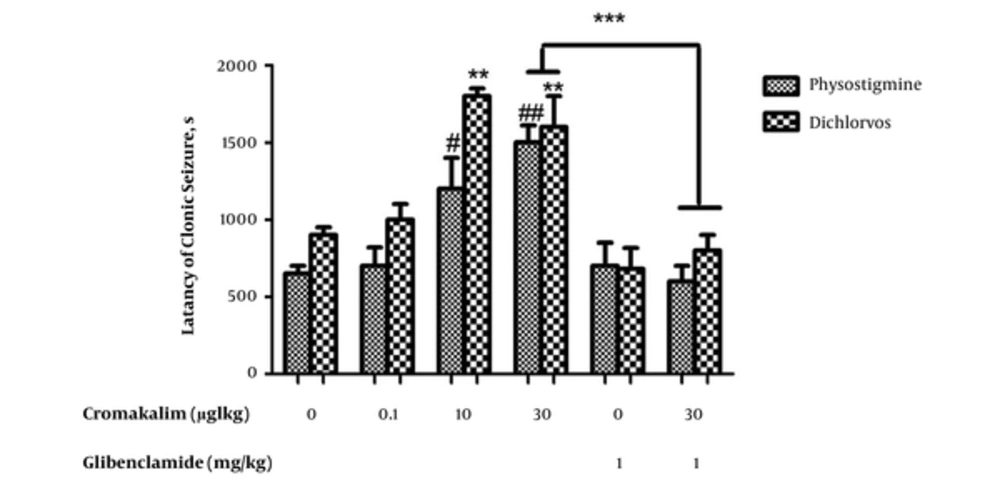
Figure 1.
Effect of glibenclamide (1 mg/kg) and cromakalim (30 µg/kg) coadministration on the onset of seizure in mice. Values represent the mean and SEM of 10 animals. #P < 0.05, ##P < 0.01, compared to the physostigmine group (control); **P < 0.01, compared to the dichlorvos group (control); ***P< 0.001 compared to the cromakalim (1 mg/kg) plus dichlorvos group.
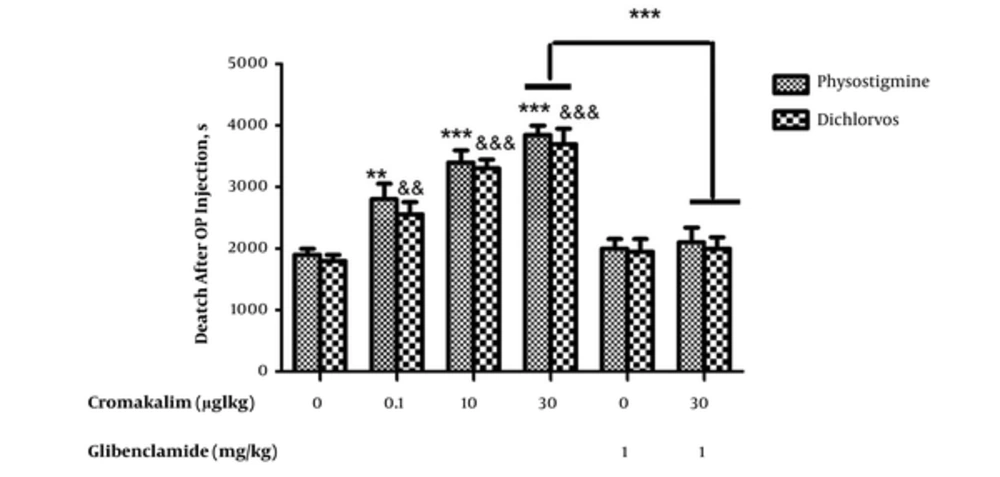
Figure 2.
The effect of glibenclamide (1 mg/kg) and cromakalim (30 µg/kg) coadministration on the onset of death in mice. Values represent the mean and SEM of 10 animals. &&P < 0.01, &&&P < 0.001, compared to the dichlorvos group (control); **P < 0.01 and ***P < 0.001, compared to the physostigmine group (control); ***P < 0.001 compared to the cromakalim (1 mg/kg) plus dichlorvos group.
3.3. Effects of Cromakalim on Death Induced by Dichlorvos and Physostigmine
Figure 3 shows that cromakalim administration reduced the percentage of mortality induced by dichlorvos and physostigmine. Cromakalim at doses of 0.1, 10, and 30 µg/kg decreased the mortality percentage, compared to the control group, which received dichlorvos and physostigmine.
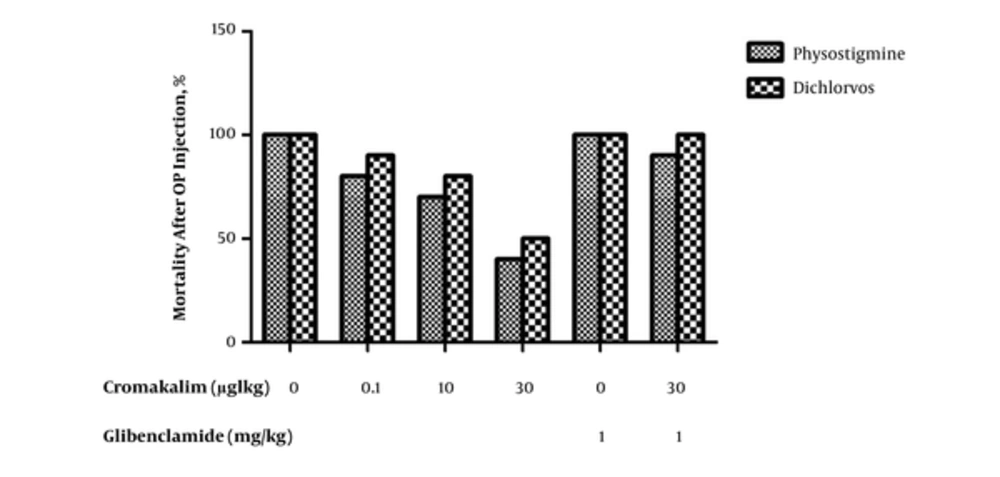
Figure 3.
Effects of glibenclamide (1 mg/kg) and cromakalim (30 µg/kg) coadministration on mortality in mice. Data are shown as percentage in mice (𝑛, 10).
3.4. Effects of Cromakalim on Seizure Stages After Dichlorvos and Physostigmine Administration
As presented in Table 1, cromakalim at doses of 0.1, 10, and 30 µg/kg disrupted the convulsive effects of both dichlorvos and physostigmine in mice. This anticonvulsant effect of the K channel blocker showed a dose-dependent manner; by increasing the dose of the drug, the percentage of stage 0 and stages 1 - 3 increased, compared to the control group (Table 1).
3.5. Effect of Glibenclamide on the Anticonvulsant Properties of Cromakalim
Administration of glibenclamide (1 mg/kg, ip) 5 minutes before cromakalim injection (30 µg/kg) inhibited the anticonvulsant effect of cromakalim on OP- and carbamate-induced seizures (Table 1) and decreased the latency of clonic seizure (P < 0.001) (Figure 1) and time of death after injection (P < 0.001) (Figure 2); it also increased the mortality rate (Figure 3).
4. Discussion
In the present study, dicholorvos and physostigmine caused colonic and tonic seizures, followed by death in 100% of animals. After the intraperitoneal injection of dichlorvos or physostigmine, some degree of tremor, besides excessive activity, appeared, and the symptoms became more severe, causing death over time. Overall, seizure is one of the adverse effects of poisoning with OPs and carbamates, such as dichlorvos and physostigmine (18, 19). These substances exert their effects by inhibiting AChE in the nervous system.
Depending on the level of AChE inhibition, cholinergic activation may cause hyperactivity of excitable tissues, fasciculation, seizure, convulsion, coma, and death (20). It has been suggested that systemic application of sublethal doses of AChE inhibitors (AChEIs) may result in seizures, convulsions, and central nervous system lesions (21). These finding are in agreement with our results, which showed that dichlorvos at a dose of 50 mg/kg and physostigmine at a dose of 2 mg/kg caused convulsion and death in all animals.
Considering the disruption of cholinergic system by the mentioned chemicals, previous studies have suggested atropine, oximes, and benzodiazepines to control this type of seizure. However, drugs typically used against epilepsy in hospitals are ineffective against OP/carbamate intoxication (6). For instance, atropine only alleviates a few symptoms and shows severe adverse effects (22). Moreover, oximes permeate poorly through the blood-brain barrier (23) and cannot affect the CNS. Benzodiazepines are also likely to depress the brainstem respiratory and circulatory centers (7). Therefore, importance of further research to discover new antiepileptic drugs, which can inhibit seizures induced by OPs and carbamates with favorable pharmacological properties and side effect profiles, is unquestionable.
In the present study, cromakalim, a K channel opener, reduced the rates of both seizure and mortality. The onset of seizure and death after OP/carbamate administration reduced in cromakalim pretreatment, which is in agreement with our previous data, showing the anticonvulsant activity of diazoxide, as a KATP channel opener, against dichlorvas-induced seizure (5). In the current study, glibenclamide, as a potassium KATP channel blocker, reversed the anticonvulsant effects of cromakalim.
K+ channels comprise a large family of ion channels. Among different types of K+ channels, KATP channels are involved in numerous physiological functions (8). They are located pre- and postsynaptically in many brain areas, and their function is controlled by the metabolic conditions of neurons. They open and close in response to alterations in intracellular ATP/adenosine diphosphate (ADP) relations. Low ATP opens these channels, leading to K+ efflux and cell hyperpolarization (24).
The hyperpolarization induced by KATP channel opening inhibits action-potential firing and prevents hypersynchronous neuronal discharge during a seizure. It has been shown that KATP channels play a significant role in the regulation of seizure threshold in several in vitro and in vivo models (13, 14, 25). In addition, KATP channel openers have been shown to decrease excitability in CA3 hippocampal cells (26) and exhibit antiepileptic effects in a model of drug-induced epilepsy (27).
Molecular studies have shown that functional KATP channels are octomeric complexes, consisting of 4 inward rectifier K+ channel subunits (Kir6.1 or Kir6.2) and 4 sulfonylurea receptor subunits (SUR1, SUR2A, or SUR 2B), with diverse neurons expressing special combinations of KATP subunits (11). Mice without the expression of either SUR1 or Kir6.1 genes are susceptible to seizures (28). Moreover, it has been shown that mice with deficiencies in a subunit of KATP channels (Kir 6.2−/− mice) are vulnerable to generalized seizure (14). In addition, it has been recently reported that KATP channel openers, such as cromakalim and diazoxide, increase clonic seizures induced by pentylenetetrazole in mice (9, 29).
The role of K channel openers in seizure has been shown in several clinical and animal studies. However, the effect of these substances on seizures induced by OPs and carbamates has not been studied yet; also, there is no article showing the possible effects. In this study, we showed that cromakalim (a KATP channel opener) at doses of 0.1, 10, and 30 µg/kg could reverse convulsion and death following OP/carbamate administration. In addition, our data showed that the antiepileptic effect of cromakalim is reversed by glibenclamide (a K+ channel blocker). These data confirm the role of K channels in mediating the convulsive effects of OPs and carbamates. These findings help introduce new aspects of specific targets to manage patients with OP or carbamate toxicity.
In summary, this study, for the first time, showed that cromakalim (a KATP channel opener) decreases seizures induced by dichlorvos and physostigmine in mice. We also introduced new aspects of specific targets to manage seizures from OP/carbamate toxicity, although further investigation is needed to evaluate the efficacy of these agents in AChEI-induced seizures.