





1. Background
Multiple sclerosis (MS) is the most common cause of progressive neurodegenerative diseases in young adults with a profound effect on the social, economic, psychological, and sexual aspects of affected people (1). The prevalence of MS in the USA is up to 149.2 per 100000 population (2). A study showed that the MS prevalence rate is 31 to 55 per 100000 population in the Persian Gulf countries. The reported prevalence for Turkey and Jordan are 51 and 20 per 100000 population, respectively. In Iran, the highest and lowest prevalence rates belong to Isfahan (93.06 per 100000) and Golestan (18.0 per 100000) provinces, respectively (3). The MS incidence increased from 1991 to 2004 in Tehran, Iran. The annual percent change (APC) was 12.8% in women and 12.5% in men in the same period (4). The prevalence in women is 3.13 times the prevalence in men (5).
Cognitive deficits are seen in 40% to 65% of patients (6, 7). MS affects different cognitive domains (8) and cognitive deficits can be seen in the early stages of MS symptoms development (9). Cognitive function is an intellectual process that enables individuals to be aware of, perceive, and comprehend the ideas. Making a decision and manifesting behavior are considered as its targets. Therefore, it is important to consider the cognitive functioning of MS patients in clinical evaluations (8). In this regard, previous reports showed a delay in reaction time and deficiency in the information processing speed of the mind and consequently impaired memory in these patients (10-12). It also has been reported that the most frequently impaired domains were attention (50.4%), information processing speed (26.5%), memory (12.4%), visuospatial function (8.8%), and language (1.8%). In patients displaying deficits in two cognitive domains, the most frequent combinations were attention and information processing speed (33.3%), attention and memory (19.3%), information processing speed and memory (19.3%), attention and visuospatial function (8.8%), and attention and language (5.3%). At least three cognitive domains were affected in 23.2% of the patients (7). Concerning previous reports, cognitive impairment is a common feature of MS that affects more than half of the MS patients. It has a sophisticated neuroanatomical and pathophysiologic background and disturbs such vital cognitive domains as the speed of information processing, memory, attention, executive functions, and visuospatial functions (13).
Previous studies have reported that cognitive impairment is common in MS patients (6, 7). Moreover, patients with primary progressive MS have had more severe cognitive impairment than patients with relapsing-remitting MS, indicating the role of disease course in cognitive impairment development (14). Some other studies indicated that processing speed is much more impaired than working memory in MS (15). There are several paradoxical points in assessing cognitive functions in MS; however, new perspectives in neuro-anatomical or neurophysiological research demonstrate EEG/MEG features as a promising procedure that may reduce the paradox and yield a better understanding in this field (16).
2. Objectives
Considering the geographic diversity and different prevalence rates of MS all over the world (2-4, 17, 18), the impacts of cognitive decline on the quality of life of MS patients, and the contradictory results of studies in this field, the aim of the current study was to compare cognitive functions in three areas of working memory, attention, and executive function in hospitalized MS patients and other patients hospitalized in internal wards.
3. Methods
3.1. Participants
This cross-sectional study was performed at Imam Reza Educational Center and Razi Educational Hospital affiliated to Tabriz University of Medical Sciences, Tabriz, Iran, in 2018. The sample was selected using a nonrandom convenience sampling method from among patients admitted to the neurology departments of the two centers. Furthermore, 34 age and gender-matched people were recruited from internal wards as a control group. G*Power software was used to calculate the sample size regarding the mean scores in the symbol digit modalities test (SDMT) of PCAP. The participants were selected from among 20 to 35-year-old patients in accordance with a previous study (19).
All ethical codes including obtaining informed consent, confidentiality and non-disclosure of patient information, and continuation of routine treatment strategy were taken into consideration. The study was performed under the regional ethical code IR.TBZMED.REC.1395.1008.
3.2. Inclusion and Exclusion Criteria
Written consent to participate in the study, a diagnosis of MS by a neurologist, an age of 20 - 35-years-old, and ability to read and write were considered as the inclusion criteria. Psychiatric illnesses such as attention deficit hyperactivity disorder (ADHD), schizophrenia, dementia, acute phase of mood disorder, substance use, and mental retardation that would affect cognitive functions were considered as the exclusion criteria. The diagnosis of psychiatric comorbidities was established during psychiatric clinical interviews.
3.3. Tools
The Persian version of paper and pencil cognitive assessment package (PCAP) was used in the study. It is a collection of the most common and applicable cognitive assessment tests covering various areas of memory and learning, working memory, attention, and executive functions. This package includes symbol digit modality test (SDMT), letter-number sequencing task (LNST), trail making task, verbal fluency task, and stroop task. A study conducted by Rezapour et al. (20) confirmed the validity and reliability of the PCAP in Iranian populations.
3.4. Statistical Analysis
The sample size was assessed by the G*Power software using the SDMT of PCAP applied on 31 individuals in each group of MS patients and non-MS controls that were increased to 34 subjects after considering a 10% dropout rate. Data analysis was performed by SPSS version 22 software (SPSS, Chicago, IL, USA) using descriptive statistics (mean and standard deviation.) and inferential statistics (Student t-test and Pearson’s correlation test). A P value of < 0.05 was considered statistically significant.
4. Results
In this study, 68 individuals (34 MS patients and 34 controls) were evaluated. The mean age was 32.44 ± 3.43 in the MS group and 31.17 ± 3.63 in the control group. There was no significant difference between the two groups in age (P > 0.05, t = 47.1).
According to Table 1, the majority of the participants in both groups were women and according to the Fisher’s exact test, there was no statistically significant difference between the two groups regarding the frequency distribution of gender and education.
Table 1.Frequency Distribution of MS Patients and Controls Based on Gender and Education Level
Abbreviation: MS, multiple sclerosis.
aValues are expressed as No. (%).
According to Table 2, the mean score of the forward digit span task (FDST) test was 5.85 in the patient group and 7.85 in the control group; the mean score of the LNST test was 4.23 in the patient group and 7.82 in the control group; the mean score of the SDMT test was 30.33 in the patient group and 49.29 in the control group; the mean score of the letter digit modality test (LDMT) was 35.30 in the patient group and 55.17 in the control group; the mean score of trail making task A test was 49.39 in the patient group and 24.26 in the control group; and the mean score of the stroop task color time test was 217.66 in the case group and 118.29 in the control group.
Table 2.Comparison of Cognitive Function-Related Tests in MS Patients and Controls
| Tests | Mean ± SD | P Value |
|---|---|---|
| Forward digit span task | 0.001 | |
| Control | 7.85 ± 1.96 | |
| MS | 5.85 ± 1.48 | |
| Backward digit span task | 0.001 | |
| Control | 5.97 ± 1.24 | |
| MS | 3.47 ± 0.89 | |
| Letter-number sequencing task | 0.001 | |
| Control | 7.82 ± 2.80 | |
| MS | 4.23 ± 1.20 | |
| Symbol digit modality test | 0.001 | |
| Control | 49.29 ± 8.06 | |
| MS | 30.33 ± 10.68 | |
| Letter digit modality test | 0.001 | |
| Control | 5.17 ± 9.24 | |
| MS | 35.30 ± 12.78 | |
| Verbal fluency task (words) | 0.001 | |
| Control | 36.76 ± 7.66 | |
| MS | 21.75 ± 8.08 | |
| Verbal fluency task (classification) | 0.001 | |
| Control | 46.47 ± 10.21 | |
| MS | 37.03 ± 8.88 | |
| Trail making task (A) | 0.001 | |
| Control | 24.26 ± 6.14 | |
| MS | 49.39 ± 26.57 | |
| Trail making task (B) | 0.001 | |
| Control | 45.76 ± 10.41 | |
| MS | 67.67 ± 10.77 | |
| Stroop task color time | 0.02 | |
| Control | 118.29 ± 32.06 | |
| MS | 217.66 ± 253.99 | |
| Stroop task color error | 0.04 | |
| Control | 0.26 ± 0.66 | |
| MS | 1.24 ± 2.64 | |
| Stroop task word time | 0.03 | |
| Control | 115.91 ± 27.83 | |
| MS | 258.27 ± 389.11 | |
| Stroop task word error | 0.04 | |
| Control | 0.08 ± 0.37 | |
| MS | 1.33 ± 3.61 | |
| Stroop task word color time | 0.001 | |
| Control | 181.26 ± 41.05 | |
| MS | 336.93 ± 224.45 | |
| Stroop task word color error | 0.003 | |
| Control | 1.70 ± 1.52 | |
| MS | 4.75 ± 5.46 |
Abbreviations: MS, multiple sclerosis; SD, standard deviation.
The Independent t-test (Table 2) showed significant differences between the two groups of participants in all scales mentioned above. Considering the results, the mean scores of cognitive indices were lower in MS patients than in controls (Figure 1).
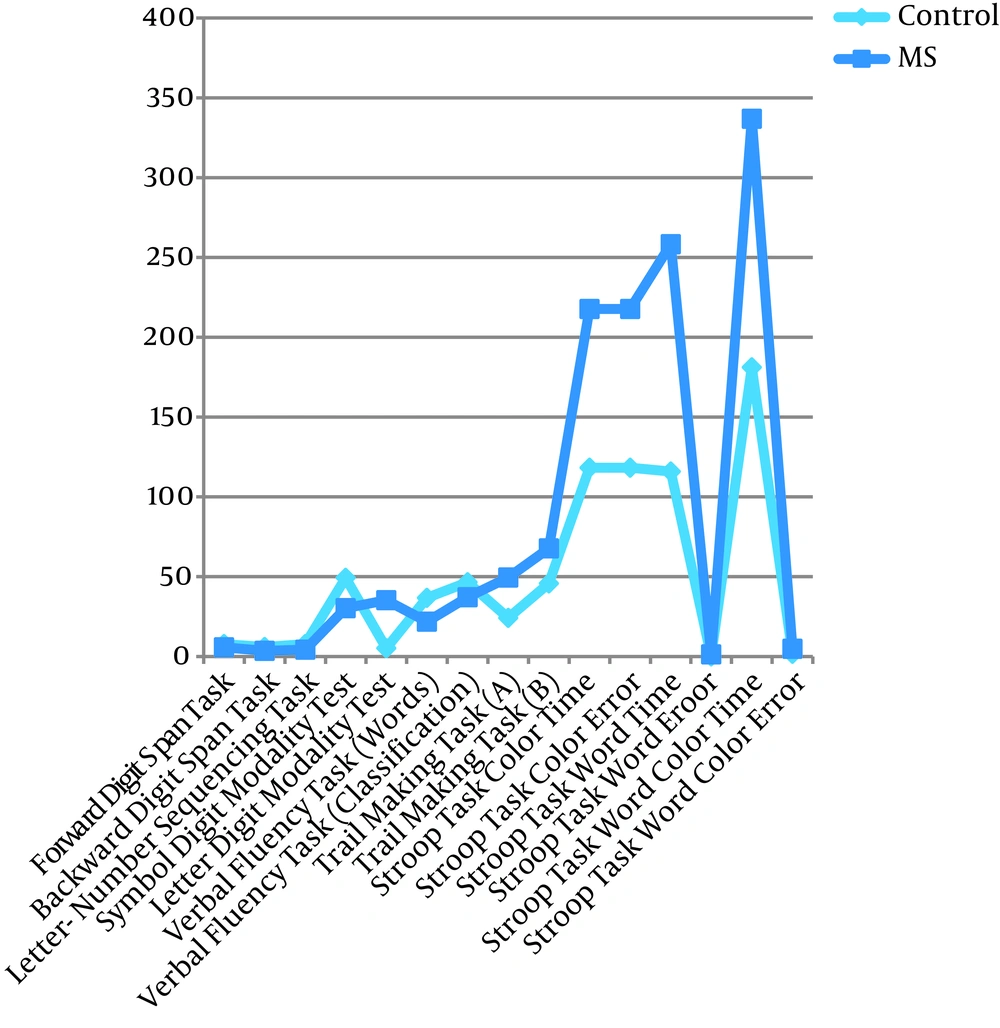
Figure 1.
Comparison of cognitive functions in MS patients and controls
5. Discussion
This study was conducted to compare the cognitive function of MS patients and a control group. Several studies have examined the presence of cognitive impairment in MS but a few studies have assessed a variety of cognitive impairments that may affect the occupational and social functions of individuals. Identifying these cognitive impairments provides us with the possibility of adopting more effective therapeutic strategies. Therefore, in the present study, three areas including attention, working memory, and executive functions were examined.
In line with other studies (11, 21-23), the results of the FDST and BDST demonstrated that the working memory of MS patients was significantly poorer than that of the control group (P = 0.001 for both). The findings indicated that working memory decline is the most common cognitive impairment in MS as seen in more than half of the patients. Among other reasons for dysfunction in the memory of these patients are fatigue and depression that should be taken seriously into consideration (24).
Language capacity and immediate, implicit, and recognition memory are not impaired generally. One of the contradictory results associated with recognition memory was found in the study by Rogers and Panegyres (24). Some authors indicated a non-significant difference in semantic and recognition memory function of MS patients (25). However, this contradiction can have different reasons. The controversy may stem from the different neuropsychological tests used, as well as sampling in different phases of MS, as sampling in acute and recovery phases can lead to diversity in results. In the present study, data were gathered from hospitalized patients who were in the acute phase.
Verbal fluency task was also evaluated in this study. Both words and classification features of this test were significantly different in MS patients compared to controls (P = 0.001). The results of several studies showed that verbal fluency performance was more impaired in MS patients than in control subjects (26-28).
The attention scores of MS patients were significantly lower than the scores of the control group (based on SMDT and LNST; P = 0.001). Therefore, attention is more impaired in MS patients than in controls. These findings are consistent with previous studies (29, 30). It was also shown that the symptoms of adult ADHD are more common in MS patients than in control counterparts (31).
Cognitive processing speed and executive functioning were also impaired in multiple sclerosis based on trail making tasks A and B (P = 0.001 for both). Stroop tests showed a significant deficit in executive functioning, too (stroop task word color time and error; P = 0.001). The current study confirms the impairment of executive function in MS patients in the acute phase probably because of axonal degeneration, inflammatory demyelination of the central nervous system, and pain feeling. Pain may have negative impacts on attention, too. Therefore, we need to improve attention and executive functioning of MS patients while establishing therapeutic interventions and cognitive training (29, 32, 33).
5.1. Limitations and Further Studies
This study was conducted among MS patients in the acute phase hospitalized in neurology wards. Therefore, the illness severity may be a reason for more acute impairment of executive function. It is suggested that the correlation between illness severity and executive function be examined in future studies. In addition, examining the efficacy of pharmacotherapy in the improvement of executive functions could be a goal for further studies.

