





1. Background
Spinal cord injury (SCI) is one of the worst and complicated diseases affecting both patients and community (1) that involves the cord. Although the risk of developing a spinal cord disease is low due to its high side effects, it has a great impact on the quality of life of patients (2) However, despite the many advances made in medical science, SCI still causes many disabilities (3). SCI occurs in nearly 11000 of traumatic injury (4). An annual incidence of SCI appears to be rising and its prevalence worldwide is about 750 per million (5). The prevalence of SCI is about 40 to 50 individuals per million in Iran and more than 3 thousand people engage with spinal cord injury each year (6). Approximately, 2200 of them are veterans who were injured in the course of Iran-Iraq War and other country-related cases (7). Motor vehicle accidents, falls, violence (gunshots/stabbing), and sports are the most common causes of SCI. This problem occurs more often in men, and this ratio is 4:1. Nineteen is the most common age for SCI (4, 8).
The quality of life in patients with SCI is strongly influenced by the negative effects of the disease (9). When SCI occurs paralysis of voluntary muscles and loss of sensation due to extreme damage to the spinal cord, resulting in impairment of social and vocational skills and reduced mobility and independence in activities of daily living (2). Outcomes such as high dependence on caregivers, restrictions on mobility, back to work problems, and reduction in social supports are combined with challenge expectations the concept of self-efficacy in people with SCI (10). Self-efficacy is seen as a key psychological resource and is considered an important predictor of behavior because it is an independent part of basic skills the person is acting (11). It is defined as a person’s ability to organize and implement necessary actions in the face of the situation (12). Having high self-efficacy in patients with SCI-related other chronic diseases can improve well-being, mental health, and health behavior (13-15). Self-efficacy reduces anxiety and depression symptoms in patients with SCI and is one of the main goals of rehabilitation programs (14). It is an important psychosocial construct that may affect health behavior to control diseases and may also function as a link between effective health promotions and educational interventions and health behavior change in disease control (15). Strengthening self-efficacy is one of the most important goals in psychotherapy (16).
A variety of educational methods have been used to improve the self-efficacy of patients in chronic diseases (17); one of which is self-care education (18, 19). Self-care is any kind of human activity, which is under personal deliberate control and self-initiated. The World Health Organization (WHO) emphasized “healthy life with self-care,” in a 2014 slogan, which demonstrated that self-care was one of the most important care priorities (20). In nursing interventions for patients with SCI, both prevention and reduction of complications are essential (21). Learning self-care skills is the major goal of rehabilitation programs and is, in fact, the main focus of these programs. Training or education in self-care includes actions and activities to change behavior so that the patient leaves inappropriate health behaviors and replaces healthy behaviors (22). Considering the importance of self-efficacy in chronic diseases, especially in the spinal cord injury, as well as the importance of self-care education by nurses, this research aimed to investigate the effect of self-care education on self-efficacy in the veteran with SCI.
2. Objectives
The objective of this research was to assess the effect of self-care plan training on self-efficacy in the veteran with SCI.
3. Methods
3.1. Design
This randomized clinical trial (RCT) was carried out in two groups at SCI center of a private hospital in Tehran, Iran in 2017 - 2018. This hospital is a special hospital with 20 wards and 500 beds that provide services for SCI patients, especially veterans from all over Iran.
3.2. Setting and Participants
In this study based on the previous study (23), the sample size was estimated at 30 patients with a power of 80% and α of 0.05. They were allocated to each group by considering a 10% drop out during the investigation. Table of random numbers was used for randomization. Patients were randomly allocated to the control group (30 patients) and intervention group (30 patients) (Figure 1).
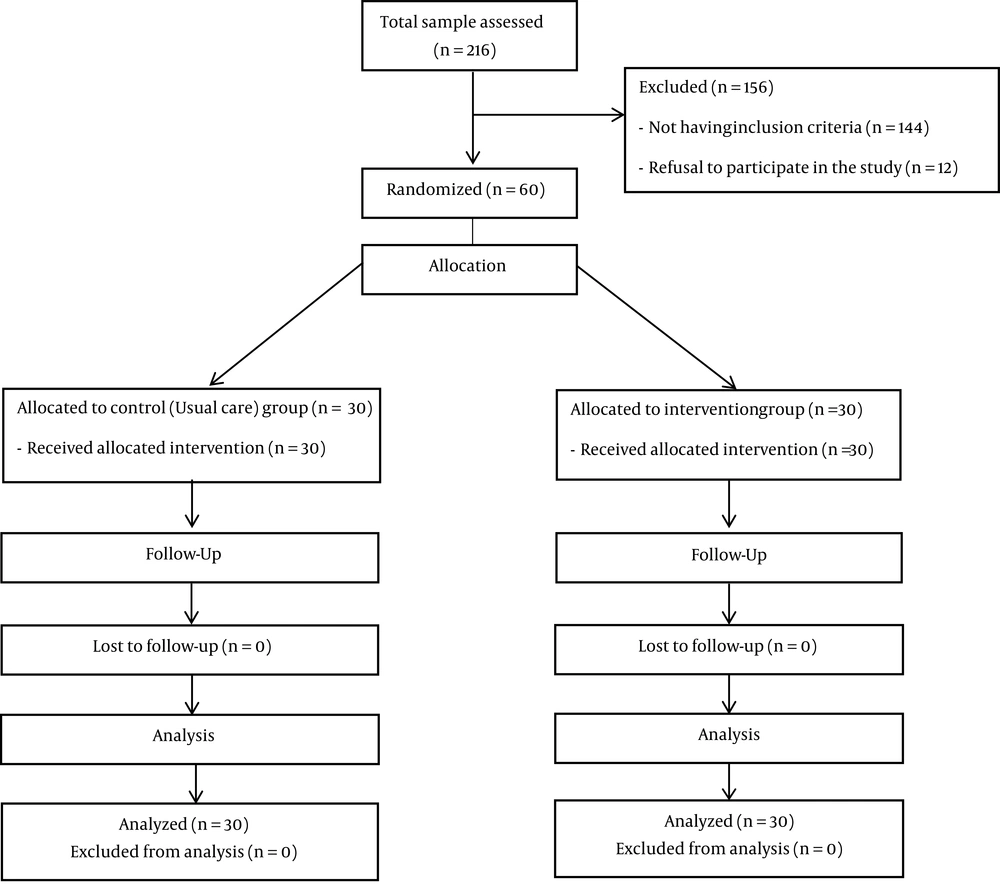
Figure 1.
Consort flowchart of study enrollment and randomization
The inclusion criteria for this study were as follows: (1) not participated in previous training programs about self-care in the last three months; (2) history of spinal cord injury for 6 months and more (both veterans of Iran-Iraq War and other country-related cases); (3) no history of underlying diseases such as CHD, hypertension, diabetes, CHF, and COPD. The exclusion criteria were as follows: (1) reluctance to continue the cooperation; (2) no participation in all meetings of the intervention; (3) patient died or partially completed questionnaires.
3.3. Ethics
This study was registered in the Iranian Clinical Trial Center (IRCT code IRCT2017050222311N2). The Ethics Committee of AJA University of Medical Sciences approved the study ethically (ethics code: ir.ajaums.rec.1396.35). The Helsinki Declaration was implemented in this study. First, the researcher introduced himself and described his research goals for patients and their companions, and noted that the participation in the study is entirely voluntary and had no effect on the treatment process and that all participants’ information would remain confidential. After receiving complete information about the research goals and the process of doing the work, patients signed a written informed consent form.
3.4. Measures
Data were gathered using two tools, including participants’ demographic characteristics and Moorong self-efficacy scale (MSES). The MSES was originally developed to measure the self-efficacy in patients with SCI. The 16-item version of this scale consisted of two concepts: daily activities and social functioning. It is scored by summing all items on a 7-point scale ranging from 1 (very uncertain) to 7 (very certain). Total scores range from 16 to 112 with higher scores indicating higher self-efficacy or beliefs in those abilities to control activities. Such activities include personal hygiene, participation in household activities, relationships, learning and leisure times accessing. We created an average score by dividing total scores by a total number of questions. Evidences from the MSES showed stability (R = 0.74) for the total score over the 6-week period (P < 0.001) and good internal consistency item-total correlations ranged from 0.46 to 0.80 (24, 25). Validity and reliability of the tool were carried out in Iran and Rajati et al. acclaimed that the Persian version of Moorong self-efficacy scale is a reliable, valid, and sensitive tool to measure the self-efficacy among SCI patients (25).
3.5. Intervention
The method of training in this study is based on the Barbara Sassen learning model, which consists of 6 steps (26). After taking the pre-test from all samples, the needs assessment was taken from the intervention group.
3.6. Needs Assessment of Patients and Determining Individual Goals with Patient Participation
At the first meeting with veterans after entering the study, first, they were provided a checklist. In this way, veterans were asked to write in their checklist their educational needs for self-care, illness, and complications, and in consultation with the researcher, scores of scope, urgency, feasibility, and effectiveness of the training to be prioritized. Then, according to the needs of the veterans, the intervention was designed and the necessary materials were included in the various sessions. The next step was to provide training that was individual, face-to-face, peer education, and movie show in 6 sessions of 45 - 60 minutes twice a week, for two weeks (Table 1). At this stage, based on the training needs of the veterans and the goals set beforehand, a daily lesson plan and training were provided to the patients. At the end of the manual, all materials written in plain language were provided to the patients. Also, a training CD containing training material on interventions, as well as self-care of SCI patients provided by the Veterans Foundation, was delivered to veterans. The control group received just the usual care. One week and one month after the intervention, the patients were retested and the data were collected.
Table 1.The Content of the Sessions of the Self-Care Program
| Sessions | Educational Content |
|---|---|
| First | Anatomy and physiology of the brain, description of the disease and its epidemiological status in Iran and the world |
| Second | Complications, various medical, and non-pharmacological treatments for disease control |
| Third | A review of past content, the importance of rehabilitation and its methods, and the elimination of harmful habits such as smoking |
| Fourth | How to adhere to the proper diet, how to adhere to the prescribed regimen and daily activities |
| Fifth | Exercise and physical activity, counseling and talking with friends, and having family and non-family support |
| Sixth | Change position and transfer skills, increasing performance and independence, and repeating the topics of the last three sessions in question and answer manner |
First, Self-efficacy was measured using Moorong self-efficacy scale after the veterans of the two groups entered the hospital and admitted the SCI ward. Also, one week and one month after the intervention, the self-efficacy was measured again in the two groups.
3.7. Data Analysis
The SPSS software version 19 was used for data analysis. Variables between the groups compared by Fisher’s exact test, independent t-test, and chi-square. The repeated-measures analysis of variance (ANOVA) was used to compare the trend of self-efficacy over time between the two groups (from pre-test to one-month follow-up).
4. Results
In this study, 60 people participated that all of them remained until the end of the study. The results of this study showed that the level of education (P = 0.41) and occupation (P = 0.67) were comparable in the two groups using chi-square test. In this regard, there was no statistically significant difference between the two groups. Also, Fisher’s exact test of genders (P = 0.68), lesion level (P = 0.58), and marital status (P = 0.55); additionally, independent t-test of mean age of patients (P = 0.55) and duration of the disease (P = 0.41) were compared in the two groups, which did not show a significant difference (Table 2).
Table 2.The Demographic Characteristics of the Participantsa
| Characteristic | Group | P Value | |
|---|---|---|---|
| Intervention (N = 30) | Control (N = 30) | ||
| Age | 49.76 ± 7.38 | 50.80 ± 6.09 | 0.55b |
| Gender | 0.68c | ||
| Male | 28 (93.4) | 26 (86.7) | |
| Female | 2 (6.6) | 4 (13.3) | |
| Marital status | 0.55c | ||
| Single | 6 (20) | 9 (30) | |
| Married | 24 (80) | 21 (70) | |
| Level of education | 0.41d | ||
| Under the diploma | 5 (16.66) | 8 (26.7) | |
| Diploma | 20 (66.66) | 15 (50) | |
| Academic | 5 (16.66) | 7 (23.3) | |
| Occupation | 0.67d | ||
| Unemployed | 3 (10) | 2 (6.66) | |
| Self-employment | 6 (20) | 6 (20) | |
| Employee | 8 (26.66) | 4 (13.33) | |
| Emeritus | 11 (36.66) | 15 (50) | |
| Housekeeper | 2 (6.66) | 3 (10) | |
| Lesion level | 0.58c | ||
| Thoracic | 21 (70) | 18 (60) | |
| Lumbar | 9 (30) | 12 (40) | |
Abbreviations: SD, standard deviation; N, number.
aValues are expressed as No. (%) or mean ± SD.
bt-test.
cFisher’s exact test.
dChi-square test.
Based on the aim of the study, the mean of self-efficacy of spinal cord injured patients was evaluated. According to the results, follow-up of the self-efficacy before the intervention was 39.26 ± 4.03 in the intervention group and 38.56 ± 3.99 in the control group, which showed statistically no significant difference (P = 0.502). One week after the intervention, self-efficacy in the intervention group was 43.86 ± 5.15 and in the control group was 38.36 ± 3.89 and in the follow-up period (one-month post-test) in the intervention group was 51.16 ± 5.36 and in the control group was 39.26 ± 4.16. The results of the Greenhouse Gizier test show that P < 0.001 and the score of self-efficacy has a significant difference in the pre-test, post-test, and follow-up time (Table 3).
Table 3.Comparison of the Results of the Self-Efficacy Variable in Three Times Per Groupa
aValues are expressed as No. (%).
bRepeated measure ANOVA.
cIndependent t-test.
5. Discussion
The objective of this research was to investigate the effect of self-care plan training on self-efficacy in the veteran with SCI. We found a significant difference between mean self-care scores before one week and one month after the intervention in the intervention group. However, there was no significant difference between the three times of the measurement in the control group. In addition, the level of self-efficacy was significantly different between the two groups following the intervention in post-test and follow-up periods. In a research conducted by Chen et al. on improving self-efficacy in patients with SCI -the efficacy of DVD-based instructions-, the results showed that multimedia DVD intervention has a positive impact on the self-care intervention of the intervention group, which was consistent with our findings (27). In other research by Chen et al. conducted on adult patients with asthma, self-efficacy improvements showed significantly higher self-care behaviors with no interventions, which was consistent with our findings (28).
In a study performed to determine the effects of needs-based patient training on self-efficacy in people with rheumatoid arthritis, Ndosi et al. found that this training helps improve patients’ self-efficacy. This study is a graceful proof of the useful effects of self-efficacy program in the enhancement of self-care in SCI patients (29). Findings of Gamboa Moreno et al. about the effect of a self-care training plan on patients with type 2 diabetes in primary care showed the positive effects of self-care behaviors on self-efficacy, which were in accordance with our results (30). The same findings were reported by Beg and Mollaoglu in a study to evaluate self-care and self-efficacy in patients undergoing hemodialysis (31). In a study conducted by Rasheed on The effectiveness of diabetes training on self-efficacy and readmission rates of patients with diabetes, the outcomes of this study displayed a strong, positive correlation between diabetes training and betterment in self-efficacy and readmission rates (32), which were consistent with our findings, With the difference that the present study focused on self-care.
5.1. Study Limitations
(1) The number of female patients in this study was low. However, the percentage of patients with spinal cord injury is the same, and the prevalence of this disease in men is about 85%, but for more generalization of results, it is better to intervene on more female patients. (2) Spinal cord injury veterans participating in this study were all paraplegic; therefore, the results cannot be generalized to patients with spinal quadriplegic lesions. (3) The cause of spinal cord injury in all of these patients was war, so doing the study on other patients with different causes and in different spinal cord centers is recommended.
5.2. Conclusions
Our findings showed that training self-care program for spinal cord injuries significantly increases the self-efficacy of injured veterans of spinal cord injury. This means that this treatment plan as a nursing intervention and an easy, inexpensive, and accessible method can play a very important role in the treatment of these veterans. Many injured spinal cord injuries, despite a large amount of lesion, still give little information about the disease and its complications, how to control and relieve these complications, types of therapies, and even the right way of transporting and achieving independence. Furthermore, since self-care plays a very important role in the quality of life of devotees, thus without any promotion of self-efficacy, no medical and nursing goals can be achieved. Therefore, training the health care system staff, especially nurses, which spend a lot of time with veterans is very helpful.
5.3. Implication for Practice
Nurses, as the people who spend a lot of time with the patient and directly see the patient’s problems, can use the results of this study and the use of educational methods and preparation of materials to play a key role in promoting self-efficacy and adherence to the treatment regimen. Veterans have a close relationship with the patient and trust him/her in order to increase the acceptance of treatment by the patient and to cooperate more in the treatment of cases. In this way, they can also enhance the nursing position and social image, which makes the nursing aspect, especially better in Iran.

