
1. Introduction
Suicide is among the most complex and challenging psychological, social, and cultural phenomena. It is a major public health issue and continues to attract the attention of researchers across disciplines. Durkheim’s classic definition describes suicide as any death that results directly or indirectly from a positive or negative act of the victim who knows that this act will lead to death (1). This definition underscores the importance of thoroughly understanding the psychological and social processes involved in suicidal behavior. Suicide often arises from a complex interplay of individual vulnerabilities, social stressors, and environmental triggers that collectively influence the decision to take one’s own life.
In recent years, increasing suicide rates across societies, together with the growing burden of mental health problems such as depression, anxiety, and hopelessness, have become a major global concern (2). Research has identified a wide range of risk factors that increase the likelihood of suicidal ideation and behavior, including psychological distress, economic hardship, unemployment, substance abuse, and mental disorders (3-5). The COVID-19 pandemic has further exacerbated these challenges, as its profound social and economic consequences have added new layers of stress and vulnerability worldwide. Prolonged isolation, grief related to the loss of loved ones, disruptions to education and employment, and uncertainty about the future have all been linked to increased mental health problems during and after the pandemic.
Despite the emphasis on risk factors, recent psychological research has shifted toward exploring protective factors that can mitigate suicide risk. Among these, reasons for living have emerged as critical determinants that buffer individuals against suicidal tendencies. These reasons encompass deeply held beliefs, values, and commitments that deter a person from taking their life and promote psychological resilience (6). In particular, reasons for living may derive from personal relationships, religious or spiritual beliefs, goals, and a sense of purpose, all of which contribute to an individual’s determination to overcome suicidal impulses (7). Research suggests that promoting positive psychological factors, such as developing meaning in life, can reduce the likelihood of suicide attempts and improve overall mental health (8-10).
The cultural and social environment in which individuals live also profoundly shapes their reasons for living. In societies in which cultural and religious values emphasize family cohesion, social solidarity, and communal support, reasons for living may serve as a robust protective mechanism against suicidal behavior (11, 12). However, the COVID-19 pandemic has challenged these protective cultural and social frameworks. Disruptions to traditional support systems, social distancing measures, and weakened community bonds have left many individuals feeling isolated and deprived of their usual sources of emotional and psychological support. This underscores the urgency of examining reasons for living in the post-COVID-19 era, as individuals must navigate emerging mental health challenges.
In Iran, particularly in regions such as Kermanshah province, mental health concerns have been exacerbated by both the pandemic and previous traumatic events, such as the 2017 earthquake (13). Although the earthquake posed a significant threat to the population’s mental well-being, the enduring impact of the COVID-19 pandemic has introduced additional long-term mental health risks. These risks, combined with socioeconomic difficulties, create an environment in which suicide rates may increase if protective psychological factors are not strengthened. Despite the growing importance of this issue, limited research has examined the role of positive psychological factors, such as reasons for living, in protecting individuals from suicidal ideation in this region.
This study aimed to address this gap by examining the relationship between positive psychological factors, specifically reasons for living and meaning in life, and suicidal ideation among high school students in Javanrud, a region deeply affected by the social and psychological consequences of the pandemic. Understanding how these factors function as protective mechanisms in the post-COVID-19 context is critical for developing targeted interventions and support systems for vulnerable populations, particularly youth.
2. Methods
2.1. Participants
This study included high school students in Javanrud who were enrolled during the 2017 - 2018 and 2018 - 2019 academic years. A total of 200 students participated and were selected using multistage cluster sampling. Four high schools (two boys’ schools and two girls’ schools) were randomly selected, and two classes were randomly selected from each school. This sampling approach was used to ensure a representative sample of the target population (14). Ethical approval was obtained from the relevant educational authorities.
2.2. Procedure
Data were collected during class sessions, and students were given 10 minutes to complete the questionnaires. Each student received instructions and was assured of confidentiality. To maintain anonymity, students did not write their names on the questionnaires. Completed forms were collected and scored according to established guidelines. This procedure followed standard practices for ensuring data quality and participant confidentiality (15). Data were analyzed using SPSS software.
2.3. Measures
2.3.1. Beck Scale for Suicide Ideation
The BSS is a 21-item self-report inventory that assesses the severity of suicidal ideation during the past week. It uses a 3-point scale for the first 19 items and includes 2 items that distinguish between individuals who attempt suicide and those who do not. Higher scores indicate more severe suicidal ideation. The scale has demonstrated strong reliability and validity (16).
2.3.2. Reasons for Living Inventory
The RFL is a 48-item measure that assesses beliefs that prevent suicidal behavior. It includes four subscales: Survival and Coping Beliefs, Fear of Suicide, Fear of Social Disapproval, and Moral Objections. Items are rated on a 6-point Likert scale. The RFL has been validated and demonstrates strong reliability.
2.3.3. Meaning in Life Questionnaire
The MLQ evaluates the presence of and search for meaning in life using a 10-item self-report format with two subscales. Each item is rated on a 7-point scale. Higher scores reflect a greater presence of or search for meaning in life. The MLQ has demonstrated strong internal consistency and reliability (17).
2.3.4. Depressive Symptom Inventory-Suicidality Subscale
The DSI-SS measures the frequency and intensity of suicidal ideation during the past 2 weeks. It has shown good internal consistency and is commonly used in research on suicidal thoughts (18).
2.4. Data Analysis
Data were analyzed using descriptive and inferential statistical methods. Descriptive statistics included frequency distributions, means, standard deviations, and Kolmogorov-Smirnov tests. Inferential analyses included multiple regression and Pearson correlation tests to evaluate the relationships among the predictor variables (including reasons for living and meaning in life), the criterion variable (suicidal thoughts), and the moderating effect of gender. Control variables, such as educational level, were included in the analyses. These methods align with best practices in psychological research (19).
3. Results
This study included 200 participants, equally distributed between 100 male and 100 female students. Participants represented different fields of study, including experimental sciences, mathematics, humanities, and technical and vocational fields. On average, boys scored slightly higher than girls in both reasons for living and meaning in life. By field of study, participants in humanities and experimental sciences reported higher mean scores for reasons for living than those in technical and vocational and mathematics fields.
Further analyses indicated that boys had higher mean scores for reasons for living (mean score, 29.82) and meaning in life (mean score, 23.62) than girls (28.00 and 21.50, respectively). By field of study, humanities and experimental sciences students scored higher, on average, for reasons for living than students in the technical and vocational and mathematics fields. In addition, when reasons for living were disaggregated into components (survival beliefs, fear of suicide, and moral issues), meaning in life had the lowest mean score for the moral issues component.
Based on the statistical findings of the study, the research hypotheses were tested using Pearson correlation analysis.
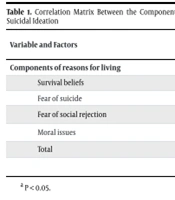
As shown in Table 1, the correlation between survival beliefs and suicidal ideation was -0.14, which was not statistically significant (P > 0.05). The correlation between fear of suicide and suicidal ideation was -0.09, which was not statistically significant (P > 0.05). However, the correlation between fear of social rejection and suicidal ideation was -0.23, which was statistically significant and negative (P < 0.05). Similarly, the correlation between moral issues and suicidal ideation was -0.21, which was also statistically significant and negative (P < 0.05). These findings suggest that higher levels of fear of social rejection and moral issues are associated with lower levels of suicidal ideation, supporting the hypothesis that reasons for living, particularly those related to social and moral concerns, are inversely related to suicidal ideation.
Table 1.
Correlation Matrix Between the Components of Reasons for Living and Suicidal Ideation
| Variable and Factors | Suicidal Ideation | |
|---|---|---|
| r | P-Value | |
| Components of reasons for living | ||
| Survival beliefs | -0.14 | 0.068 |
| Fear of suicide | -0.09 | 0.33 |
| Fear of social rejection | -0.23 | 0.04 a |
| Moral issues | -0.21 | 0.03 a |
| Total | -0.12 | 0.071 |
a P < 0.05.
As shown in Table 2, the correlation between survival beliefs and meaning in life was 0.36, which was statistically significant and positive (P < 0.01). The correlation between fear of suicide and meaning in life was 0.76, which was also statistically significant and positive (P < 0.01). The correlation between fear of social rejection and meaning in life was 0.87, indicating a statistically significant positive correlation (P < 0.01). The correlation between moral issues and meaning in life was 0.36, which was statistically significant and positive (P < 0.01). These results indicate that higher levels of all components of reasons for living, especially fear of social rejection and fear of suicide, are associated with a greater sense of meaning in life. This supports the hypothesis that reasons for living are positively related to meaning in life.
Table 2.
Correlation Matrix Between the Components of Reasons for Living and Meaning in Life
| Variable and Factors | Meaning in Life | |
|---|---|---|
| r | P-Value | |
| Components of reasons for living | ||
| Survival beliefs | 0.36 | 0.001 |
| Fear of suicide | 0.76 | 0.001 |
| Fear of social rejection | 0.87 | 0.001 |
| Moral issues | 0.36 | 0.001 |
| Total | 0.51 | 0.001 |
To further investigate the effect of each component of reasons for living on the variance in suicidal ideation and meaning in life, a stepwise regression analysis was conducted with the components of reasons for living as predictor variables and meaning in life as the criterion variable. The results are presented in Table 3.
Table 3.
| Predictor Variables | Unstandardized Coefficients | Standardized Coefficients | t | P-Value | |
|---|---|---|---|---|---|
| B | SE | β | |||
| Constant | 119.29 | 11.02 | - | 10.82 | 0.05 |
| Survival beliefs | -2.009 | 0.213 | -0.454 | -9.44 | 0.05 |
| Fear of suicide | 1.02 | 0.215 | 0.228 | 0.474 | 0.05 |
| Fear of social rejection | 0.12 | 0.164 | 0.109 | 1.43 | 0.153 |
| Moral issues | 0.11 | 0.155 | 0.080 | 0.983 | 0.326 |
a The criterion variable examined in this table is meaning of life.
b The table shows r = 0.47, RS = 0.22, ARS = 0.168, with statistical significance at P < 0.01.
As shown in Table 3, all components of reasons for living, including survival beliefs, fear of suicide, fear of social rejection, and moral issues, significantly predicted meaning in life. The strongest contribution came from fear of social rejection (β = 0.41, P < 0.001), followed by fear of suicide (β = 0.26, P < 0.001), survival beliefs (β = 0.16, P < 0.001), and moral issues (β = 0.18, P = 0.04). These results suggest that stronger beliefs related to fear of social rejection and suicide are positively associated with a stronger sense of meaning in life.
Based on the results shown in Table 4, the observed t value was significant, indicating that 22% of the variance in meaning in life was explained by the components of reasons for living. According to the beta values and significance levels, the strongest predictors of meaning in life among students were survival beliefs (β = -0.454) and fear of suicide (β = 0.228). Furthermore, the results showed that 29% of the variance in suicidal ideation was explained by the components of reasons for living. The strongest predictors of suicidal ideation among students, based on beta values and significance levels, were survival beliefs (β = 0.538) and moral issues (β = 0.186).
Table 4.
| Predictor Variables | B | SE | β | t | P-Value |
|---|---|---|---|---|---|
| Constant | 12.74 | 10.8 | - | 1.17 | 0.0001 |
| Survival beliefs | 2.51 | 0.212 | 0.538 | 11.87 | 0.0001 |
| Fear of suicide | -0.775 | 0.204 | -0.172 | -3.8 | 0.0001 |
| Fear of social rejection | 1.17 | 0.056 | 0.148 | 2.14 | 0.033 |
| Moral issues | 1.41 | 0.037 | 0.186 | 2.70 | 0.007 |
a The criterion variable examined in this table is Suicidal ideation.
b The table presents r = 0.538, RS = 0.290, ARS = 0.259, with statistical significance at P < 0.01.
Overall, the hypotheses were supported by the data. The analyses showed that reasons for living were inversely related to suicidal ideation and positively related to meaning in life. Higher levels of fear of social rejection and moral issues were associated with lower levels of suicidal ideation, whereas all components of reasons for living, particularly fear of social rejection and fear of suicide, were positively associated with a greater sense of meaning in life.
4. Discussion
This study examined the relationship between reasons for living and meaning in life, as positive psychological factors, and their impact on suicidal ideation among high school students in Javanrud during the 2023 - 2024 academic year in the post-COVID-19 era. The findings provide valuable insights into how these factors interact and offer protection against suicidal thoughts, particularly in the context of the ongoing challenges associated with the aftermath of the pandemic.
The results indicate that both reasons for living and meaning in life are significantly negatively correlated with suicidal ideation. Meaning in life not only serves as a protective factor against suicidal thoughts directly but also mediates the relationship between reasons for living and suicidal ideation. This suggests that a strong sense of meaning in life strengthens the protective effect of reasons for living. In a post-pandemic world, in which uncertainty and disruptions to daily life have been prominent stressors, this mediating role of meaning in life may be especially important for safeguarding mental health.
The negative association between reasons for living and suicidal ideation underscores the importance of fostering positive psychological factors in adolescents. This aligns with existing literature, which consistently identifies reasons for living as a critical protective factor against suicidal ideation (20, 21). Our study extends these findings by demonstrating that meaning in life adds a unique dimension to explaining suicidal ideation. This suggests that meaning in life, particularly in the post-COVID-19 context, when individuals may struggle to find a sense of purpose amid uncertainty, is a vital element of psychological resilience that extends beyond the influence of reasons for living alone (22).
The strong association between reasons for living and meaning in life further highlights the importance of identifying and cultivating sources of meaning in adolescents’ lives. Although related, these 2 factors are conceptually distinct: Reasons for living can be viewed as specific components of meaning that directly prevent suicidal ideation, whereas meaning in life reflects a broader, enduring sense of purpose and fulfillment. This distinction is particularly relevant in the post-pandemic context, when adolescents may find it challenging to restore a sense of normalcy and purpose after prolonged periods of social isolation, educational disruption, and family stress (23, 24). Therefore, fostering a broader sense of meaning in life may be key to mitigating the long-term mental health effects of the pandemic (25, 26).
Our findings also suggest that reasons for living explain variation in suicidal ideation beyond what can be accounted for by other risk factors, such as depressive symptoms. This is consistent with prior research demonstrating that reasons for living are strong predictors of suicidal ideation, even when controlling for depression and other demographic variables (27, 28). Moreover, reasons for living serve as an important moderator of the relationship between depression and suicidal ideation, suggesting that having more reasons for living can buffer the impact of severe depressive symptoms on suicidal thoughts. This protective effect may be particularly important in the context of post-COVID-19 mental health challenges, when adolescents face new and intensified stressors (29).
These results support theoretical perspectives that conceptualize suicidal ideation as involving ambivalence about life and death (30). For example, individuals with a stronger orientation toward death were more likely to die by suicide than those who maintained a more life-oriented or ambivalent stance (31). This underscores the role of positive psychological factors, such as reasons for living and meaning in life, in countering suicidal thoughts and behaviors. In the post-pandemic era, when adolescents may grapple with existential questions and uncertainty about their future, the importance of these protective psychological factors cannot be overstated.
Furthermore, the findings are consistent with a growing body of research highlighting the importance of meaning in life as a buffer against suicidal ideation. Studies have shown that individuals with a strong sense of meaning are less likely to experience suicidal thoughts, even in the face of adversity (32, 33). For instance, a deep sense of meaning in life can protect individuals against suicide risk, reinforcing the relevance of our findings in the context of the COVID-19 pandemic, when many individuals have experienced disruptions in their sense of meaning and purpose (34).
Overall, these results emphasize the importance of integrating interventions that enhance both reasons for living and meaning in life into adolescent mental health programs. In the wake of the COVID-19 pandemic, such programs are even more critical. Adolescents need support to rebuild a sense of purpose and identify meaningful reasons to continue living despite the difficulties they face. Mental health professionals can play a key role in helping young people cultivate resilience by strengthening positive psychological factors. Programs aimed at enhancing meaning in life and identifying reasons for living could serve as effective tools for preventing and addressing suicidal ideation, especially during recovery from the social and psychological disruptions caused by the pandemic (35, 36).
In conclusion, our findings underscore the importance of promoting positive psychological factors, such as reasons for living and meaning in life, as essential components of suicide prevention efforts in adolescents. The post-COVID-19 context presents both challenges and opportunities for mental health interventions, and focusing on these protective factors can provide young people with the psychological resources needed to navigate complex emotional landscapes.
4.1. Conclusions
This study underscores the critical role of meaning in life and reasons for living as protective psychological factors against suicidal ideation among adolescents, particularly in the post-COVID-19 context. The findings indicate that meaning in life significantly mediates the relationship between reasons for living and suicidal ideation, suggesting that a strong sense of meaning not only directly reduces suicidal thoughts but also strengthens the protective effects of reasons for living. These results highlight the importance of promoting both meaning and specific reasons for living as central components of mental health support for adolescents.
The aftermath of the COVID-19 pandemic has created unique mental health challenges, including pervasive uncertainty, loss, and disruption of life trajectories, which have substantially affected the psychological well-being of young people. In this context, interventions that foster a robust sense of meaning and help adolescents identify personal reasons to live are more important than ever. By focusing on these factors, mental health professionals can empower adolescents to develop resilience and manage emotional struggles more constructively. This is particularly critical given that the erosion of social networks and the stress of adapting to new realities may leave many adolescents vulnerable to hopelessness and despair.
Our findings suggest that strengthening meaning in life may be a powerful approach to reducing the risk of suicidal ideation and improving overall mental health among youth. Adolescents who perceive their lives as meaningful and maintain specific reasons for living, such as future aspirations, relationships, and personal values, may be better equipped to withstand periods of intense emotional distress. Therefore, mental health programs should prioritize fostering these protective factors to prevent suicide, particularly in educational settings where students are navigating the complex emotional landscape of the post-pandemic world.
Future research should continue to examine the nuanced interplay among positive psychological factors and their roles in reducing suicidal ideation and behavior. Investigating how these factors operate across diverse social and cultural contexts, particularly in regions that have experienced substantial disruptions due to COVID-19 and other adversities, will provide deeper insights into effective prevention strategies. In addition, examining how these protective factors interact with other variables, such as family dynamics, community support, and economic conditions, may further inform tailored intervention approaches.
Overall, this study emphasizes that enhancing meaning in life and cultivating reasons for living are essential strategies for supporting adolescent mental health, particularly in the aftermath of a global crisis such as COVID-19. By incorporating these elements into prevention programs, mental health professionals can provide more comprehensive and context-sensitive support to adolescents, ultimately helping them build the psychological resilience needed to navigate future challenges and reduce the risk of suicidal ideation.