
1. Background
A significant number of bereaved adults experience intense and persistent grief that leads to functional impairment in social, occupational, and emotional domains. In the DSM-5-TR, prolonged grief disorder has been added to the category of trauma- and stress-related disorders. Adults who experience prolonged grief suffer from symptoms of intense longing for the deceased, preoccupation with memories of the deceased, emotional pain, identity disturbance, disbelief about the death, intense loneliness, emotional numbness, avoidance of recollection, and difficulty reintegrating themselves into activities (1). Given that the prevalence of prolonged grief disorder in bereaved adults is 13% (2). It is important to identify factors affecting the prolongation of grief (3).
Previous studies have shown that psychological factors, including attachment style and childhood trauma, affect grief severity. Childhood trauma involves emotional distress due to uncontrollable stressful events like death (4). It occurs when children face uncontrollable, stressful events such as physical, emotional, or sexual abuse or neglect (5). Childhood trauma disrupts parent-child bonds, leading to insecure attachment and increased vulnerability to prolonged grief in adulthood (6).
Another factor that affects social interactions related to prolonged grief disorder is attachment style. Attachment theory states children form an internal model of relationships through interactions with their primary caregivers (7). Attachment theory provides principles that allow understanding of different attachment styles and their impact on the response to grief. Individuals with various attachment styles exhibit unique grieving processes (8). Different attachment styles have different manifestations in social interactions, which makes it a risk factor for developing prolonged grief disorder when experiencing grief with an insecure attachment style. Individuals with an anxious attachment style have a high preoccupation and longing for the deceased, which leads to a lack of acceptance of the deceased's death (9). This attachment style leads to excessive reassurance in social relationships. Individuals with an avoidant attachment style suppress their feelings about their grief, which leads to prolonged and unresolved grief. They also avoid receiving social support after experiencing grief, which intensifies their grief. Therefore, insecure attachment styles lead to different manifestations of social interactions that make individuals susceptible to prolonged grief symptoms (10).
Previous studies have shown a correlation between social interactions and symptoms of prolonged grief. In grief, social interactions are associated with perceived social support, and the higher the perceived social support, the lower the symptoms of prolonged grief (11, 12). For avoidant interactions, quality matters more than quantity. A 2024 study found that the amount of eye contact was negatively correlated with symptoms of prolonged grief. Social withdrawal is a strong predictor of developing prolonged grief disorders (13, 14).
Based on prior research findings, previous studies have measured the influence of psychological factors such as childhood trauma and attachment style on prolonged grief symptoms, but few studies have examined these factors simultaneously, and it is unclear how common social dimensions of these factors are related to prolonged grief symptoms. In addition, most previous studies have used traditional statistical analysis methods to examine these relationships, which assume linearity, while psychological processes are inherently multifaceted and need to be examined using more advanced approaches. One of these approaches is machine learning )ML), which enables pattern recognition in dimensional data to identify latent patterns and complex variable relationships and helps to uncover nonlinear relationships of hidden patterns between variables. Linear regression is a supervised ML model used to predict a dependent (continuous) variable based on one or more independent variables. The model assumes that the relationship between the independent and dependent variables is linear. In other words, the dependent variable is modeled as a linear combination of the independent variables and their coefficients.
2. Objectives
The aim of the present study is to investigate the relationship between social dimensions of childhood trauma and attachment style with the severity of prolonged grief symptoms, which has been investigated through ML. Using ML models, this study seeks to uncover hidden patterns in grief-related mechanisms to provide a more accurate and data-driven understanding of the severity of grief symptoms and to provide clinical interventions. To this end, instead of employing a separate social interaction scale, relevant items were extracted from psychological measures.
3. Methods
3.1. Participants
The present study is a descriptive correlational design based on ML. The statistical population consisted of bereaved adults, from whom 516 individuals were selected through convenience sampling in Iran. Inclusion criteria included participants aged between 18 and 80 years, positive responses to questions 1 and 13 of the the Prolonged Grief Scale (PG-R-13) Questionnaire regarding functional occupation, and at least 12 months had passed since the death. Exclusion criteria included incomplete and patterned completion of the questionnaire.
3.2. Instruments
The Childhood Trauma Questionnaire (CTQ), developed by Bernstein et al., includes 28 items across five subscales: Sexual, physical, and emotional abuse, and emotional and physical neglect. Items are rated on a 5-point Likert scale. Bernstein et al. reported Cronbach’s alpha values of 0.87, 0.86, 0.95, 0.89, and 0.78 (15). Concurrent validity with therapists’ ratings ranged from 0.59 to 0.78. Ebrahimi et al. (16) found alpha values of 0.81 - 0.98, while the present study reported 0.74 - 0.85.
3.3. The Adult Attachment Style Questionnaire
The Adult Attachment Style Questionnaire (RAAS) by Collins and Reed comprises 18 items rated on a 5-point scale, based on three attachment styles. Reported alpha values were 0.75, 0.72, and 0.69 (17). The scale was validated in Iran by Hajializadeh et al. (18), with test-retest reliabilities of 0.57, 0.75, and 0.47.
3.4. The Prolonged Grief Questionnaire
by Prigerson et al. measures prolonged grief symptoms as a unidimensional construct. Reported internal consistency values were 0.83 (Yale), 0.90 (Utrecht), and 0.93 (Oxford) (19). In Iran, Ashouri et al. (20) reported Omega reliability of 0.93 and test-retest reliability (6 weeks) of 0.89. Validity was supported through significant correlations with depression, PTSD, functional impairment, and hope.
3.5. Procedure
The authors followed the ethical considerations of the study according to the Declaration of Helsinki (1975) as revised in 2008. Informed written consent was obtained from all participants. Participants were then given a link to complete the study questionnaires via Google Forms. Participants were asked to complete the PG-13-R, CTQ, RAAS, RFQ, and SSGS questionnaires. To examine the social interactions, dimensions were estimated by identifying items related to relationships in the attachment style and childhood trauma variables, and no independent questionnaire was used to examine social interactions. Relevant items were selected from each questionnaire, which are items 2, 5, 7, 13, 19, and 28 from the Childhood Trauma Questionnaire; items 1, 12, 14, and 16 from the Attachment Styles Questionnaire; and G2, G3, G8, and G12 from Prolonged Grief Questionnaire. The criterion for selecting the social interactions variable was selected based on the number and quality of interpersonal relationships in the independent variable items. Descriptive statistics and ML models were used to analyze the data. The Pandas and NumPy libraries were used for data management and processing, Matplotlib and Seaborn for visualization, SciPy for statistical analysis, Scikit-learn for ML modeling (including random forest and gradient boosting) and model performance evaluation, and Statsmodels for advanced statistical analysis.
4. Results
Descriptive data showed that 87.79% of the participants were female, 56.20% were single, and most had a bachelor's or master's degree. Correlation analyses showed that childhood social support variables (T2, T5, T7, T13, T19, T28) were negatively associated with symptoms of bereavement such as longing, difficulty in daily functioning, and impairment. Similarly, social skills from the Attachment Style Questionnaire (A1, A12, A14) were associated with reduced functioning problems. Conversely, distrust (A16) showed weaker but negative correlations, indicating increased vulnerability to functional impairment (Table 1 and Figure 1).
Table 1.
Correlation Analysis
| Variables 1 | Variables 2 | Correlation Coefficient | P-Value |
|---|---|---|---|
| T2 | G2 | -0.07 | 0.10375 |
| T2 | G3 | -0.05 | 0.22606 |
| T2 | G12 | -0.11 | 0.0122 |
| T5 | G2 | -0.11 | 0.01503 |
| T5 | G8 | -0.09 | 0.03667 |
| T5 | G12 | -0.10 | 0.02474 |
| T7 | G2 | -0.15 | 0.00051 |
| T7 | G12 | -0.12 | 0.51528 |
| T13 | G2 | -0.13 | 0.00304 |
| T13 | G12 | -0.15 | 0.05362 |
| T19 | G2 | -0.13 | 0.00286 |
| T19 | G12 | -0.10 | 0.02881 |
| T28 | G2 | -0.13 | 0.00222 |
| T28 | G12 | -0.15 | 0.00252 |
| A1 | G3 | -0.09 | 0.05292 |
| A1 | G12 | -0.14 | 0.00178 |
| A12 | G3 | -0.08 | 0.07653 |
| A12 | G12 | -0.13 | 0.00301 |
| A14 | G3 | -0.17 | 0.00011 |
| A14 | G12 | -0.19 | 1e-05 |
| A16 | G3 | -0.04 | 0.41647 |
| A16 | G12 | -0.14 | 0.0018 |
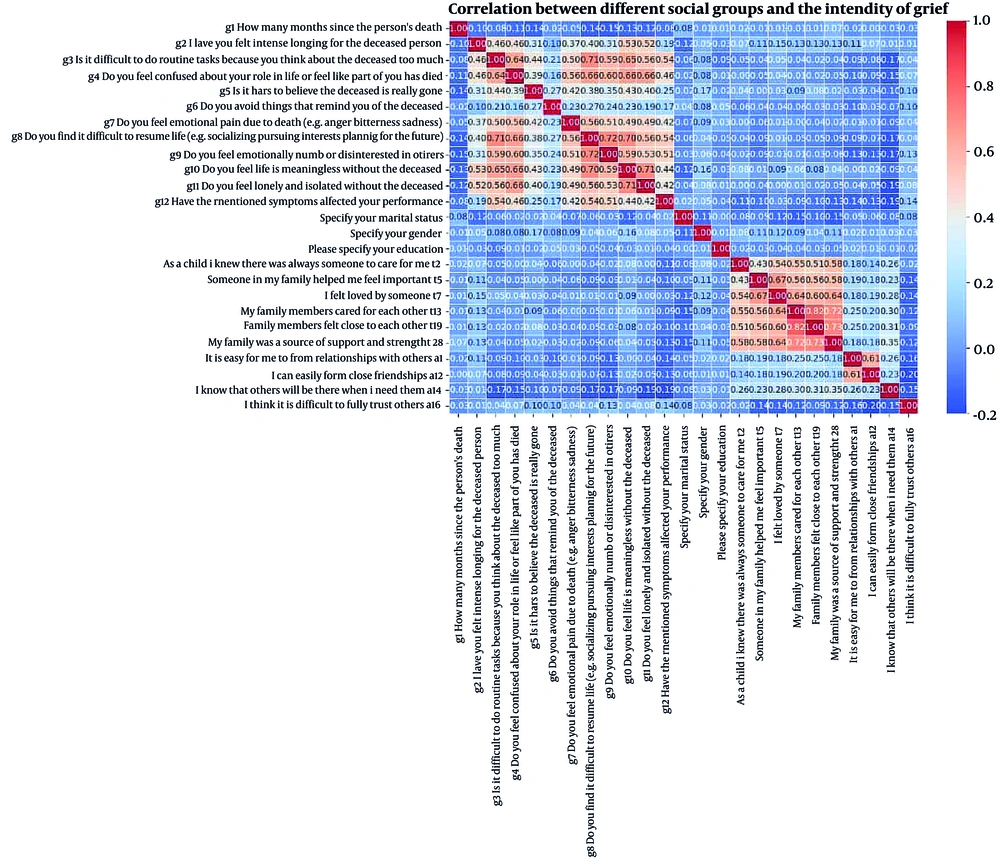
Figure 1.
Correlation between different social group and the intensity of grief
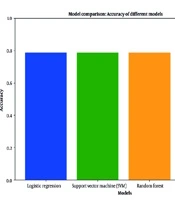
Three models were applied to predict grief severity: Linear regression to assess the impact of independent variables, a random forest for prediction, and Gradient Boosting to enhance accuracy. Among them, the most accurate model identified childhood trauma and insecure attachment as key predictors (Table 2 and Figure 2).
Table 2.
Results of Models
| Model | Accuracy | Diagnosis of Severe Grief (Recall - 1) | F1-Scores | Precision |
|---|---|---|---|---|
| Linear regression (%) | 57.7 | 75 | 62 | 53 |
| Random forest (%) | 60.6 | 69 | 62 | 56 |
| Gradient boosting (%) | 54.8 | 65 | 57 | 51 |
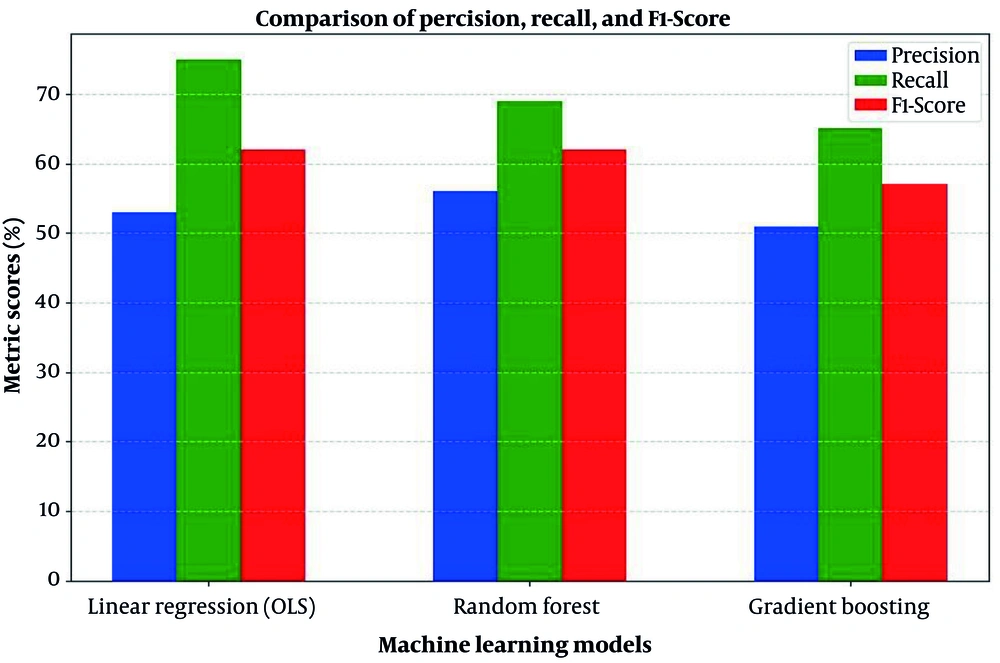
Figure 2.
Comparison of precision, recall, and F1-score
5. Discussion
The present study aimed to investigate the relationship between the social dimensions of childhood trauma and attachment style with the severity of prolonged grief symptoms, which are investigated through ML. The findings showed that the greatest predictor of the severity of prolonged grief symptoms was related to social interactions based on childhood trauma, and then it was related to insecure attachment of the avoidant type. The predictive power of the model was estimated at Random Forest 60.6%, which indicates a strong relationship. Also, ML methods were used to analyze the data and the factors predicting the severity of prolonged grief symptoms. As a result, this finding provided accurate insight into the factors associated with prolonged grief disorder.
5.1. Comparison with Previous Studies
The findings of the present study are consistent with previous studies and showed that social interactions significantly reduce vulnerability to prolonged grief symptoms. A study on 539 bereaved individuals showed that perceived social interactions are related to prolonged grief symptoms in that social interactions increase self-compassion in individuals and, as a result, reduce vulnerability to prolonged grief disorder (21). Another study showed that a decrease in social interactions, which is characterized by the frequency and negative perception of social relationships, causes social isolation (22). Therefore, the bereaved individual does not receive social support after grief, and grief symptoms become more severe and prolonged. Studies have shown inconsistent results with the hypothesis of the present study and demonstrated that in bereaved individuals who experience anxiety, social interactions do not play a reducing role in the anxiety caused by their grief symptoms (21). Another study also considered the role of social interactions conditional on emotional engagement with a supportive source in order to be able to reduce the severity of grief symptoms, and if social interactions are not based on emotional experience, they do not have a reducing effect on prolonged grief symptoms (22).
The findings of the present study are consistent with previous studies, showing that the social aspect of childhood trauma leads to an exacerbation of symptoms of prolonged grief (23). A meta-analysis showed that childhood trauma is associated with lifelong psychological disorders. In particular, socioeconomic disadvantages and inequalities predispose individuals to experience psychological disorders with grief (24). A study on grief due to the death of a spouse showed that childhood maltreatment, combined with poor social status, predicts symptoms of prolonged grief. Another study showed that bereaved individuals due to the death of a parent in childhood become socially withdrawn and exacerbate prolonged grief (25).
The hypothesis of the present study can be explained as follows: The aspect of social interactions resulting from childhood trauma causes individuals to cognitively perceive others as untrustworthy or rejecting, and as a result, to have a negative interpretation of social interactions. This cognitive bias causes social isolation, which intensifies the symptoms of prolonged grief (26, 27). Childhood trauma also leads to emotional dysregulation, and as a result, the grieving person has a disorder in integrating his loss into life and therefore does not process the loss and does not experience his emotions properly, which leads to an exacerbation of the symptoms of prolonged grief (28, 29).
The findings of the present study are consistent with those from previous studies. A study of 157 bereaved individuals showed that avoidant attachment style moderates the effect of perceived social support on grief symptoms because individuals with avoidant attachment style avoid social support due to distress from emotional intimacy and therefore do not experience natural grief, and on the contrary, individuals with secure attachment style use social interactions as their support network to process grief (30). A study inconsistent with the findings of the present study showed that insecure attachment style predicts prolonged grief symptoms cross-sectionally and does not predict grief symptoms longitudinally and 12 months after death. A comparison of these two studies shows differences in social context (10). The attachment model of complex grief suggests that internalized working models regulate grief by integrating the loss into the individual's life narrative, and social interactions facilitate the integration of the loss by examining the internal representation of the deceased (31). Secure attachment allows the grieving person to reactivate their exploration system and go through a natural grieving process. However, individuals with an avoidant attachment style have internalized emotional distance from important individuals, and after the loss, they use emotional suppression as an emotion regulation strategy to stay away from social support and experience emotions related to grief (32). These cases lead to unfinished grief in them. In summary, secure attachment helps social interactions in grief processing, and individuals with an insecure-avoidant attachment style do not trust others enough for social support, and this intensifies their grief (33).
5.2. Clinical Implications
The findings offer significant clinical value for psychologists, psychiatrists, and social workers dealing with grief and crisis intervention. Children and adults bereaved by suicide are vulnerable to prolonged grief, and social interaction factors — particularly perceived social support — play a critical role. This study highlights the impact of social history on grief symptom severity.
5.3. Limitations and Future Directions
The cross-sectional design limits causal interpretation; longitudinal studies are recommended. Data were gathered via retrospective self-reports, making recall bias likely; future research should include interviews. The study measured limited dimensions of social interaction; broader aspects should be addressed in future work. It is also suggested to use deep neural models to analyze data and assess the effect of treatment on bereaved individuals’ interpersonal relationships.
5.4. Conclusions
Overall, the present study measured the important role of the social interaction dimensions of childhood trauma and insecure attachment style in the severity of prolonged grief symptoms using a ML approach. The use of ML provides new insights into these complex interactions and paves the way for more personalized grief interventions. Future research could address psychological interventions based on this method to improve prolonged grief disorder.