


1. Introduction
Coronaviruses are the leading cause of severe acute respiratory syndrome (SARS) in 2019 and 2020. This viral pneumonia distributed very fast all over the world by the human-to-human transmission and caused a high-mortality pandemic (1, 2). More than 202,000 people died because of COVID-19, according to the World Health Organization (WHO) until 24 April 2020 (3).
The clinical manifestations vary widely from an asymptomatic infection to severe illness resulting in ICU admission, intubation, and death. However, the signs and symptoms are usually milder in children than adults (4). Although the majority of patients are adults, several cases of the affected children have been reported (5). In this case report, we aimed to introduce an 11-day-old neonate with COVID-19.
2. Case Presentation
An 11-day-old breastfed male neonate was brought to the Neonatal Emergency Room (NER) in Marvdasht Hospital, Fars Province, Iran, with diarrhea since seven days before the admission, that exacerbated since the day of admission. The full-term baby was born by normal vaginal delivery. His mother reported a high frequency (10 - 20 times per day), loose, non-bloody, and watery diarrhea accompanied by non-bloody vomiting (two times since the admission). He had a negative history of fever, sweating, chills, abnormal breathing, nasal congestion, sneezing, and rhinorrhea. No change in the neonate’s feeding was reported. His mother reported a normal past medical history. The birth weight of the neonate was 3,400 g. Zinc gluconate syrup two milliliters every 12 hours per day, probiotic drop, ten drops every 12 hours per day, were prescribed along with a bolus of intravenous (IV) hydration. His parents were not relatives. No documented family history was present. There was no history of cough, fever, sore throat, or anosmia in his parents. Nasopharyngeal swab PCR test of the mother was done after the admission of the neonate, and it came back positive. The newborn’s weight, length, and head circumference were 3,100 g, 52 cm, and 33 cm, respectively, at the time of the admission. His skin color was normal, and his respiratory rate (RR) was 46/min, heart rate (HR) was 110/min. Oxygen saturation (SO2) was 99% without supplemental oxygen, and his body temperature was 37.1°C. No respiratory distress, nasal flaring, substernal, suprasternal, and intercostal retractions were seen. The patient had sunken-eyes, was irritable, and skin pinch went back slowly. Other physical examinations were normal. White blood cell (WBC) count was 13,000 per mm3 without differential count. The C-reactive protein test (CRP) was negative two times. Stool occult blood and ova and parasite test were normal. There was no electrolyte imbalance (Na = 137 mEq/L, normal range: 135 - 150 mEq/L; K = 5.9 mEq/L, normal range: 3.5 - 5.9 mEq/L). Other laboratory tests were also normal. Quantitative real-time polymerase chain reaction (qRT-PCR) of the nasopharyngeal swab was positive for COVID-19 two times. The supine chest X-ray showed bilateral central para hilar, and peri-bronchial thickening, suggesting viral infection (Figure 1). The neonate was transferred to the neonatal intensive care unit (NICU), ampicillin and amikacin were started, and he was isolated for further monitoring. Diarrhea got better in the following days. He was completely stable during hospital admission and was discharged on the recommendation of a home quarantine six days after the diagnosis.
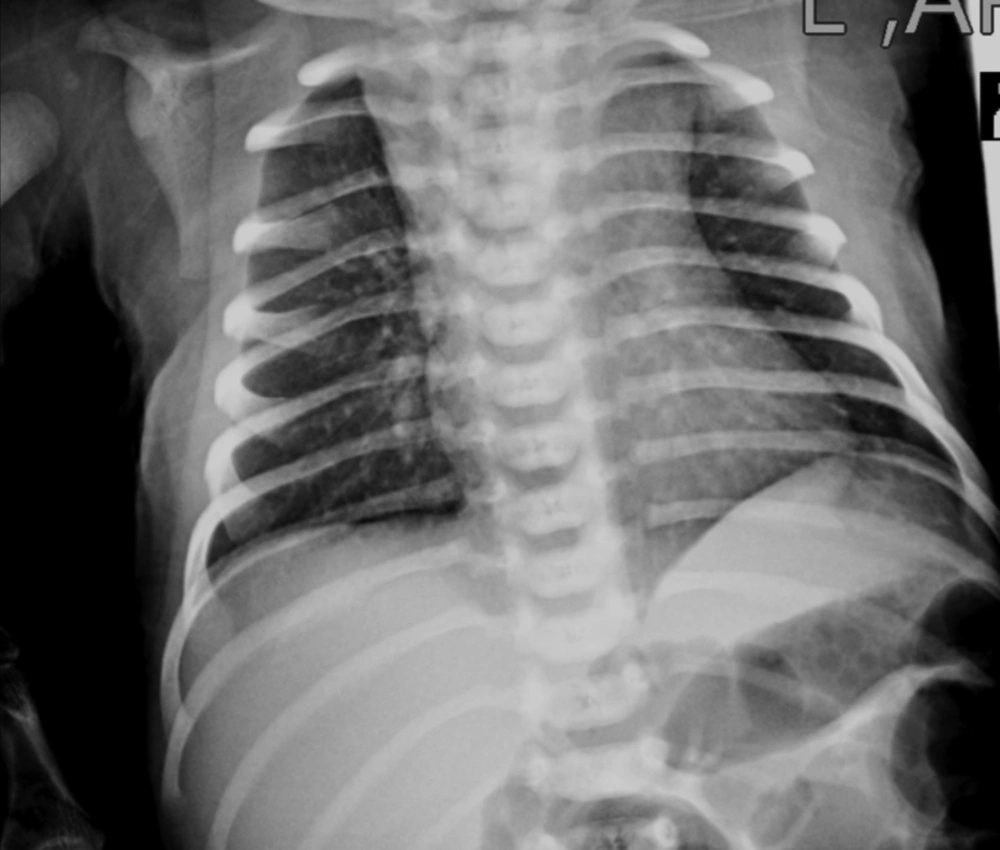
Figure 1.
Supine chest X-ray. It revealed bilateral, central, parahilar peribronchial thickenings. Other findings were normal.
3. Discussion
Although COVID-19 viruses can affect people of all ages, multiple studies showed that the disease is milder in the pediatric population than in adults (6). The clinical findings vary from asymptomatic illness to severe respiratory failure. The most common clinical manifestations are fever and cough, but non-specific and/or extrapulmonary events can occur that are usually abdominal pain, vomiting, and diarrhea (1). To the best of our knowledge, only five COVID-19 positive neonates were reported in English literature until 28 April 2020. Table 1 showed a brief history of these five cases. All these neonates were born of symptomatic mothers that were inconsistent with the presently reported neonate. All of the previously reported neonates had a fever at the time of admission, but our case experienced only one episode of fever two days after the NICU admission. Only two out of these five cases had gastrointestinal symptoms, and unlike the recent case, all of them had typical findings on CT imaging (1, 4, 7-9). We avoided a CT scan in this case because of the lack of respiratory problems and to prevent possible radiation injuries.
Table 1.Brief Characteristics of Neonates with Proven COVID-19
| Cases | Age | Gender | Symptomatic Parents | Clinical Manifestations in the Neonate | Outcome |
|---|---|---|---|---|---|
| Kamali Aghdam et al. (4) | 15 d | M | + | Fever, lethargy | CR |
| Zeng et al. (8) | 17 d | M | + | Fever, cough, vomiting | CR |
| Lu et al. (1) | 5 d | M | + | Fever | CR |
| Wang et al. (7) | 36 h | M | + | Asymptomatic | Discharged |
| Zhang et al. (10) | 5 d | F | + | Asymptomatic | Discharged |
| Recent study | 11 d | M | - | Severe diarrhea, vomiting | CR |
zAbbreviations: CR, completely recovered; d, days-old; F, female; h, hours-old; M, male; +, with COVID-19’s signs and symptoms; -, without these findings.
Although other differential diagnoses of neonatal diarrhea should also be considered, bacterial and parasitic enteritis typically affects children older than two years of age and usually accompanied by high-grade fever, bloody diarrhea, and smaller fecal volumes (11).
Unlike adults, the exact transmission route in children younger than 28 days of age remains unclear; in a retrospective study, Chen et al. (12) showed that no definite evidence for intrauterine transmission is available due to the lack of viral detection in amniotic fluids, cord blood, and breastmilk samples. The qRT-PCR detection positive rate was less than 50% in one survey conducted by Lu et al. (1) Therefore, repeated sampling could increase in PCR’s sensitivity.
Although COVID-19 is milder in children, especially neonates, than adults and has a lower mortality rate, newborns can be a source of disease to the family members and medical staff. (13). The unusual presentation of COVID-19 may raise the index of suspicion of the physicians, especially at a younger age and in areas amid the outbreak.




