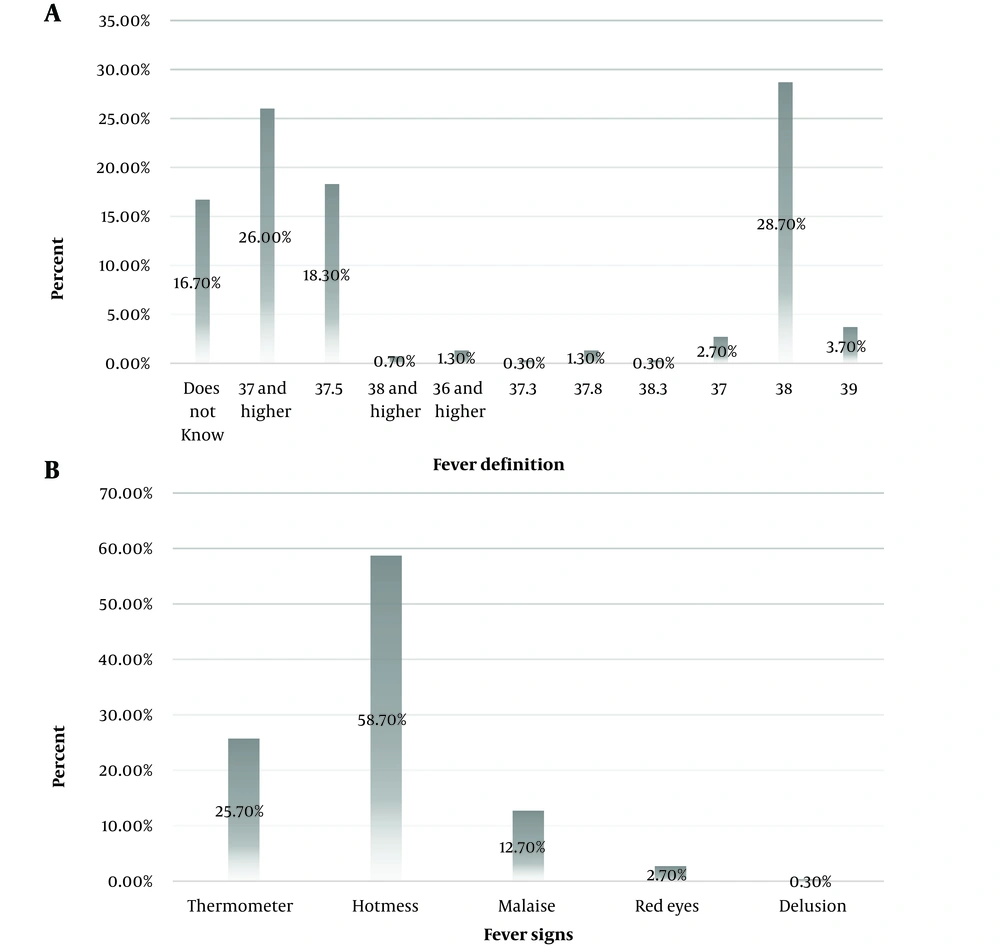
Our study showed that most mothers considered a temperature of 38°C to indicate a fever, and 50 mothers did not know the exact temperature at which a fever occurs. This lack of knowledge appears to be directly related to their level of education. All mothers who were aware of effective fever treatment and control had a high school diploma or higher, and these mothers tended to be older on average. Many mothers who reported acetaminophen as their preferred antipyretic did not know the correct dosage. Furthermore, all the mothers believed that if a fever is not treated, the child would suffer seizures or brain damage.
The mothers included in this study generally lacked correct information on how to treat and care for a feverish child, with this issue being more prevalent among those with a lower level of education. The increasing concern among mothers was associated with their lack of knowledge, as our results showed that many mothers do not even have a correct definition of their child's fever.
Parental concerns about fever management practices have remained almost unchanged (
12). Wan-Tsien Bong found that 72% of mothers experienced fever anxiety, and 12% were afraid that their children would die from a fever (
13). Mothers need various forms of educational, emotional, and spiritual support to better manage their children's fevers. The reactions they show to fever and their level of awareness are influenced by their level of education. Bakry highlighted the importance of providing appropriate information to younger mothers, those with fewer children, higher education, sufficient income, and good knowledge of fever (
14). While a lower average age and fewer children did not significantly influence our results, all mothers in our study met the minimum education requirement of a high school diploma.
Mothers' perceptions were related to their level of education, indicating that educated mothers are more likely to understand the relationship between fever and the presence of a pathogen in the body. A high percentage of mothers who were more aware of their condition believed that untreated fever leads to convulsions. Reducing fever and normalizing body temperature are the main approaches taken by parents, and body temperature is considered the primary indicator of disease severity (
15). An increase in children's body temperature is a disease-related symptom, but most mothers do not measure their child's body temperature correctly.
More than half of the mothers in the Korkut study had a thermometer, but almost half of the population examined their child's fever by touch, and a few examined the appearance of their child (
16). This pattern was consistent with our study, as most of our mothers used touch and body warmth, and 75% did not use a thermometer accordingly. Although understanding the importance of fever is directly related to education, the results showed that using a thermometer was not necessarily dependent on education. Even though using a thermometer was the most common method of diagnosis, detecting fever was still a challenge for mothers. In other words, only 18% of the participants considered a fever to be a temperature above 38°C, and just 4% considered a fever to be a temperature between 37°C and 38°C. This indicates that the method of diagnosing fever by mothers has been accompanied by incorrect information about the normal range of a child's body temperature (
17).
The normal body temperature of children is considered to be between 37.2°C and 37.8°C (
18). Fever was defined as an oral temperature above 37.8°C, a tympanic or rectal temperature of 38°C, and an axillary temperature above 37.2°C (
4). Despite the high percentage of educated mothers in our study, approximately 16% did not know the normal range of temperature, and about half did not correctly know the desired temperature for fever. According to a study by Anokye, 71% of mothers used an axillary thermometer to measure their child's temperature, but only 22% considered a temperature above 37°C to indicate a fever (
19). Mothers may have taken inappropriate action for fever treatment, as they considered temperatures less than 37°C to indicate fever (
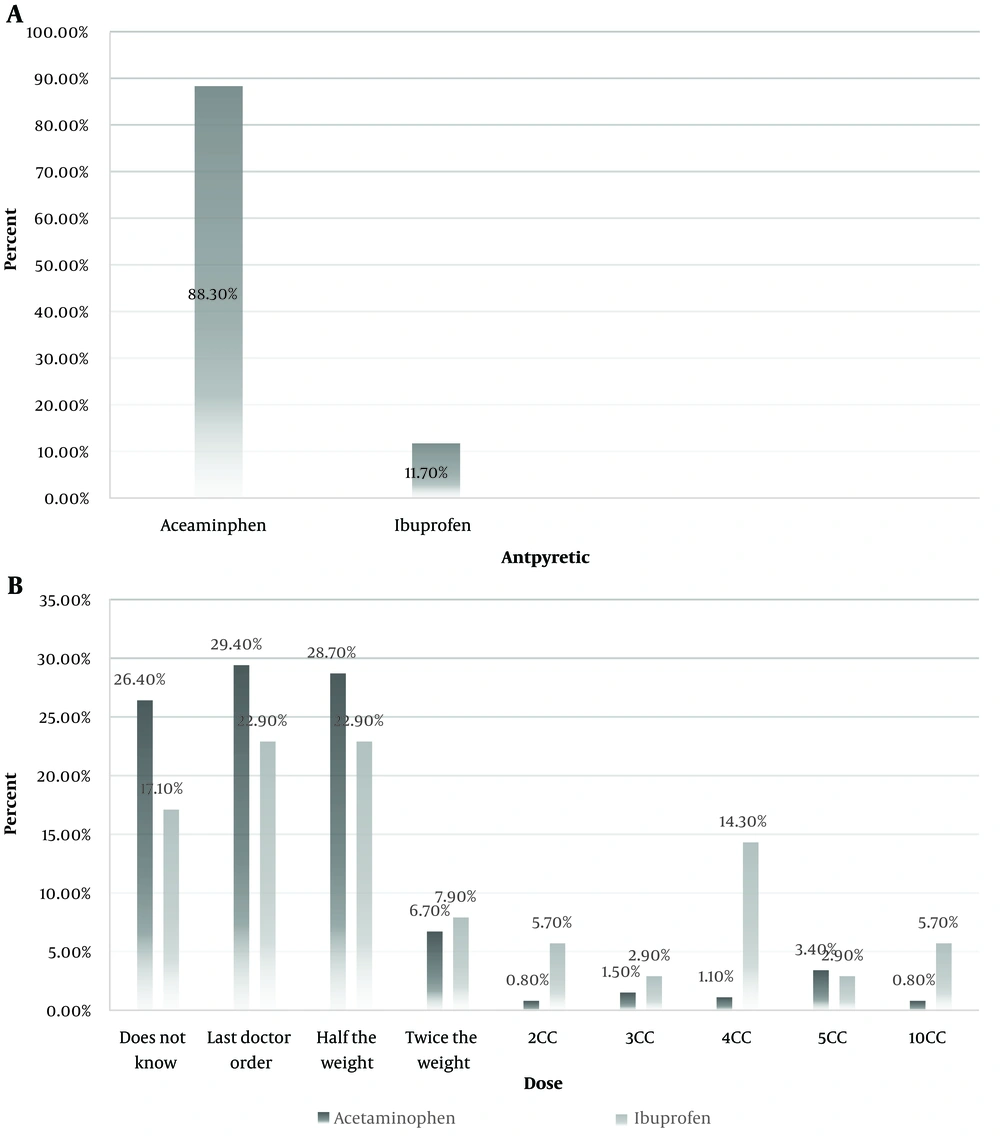
20). This means that a large percentage of mothers may have misdiagnosed fever (at 37°C) and used antipyretics incorrectly. In our study, 26.4% of mothers who reported acetaminophen as a preferred antipyretic did not know the exact dosage. Most of them used acetaminophen according to the doctor's last order, and it was half of the child's weight.
Self-medication and visiting the nearest hospital were the most common actions taken by mothers when their child experienced fever symptoms (
19). Approximately 69% of mothers in the study used a wet cloth to lower their child's temperature, while only 1% were aware of and used suppositories for fever treatment at home. It is encouraging to see that, despite inadequate education, mothers prioritize physical methods over medication based on pediatricians' recommendations (
6). However, knowledge of these physical methods may be limited regarding treating fevers.
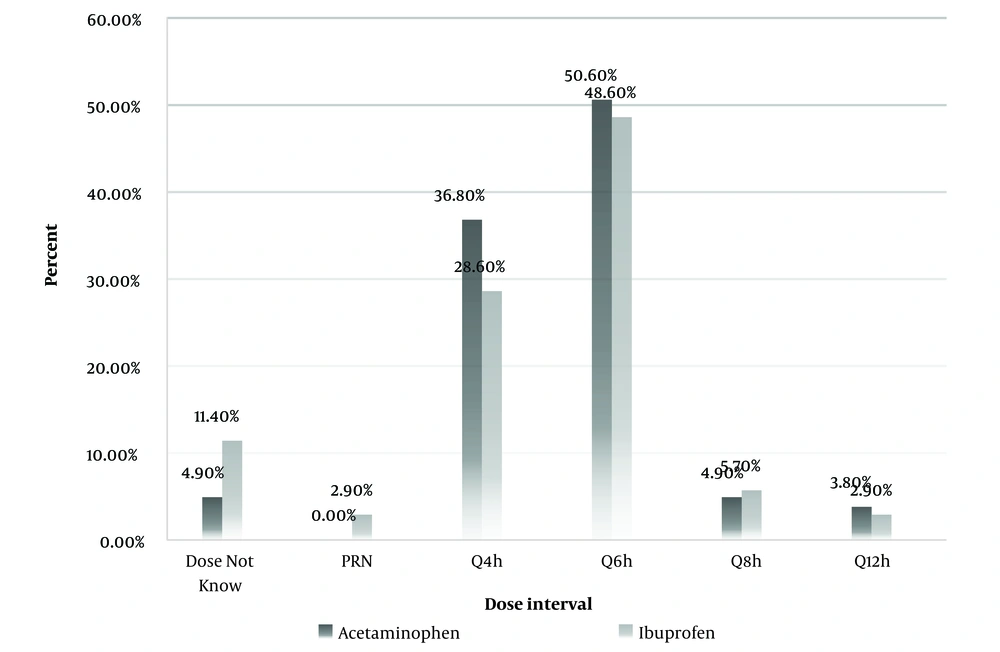
Approximately one-fourth of mothers were unaware of the appropriate use of antipyretics, and even among those who were aware of the medication, 35% adjusted the dosage based on their child's weight, regardless of the type of medication. Only 30% of mothers followed the latest doctor's instructions for timely use of antipyretics, which indicates the need for better education on proper use. Approximately 5% of the mothers were not familiar with the exact duration of use, and 8% of the mothers used antipyretics every eight or twelve hours, whereas the most effective method is every 4 to 6 hours (
21). Caring for a feverish child is a significant concern for parents because their knowledge, especially mothers', about the effectiveness and appropriateness of antipyretics is often questionable.
Ayatollahi introduced acetaminophen and ibuprofen as common drugs used by mothers (
20). In our study, approximately 88% of mothers used acetaminophen, though about a quarter of them did not know how to use it correctly. This issue persisted for ibuprofen, with around three-quarters of mothers lacking complete knowledge of its proper use. Twenty-six percent of mothers using acetaminophen did not know the correct dosage, and only 28% used it based on the child's weight. Similarly, for 17% of mothers, the correct dosage of ibuprofen was unknown, and less than a quarter administered it based on half the child's weight (according to the latest doctor's instructions). Inaccurate information about antipyretics leads to their incorrect use, potentially threatening the child's health. Concerns can cause the use of inappropriate treatment and sometimes result in poisoning due to nonstandard drugs, leading to numerous visits to emergency wards (
22,
23).
In summary, our results were consistent with previous findings and showed a significant correlation between mothers’ education levels and their knowledge of effective fever treatment and control. A large percentage of mothers in this study did not have accurate knowledge of how to treat and care for a child with a fever, particularly those with lower education levels. Many mothers did not know the correct information about antipyretic drugs, the proper dosage, and how to use them. This lack of knowledge makes managing children's health during fever treatment uncertain. If mothers are not properly informed about fever and fever reducers, they will not provide adequate care. Since fever in children is an important sign of infection and can lead to seizures, the importance of mothers' knowledge and their response to fever increases.
5.1. Conclusions
Diagnosing and managing children's fever heavily depends on mothers' education levels, as educated mothers are generally more aware of proper child care standards. There is a significant gap between mothers' awareness of the duration and dosage of antipyretics and the standard use of these drugs, which is highly concerning for child care. Increasing mothers' awareness is a critical issue in health and child care and should receive special attention. We recommend that a comprehensive program be organized to enhance mothers’ understanding of managing children's