


1. Background
Gastroenteritis is one of the most common reasons for referral to pediatricians. It is the second leading cause of death in children (1). Studies show that dehydration caused by diarrhea comprises about 17% of worldwide deaths in children under 5 years (2). Acute diarrhea leads to water and electrolyte loss and consequently mild, moderate, or severe dehydration, which might be life-threatening if not compensated for promptly (3). If dehydration is not corrected promptly, it can lead to hypovolemic shock, decreased tissue perfusion, multiorgan failure, and even death (4).
In the vast majority of patients, dehydration can be corrected with oral rehydration solutions (ORS). However, in patients with hypovolemic shock, severe dehydration, paralytic ileus, intractable vomiting, or in those whose dehydration cannot be compensated by oral fluids alone, intravenous fluid therapy (IVFT) is necessary (5). The main goals of IVFT in children with diarrhea are: 1. Resuscitation fluid (acute correction of hypovolemia), 2. replacement of pre-existing fluid deficits that cannot be compensated orally, 3. maintenance fluids in hemodynamically stable patients who are either unable to drink or for whom oral feeding is contraindicated, and 4. replacement of ongoing fluid losses caused by gastroenteritis (6).
The main approach in confronting severely dehydrated children is aggressive IVFT with 20 cc/kg of isotonic crystalloid fluids [Normal saline (NS) or Ringer's Lactate (RL)], and repeating it as necessary (6, 7). Crystalloid fluids are preferred to colloids as the first choice of dehydration treatment due to their lower cost (6). Colloids are indicated in selected conditions (severe burn), because they remain well in the intravascular space and increase blood pressure. Colloids did not have a significant effect on reducing mortality compared to crystalloids in studies (6, 7).
The most commonly recommended fluid for correcting severe dehydration in children is an initial bolus of NS followed by continued dextrose saline to prevent possible hyponatremia (8). Normal saline is the most widely used fluid in pediatric gastroenteritis due to its high sodium and chloride content (154 meq/L), low cost, and no risk of hyponatremia (6, 8, 9). One-fourth of the injected NS effectively enters the vascular space, and the rest remains in the interstitial space (6). The osmolarity of NS outside the body is 308 milliosmoles per liter (mosm/L), but in vivo it is considered isotonic with an osmolarity of about 285 mosm/L (10).
Recent studies show that NS infusion in large volumes can cause hyperchloremia, normal anion gap metabolic acidosis (NAGMA), hypernatremia, increased inflammatory cytokines, and hyperkalemia. There are even concerns about the occurrence of acute kidney injury caused by renal vasoconstriction (6, 7, 10-16). It is also suggested that treatment with large volumes of NS may sometimes prolong the patient's acidosis (11). According to the results of some studies, the increased intravascular volume created by NS infusion can predispose the patient to pulmonary edema (10). Since NS is slightly hypertonic, it increases the secretion of Arginine Vasopressin (AVP), and in addition to its effect on renal perfusion, it leads to less renal water excretion compared to balanced fluids. Therefore, more fluid is retained in the interstitial space, which can predispose the patient to edema (12). Some studies suggested that metabolic acidosis and decreased gastric perfusion following administration of NS may be the cause of gastroparesis (12, 13). There is evidence that chloride-rich fluids such as NS may cause greater degrees of acidosis and hyperchloremia, which can cause vascular smooth muscle cell contraction and potentially predispose the patient to renal hypoperfusion (12). Administration of NS to healthy volunteers significantly reduces renal blood flow velocity, reduces perfusion of the renal cortex, and decreases urine output, resulting in extravascular fluid accumulation compared with buffered fluids. These findings support the hypothesis that hyperchloremia may cause tubulo-glomerular feedback and reduce cortical perfusion (12).
The World Health Organization (WHO) considers Ringer's Lactate (RL) as the initial recommended fluid and NS as an acceptable fluid for correcting dehydration in children (1). Ringer's Lactate is a buffered crystalloid solution that contains lactate (28 meq/L convertible to bicarbonate), potassium (4 meq/L), calcium (3 meq/L), and sodium chloride (130, 109 meq/L, respectively). Due to the presence of lactate, it does not carry the risk of lactic acidosis. Ringer's Lactate replaces bicarbonate that has been lost through diarrheal excretion. The lactate anion in RL is converted to bicarbonate by the liver, which prevents acidosis and hyperkalemia compared to NS (14). The in vitro osmolarity of RL is 272-281 mOsmol/L, whereas in vivo osmolarity is about 254 mOsmol/L, which is slightly hypotonic compared to NS, and is closer to normal body plasma osmolarity (7, 11). Ringer's Lactate should be used cautiously in patients with hepatic failure who cannot metabolize lactate to bicarbonate (7). Ringer's Lactate is preferred to NS in terms of positive effects on cardiac contractility (10). Some studies have also mentioned that the administration of RL compared to NS has a lesser effect on thrombin formation and platelet activation (10).
2. Objectives
Given the lack of sufficient data in the pediatric field, this study was designed to compare the therapeutic effects of RL versus NS in two groups of children admitted to the emergency department following severe dehydration caused by acute gastroenteritis.
3. Methods
The parallel randomized controlled trial was a clinical trial conducted on 104 children with severe dehydration caused by acute gastroenteritis referred to the emergency department of 17 Shahrivar Hospital in Rasht, Iran, from September 2023 to September 2024. Inclusion criteria included age between 30 days and 14 years, and severe dehydration caused by acute gastroenteritis. Severe dehydration was considered according to the World Health Organization (WHO) criteria and the presence of two out of the four signs (drowsiness/unconsciousness, severe oliguria or anuria, inability to drink, impaired skin turgor > two seconds), with or without a decrease in blood pressure less than the 5th percentile according to sex, age, and height.
Exclusion criteria included severe acute malnutrition, prolonged diarrhea for more than 7 days, underlying systemic disease, outpatient administration of RL or NS within 24 hours before hospitalization, presence of hypo- or hypernatremia, or occurrence of seizures during hospitalization.
The sample size was calculated based on the study by Kartha et al. (1). The calculation was performed with a 95% confidence level and 80% power, using the primary outcome of interest: Clinical improvement and pH > 7.35. A clinically meaningful difference of 25% between groups was expected, resulting in a required sample size of 52 participants per group.
α = 95% Z 1-α/2 = Z 0.975 = 1.96; β = 80% Z 1-β = 0.85; Ringer’s Lactate = 38%; P (pH > 7.35); Normal Saline = 23%;
n = (Z 1-α/2 + Z 1-β) 2 [P1- (1-P1) + P2 (1-P2)] = [(1.96 + 0.85) 2 (0.38 × 1 – 0.38) + 0.23(1- 0.23)]/ d2 = 52
After obtaining written consent, 104 patients meeting the inclusion criteria were enrolled in the study using consecutive sampling. Patients were randomly assigned in a 1:1 allocation ratio to two groups, with 52 patients in each group: Group A received RL and Group B received NS (Figure 1). The randomization process was conducted under the supervision of the project manager, with direct oversight from the study statistician and supervisor. Children were assigned to either the NS or RL group using a block randomization method with four blocks, ensuring balanced group sizes throughout the study. The random sequence was generated using computer-based random allocation software. To maintain allocation concealment, the generated sequence was handled by a third party who was not involved in any other aspect of the study and had no knowledge of patient characteristics or group assignments. The block sequences were placed in a sealed, opaque envelope and stored securely at the Children’s Research Center until the time of assignment. Once a participant was enrolled, the envelope was opened in sequence, and the child was allocated to the corresponding group. The researchers performing the intervention and outcome assessments remained blinded to the allocation process, ensuring that group assignment did not influence treatment administration or data collection.
3.1. Group 1 Normal Saline
Patients in the NS group received an initial bolus of 20 mL/kg via a peripheral vein. The bolus was administered over 10 minutes if hypotension was present or 20 minutes if blood pressure was normal. Following each bolus, patients were reassessed for perfusion, capillary refill time, urine output, and heart rate. If target hemodynamic goals were not achieved, a second bolus of 20 mL/kg was administered over 10 - 20 minutes. A third bolus of 20 mL/kg was given if necessary, for a maximum of three boluses per patient. After stabilization, patients were transitioned to maintenance and deficit fluid therapy, excluding the boluses already administered. Maintenance fluids consisted of dextrose saline with 20 mEq/L potassium chloride (KCl). For each episode of voluminous diarrhea, 5% dextrose in half-normal saline with 20 mEq/L KCl was administered at a rate of 10 mL/kg per episode to replace ongoing losses.
3.2. Group 2 Ringer’s Lactate
Patients in the RL group received the same fluid management protocol as the NS group, except that the initial boluses (20 mL/kg, maximum three times) were given using RL instead of NS. Maintenance and deficit fluids, as well as ongoing loss replacement for diarrhea, were identical to the NS group (dextrose saline with 20 mEq/L KCl and 5% dextrose in half-normal saline with 20 mEq/L KCl per episode of diarrhea).
In both groups, baseline assessments included vital signs (blood pressure, pulse rate, and respiratory rate), level of consciousness according to Alert-Verbal-Pain-No response (AVPN) criteria, capillary refill time, and skin turgor. Laboratory evaluations at admission included blood gas analysis and serum measurements of glucose, sodium, potassium, chloride, blood urea nitrogen (BUN), and creatinine. During the first six hours of treatment, these parameters were continuously monitored, and precise urine output was measured using a Foley catheter. The time from initiation of intravenous fluid therapy (IVFT) to improvement of clinical signs of dehydration was also recorded.
In cases of inflammatory diarrhea, both groups received cefotaxime 50 mg/kg/day in two divided doses due to the risk of precipitation when calcium-containing fluids, such as RL, interact with ceftriaxone.
The primary outcome of the study was the time to recovery from severe dehydration, defined by the achievement of clinical improvement, including normalization of vital signs, restoration of consciousness, capillary refill time ≤2 seconds, correction of skin turgor, and urine output ≥1 mL/kg/hour. This composite outcome was chosen to reflect overall hemodynamic and hydration recovery in children with severe dehydration. The focus on a clinically meaningful endpoint allowed the study to assess the comparative effectiveness of RL and NS in rapidly restoring physiological stability.
Secondary outcomes included changes in biochemical and blood gas parameters, such as pH, bicarbonate, base excess, anion gap, and serum levels of glucose, sodium, potassium, chloride, BUN, and creatinine, measured at baseline and six hours after fluid therapy initiation. Additional secondary outcomes included the frequency of bolus fluid administration required to correct severe dehydration and the overall length of hospitalization. Demographic variables, including age, sex, weight, and height, were also recorded to enable comprehensive comparisons between the two groups.
3.3. Statistical Analysis
After collecting the study data, the data were entered into SPSS Statistics for Windows, version 26.0 (IBM Corp., Armonk, NY, USA). Prior to comparative analyses, the normality of continuous variables was assessed using the Kolmogorov–Smirnov test. Frequency and percentage were employed to describe the data for qualitative variables. To describe quantitative variables such as BUN and creatinine levels, mean, standard deviation (SD), and minimum and maximum were used. To compare qualitative variables in two groups, the chi-square test and Fisher's exact test were used, and for quantitative variables, the independent t-test was used. P < 0.05 was considered significant.
4. Results
As Table 1 shows, a comparison between the groups revealed no significant differences in weight (P = 0.349), gender distribution (P = 0.712), or age (P = 0.105). However, height was significantly higher in the RL group (P = 0.019). Pulse rate decreased significantly within both groups from hour one to hour six (P < 0.001), with a greater reduction in the RL group (-21.74 ± 7.99) compared to the NS group (-13.05 ± 12.97), showing a statistically significant intergroup difference (P < 0.001). Consciousness levels (Alert-Verbal-Pain-No response, AVPN) were similar between the two groups at baseline (P = 0.484), with no significant difference. The respiratory rate significantly decreased from hour one to hour six in both groups (P < 0.001), but the intergroup difference was not statistically significant (P = 0.169). Similarly, systolic blood pressure increased significantly in both groups (P < 0.001), yet the change was not significantly different between groups (P = 0.329), indicating similar effects of both interventions. Diastolic blood pressure also showed a significant increase within both groups (P < 0.001), but the difference in changes between the groups was not significant (P = 0.983), suggesting comparable effects of NS and RL on this parameter.
Table 1.Comparison of Baseline Characteristics between Normal Saline and Ringer’s Lactate a
| Parameter b | Unit | Normal Saline | Ringer’s Lactate | Statistical Test | P-Value |
|---|---|---|---|---|---|
| Weight | kg | 11.19 ± 6.78 | 12.42 ± 3.42 | Independent sample t-test | 0.349 |
| Height | cm | 81.49 ± 16.17 | 88.62 ± 14.13 | Independent sample t-test | 0.019 c |
| Gender | |||||
| Female | Number (%) | 22 (42.3) | 23 (44.3) | Chi-square | 0.712 |
| Male | Number (%) | 30 (57.6) | 29 (55.7) | ||
| Age | Months | 21.82 ± 20.17 | 27.08 ± 21.28 | Independent sample t-test | 0.105 |
| Pulse rate (hour 1) | beats/min | 124.75 ± 11.63 | 122.15 ± 9.08 | ||
| Pulse rate (hour 6) | beats/min | 111.69 ± 10.79 | 100.41 ± 8.27 | ||
| Pulse change | beats/min | -13.05 ± 12.97 | -21.74 ± 7.99 | Independent sample t-test | < 0.001 c |
| Consciousness (alert) | Number (%) | 27 (51.9) | 30 (57.6) | Fisher’s exact test | 0.484 |
| Verbal response | Number (%) | 23 (44.2) | 19 (36.5) | ||
| Pain response | Number (%) | 2 (3.8) | 3 (5.7) | ||
| Total consciousness | Number (%) | 52 (100) | 52 (100) | ||
| Respiratory rate (hour 1) | breaths/min | 28.28 ± 4.72 | 28.09 ± 2.34 | ||
| Respiratory rate (hour 6) | breaths/min | 24.05 ± 2.23 | 23.00 ± 1.53 | ||
| Respiratory change | breaths/min | -4.22 ± 3.94 | -5.09 ± 2.10 | Independent sample t-test | 0.169 |
| Systolic BP (hour 1) | mmHg | 85.00 ± 7.78 | 85.61 ± 5.98 | ||
| Systolic BP (hour 6) | mmHg | 92.79 ± 5.88 | 94.50 ± 4.03 | ||
| Systolic BP change | mmHg | 7.79 ± 6.65 | 8.89 ± 4.62 | Independent sample t-test | 0.329 |
| Diastolic BP (hour 1) | mmHg | 56.07 ± 8.05 | 56.96 ± 5.00 | ||
| Diastolic BP (hour 6) | mmHg | 63.21 ± 6.43 | 64.12 ± 3.83 | ||
| Diastolic BP change | mmHg | 7.13 ± 6.02 | 7.15 ± 5.50 | Independent sample t-test | 0.983 |
a Continuous variables were compared using independent samples t-test. Categorical variables were analyzed using the chi-square test or Fishers exact test.
b Parameters are express as mean ± SD.
c Significant difference.
The results indicated that both NS and RL significantly improved capillary refill time and skin turgor from hour 1 to hour 6, with greater reductions observed in the NS group (P < 0.040 and P < 0.004, respectively). Although the time to recover from severe dehydration was shorter in the RL group (2.19 vs. 2.87 hours), this difference was not statistically significant (P = 0.080). Similarly, the frequency of bolus dose administration was slightly higher in the NS group (1.33 vs. 1.19), but without a significant difference (P = 0.118). Although urine output increased significantly in both groups, the intergroup results showed a statistically significant difference (P = 0.047). Patients in the RL group had higher urine output than the other group during the first six hours after starting fluid therapy (Table 2).
Table 2.Comparison of Clinical Parameters Between Normal Saline and Ringer’s Lactate a
| Variables and Timepoint | Normal Saline | Ringer’s Lactate | P-Value b |
|---|---|---|---|
| Capillary refill time (sec) | 0.040 c | ||
| Hour 1 | 2.20 ± 0.49 | 2.01 ± 0.14 | |
| Hour 6 | 1.84 ± 0.36 | 1.86 ± 0.34 | |
| Difference | 0.35 ± 0.10 | 0.15 ± 0.03 | |
| Skin turgor (sec) | 0.004 c | ||
| Hour 1 | 2.98 ± 0.72 | 2.49 ± 0.61 | |
| Hour 6 | 1.56 ± 0.57 | 1.52 ± 0.50 | |
| Difference | 1.41 ± 0.79 | 0.96 ± 0.79 | |
| time to recover from severe dehydration (hrs.) | 2.87 ± 0.68 | 2.19 ± 0.68 | 0.080 |
| Bolus dose frequency | 1.33 ± 0.51 | 1.19 ± 0.40 | 0.118 |
| Urine output (mL) | 0.047 c | ||
| Hour 1 | 0.6019 ± 0.13515 | 0.6294 ± 0.12537 | |
| Hour 6 | 1.3283 ± 0.34551 | 1.4745 ± 0.33636 | |
| Difference | 0.7264 ± 0.29362 | 0.8451 ± 0.30745 |
a Values are express as mean ± SD.
b Independent sample t-test.
c Significant difference.
As this study compared biochemical changes between NS and RL over six hours, sodium, chloride, blood sugar (BS), pH, and bicarbonate levels showed statistically significant differences between the two groups (P < 0.001). The correction changes in the base excess (BE) level were also statistically different in the RL group compared to the NS group (P < 0.01). The difference in the anion gap (AG) was also statistically significant between the two groups (P < 0.014). The increase in sodium and chloride was more noticeable in the RL group. Blood glucose levels increased significantly in both groups, but the increment was greater in patients treated with RL (P < 0.001). Furthermore, pH and bicarbonate increased significantly in both groups, with a larger increase in RL (P < 0.001). However, potassium, blood urea nitrogen (BUN), and creatinine changes were not significantly different between the groups (P > 0.05) (Table 3).
Table 3.Comparison of Biochemical Changes Between Normal Saline and Ringer's Lactate from Hour 1 to Hour 6 a
| Variables and Timepoint | Normal Saline | Ringer’s Lactate | P-Value b |
|---|---|---|---|
| Sodium (mEq/L) | < 0.001 c | ||
| Hour 1 | 137.98 ± 5.37 | 136.47 ± 3.47 | |
| Hour 6 | 140.67 ± 3.97 | 142.27 ± 3.63 | |
| Difference | 2.69 ± 0.90 | 5.80 ± 3.61 | |
| Potassium (mEq/L) | 0.140 | ||
| Hour 1 | 3.95 ± 0.57 | 3.88 ± 0.52 | |
| Hour 6 | 4.20 ± 0.45 | 4.25 ± 0.38 | |
| Difference | 0.24 ± 0.04 | 0.37 ± 0.04 | |
| Chloride (mEq/L) | < 0.001 c | ||
| Hour 1 | 104.16 ± 5.97 | 101.23 ± 4.58 | |
| Hour 6 | 109.48 ± 4.14 | 109.74 ± 3.64 | |
| Difference | 5.31 ± 4.61 | 8.50 ± 3.88 | |
| BUN (mg/dL) | 0.637 | ||
| Hour 1 | 15.13 ± 1.20 | 13.07 ± 1.05 | |
| Hour 6 | 10.14 ± 1.63 | 7.18 ± 1.86 | |
| Difference | 4.98 ± 0.52 | 5.88 ± 1.20 | |
| Creatinine (mg/dL) | 0.926 | ||
| Hour 1 | 0.46 ± 0.10 | 0.43 ± 0.08 | |
| Hour 6 | 0.46 ± 0.05 | 0.44 ± 0.07 | |
| Difference | 0.00 ± 0.10 | 0.002 ± 0.10 | |
| Blood glucose (mg/dL) | < 0.001 c | ||
| Hour 1 | 78.92 ± 20.98 | 77.09 ± 15.76 | |
| Hour 6 | 120.76 ± 31.45 | 147.33 ± 32.21 | |
| Difference | 42.32 ± 31.36 | 70.23 ± 31.98 | |
| pH | < 0.001 c | ||
| Hour 1 | 7.32 ± 0.08 | 7.33 ± 0.05 | |
| Hour 6 | 7.37 ± 0.05 | 7.43 ± 0.06 | |
| Difference | 0.04 ± 0.07 | 0.09 ± 0.06 | |
| Bicarbonate (HCO3) (mmol/L) | 0.007 c | ||
| Hour 1 | 21.16 ± 2.92 | 17.35 ± 3.59 | |
| Hour 6 | 21.37 ± 2.91 | 22.73 ± 3.45 | |
| Difference | 0.20 ± 1.30 | 5.37 ± 3.28 | |
| BE (base excess) | < 0.01 c | ||
| Hour 1 | 8.89 ± 4.35 | 7.36 ± 3.61 | |
| Hour 6 | 4.90 ± 4.52 | 1.43 ± 3.81 | |
| Difference | 3.99 ± 4.05 | 5.92 ± 3.93 | |
| Anion gap | 0.014 c | ||
| Hour 1 | 22.06 ± 6.18 | 21.58 ± 4.54 | |
| Hour 6 | 16.63 ± 4.67 | 13.88 ± 3.45 | |
| Difference | 5.43 ± 5.08 | 7.97 ± 4.10 |
a Values are express as mean ± SD.
b Independent sample t-test.
c Significant difference.
The mean and standard deviation of hospitalization days in the NS group were 3.79 ± 1.32 days, while in the RL group, they were 3.49 ± 0.96 days. An independent sample t-test indicated no statistically significant difference (P = 0.187) (Table 4).
Table 4.Comparison of the Length of Hospitalization Between Normal Saline and Ringer’s Lactate Groups
| Parameter | Unit | Normal Saline | Ringer’s Lactate | P-Value a |
|---|---|---|---|---|
| Days of hospitalization | day | 3.79 ± 1.32 | 3.49 ± 0.96 | 0.187 |
a Independent sample t-test.
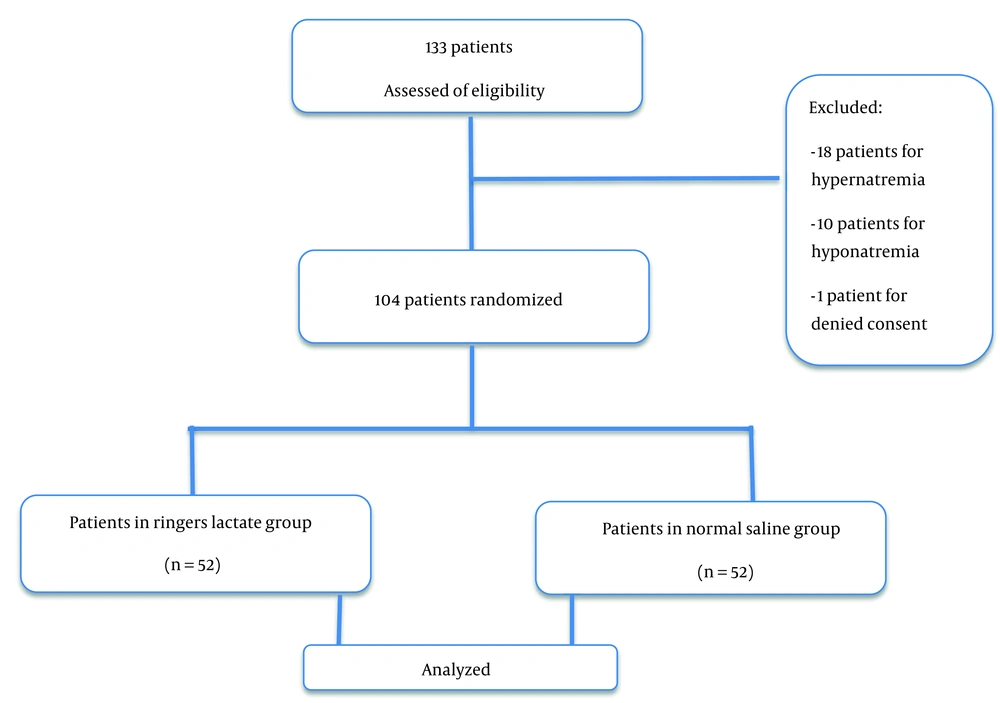
Figure 1.
Flow diagram of patients
5. Discussion
Appropriate fluid therapy and selection of the preferred fluid are vital and life-saving for the rapid improvement of clinical symptoms and laboratory abnormalities. Based on recent studies, there is evidence that RL is superior to NS in the treatment of pediatric severe dehydration (1). However, studies are limited, and the results are somewhat contradictory. The present clinical trial was conducted on 104 children with severe dehydration caused by gastroenteritis to compare the therapeutic effects of RL versus NS. All patients in the present study were under 3 years of age. Although children up to 14 years of age were included, during the study period, older patients with severe dehydration were not admitted to the emergency department. The age range of the participants revealed that this age group was very high risk and predisposed to severe dehydration. In line with the present study, the average age of the participants in the study by Kartha et al. was 17 months despite the inclusion criterion of up to 12 years of age (1).
The main aim of the current study was to compare the improvement of acidosis between the two groups. A decrease in pH can exacerbate cellular damage (17). In general, three variables can affect blood pH: PCO₂ concentration, nonvolatile acids, and the difference between cations and anions. Therefore, prescribed fluids can affect blood pH through different electrolyte content, which affects the cation-anion difference (Strong ion difference (SID) = sodium, potassium, magnesium, and calcium cations minus chloride and lactate), and by diluting blood volume (10, 12). Ideally, in the presence of constant PCO₂, there should be little change in pH after administration of intravenous fluids. On the other hand, if the cation-anion difference of the prescribed serum is higher than the patient's serum bicarbonate, the patient's pH will move towards alkalosis, and conversely, if the difference between positive and negative ions is lower than the patient's bicarbonate (as occurs in administration of 0.9% NS), the patient's pH will move towards acidosis. In NS, the difference between anion and cation is zero, and in extracellular fluids, this difference is about 40 meq/L. Therefore, the administration of NS reduces plasma SID and will lead to metabolic acidosis. If the fluid has a lower chloride content (less than 110), it is called a balanced fluid. RL has low chloride content, and it is slightly more hypotonic than NS, but considering that the difference between cation and anion is more than 24 meq/L (about 29 meq/L), it will lead to metabolic alkalosis, so it is preferred, especially for patients with acidemia (10). RL improves pH by converting lactate to bicarbonate in the liver, which potentiates its positive effects on intravascular volume and tissue perfusion (17).
In this study, the mean anion gap (AG) in both groups was above the normal range (12), which indicated that there was probably some degree of lactic acidosis, because high AG metabolic acidosis is not expected in simple diarrhea. The present study showed that in recipients of RL, correction of acidosis (pH and AG) occurred sooner than in the NS group. Bicarbonate and pH increased more, and there was also a significant anion gap correction. In line with the study by Rasheedd et al., the current study revealed better improvement in bicarbonate and pH in the RL compared to the NS groups, which led to better correction of acidosis and base excess (BE) (18). Pourfakhr et al. achieved similar results in terms of increasing bicarbonate and improving acidosis with RL, although the studied group consisted of adults (14). Cieza et al. also showed a greater increase in pH in RL recipients (19). Shaikh et al. achieved similar results (20). Naseem et al. also found higher bicarbonate and greater BE correction in the recipients of RL (21). In the study by Mahajan et al. (17), neither NS nor RL had a significant effect on improving pH. Kartha et al. also found no difference in the correction of acidosis between the two groups (1). The present study suggested RL as a preferred solution to correct acidosis and blood gas parameters.
Based on the results of some recent studies, resuscitation with NS may increase the risk of metabolic acidosis, hyperchloremia, and hyperkalemia (17). On the other hand, NS also showed reliable effects on neurological complications related to changes in serum sodium levels (9). In addition, studies showed that treatment with RL compared with NS in patients with diabetic ketoacidosis was associated with a lower risk of cerebral edema (11). Despite the higher sodium and chloride content in NS, the results of the present study showed a greater increase in sodium and chloride levels in the RL group compared to the NS group, while changes in potassium levels were not significant in either group. It is worth noting that despite the increasing changes in serum sodium in both groups, its level did not exceed the threshold for hypernatremia. In line with the present results, the study by Shaikh et al. showed a greater increase in serum sodium level in the RL recipients compared to the NS group after six hours. However, unlike the present study, they also obtained the same result for potassium (20).
In line with Rasheed and Cieza's study, the present trial did not find any difference in the potassium level six hours after treatment in either group (18, 19). Mahajan et al. and Naseem et al. reported a decrease in serum potassium in the group receiving NS, which was attributed to the lack of potassium in NS compared to RL (17, 21). Furthermore, Florez et al., in a systematic review, found that administration of balanced solutions reduced the risk of hypokalemia and led to better correction of the acidosis process (22).
In the present trial, in line with Mahajan's study, hyperchloremia was not found in the recipients of NS (17). Chloride showed a greater increase in the RL group. Given the higher chloride content in NS compared to RL (154 vs. 109), we expected a higher chloride level in recipients of NS after six hours, as was the conclusion achieved by Pourfakhr et al. (14). On the contrary, the RL recipients experienced a greater increase in serum chloride. It can be hypothesized that the electrolyte contents of different fluids could not be the sole reason for the changes in patients' serum electrolytes, and in vivo ion changes may have an impact. The study by Kartha et al. did not find any change in serum chloride levels in the two groups (1).
There was no statistical difference regarding blood urea nitrogen (BUN) and creatinine levels between the two groups, which was consistent with the study by Nasim and Kartha et al. (1, 21). Although Pourfakhr demonstrated a greater decrease in BUN and creatinine in patients undergoing kidney transplantation who were treated with RL, the age range and underlying disease of participants were totally different from the present study (14).
This study conducted a comparative evaluation of the patient's vital signs at the time of admission and six hours after initiation of treatment. Tachycardia is one of the first signs of hypovolemic shock (23). The decrease in heart rate was significantly greater in the RL group, which indicated a better response in terms of resolving the first sign of shock. There was no significant difference between the two groups in terms of the decrement of respiratory rate and increment in both systolic and diastolic blood pressure. The NS group was superior regarding improvement of capillary refill time and skin turgor compared to the other group.
In the recent study, RL recipients showed greater urine output within six hours, which indicated better response to RL regarding the establishment of urine flow. The study by Pourfakhr et al. was consistent with the current trial in terms of higher urine output during renal transplantation surgery; however, the age group was completely different from the present study (14).
Although consistent with Mahajan et al., the frequency of administered boluses of RL was lower than that of NS; the difference was not statistically significant in the present study. The present trial, consistent with the study by Mahajan et al., showed a lower frequency of administered boluses of RL compared to NS; however, the difference was not statistically significant (17). In terms of the total volume of boluses administered, our results, in line with Naseem et al., showed no difference between NS and RL (21).
The present trial, consistent with the Karta study, showed no difference regarding length of hospitalization between the two groups. This was in contrast with previous studies (1, 17, 19, 23). According to Friedrich et al., recipients of RL and NS had similar recovery and duration of hospitalization (24). However, a recent systematic review by Florez et al. found that balanced solutions in children were associated with a likely trivial reduction of the length of stay compared to 0.9% saline (22).
Overall, based on the findings of this study, RL was associated with better response than NS in terms of improving acid-base status, increasing pH and bicarbonate, correcting BE and anion gaps, reducing tachycardia, and increasing urine output in severely dehydrated pediatric patients. Meanwhile, treatment with NS had positive effects on capillary refill time and skin turgor. Considering that previous studies show contradictory results in relation to some of the investigated variables, further investigations are required.
5.1. Limitations
The lack of blinding was a limitation of our study. Many patients could not be enrolled in the study due to electrolyte disturbance (hypernatremia). We acknowledge the value of advanced modeling and recommend it for future studies involving larger sample sizes and longitudinal follow-up to further adjust for baseline disparities.
5.2. Recommendations
Conducting further studies with a larger sample size can make the study results more generalizable. Therefore, it is recommended to conduct more detailed studies. In addition, meta-analyses and systematic reviews are recommended for more precise results.
5.3. Conclusions
This study found that treatment with RL compared to NS had a greater impact on improving the acid-base status, correcting anion gap and BE, reducing tachycardia, and establishing urine output in children with severe dehydration caused by gastroenteritis during six hours of fluid administration. There was no difference in the frequency of bolus administration or the duration of hospitalization in those receiving RL compared to NS. However, more detailed and precise studies are needed for more reliable conclusions.



