Arch Pediatr Infect Dis

Image Credit:Arch Pediatr Infect Dis

Healthcare-Associated Infections in the NICU of a Tertiary Referral Center in Southern Iran

Author(s):
Roya OboodiRoya OboodiRoya Oboodi ORCID1, Alireza AsemanrafatAlireza Asemanrafat2, Zahra HashemiZahra HashemiZahra Hashemi ORCID1, Marziyeh DoostfatemehMarziyeh DoostfatemehMarziyeh Doostfatemeh ORCID3, Reza BahramiReza BahramiReza Bahrami ORCID1, Khadijeh Sadat NajibKhadijeh Sadat NajibKhadijeh Sadat Najib ORCID1, Somayeh ZolfaghariSomayeh Zolfaghari4, Hamide BarzegarHamide BarzegarHamide Barzegar ORCID1,*
1Neonatal Research Center, Shiraz University of Medical Sciences, Shiraz, Iran
2School of Medicine, Shiraz University of Medical Sciences, Shiraz, Iran
3Department of Biostatistics, School of Medicine, Shiraz University of Medical Sciences, Shiraz, Iran
4Shiraz University of Medical Sciences, Shiraz, Iran

Archives of Pediatric Infectious Diseases:Vol. 14, issue 3; e166488
Published online:Feb 17, 2026
Article type:Research Article
Received:Sep 17, 2025
Accepted:Feb 08, 2026
How to Cite:Oboodi R, Asemanrafat A, Hashemi Z, Doostfatemeh M, Bahrami R, et al. Healthcare-Associated Infections in the NICU of a Tertiary Referral Center in Southern Iran. Arch Pediatr Infect Dis. 2026;14(3):e166488. doi: https://doi.org/10.5812/apid-166488

Abstract

Background:

Healthcare-associated infections (HAIs) contribute significantly to neonatal morbidity and mortality.

Objectives:

This study aimed to evaluate the characteristics of HAIs in neonatal intensive care units (NICUs) affiliated with Shiraz University of Medical Sciences.

Methods:

This retrospective cohort study was conducted from 2021 to 2023 in NICUs affiliated with Shiraz University of Medical Sciences. All neonates diagnosed with HAIs were enrolled, and data were collected from hospital records. Statistical analyses were performed using SPSS and R software, including Mann-Whitney U test, Kruskal-Wallis test, and logistic regression.

Results:

Among 214 neonates with HAIs, 122 had bloodstream infections (BSIs) and 66 had ventilator-associated pneumonia (VAP). The mean gestational age was 32.27 ± 4.07 weeks, and the mean birth weight was 1949.63 ± 924.85 grams. The duration of central line use and mechanical ventilation was significantly longer in the VAP group compared to the BSI group (P = 0.001 and P = 0.03, respectively). Gram-positive bacteria were slightly more common in BSI cases, while gram-negative bacteria predominated among VAP cases. Logistic regression identified lower birth weight and mechanical ventilation as significant predictors of mortality.

Conclusions:

HAIs remain a major concern among neonates, with mortality significantly associated with lower birth weight, prolonged mechanical ventilation, and central line use. Understanding the microbiological profile, with Gram-positive organisms being predominant in BSIs and gram-negative organisms in VAPs, can guide the selection of appropriate empiric antibiotics and improve outcomes in NICUs.

1. Background

Healthcare-associated infections (HAIs) are infections that patients acquire while receiving medical, surgical, or therapeutic care within a healthcare setting, typically manifesting at least 48 hours after admission or during their treatment (1), and are related to increased morbidity, mortality, and length of hospital admission (2). The incidence varies from 9 to 50.7% in different neonatal intensive care units (NICUs) (3-5). Preterm infants in NICU are particularly vulnerable to HAIs owing to their compromised immune defenses, extended use of invasive medical devices during long hospital stays, and coexisting medical conditions (6). Bloodstream infections (BSIs) are the most prevalent HAIs, particularly among patients with central lines (7-9). Pneumonia, primarily associated with ventilator use, is the second most common cause of HAIs (10). This poses a significant challenge, as critically ill neonates often require prolonged dependence on mechanical ventilation. Although the preventability of HAIs has been well-documented in numerous studies (11, 12), they remain a leading cause of mortality among neonates (13, 14), underscoring the critical importance of addressing this issue.

2. Objectives

This study aims to investigate the primary sources and microorganisms associated with HAIs in NICUs affiliated with Shiraz University of Medical Sciences, the referral center for southern Iran. Understanding the epidemiological characteristics of this significant and preventable cause of neonatal mortality can aid in developing guidelines and strategies to reduce associated morbidity and mortality.

3. Methods

This retrospective cohort study was conducted between 2021 and 2023 in the NICUs of hospitals affiliated with Shiraz University of Medical Sciences. It focused specifically on neonates who developed HAIs during their hospitalization. This study evaluated the underlying risk factors, microbial profile, and clinical outcomes of neonates diagnosed with HAIs. Neonates admitted to participating NICUs for at least 48 hours were considered eligible. Those included presented with clinical signs of infection (such as fever, hypothermia, respiratory distress, or feeding intolerance), supported by a positive laboratory finding such as blood culture, radiographic evidence of pneumonia, or abnormal cerebrospinal fluid (CSF) findings indicative of meningitis.
Neonates with incomplete or missing medical records, those transferred from other hospitals with unknown histories, or those who received prior antibiotic treatment for non-HAI infections before NICU admission were excluded. We used a census sampling method, enrolling all neonates who met the inclusion criteria during the study period. For this study, neonatal HAIs were categorized into the following groups based on standard definitions by the centers for disease control and prevention (CDC) criteria: Bloodstream infection (BSI) is defined as septicemia with symptoms such as lethargy, fever, hypothermia, apnea, bradycardia, or hypotonia alongside a positive blood culture. Blood cultures were obtained using sterile techniques and processed in the microbiology laboratory. Organisms were identified using standard automated biochemical and susceptibility testing systems, including the BACTEC system. Pneumonia is diagnosed based on clinical signs (e.g., respiratory distress, desaturation) and radiographic evidence of pulmonary infiltration or consolidation. Ventilator-associated pneumonia (VAP) was diagnosed based on a combination of clinical, radiographic, and microbiological criteria. Clinical findings included new or progressive respiratory distress, increased tracheal secretions, temperature instability, or increased oxygen requirement after 48 hours of mechanical ventilation. Radiographic evidence included new or progressive infiltrates on chest X-ray consistent with pneumonia. In addition, a positive endotracheal tube (ETT) culture was used to support the diagnosis. Only patients meeting all three criteria were classified as having VAP. Urinary tract infection (UTI) was defined by a single positive urine culture yielding ≥ 100,000 colony-forming units (CFU/mL), obtained via sterile suprapubic aspiration or catheterization, with clinical signs of infection. Meningitis was diagnosed by analyzing CSF findings (elevated WBC, abnormal protein/glucose ratio) and/or positive CSF culture and symptoms of irritability, seizures, or bulging fontanelle. Cerebrospinal fluid collection was performed via lumbar puncture under sterile conditions. Any sample yielding pathogenic organisms in culture or abnormal cytological/biochemical profiles was classified as meningitis. Medical Device-Associated Infections (MDI) were defined as positive microbial cultures from device tips (e.g., central venous catheter or chest tube tips) in the presence of localized or systemic signs of infection. All cultured pathogens underwent antimicrobial susceptibility testing to guide therapy decisions (Figure 1).
All data were collected retrospectively by trained clinical researchers using a detailed data collection form. The following variables were recorded for each patient: Demographic data (age at admission, gender, birth weight), perinatal and medical history (mode of delivery [vaginal or cesarean section], gestational age, maternal risk factors [e.g., prolonged rupture of membranes (PROM), maternal infection]), clinical and laboratory data (duration of NICU stay, symptoms of infection, laboratory findings: White blood cell (WBC) count, platelets, C-reactive protein (CRP)), microbiology data, including culture sites and organism types (e.g., Gram-positive or Gram-negative bacteria, fungal infections), and patient outcomes, including discharge or death. Device and ventilator days were calculated from the time of initiation of the device until its removal or the occurrence of infection.

3.1. Statistical Analysis

Data were analyzed using IBM SPSS Statistics, version 24.0 (IBM Corp., Armonk, NY, USA). Additional regression and diagnostic evaluations were conducted using R software, version 4.3.0 (R Foundation for Statistical Computing, Vienna, Austria). Continuous variables were first assessed for distributional characteristics using histograms, the Shapiro–Wilk test, and skewness measures. Variables demonstrating non-normal right-skewed distributions were summarized using median and interquartile range (IQR), while normally distributed variables were reported as mean ± standard deviation (SD). Group comparisons were performed using the Kruskal–Wallis or Mann–Whitney U test for non-normally distributed variables, and the independent-samples t-test or one-way ANOVA for normally distributed variables, as appropriate. Categorical variables were summarized as frequencies and percentages and compared using the Chi-square or Fisher’s exact test. Variables with potential clinical relevance (P < 0.2 in univariate analyses or supported by previous literature) were entered into multivariable logistic regression models using a forward stepwise strategy.
Logistic regression models were used to evaluate factors associated with pneumonia versus bloodstream infection, gram-negative versus Gram-positive infection, and mortality. Model assumptions, multicollinearity, and events-per-variable (EPV) criteria were examined. For models with low event counts, penalized logistic regression (Firth’s method) was additionally applied. Odds ratios (ORs) with 95% confidence intervals (CIs) were reported. For continuous predictors with small measurement units (e.g., birth weight in grams), effect sizes were re-expressed per 100-gram increments to improve interpretability. Length of hospital stay (LOS) was analyzed as a continuous outcome. Because LOS demonstrated a right-skewed distribution (Shapiro–Wilk P < 0.001), a logarithmic transformation was applied prior to modeling. Predictors included gender, birth weight (scaled per 100 g), gestational age, PROM, type of delivery, pneumonia, mechanical ventilation, bloodstream infection, and central line use. Model assumptions were examined using diagnostic plots and statistical tests. Mild heteroscedasticity was detected; therefore, robust regression methods were additionally applied to verify coefficient stability. Results from linear models were presented as β coefficients and converted to percent change in LOS using the formula: (exp(β) − 1) × 100. Missing data were <5% for all variables; therefore, analyses were conducted using complete-case datasets. A P-value < 0.05 was considered statistically significant.

3.2. Ethical Considerations

The study was reviewed and approved by the Ethics Committee of Shiraz University of Medical Sciences (ethics code: IR.SUMS.MED.REC.1399.198).

4. Results

A total of 214 neonates were enrolled in the study. The mean gestational age was 32.27 ± 4.07 weeks (range: 25 - 40 weeks), and the mean birth weight was 1949.63 ± 924.85 grams (range: 680 - 4700 grams). There were 89 (41.8%) females and 124 (58.2%) males. The majority of neonates in each group were born via cesarean section. The neonates were categorized into three groups based on their infections: Bloodstream infection (BSI), VAP, and others (including urinary tract infection (UTI), meningitis, etc). Table 1 depicts the demographic and laboratory data of these patients.
Table 1.Characteristics of neonates with Healthcare-Associated Infections a, b
LevelValues; n/N
Sex
Female89/213 (41.8)
Male124/213 (58.2)
Gestational age (week)
< 38181/214 (84.6)
≥ 3833/214 (15.4)
Delivery
Vaginal34/213 (16.0)
Cesarean section179/213 (84.0)
Feeding
Breast milk144/213 (67.6)
Formula69/213 (32.4)
Mechanical ventilation
No72/214 (33.6)
Yes142/214 (66.4)
PROM
No167/214 (78.0)
Yes47/214 (22.0)
Central line
No118/214 (55.1)
Yes96/214 (44.9)
Urine catheter
No201/214 (93.9)
Yes13/214 (6.1)
Age on admission; mean ± SD [median (IQR)]12.7 ± 14.3; 7.0 (3.0 - 20.0)
Gestational age; mean ± SD [median (IQR)]32.3 ± 4.11; 32.0 (29.0 - 36.0)
Birth weight; mean ± SD [median (IQR)]1949.6 ± 924.9; 1695.0 (1192.5 - 2850.0)
CRP on admission; mean ± SD [median (IQR)]28.5 ± 47.4; 3.5 (1.0 - 33.2)
Second CRP; mean ± SD [median (IQR)]21.2 ± 30.2; 8.0 (1.0 - 33.0)
WBC on admission; mean ± SD [median (IQR)]11.6 ± 5.1; 11.0 (8.2 - 14.0)
Second WBC; mean ± SD [median (IQR)]11.1 ± 5.1; 10.1 (7.8 - 13.0)

Abbreviations: CRP: C-reactive protein; WBC, White blood cell; PROM, prolonged rupture of membranes.

a One case had incomplete data for sex, delivery type, and feeding status; percentages were calculated based on available data (n/N).

b Values are presented as (%) unless otherwise indicated.

The characteristics of neonates diagnosed with bloodstream infection (BSI) and VAP are illustrated in Tables 2 and 3.
Table 2.Characteristics of Neonates Diagnosed with Bloodstream Infection by Microorganism
MicroorganismNMean ± SDMedian (IQR)P-Value
GA (week)0.362
Gram negative5131.9 ± 4.530.0 (28.0 - 36.0)
Gram positive5632.8 ± 3.933.0 (30.0 - 36.0)
Candida1533.1 ± 3.534.0 (30.0 - 36.0)
B.W (gram)0.237 a
Gram negative511853.3 ± 1029.61390.0 (1030.0 - 2847.5)
Gram positive561996.5 ± 831.41700.0 (1276.2 - 2850.0)
Candida152103.7 ± 951.81625.0 (1250.0 - 3050.0)
Age (day)0.182
Gram negative5015.7 ± 19.96.5 (3.0 - 20.0)
Gram positive5611.7 ± 13.56.5 (1.0 - 20.0)
Candida1517.9 ± 14.316.0 (8.0 - 25.0)
WBC1 (× 109/L)0.774
Gram negative5111.8 ± 5.411.3 (7.8 - 14.6)
Gram positive5611.7 ± 4.811.4 (8.6 - 14.8)
Candida1510.6 ± 4.69.6 (8.1 - 13.5)
CRP1 (mg/L)0.011 b
Gram negative5043.7 ± 61.15.0 (2.0 - 49.5)
Gram positive5620.9 ± 39.61.9 (1.0 - 16.0)
Candida1539.5 ± 48.826.9 (1.8 - 48.0)
WBC2 (× 109/L)0.996
Gram negative4810.9 ± 5.210.6 (7.6 - 13.0)
Gram positive5110.3 ± 3.49.8 (8.0 - 13.2)
Candida1511.3 ± 5.911.0 (7.1 - 12.2)
CRP2 (mg/L)0.003 b
Gram negative4225.1 ± 24.616.4 (3.2 - 40.0)
Gram positive5213.7 ± 26.01.0 (1.0 - 13.2)
Candida1511.6 ± 16.35.0 (1.0 - 10.5)
Admission duration (day)0.189
Gram negative5118.8 ± 19.513.0 (7.0 - 19.0)
Gram positive5515.9 ± 10.314.0 (10.0 - 17.0)
Candida1515.9 ± 3.715.0 (15.0 - 19.0)
Central line duration (day)0.048 b
Gram negative519.2 ± 13.94.0 (0.0 - 14.0)
Gram positive566.0 ± 8.50.0 (0.0 - 10.0)
Candida152.2 ± 4.80.0 (0.0 - 0.0)
Mechanical ventilation duration (day)0.085
Gram negative517.5 ± 8.95.0 (0.0 - 11.5)
Gram positive564.8 ± 6.50.0 (0.0 - 10.0)
Candida153.7 ± 5.80.0 (0.0 - 7.5)

Abbreviations: N, number; GA, gestational age; BW, birth weight; WBC, white blood cell; CRP, C-Reactive protein.

a P-value from independent sample t-test. Other P-values are from the Kruskal–Wallis test.

b A significant P-value is considered less than 0.05.

Table 3.Characteristics of Neonates Diagnosed with Ventilator-Associated Pneumonia by Microorganism
MicroorganismNMean ± SDMedian (IQR)
GA (week)
Gram negative5331.0 ± 3.831.0 (28.0 - 33.0)
Gram positive732.9 ± 4.032.0 (31.0 - 35.5)
B.W (gram)
Gram negative531674.1 ± 748.61450.0 (1180.0 - 1910.0)
Gram positive72260.0 ± 1138.01905.0 (1480.0 - 2937.5)
Age (day)
Gram negative5311.5 ± 10.07.0 (5.0 - 19.0)
Gram positive78.4 ± 8.85.0 (4.0 - 7.5)
WBC1 (× 109/L)
Gram negative5311.3 ± 5.49.4 (7.9 - 14.0)
Gram positive710.0 ± 3.411.0 (8.1 - 12.4)
CRP1 (mg/L)
Gram negative5226.8 ± 42.54.5 (1.0 - 33.5)
Gram positive727.0 ± 53.57.0 (5.0 - 11.5)
WBC2 (× 109/L)
Gram negative4811.2 ± 5.99.4 (7.3 - 13.9)
Gram positive614.7 ± 11.911.5 (8.5 - 13.7)
CRP2 (mg/L)
Gram negative4022.2 ± 29.912.0 (2.0 - 32.2)
Gram positive630.3 ± 50.85.5 (2.8 - 30.0)
Admission duration (day)
Gram negative5228.0 ± 17.726.5 (11.0 - 43.0)
Gram positive722.6 ± 17.815.0 (12.0 - 26.5)
Central line duration (day)
Gram negative5316.2 ± 19.010.0 (0.0 - 29.0)
Gram positive75.7 ± 11.60.0 (0.0 - 4.5)
Mechanical ventilation duration (day)
Gram negative5317.5 ± 15.112.0 (8.0 - 21.0)
Gram positive714.0 ± 9.810.0 (8.5 - 18.0)

Abbreviations: N, number; GA, gestational age; BW, birth weight; WBC, white blood cell; CRP, C-Reactive protein.

Prolonged rupture of membranes Among those with bloodstream infection (BSI), 29 (23.8%) had a history of PROM; 7 (24.1%) were positive for Gram-negative organisms, 20 (68.9%) for Gram-positive organisms, and 2 (6.8%) for Candida. Prolonged rupture of membranes was significantly more frequent among neonates with gram-negative infections (P = 0.019). Among those with VAP, 17 (25.8%) had a history of PROM; 16 (94.1%) with gram-negative organisms and 1 (5.8%) with a Gram-positive organism, showing no significant association between PROM and microorganism distribution (P = 0.86).
Central Line Duration The mean duration of central line use was 15.61 ± 12.15 days in neonates with BSI, 27.49 ± 16.48 days in those with VAP, and 14.8 ± 3.5 days in neonates with other infections. The duration was significantly longer in the VAP group compared to the BSI group (mean difference: 11.87 days, SE: 3.22, P = 0.001) and the "others" group (mean difference: 12.68 days, SE: 3.2, P = 0.001). There was no significant difference between the BSI and the "others" groups (mean difference: 0.8 days, SE: 2.27, P = 0.93).
Mechanical Ventilation Duration The mean duration of mechanical ventilation was 11 ± 7.2 days in the BSI group, 15.6 ± 13.81 days in the VAP group, and 5.67 ± 1.15 days in the "others" group. Ventilation duration was significantly longer in the VAP group compared to the BSI group (mean difference: 4.6 days, SE: 1.83, P = 0.03) and the "others" group (mean difference: 10.02 days, SE: 1.7, P < 0.001). Additionally, neonates in the BSI group required significantly more prolonged ventilation than the "others" group (mean difference: 5.33 days, SE: 1.11, P = 0.001).
Bloodstream infection (BSI) Among the neonates, 122 had positive blood cultures, with the identified organisms being Acinetobacter in 25 (20.5%), Staphylococcus epidermidis in 23 (18.8%), methicillin-resistant coagulase-negative staphylococci (MRCONS) in 21 (17.2%), and other organisms in 38 (31.1%). Of these neonates, 67 (55.4%) were male and 54 (44.6%) were female (P = 0.28). A total of 104 (85.2%) were preterm, while 18 (14.8%) were term (P = 0.9). Most were born via cesarean section (85.1%) and were predominantly breastfed (65.3%). A history of PROM was documented in 29 (23.8%). Sixty-four (52.5%) required mechanical ventilation for respiratory support. Among the neonates with BSI, 43 (35.5%) passed away. A central line was present in 55 (45.1%) of cases (P = 0.03). Those with Staphylococcus epidermidis had a significantly lower age at hospital admission (6.22 ± 10.1 days) compared to those with MRCONS (16.76 ± 16.1 days) and Candida infections (17.87 ± 14.2 days, P < 0.001). The C-reactive protein (CRP) level at admission was significantly lower in those with Staphylococcus epidermidis infections (8.1 ± 17.23 mg/L) compared to MRCONS (37.08 ± 52.3 mg/L), Candida (39.4 ± 48.8 mg/L), and Acinetobacter infections (35.7 ± 57.8 mg/L, P < 0.001). The second CRP level remained significantly higher in those with gram-negative infections (25.13 ± 24.5 mg/L) than in those with Gram-positive infections (13.66 ± 26.03 mg/L) and Candida infections (11.58 ± 16.29 mg/L, P = 0.003). Neonates with positive Acinetobacter culture had longer durations of mechanical ventilation (7.27 ± 6.24 days) compared to Candida (3.67 ± 5.8 days), MRCONS (5.52 ± 6.1 days), and Staphylococcus epidermidis (2.52 ± 4.47 days) (P = 0.036).
Ventilator-Associated Pneumonia A total of 66 neonates were diagnosed with VAP based on the presence of compatible clinical symptoms, radiographic findings, and a positive endotracheal tube (ETT) culture. The most frequently identified organism was Acinetobacter (55.3%), followed by Klebsiella (13.8%), non-hemolytic streptococcus (10.7%), and others (20%). Among these neonates, 40 (61.5%) were male and 26 (38.5%) were female (P = 0.9). Most were born preterm (86.4%) (P = 0.17). The majority were delivered via cesarean section (78.8%) and predominantly fed breast milk (77.3%). Prolonged rupture of membranes was observed in 17 (25.8%). A central line was present in 37 (56.1%), and 25 (37.9%) neonates died. Sixty-one neonates had positive throat cultures. The most commonly isolated organisms were Acinetobacter (50.8%), Klebsiella (16.3%), non-hemolytic streptococcus (8%), and others (24.5%). The majority of these neonates were preterm (90.3%), and 82.3% were born via cesarean section. Fifty-three (85.5%) were breastfed. Prolonged rupture of membranes was observed in 14 (22.6%). A central line was present in 33 (53.2%), and only one (1.6%) had a urinary catheter. BSI was diagnosed in 9 (14.5%), and pneumonia was present in 53 (85.5%). A total of 23 (37.1%) of these neonates died.
Mortality Sixty-nine (32.2%) neonates died during the study. Among these, 65 (94.2%) were preterm, 52 (75.4%) had central lines, 65 (94.2%) required mechanical ventilation, and 9 (13%) had urinary catheters. Regarding infection types, 43 (62.3%) had BSI, 23 (33.3%) had pneumonia, and 3 (4.3%) had other infections.
Logistic Regression Analysis of Risk Factors for Hospital-Acquired Infections and Mortality Logistic regression analysis demonstrated that each additional day of mechanical ventilation increased the odds of developing pneumonia compared to bloodstream infection (BSI) by 1.13 times (P < 0.001; OR: 1.138; 95% CI: 1.078 - 1.2). In contrast, each additional day of central line placement was associated with a 5% reduction in the odds of pneumonia compared to BSI (P = 0.036; OR: 0.95; 95% CI: 0.92 - 0.99). However, the duration of hospitalization did not significantly influence the odds of developing pneumonia versus BSI (P = 0.4). Further logistic regression analysis showed that gestational age (P = 0.65), central line placement (P = 0.73), and mechanical ventilation (P = 0.11) were not significantly associated with increased odds of infection with gram-negative versus Gram-positive organisms. Nevertheless, infection with gram-negative organisms was significantly associated with higher mortality, increasing the odds by 3.5 times compared to Gram-positive organisms (P = 0.028; OR: 3.5; 95% CI: 1.14 - 10.8). Additionally, BSIs caused by Acinetobacter were significantly associated with increased mortality compared to infections caused by methicillin-resistant coagulase-negative staphylococci (MRCONS) and Staphylococcus epidermidis. The odds of mortality were 6.34 times higher in the Acinetobacter group compared to MRCONS (P = 0.019; OR: 6.24; 95% CI: 1.34 - 29.9), and 5.22 times higher compared to Staphylococcus epidermidis (P = 0.04; OR: 5.22; 95% CI: 1.01 - 26.9).
A multivariable logistic regression model was fitted to identify predictors of mortality among neonates with hospital-acquired infections. The model included: Gestational age (per week), birth weight (reported per 100 grams for clinical interpretability), type of delivery, history of PROM, bloodstream infection, pneumonia, mechanical ventilation, and central line use. Given 69 deaths and 9 predictors, the events-per-variable (EPV) was 7.7, indicating a borderline sample size for maximum likelihood estimation. Therefore, alongside the standard logistic regression, a Firth penalized logistic regression was also performed to reduce small-sample bias. Both models produced consistent effect directions. In the penalized model, lower gestational age (OR = 0.70; 95% CI: 0.54 - 0.86) and mechanical ventilation (OR = 14.1; 95% CI: 4.7 - 52.3) were strongly associated with increased mortality. Central line use showed a borderline association (OR = 2.22; 95% CI: 0.99 - 4.98). Birth weight (per 100 g increase) showed no significant association after adjusting for other variables (OR = 1.07; 95% CI: 0.98 - 1.18). Pneumonia was associated with significantly lower mortality (OR = 0.14; 95% CI: 0.02 - 0.89). Overall, the penalized estimates closely aligned with the standard logistic regression results but provided more stable confidence intervals under the modest EPV.
Linear Regression Analysis of Hospital Stay Duration The length of hospital stay (LOS) distribution was right-skewed and was log-transformed for analysis. Central line use and pneumonia were associated with longer hospital stays in all models. In the transformed linear regression model, central line use increased LOS by about 44% (β = 0.37, 95% CI 0.16–0.57, P < 0.001), and pneumonia by 45% (β = 0.37, 95% CI −0.00 to 0.75, P = 0.041). Other variables, including birth weight, gestational age, and mechanical ventilation, were not significant. Results from robust and quantile regressions were consistent with the ordinary least squares (OLS) model, confirming the robustness of these associations.
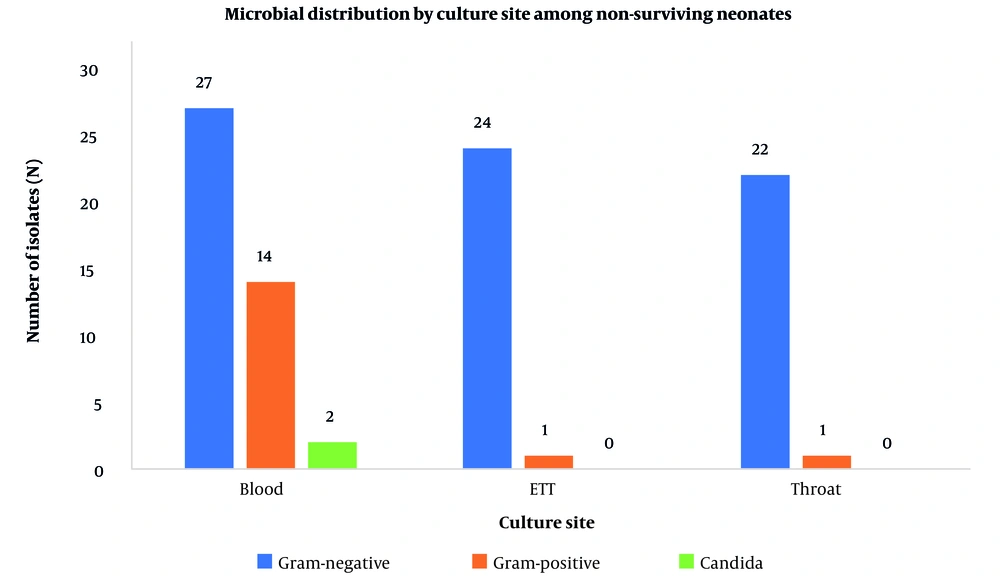
Distribution of microorganisms isolated from blood, endotracheal tube (ETT), and throat cultures among neonates who did not survive. Each bar represents the number of isolates (N) per culture site, categorized as Gram-negative, Gram-positive, or <i>Candida</i> species.
Figure 1.

Distribution of microorganisms isolated from blood, endotracheal tube (ETT), and throat cultures among neonates who did not survive. Each bar represents the number of isolates (N) per culture site, categorized as Gram-negative, Gram-positive, or Candida species.

5. Discussion

Healthcare-associated infections in neonates are a major concern, given their substantial impact on neonatal morbidity and mortality. Several risk factors influence the occurrence of these infections in neonatal intensive care units (NICUs). In our study, prolonged mechanical ventilation and the presence of a central line were associated with an increased risk of mortality, whereas higher birth weight (per gram increase) and the absence of pneumonia were linked to reduced mortality. Regarding predictors of hospital stay duration, the presence of a central line and pneumonia were associated with longer stays, while greater gestational age was linked to shorter hospitalization periods. Neonates, particularly those who are preterm or have low birth weight, are highly vulnerable to HAIs due to their underdeveloped immune systems and the frequent use of invasive medical devices.
In our study, 57% of HAIs were identified as BSIs. Bloodstream infections, especially central line-associated bloodstream infections (CLABSIs), represent the most common type of HAI in NICUs, accounting for about 70% of cases (15, 16). Pneumonia, particularly VAP, is another frequent HAI, typically caused by gram-negative bacteria (17, 18). In our findings, 30.8% of neonates developed VAP, and 89.3% of infections were attributed to gram-negative organisms. Perlman et al. reported that the use of central venous catheters was associated with a higher risk of bloodstream infection. Their analysis showed that catheter-related BSIs were more commonly attributed to Gram-positive organisms than gram-negative strains (77.1% vs. 61.4%). However, in their multivariable logistic regression model, neither ventilator use nor central line presence remained significant predictors when comparing gram-negative with gram-positive infections (19).
Gram-negative bacteria are recognized as the predominant causative agents of VAP in neonates. Multiple studies have consistently demonstrated that organisms such as Klebsiella pneumoniae, Escherichia coli, Pseudomonas aeruginosa, and Acinetobacter baumannii are the most frequently isolated pathogens from the aspirates of neonates diagnosed with VAP (20, 21). The elevated incidence of gram-negative bacterial VAP in neonates is largely attributed to risk factors such as prolonged mechanical ventilation, low birth weight, and the use of invasive medical devices (22). Although gram-positive bacteria, including Staphylococcus aureus and coagulase-negative staphylococci, are also implicated in neonatal VAP, their prevalence is generally lower compared to gram-negative organisms. Certain studies have suggested that Gram-positive pathogens may be more commonly isolated in specific subpopulations, such as extremely preterm infants (23). Nevertheless, the overall burden of VAP caused by Gram-positive bacteria remains less significant than that attributed to gram-negative organisms (24).
Our analysis demonstrated that gestational age, central line placement, and mechanical ventilation were not independently associated with the likelihood of gram-negative versus Gram-positive infection. This finding is consistent with previous neonatal studies indicating that while prematurity and invasive device use are well-established risk factors for hospital-acquired infections overall, they do not reliably predict the microbial class of the causative pathogen. Large surveillance studies have reported substantial variability in pathogen distribution across NICUs, suggesting that organism patterns are more strongly influenced by unit-specific factors such as local microbial ecology, antibiotic utilization, and infection control practices rather than individual patient characteristics alone (25). Similarly, studies focusing on neonatal BSIs have shown that exposure to central venous catheters and mechanical ventilation increases infection risk but does not consistently favor gram-negative over Gram-positive organisms (26). International surveillance data further support the role of institutional factors in shaping pathogen profiles across NICUs (27). Together, these findings underscore the multifactorial nature of pathogen distribution in NICUs and highlight the importance of ongoing local microbiological surveillance to guide empiric antimicrobial therapy.
In our study, each additional day of central line placement was associated with a reduced odds of pneumonia compared with bloodstream infection, indicating a relative shift in infection risk toward BSI with increasing central venous catheter exposure. This finding is consistent with existing evidence demonstrating that longer central line duration is robustly associated with an increased risk of CLABSI and overall nosocomial infections (28, 29), whereas the risk of pneumonia is primarily driven by the duration and use of mechanical ventilation (30). Neonates with prolonged central venous catheter (CVC) use often overlap with mechanically ventilated patients, potentially compounding infection risk through multiple invasive devices; however, available literature does not support a direct causal relationship between CVC duration and the development of pneumonia. Collectively, these findings suggest that device-specific exposure is the predominant determinant of infection type in the NICU, underscoring the importance of targeted prevention strategies tailored to individual devices rather than assuming uniform risk across different nosocomial infections.
The mortality rate associated with VAP in neonates remains notably high, irrespective of the causative microorganism. In the present study, neonates who required mechanical ventilation and subsequently developed VAP demonstrated a 14.1-fold increased risk of mortality compared to those without VAP. Previous studies have reported mortality rates for neonatal VAP ranging from 14.3% to 50%, with no significant differences observed between infections caused by gram-negative and Gram-positive organisms (31, 32). A prospective study of 140 NICU admissions found VAP in 27.2% (38 cases), with in-hospital mortality of 65% in the VAP group versus 25.5% in non-VAP (P < 0.001, significant increase) (33). Mir et al. also reported that among 96 ventilated neonates, VAP occurred in 33.3% (32 cases). The mortality rate was higher in the VAP group compared to non-VAP infants (28.1% vs. 21.8%), although this difference did not reach statistical significance (34). Nevertheless, the emergence of multidrug-resistant (MDR) gram-negative bacteria, particularly Acinetobacter baumannii and Pseudomonas aeruginosa, has been associated with poorer clinical outcomes and elevated mortality rates (35).
This study was conducted in a major neonatal referral center in southern Iran, which enhances the representativeness of the data and supports the generalizability of findings to a broader neonatal population. Another strength lies in the comprehensive data collection process and the systematic follow-up of all culture results, ensuring a reliable assessment of infection patterns and outcomes. Nonetheless, several limitations should be acknowledged. First, denominator data such as total admissions, patient-days, and device-days were unavailable, preventing the calculation of incidence density, device utilization ratios, and standardized infection ratios, thereby limiting benchmarking across NICUs. Second, although VAP was defined using combined clinical, radiographic, and microbiological criteria, the reliance on non-sterile ETT and throat cultures may have introduced some misclassification between colonization and true infection. Third, as a single-center study conducted within hospitals affiliated with one university, the findings may not be fully generalizable to other NICUs with different patient populations, infection control policies, or antibiotic resistance profiles. Fourth, some variables had incomplete data, and denominators varied across tables, which may have slightly influenced the comparative analyses. Fifth, continuous predictors such as birth weight were analyzed on a small scale, and the length of stay distribution may not have met all statistical assumptions. Additionally, detailed antibiogram data and antimicrobial resistance patterns were not consistently available and therefore could not be analyzed, limiting pathogen-specific treatment insights.
Finally, while this study provides valuable insights into neonatal infections and associated factors, future multicenter studies incorporating denominator-based infection metrics and long-term follow-up — such as neurodevelopmental outcomes — are warranted to strengthen external validity and clinical applicability. Incorporation of comprehensive antibiogram and antimicrobial resistance surveillance is strongly recommended, particularly in settings such as Iran where high levels of antimicrobial resistance pose a significant clinical and public health challenge. Such data would substantially enhance infection control strategies and guide empiric and targeted antibiotic therapy in NICUs.
As a retrospective study, this research is subject to certain biases. Selection bias may have occurred due to the inclusion of only cases with complete records, potentially missing milder infections. Information and misclassification biases are also possible because of reliance on medical records and challenges distinguishing true infection from colonization, particularly in VAP cases. Additionally, variations in clinical practice and infection control measures could have introduced confounding. Despite efforts to reduce these limitations through standardized definitions and careful data collection, these potential biases should be considered when interpreting the results.
In conclusion, HAIs are a significant cause of morbidity and mortality in neonates. Since many HAIs are preventable, it is crucial to understand the epidemiologic factors associated with these infections in different NICUs in order to develop effective guidelines and preventive strategies. Our study highlights the important role of invasive procedures, such as central line placement and mechanical ventilation, in contributing to mortality among affected neonates. Furthermore, by identifying the prevalent microorganisms, we can better plan and select appropriate empiric antibiotic therapies tailored to the specific microbial patterns observed in each center. In our study, Gram-positive bacteria were slightly more common in BSIs, whereas gram-negative bacteria were clearly predominant among cases of VAP.

Acknowledgments

Footnotes

References

  • 1.
    Centers for Disease Control and Prevention (CDC). Healthcare-associated infections (HAIs). 2023. Available from: https://www.cdc.gov/hai/index.html.
  • 2.
    Polin RA, Denson S, Brady MT, Committee on Fetus, Newborn, Committee on Infectious Diseases, et al. Epidemiology and diagnosis of health care–associated infections in the NICU. Pediatrics. 2012;129(4):e1104-9.
  • 3.
    Nagata E, Brito AS, Matsuo T. Nosocomial infections in a neonatal intensive care unit: incidence and risk factors. Am J Infect Control. 2002;30(1):26-31. [PubMed ID: 11852413]. https://doi.org/10.1067/mic.2002.119823.
  • 4.
    Peng H, Tao XB, Li Y, Hu Q, Qian LH, Wu Q, et al. Health care-associated infections surveillance in an intensive care unit of a university hospital in China, 2010-2014: Findings of International Nosocomial Infection Control Consortium. Am J Infect Control. 2015;43(12):e83-5. [PubMed ID: 26315060]. https://doi.org/10.1016/j.ajic.2015.07.023.
  • 5.
    Crivaro V, Bogdanovic L, Bagattini M, Iula VD, Catania M, Raimondi F, et al. Surveillance of healthcare-associated infections in a neonatal intensive care unit in Italy during 2006-2010. BMC Infect Dis. 2015;15:152. [PubMed ID: 25885702]. [PubMed Central ID: PMC4374496]. https://doi.org/10.1186/s12879-015-0909-9.
  • 6.
    Jansen SJ, Lopriore E, van der Beek MT, Veldkamp KE, Steggerda SJ, Bekker V. The road to zero nosocomial infections in neonates-a narrative review. Acta Paediatr. 2021;110(8):2326-35. [PubMed ID: 33955065]. [PubMed Central ID: PMC8359829]. https://doi.org/10.1111/apa.15886.
  • 7.
    Gaur AH, Bundy DG, Werner EJ, Hord JD, Miller MR, Tang L, et al. A Prospective, Holistic, Multicenter Approach to Tracking and Understanding Bloodstream Infections in Pediatric Hematology-Oncology Patients. Infect Control Hosp Epidemiol. 2017;38(6):690-6. [PubMed ID: 28399945]. https://doi.org/10.1017/ice.2017.57.
  • 8.
    Zingg W, Hopkins S, Gayet-Ageron A, Holmes A, Sharland M, Suetens C, et al. Health-care-associated infections in neonates, children, and adolescents: an analysis of paediatric data from the European Centre for Disease Prevention and Control point-prevalence survey. Lancet Infect Dis. 2017;17(4):381-9. [PubMed ID: 28089444]. https://doi.org/10.1016/S1473-3099(16)30517-5.
  • 9.
    Miliaraki M, Katzilakis N, Chranioti I, Stratigaki M, Koutsaki M, Psarrou M, et al. Central line-associated bloodstream infection in childhood malignancy: Single-center experience. Pediatr Int. 2017;59(7):769-75. [PubMed ID: 28376269]. https://doi.org/10.1111/ped.13289.
  • 10.
    Rangelova VR, Raycheva RD, Kevorkyan AK, Krasteva MB, Kalchev YI. Ventilator-Associated Pneumonia in Neonates Admitted to a Tertiary Care NICU in Bulgaria. Front Pediatr. 2022;10:909217. [PubMed ID: 35837238]. [PubMed Central ID: PMC9273943]. https://doi.org/10.3389/fped.2022.909217.
  • 11.
    Mobley RE, Bizzarro MJ. Central line-associated bloodstream infections in the NICU: Successes and controversies in the quest for zero. Semin Perinatol. 2017;41(3):166-74. [PubMed ID: 28411947]. https://doi.org/10.1053/j.semperi.2017.03.006.
  • 12.
    Sagana R, Hyzy RC. Achieving zero central line-associated bloodstream infection rates in your intensive care unit. Crit Care Clin. 2013;29(1):1-9. [PubMed ID: 23182523]. https://doi.org/10.1016/j.ccc.2012.10.003.
  • 13.
    Rosenthal VD, Al-Abdely HM, El-Kholy AA, AlKhawaja SAA, Leblebicioglu H, Mehta Y, et al. International Nosocomial Infection Control Consortium report, data summary of 50 countries for 2010-2015: Device-associated module. Am J Infect Control. 2016;44(12):1495-504. [PubMed ID: 27742143]. https://doi.org/10.1016/j.ajic.2016.08.007.
  • 14.
    Venturini E, Montagnani C, Benni A, Becciani S, Biermann KP, De Masi S, et al. Central-line associated bloodstream infections in a tertiary care children's University hospital: a prospective study. BMC Infect Dis. 2016;16(1):725. [PubMed ID: 27903240]. [PubMed Central ID: PMC5131534]. https://doi.org/10.1186/s12879-016-2061-6.
  • 15.
    Kilic A, Okulu E, Kocabas BA, Alan S, Cakir U, Yildiz D, et al. Health care-associated infection surveillance: A prospective study of a tertiary neonatal intensive care unit. J Infect Dev Ctries. 2019;13(3):181-7. [PubMed ID: 32040446]. https://doi.org/10.3855/jidc.10688.
  • 16.
    Moses* SS, Kuruvilla TS, B K P. Clinico-microbiological profile of healthcare associated infections in a neonatal intensive care unit and its relation with environmental surveillance. Panacea Journal of Medical Sciences. 2023;13(1):36-41. https://doi.org/10.18231/j.pjms.2023.008.
  • 17.
    Folic N, Djordjevic Z, Folic M, Markovic S, Vuletic B, Savic D, et al. Hospital-Acquired Pneumonia in Newborns with Birth Weight Less Than 1500 Grams: Risk Factors and Causes. Serbian Journal of Experimental and Clinical Research. 2016;17(4):327-32. https://doi.org/10.1515/sjecr-2016-0057.
  • 18.
    Choobdar F, Vahedi Z, Khosravi N, Khalesi N, Javid A, Shojaee S. Nosocomial Infection in an Iranian Neonatal Intensive Care Unit: Hospital Epidemiology and Risk Factors. Archives of Pediatric Infectious Diseases. 2020;8(4). https://doi.org/10.5812/pedinfect.96850.
  • 19.
    Perlman SE, Saiman L, Larson EL. Risk factors for late-onset health care-associated bloodstream infections in patients in neonatal intensive care units. Am J Infect Control. 2007;35(3):177-82. [PubMed ID: 17433941]. [PubMed Central ID: PMC2094724]. https://doi.org/10.1016/j.ajic.2006.01.002.
  • 20.
    Afjeh SA, Sabzehei MK, Karimi A, Shiva F, Shamshiri AR. Surveillance of ventilator-associated pneumonia in a neonatal intensive care unit: characteristics, risk factors, and outcome. Arch Iran Med. 2012;15(9):567-71. [PubMed ID: 22924377].
  • 21.
    Oboodi R, Hashemi Z, Jaafarzadeh E, Yazdani N, Barzegar H. Bacterial Etiology and Antibiotic Susceptibility Profile in Neonatal Sepsis. Archives of Pediatric Infectious Diseases. 2024;12(1). https://doi.org/10.5812/apid-136487.
  • 22.
    Afify M, AI-Zahrani S, Nouh MA. Risk Factors for the Development of Ventilator-Associated Pneumonia in Critically-III Neonates. Life Science Journal-Acta Zhengzhou University Overseas Edition. 2012;9(1):302-7.
  • 23.
    Huang J, Cayabyab R, Cielo M, Ramanathan R. Incidence, Risk Factors, Short-term Outcomes, and Microbiome of Ventilator-associated Pneumonia in Very-low-birth-weight Infants: Experience at a Single Level III Neonatal Intensive Care Unit. Pediatr Infect Dis J. 2024;43(11):1083-9. [PubMed ID: 38900079]. https://doi.org/10.1097/INF.0000000000004440.
  • 24.
    Monteiro-Neto V, Lima-Neto LG, Abreu AG, Monteiro CRA. Microbiology of Ventilator-Associated Pneumonia. Contemporary Topics of Pneumonia. 2017. https://doi.org/10.5772/intechopen.69430.
  • 25.
    Stoll BJ, Hansen N, Fanaroff AA, Wright LL, Carlo WA, Ehrenkranz RA, et al. Late-onset sepsis in very low birth weight neonates: the experience of the NICHD Neonatal Research Network. Pediatrics. 2002;110(2 Pt 1):285-91. [PubMed ID: 12165580]. https://doi.org/10.1542/peds.110.2.285.
  • 26.
    Tsai MH, Chu SM, Hsu JF, Lien R, Huang HR, Chiang MC, et al. Risk factors and outcomes for multidrug-resistant Gram-negative bacteremia in the NICU. Pediatrics. 2014;133(2):e322-9. [PubMed ID: 24420803]. https://doi.org/10.1542/peds.2013-1248.
  • 27.
    Rosenthal VD, Bijie H, Maki DG, Mehta Y, Apisarnthanarak A, Medeiros EA, et al. International Nosocomial Infection Control Consortium (INICC) report, data summary of 36 countries, for 2004-2009. Am J Infect Control. 2012;40(5):396-407. [PubMed ID: 21908073]. https://doi.org/10.1016/j.ajic.2011.05.020.
  • 28.
    Couto RC, Pedrosa TM, Tofani Cde P, Pedroso ER. Risk factors for nosocomial infection in a neonatal intensive care unit. Infect Control Hosp Epidemiol. 2006;27(6):571-5. [PubMed ID: 16755475]. https://doi.org/10.1086/504931.
  • 29.
    Urzedo JE, Levenhagen MM, Pedroso RS, Abdallah VO, Sabino SS, Brito DV. Nosocomial infections in a neonatal intensive care unit during 16 years: 1997-2012. Rev Soc Bras Med Trop. 2014;47(3):321-6. [PubMed ID: 25075483]. https://doi.org/10.1590/0037-8682-0101-2014.
  • 30.
    Scamardo MS, Dolce P, Esposito EP, Raimondi F, Triassi M, Zarrilli R. Trends, risk factors and outcomes of healthcare-associated infections in a neonatal intensive care unit in Italy during 2013-2017. Ital J Pediatr. 2020;46(1):34. [PubMed ID: 32183842]. [PubMed Central ID: PMC7079437]. https://doi.org/10.1186/s13052-020-0799-3.
  • 31.
    Fallahi M, Sanaee A, Naeempour N, Bassir M, Ghadamli P. Ventilator-Associated Pneumonia in Hospitalized Newborns in a Neonatal Intensive Care Unit. Archives of Pediatric Infectious Diseases. 2014;2(1). https://doi.org/10.5812/pedinfect.16514.
  • 32.
    Vijayakanthi N, Kitchanan S, Arasan D. Ventilator associated pneumonia (VAP) in neonatal intensive care unit--an emerging problem. Indian J Pediatr. 2015;82(1):96. [PubMed ID: 25186568]. https://doi.org/10.1007/s12098-014-1561-x.
  • 33.
    Gohr AR, El Tayeb A, Shalaby A. An Observational Study on Ventilator-Associated Pneumonia as a Cause for Nosocomial Infection in Mechanically Ventilated Neonates. Annals of Neonatology Journal. 2021;0(0):0. https://doi.org/10.21608/anj.2021.56811.1019.
  • 34.
    Mir Z, Ali I, Qureshi O, Wani G. Risk factors, pathogen profile and outcome of ventilator associated pneumonia in a Neonatal intensive care unit. International Journal of Contemporary Pediatrics. 2015;2(1). https://doi.org/10.5455/2349-3291.ijcp20150204.
  • 35.
    Celik IH, Oguz SS, Demirel G, Erdeve O, Dilmen U. Outcome of ventilator-associated pneumonia due to multidrug-resistant Acinetobacter baumannii and Pseudomonas aeruginosa treated with aerosolized colistin in neonates: a retrospective chart review. Eur J Pediatr. 2012;171(2):311-6. [PubMed ID: 21809011]. https://doi.org/10.1007/s00431-011-1537-z.

Crossmark
Crossmark
Checking
Share on
Cited by
Metrics

Purchasing Reprints

  • Copyright Clearance Center (CCC) handles bulk orders for article reprints for Brieflands. To place an order for reprints, please click here (   https://www.copyright.com/landing/reprintsinquiryform/ ). Clicking this link will bring you to a CCC request form where you can provide the details of your order. Once complete, please click the ‘Submit Request’ button and CCC’s Reprints Services team will generate a quote for your review.
Search Relations

Author(s):

Related Articles