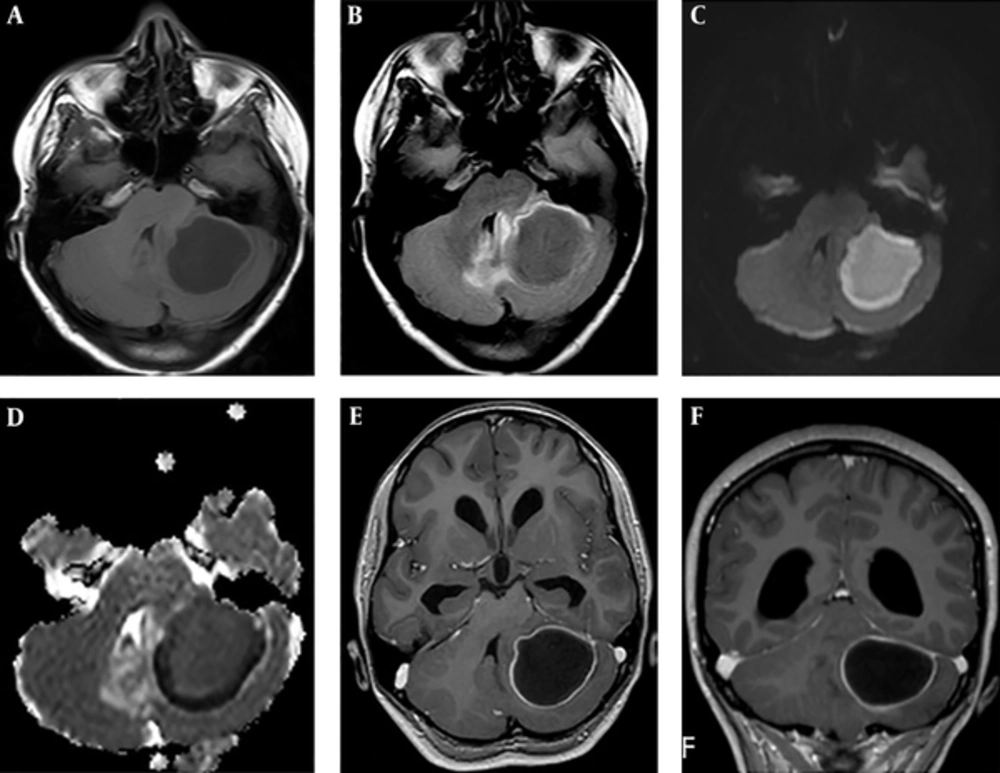
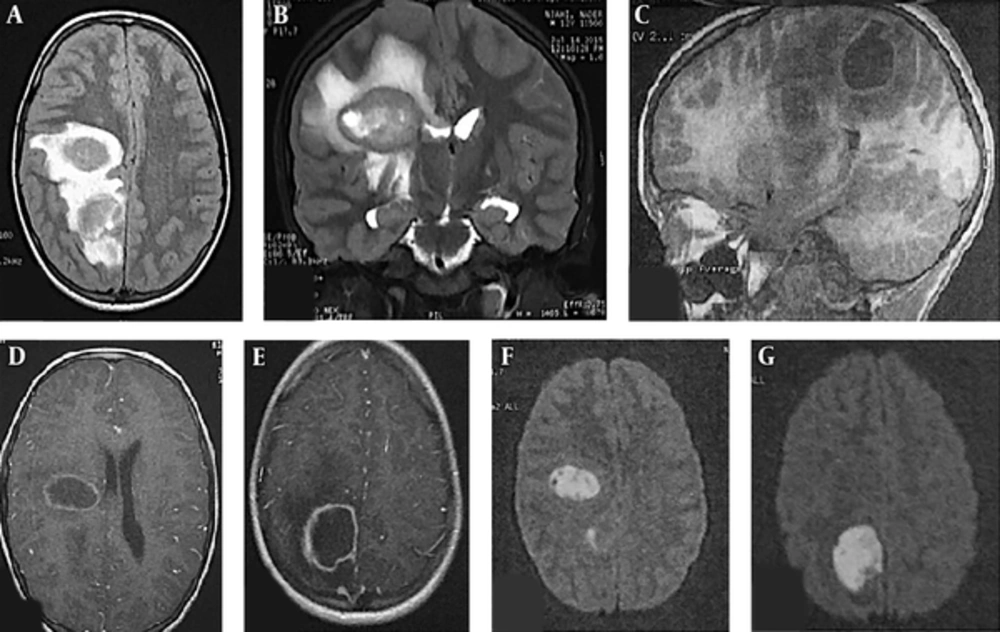
The presentation of BA in infants is not specific (
4,
5). However, headache, fever and vomiting, each occur in 60% to 70% of the patients (
6,
7). The clinical manifestations in the current patients were compatible with the results of a number of other analogous studies (
4,
7-
9).
The most common underlying conditions in developed countries are sub-acute and chronic otitis media, mastoiditis, and congenital heart disease. However, their role has declined with the introduction of pneumococcal vaccination and administration of antimicrobial therapy for ear infections (
10). In Tunisia, pneumococcal vaccination is still not introduced in infant immunization programs. A predisposing factor was identified in 82.9% of patients. In contrast to the most commonly described predisposing factors, meningitis and sinusitis were the most common predisposing factors followed by CCHD, in discordance with most published reports (
1,
4). This cannot be explained by the high rate of CCHD in Tunisia. In fact, birth incidence of CCHD in the Tunisian population is in line with the general estimates in the world. However, a high rate of mortality (23%) was reported because of the lack of medical and surgical care (
11). Differences between studies may also be related to different patients recruitment with 35% of patients aged less than two years. In Tunisia, meningitis affects children less than two years old with relatively high frequency (
12).
An occipital dermal sinus and a congenital defect arising from neural tube closure failure, was identified in one case. A few cases of the association with BA have been reported (
13,
14). This underlines the importance of early detection of congenital dermal abnormalities along craniospinal axis by routine examination of newborns (
14).
The current patients had more frontal and parietal abscesses. This finding was similar to other studies (
1,
4,
15). The specificity of the current findings was a high rate of multiple BA (19.5%).
Negative cultures totaled 46.3%, with sterile pus found in 46%. It represents a high rate of sterile cultures that have been described in others studies (
4,
16,
17). There are different possible reasons for the high culture negative rate in the current series. First, abusive antibiotic use in Tunisia is common. Second, the intracranial pus samples may not have been transported to the microbiology laboratory quickly enough to be successfully analyzed. Third, before abscess fluid was sampled, 37% of the patients had undergone antimicrobial administration.
Nine (22%) of the patients had pathogens including Streptococcus and Staphylococcus in the cultures. Five (12.2%) of the patients had gram negative bacilli, in concordance with the literature (
1,
3). In children, the causative pathogens were aerobic and anaerobic streptococci (60% to 70% of cases), gram-negative anaerobic bacilli (20% to 40%) followed by
Enterobacteriaceae (20% to 30%) and
Staphylococcus aureus (10% to 15%) (
3).
The treatment of BA requires a combination of antimicrobials and surgical interventions (
7). Antibiotics are always necessary to manage BA, either alone or associated with surgical intervention (
18).
In the current study, 15 patients (36.5%) were treated with antimicrobial therapy alone. The current ratio represents a relatively high rate of isolated medical therapy. This may be explained by the difficulty in surgical drainage for multiple, small, and deeply localized BAs in Tunisian Surgical Departments. Recent studies (
4,
15) considered that surgical treatment should be attempted in all BA cases, except during the stage of cerebritis. This not only allows achievement of a reduction of the mass effect, yet also identifies infecting pathogens. Precocious culture of abscess material provided during surgery is the best opportunity to make a microbiological diagnosis (
15). However, surgery can be avoided by use of a minimally invasive radiologic method. Aspiration of the pus can be achieved through a burr hole under CT guided stereotaxy or real-time ultrasound (
19). Those modalities are not yet used in Tunisia.
The treatment duration was usually guided by regression of abscess as verified by CT or MRI (
19). In the current series, all patients had neuro-imaging follow-up. CT scan is a more available technique in Tunisia in emergency conditions and has been proved as a valuable asset in the diagnosis of BA. This imaging modality allows localization of the abscess and demonstration of any associated edema or mass effect. However, improvement in CT scans is generally observed within an average of 2.5 weeks and complete resolution of BA occurs in an average of 3.5 months. Radiographic abnormalities may persist for months after successful therapy, making useless the CT scan control before three weeks of intravenous antibiotic therapy (
9). Moreover, Park et al. demonstrated that MRI plus FDG-PET improved the accuracy of assessing therapeutic responses to antibiotics treatment of brain abscess and aided in optimizing therapy (
20).
There are a few recent recommendations about the duration of antibiotic therapy in the pediatric population. The standard duration of antibiotic therapy is four to six weeks (
3). Indeed, Helweg-Larsen et al. (
21) reported no cases of recurrence in patients with postsurgical antibiotic treatment limited to less than six weeks. However, Sharma et al. (
22) report an association of short duration (< 3 weeks) or choice of oral antibiotic therapy with recurrence of BA among eight patients. Recently, Chengyu Xia et al. (
18) showed that short-course intravenous antimicrobial administration in the adult population can be considered as a standard therapy for bacterial BA in the surgically treated group for 10 to 14 days. According to this data, the long duration of intravenous antibiotic therapy could be shortened. Neuro-imaging follow-up and the resolution of BA is a mandatory simultaneous condition. The emergence of imaging technologies, improved microbiological techniques, and prompt antibiotic and surgical management reduced mortality rates to 5% to 10% (
23). In the current series, there was a high rate of mortality (24%). However, mortality directly due to BA in the current series was 14.6%, similar to other studies (
1,
4).
The high rate mortality is attributed to the percentage of nosocomial bacteremia. The current findings highlight the need to intensify the fight against nosocomial infections in Pediatric Intensive Care Units, especially in developing country. The duration of hospitalization exposes to a high risk of nosocomial infections (
24). However, the choice between prolonged antimicrobial administration therapy with possible additive side effects and shorter duration of antibiotic therapy in children with possible higher rate of recurrence remains controversial.
5.1. Conclusion
Pediatric BA treatment is still a public health challenge in developing countries. Predisposing factors for BA in children are different depending on the health system development level. The mortality rate is still high in Tunisia with a high rate of nosocomial infections compared to a recent multicenter study (
25). The therapeutic strategy based on intravenous antibiotic therapy associated with the surgical intervention in some cases should be adapted to Tunisian context. The current study highlights the need for standardized national guidelines or adequate recommendations on type and especially intravenous duration of antibiotic treatment.
The most significant determinant of poor outcome was age of less than two years. However, the findings of results in this case series is limited by the selection biases inherent to a retrospective study and the number of patients.