
1. Background
Perianal abscess (PA) is a prevalent surgical condition in pediatric populations, particularly children under 24 months, with an estimated incidence of 0.5 - 2.3% (1-3). The definitive treatment for PA is drainage, but the choice of anesthesia, general anesthesia (GA) or local anesthesia (LA), is debated due to varying evidence regarding postoperative outcomes, recurrence rates, and procedural stress (4, 5). Studies indicate that surgical drainage under GA may reduce recurrence rates compared to LA, especially when concurrent fistulotomy is performed (4, 6). However, some research suggests that conservative management with LA can be effective, particularly in selected cases, leading to lower rates of fistula formation (7). The choice of anesthesia may also influence the child’s stress levels during the procedure, which is an important consideration in pediatric care (8).
General anesthesia provides complete immobility and effective pain control during procedures for perianal abscesses (PAs), but it is associated with risks such as respiratory complications and prolonged recovery times (9). In contrast, LA avoids systemic side effects and is generally safer, but it may be less effective in uncooperative pediatric patients, potentially resulting in incomplete drainage of the abscess (10). Recent studies have highlighted the cost-effectiveness of LA, as it often leads to shorter hospital stays compared to GA (11, 12). However, data specifically addressing pediatric outcomes with LA remain limited, making it challenging to draw definitive conclusions (4, 13). The choice between GA and LA should consider the individual patient’s needs, the complexity of the procedure, and the potential for postoperative complications.
2. Objectives
The present study aims to compare postoperative pain, complications, and recurrence rates between GA and LA in pediatric PA drainage.
3. Methods
3.1. Study Design
This retrospective cohort study was conducted at Hazrat Masoumeh Hospital, affiliated clinics, and a private physician’s office in Qom province, Iran. The study reviewed medical records of pediatric patients with PAs treated between 2012 and 2022.
3.2. Study Population
The study population comprised 426 children under 2 years of age diagnosed with PA who underwent surgical drainage at the participating institutions. All included cases had complete follow-up records for at least 6 months post-procedure.
3.2.1. Inclusion Criteria
- Age < 2 years at time of procedure
- First-time PA diagnosis
- Complete surgical and follow-up documentation
3.2.2. Exclusion Criteria
- Systemic diseases (leukemia, Hirschsprung disease, inflammatory bowel disease)
- Anorectal malformations
- Incomplete medical records
3.3. Anesthesia Protocol
3.3.1. Anesthesia Modality Selection Criteria
The choice between GA and LA was standardized according to institutional protocol based on the following criteria:
LA was indicated for:
- ASA physical status I patients
- Abscess diameter < 2 cm
- Non-fluctuant or minimally fluctuant abscesses
- Abscess location permitting adequate local infiltration
- Hemodynamically stable infants
GA was indicated for:
- ASA physical status II or higher
- Large abscesses (> 2 cm diameter)
- Deep-seated or complex abscess collections
- Patients requiring extensive exploration
- Failed LA attempt or patient intolerance
3.3.2. Local Anesthesia Protocol
For patients selected for LA, the following standardized protocol was implemented:
- Pre-anesthesia preparation: All patients received acetaminophen syrup (15 mg/kg) 30 - 45 minutes preoperatively. Non-pharmacological comfort measures including breastfeeding or sucrose solution were utilized where feasible.
- Technique: Following antisepsis with 2% chlorhexidine solution, local infiltration was performed using 1% lidocaine with epinephrine (1:100,000) surrounding the abscess periphery.
- Dosage: The maximum lidocaine dose was strictly limited to 4 mg/kg. The injection volume was titrated based on abscess size and patient weight.
- Monitoring: Continuous monitoring of heart rate, oxygen saturation, and respiratory rate was maintained throughout the procedure.
3.3.3. General Anesthesia Protocol
For patients requiring GA, a standardized protocol was followed:
- Pre-anesthesia: Patients fasted according to ASA guidelines (2 hours for clear liquids, 4 hours for breast milk).
- Induction: Inhalational induction with 8% sevoflurane in 100% oxygen via face mask.
- Maintenance: Anesthesia maintained with sevoflurane (2 - 3%) in oxygen-air mixture (FiO2 0.4).
- Adjuvants: Atracurium (0.5 mg/kg) for muscle relaxation and fentanyl (1 - 2 mcg/kg) for analgesia.
- Airway management: Endotracheal intubation or laryngeal mask airway based on surgical requirements and patient factors.
- Monitoring: Standard ASA monitoring including ECG, NIBP, SpO2, EtCO2, and temperature.
3.3.4. Conversion Protocol
Conversion from LA to GA was indicated for:
- Inadequate surgical anesthesia despite maximum safe local anesthetic dose
- Patient agitation or movement compromising surgical safety
- Procedural complications requiring extended operation time
- Development of respiratory compromise or hemodynamic instability
3.4. Data Collection
Data were systematically collected using a standardized checklist capturing:
- Demographic characteristics: Age, sex, weight, residence (urban/rural), caregiver employment status
- Clinical parameters: Abscess size, distance from anal verge, procedure time, ASA classification
- Anesthesia details: Type of anesthesia, agents used, dosages, duration, conversions
- Outcome measures: Healing time, recurrence rates, postoperative complications
- Monitoring data: Vital signs, adverse events, recovery parameters
3.5. Statistical Analysis
Statistical analysis was performed using SPSS version 22 (IBM Corp., Armonk, NY, USA). Descriptive statistics, including frequencies, percentages, and mean values with standard deviations, were calculated. A post-hoc power analysis confirmed adequate power (82.7%) to detect recurrence rate differences. Independent samples t-tests and chi-square tests were used for group comparisons. A P-value < 0.05 was considered statistically significant. We performed multivariable logistic regression to control for potential confounding effects. The model was constructed with abscess recurrence as the binary dependent variable and anesthesia type (with GA as the reference category), age (months), and abscess diameter (mm) as independent variables. Model fit was assessed using the Hosmer-Lemeshow test.
3.6. Ethical Considerations
This study was approved by the Institutional Review Board of Qom University of Medical Sciences (IR.MUQ.REC.1402.128). The requirement for informed consent was waived due to the retrospective design. All patient data were anonymized and maintained with strict confidentiality.
4. Results
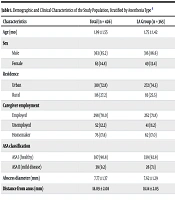
The study analyzed 426 medical records of pediatric patients (aged < 2 years) with PAs treated between 2012 and 2022. The analysis of additional socioeconomic and clinical severity factors revealed significant differences between the treatment groups (Table 1). A significantly larger proportion of patients in the GA group resided in rural areas (37.7% vs. 25.5%, P = 0.042) and had an ASA classification of II, indicating the presence of mild systemic disease (21.3% vs. 7.1%, P = 0.001). While not statistically significant, a trend was observed in caregiver employment status, with a higher percentage of unemployed caregivers in the GA group. These findings indicate that patients selected for GA generally had a higher comorbidity burden and potentially lower socioeconomic status.
Table 1.
Demographic and Clinical Characteristics of the Study Population, Stratified by Anesthesia Type a
| Characteristics | Total (n = 426) | LA Group (n = 365) | GA Group (n = 61) | P-Value |
|---|---|---|---|---|
| Age (mo) | 1.99 ± 1.55 | 1.75 ± 1.42 | 3.12 ± 1.89 | 0.001 b |
| Sex | 0.051 | |||
| Male | 363 (85.2) | 316 (86.6) | 47 (77.0) | |
| Female | 63 (14.8) | 49 (13.4) | 14 (23.0) | |
| Residence | 0.042 b | |||
| Urban | 310 (72.8) | 272 (74.5) | 38 (62.3) | |
| Rural | 116 (27.2) | 93 (25.5) | 23 (37.7) | |
| Caregiver employment | 0.098 | |||
| Employed | 298 (70.0) | 262 (71.8) | 36 (59.0) | |
| Unemployed | 52 (12.2) | 41 (11.2) | 11 (18.0) | |
| Homemaker | 76 (17.8) | 62 (17.0) | 14 (23.0) | |
| ASA classification | 0.001 b | |||
| ASA I (healthy) | 387 (90.8) | 339 (92.9) | 48 (78.7) | |
| ASA II (mild disease) | 39 (9.2) | 26 (7.1) | 13 (21.3) | |
| Abscess diameter (mm) | 7.77 ± 1.37 | 7.62 ± 1.29 | 8.45 ± 1.58 | 0.001 b |
| Distance from anus (mm) | 18.09 ± 2.08 | 18.14 ± 2.05 | 17.82 ± 2.31 | 0.265 |
Abbreviations: LA, local anesthesia; GA, general anesthesia; ASA, American Society of Anesthesiologists.
a Values are expressed as No. (%) or mean ± SD.
b P-values are from independent t-tests for continuous variables and chi-square tests for categorical variables. A P-value < 0.05 was considered statistically significant.
The study population was stratified into two treatment groups: Group 1 (LA) comprising 85.7% (n = 365) of cases and group 2 (GA) representing 14.3% (n = 61). Recurrence analysis revealed an overall abscess recurrence rate of 24.6% (n = 105), with significantly different rates between groups: 23.3% (n = 85) in the LA group compared to 32.8% (n = 20) in the GA group (P < 0.05) (Table 2).
Table 2.
Recurrence Rates by Treatment Group a
| Groups | No Recurrence | Recurrence | Total |
|---|---|---|---|
| LA | 280 (76.7) | 85 (23.3) | 365 |
| GA | 41 (67.2) | 20 (32.8) | 61 |
| Total | 321 (75.4) | 105 (24.6) | 426 |
Abbreviations: LA, local anesthesia; GA, general anesthesia.
a Values are expressed as No. (%).
New abscess formation at different locations occurred in only 3.8% (n = 16) of cases (Table 3).
Table 3.
New Abscess Formation by Treatment Group a
| Groups | No New Abscess | New Abscess | Total |
|---|---|---|---|
| LA | 351 (96.2) | 14 (3.8) | 365 |
| GA | 59 (96.7) | 2 (3.3) | 61 |
| Total | 410 (96.2) | 16 (3.8) | 426 |
Abbreviations: LA, local anesthesia; GA, general anesthesia.
a Values are expressed as No. (%).
A statistically significant age difference was observed between the groups (P = 0.001), with the GA group being generally older than the LA group. Second, while there was no significant difference in the abscess distance from the anus between groups (P > 0.05), the abscess diameter showed a significant variation (P = 0.001), with larger abscesses more commonly associated with the GA approach. Importantly, the analysis found no gender-based differences in treatment outcomes (P > 0.05), suggesting that sex did not influence the effectiveness of either anesthesia method (Table 4).
Table 4.
Comparison of Baseline Characteristics and Abscess Parameters Between Pediatric Patients Undergoing Perianal Abscess Drainage Under Local Versus General Anesthesia a
| Parameters | LA Group (n = 365) | GA Group (n = 61) | P-Value |
|---|---|---|---|
| Age (mo) | 1.75 ± 1.42 | 3.12 ± 1.89 | 0.001 b |
| Distance from anus (mm) | 18.14 ± 2.05 | 17.82 ± 2.31 | > 0.05 |
| Abscess diameter (mm) | 7.62 ± 1.29 | 8.45 ± 1.58 | 0.001 b |
| Gender distribution (male:female) | 316:49 | 47:14 | > 0.05 |
a Values are expressed as mean ± SD.
b A P-value < 0.05 was considered statistically significant.
The anatomical distribution analysis of PAs revealed distinct positional patterns among pediatric patients. As demonstrated in Table 5, the 3 o’clock position (right lateral) was the most frequent location, accounting for 23.2% of cases (n = 99), followed by the 9 o’clock position (left lateral) at 16.0% (n = 68). Together, these two locations represented nearly 40% of all abscess cases, suggesting a predilection for lateral positions in the perianal region (Table 5).
Table 5.
Anatomical Distribution of Abscesses
| Clock Position | No. (%) |
|---|---|
| 3 o’clock | 99 (23.2) |
| 9 o’clock | 68 (16.0) |
| Other positions | 259 (60.8) |
| Total | 426 (100.0) |
The results of multivariable logistic regression are presented in Table 6. Multivariable logistic regression analysis, adjusted for age and abscess diameter, revealed that although the overall model showed borderline statistical significance (P = 0.081), it demonstrated good fit (Hosmer-Lemeshow test, P = 0.899). In this adjusted model, LA was associated with a 34.7% reduction in recurrence risk compared to GA (adjusted odds ratio: 0.653, 95% confidence interval: 0.356 - 1.200). Although this association did not reach statistical significance (P = 0.170), the direction of the observed effect was consistent with our primary findings.
Table 6.
Multivariable Logistic Regression Analysis for Recurrence Risk
| Variables | aOR | 95% CI | P-Value |
|---|---|---|---|
| Anesthesia (LA vs. GA) | 0.653 | 0.356 - 1.200 | 0.170 |
| Age (per mo) | 0.852 | 0.725 - 1.001 | 0.051 |
| Abscess diameter (per mm) | 0.950 | 0.806 - 1.121 | 0.543 |
Abbreviations: LA, local anesthesia; GA, general anesthesia.
5. Discussion
The management of PA in infants, particularly the optimal choice of anesthesia for surgical drainage, remains a persistent clinical challenge. Our study found that the recurrence rate following treatment under GA was significantly higher than under LA (32.8% vs. 23.3%). This finding initially appears contradictory to studies such as Gong et al., which reported successful outcomes with surgical management under GA (6). However, a deeper analysis of key differences in surgical philosophy and patient demographics provides a compelling explanation for this apparent discrepancy.
The most significant explanatory factor is the difference in the rate of performing "fistulotomy" as part of the surgical procedure. Studies like Gong et al., which advocate for GA, typically routinely perform fistulotomy during surgery if a fistula tract is identified (6). This aggressive approach directly eliminates the primary pathophysiological cause of recurrence (i.e., the fistula tract). In contrast, the surgical protocol in the present cohort was based on conservatism and prioritizing sphincter preservation in very young infants. Consequently, the initial intervention in the GA group was primarily limited to simple abscess drainage, avoiding systematic fistulotomy. This fundamental difference in surgical technique — drainage alone versus drainage plus fistulotomy — directly impacts the disease’s recurrence potential.
Furthermore, patient selection was another determining factor. Our data indicate that the GA group consisted of significantly older infants (mean age 3.12 vs. 1.75 months) with larger abscesses (mean diameter 8.45 vs. 7.62 mm). This suggests that surgeons intuitively selected GA for more complex cases with a higher likelihood of fistulae. Therefore, the higher recurrence rate in the GA group likely more accurately reflects the more complex nature of the disease in this specific patient subgroup, rather than an inherent flaw in the anesthetic method itself. This argument is reinforced by the systematic review by Chen et al., which concluded, based on an analysis of 1,770 infant patients, that there are minimal differences in cure and recurrence rates between conservative and surgical approaches (14). This finding suggests that the characteristics of the disease itself may contribute more to determining the risk of recurrence than merely the type of intervention.
Emerging evidence from microbiome studies provides further mechanistic insight. The research by Ma et al. revealed a specific dysbiosis in the gut microbiota of children with PA, including a reduction in beneficial short-chain fatty acid-producing bacteria (such as Blautia and Faecalibacterium) (15). Such dysbiosis can create an inflammatory environment prone to recurrence. It is possible that our GA patients, who generally had more severe cases, suffered from a greater degree of this underlying dysbiosis, predisposing them to recurrence regardless of the anesthetic or surgical technique.
Our finding that 39.2% of abscesses were located at the 3 and 9 o’clock positions aligns with the recognized anatomical pattern of anal glands (16) and emphasizes the importance of careful examination of these areas. The safety advantages of LA observed in our study, including a low and similar rate of new abscess formation (3.8% overall), avoidance of GA-associated respiratory complications (17), and lower resource requirements, support its role as an effective and efficient first-line option for simple cases in healthy infants. This finding is consistent with previous studies confirming the safety and efficacy of LA for anorectal procedures (11, 18).
Based on the integration of our findings with existing evidence, we propose a stratified management algorithm to optimize treatment outcomes. Local anesthesia should be considered the first-line treatment for simple, uncomplicated PAs in healthy (ASA I) infants under 2 - 3 months of age, offering a favorable safety profile and comparable efficacy. For more complex presentations — including large abscesses (> 8 - 10 mm), cases with complex anatomical involvement, or failure of initial LA treatment — GA remains the preferred approach. In these complex cases managed under GA, careful intraoperative assessment for fistula presence is essential, with strong consideration given to performing concurrent fistulotomy when identified to address the underlying pathology and potentially reduce recurrence risk.
To address concerns about whether the observed association between anesthesia type and recurrence could be influenced by confounding factors, we performed multivariable logistic regression analysis. Although this analysis was not statistically significant, the trend toward reduced recurrence risk in the LA group persisted even after adjusting for age and abscess size. This finding supports the hypothesis that the advantage of LA in reducing recurrence cannot be explained solely by differences in age or abscess size. The lack of statistical significance in the multivariable analysis may be attributable to the limited sample size in the GA group.
5.1. Conclusions
This study demonstrates that LA is an effective and safe option for drainage of PA in infants with simple cases, while GA is more suitable for complex cases. The higher recurrence rate observed in the GA group likely reflects the selection of more complex cases for this method and the non-routine performance of fistulotomy during surgery, rather than an inherent deficiency in GA. The findings emphasize the importance of a stratified management approach based on patient characteristics (age, abscess size, complexity) and surgical philosophy. We suggest that LA be considered as the first line for simple cases in young, healthy infants, while GA is reserved for more complex cases. Future prospective studies employing standardized surgical protocols and clear fistulotomy criteria are essential to more precisely determine the role of anesthetic method in outcomes of infantile PA.
5.2. Limitations
This study has several limitations. Its retrospective design limits causal inference, and the unbalanced group sizes may affect the statistical power of comparisons. The lack of a standardized scoring system for abscess severity makes direct comparison of cases between groups challenging. Furthermore, the absence of quantitative postoperative pain assessment and the lack of standardized recording of fistula status during surgery are other limitations. Future prospective studies utilizing validated pain scales, standardized abscess severity systems, and clear protocols for reporting fistula status and performing fistulotomy are essential for further validating these findings. Although we used multivariable analysis to control for potential confounders, the non-significant results in this analysis may indicate insufficient statistical power due to the relatively small number of cases in the GA group.