



1. Background
Pneumonia is an inflammation of the lung parenchyma, and it is a leading cause of children’s morbidity and mortality worldwide, and along with diarrhea, is the most common cause of death in children in developing countries. Approximately 158 million cases of pneumonia occur worldwide, and 154 million are in developing countries. Pneumonia causes 29% of all deaths in children younger than 5 years worldwide (1).
Most cases of pneumonia are caused by microorganisms, but some noninfectious causes including aspiration of food or gastric foreign bodies, hydrocarbons, and hypersensitivity reactions to drugs or radiation-induced pneumonitis are also involved. Pneumonia and its causes are difficult to prove because lung tissue (biopsy) culture is an aggressive procedure and is rarely done. Streptococcus pneumoniae (pneumococcus) is the most common bacterial pathogen in children aged 3 months to 4 years, while Mycoplasma pneumoniae and Chlamydia pneumoniae are common pathogens in children older than 5 years. Viruses are the main causes of lower respiratory tract infections in children younger than 5 years (1).
An insufficient vitamin D level in the umbilical cord is associated with an increased risk of respiratory infection within the first 3 months of life and wheezing in early childhood (2). The prevalence of vitamin D deficiency is higher in patients with severe bronchiolitis (3). Also, insufficient serum level of vitamin D increases the risk of allergic and atopic diseases (4).
Studies over the past 20 years have shown the relationship between serum levels of vitamin D and an increased incidence and severity of TB infection. Vitamin D metabolism leads to activation of macrophages and inhibits intracellular growth of Mycobacterium tuberculosis (5).
Banajeh has reported that in patients with severe pneumonia, vitamin D deficiency is strongly related to neutropenia and hypoxia (oxygen saturation less than 88%) (6). In some studies, vitamin D deficiency was associated with an increased incidence of lower respiratory tract disease requiring hospitalization (severe pneumonia) (7). This is because vitamin D may play a role in activating the innate immune system. Innate immune system activates Kathelicidin (an endogenous antimicrobial peptide that attracts monocytes and neutrophils) and prevents viral and bacterial infections (8). The peak incidence of viral infections in the pediatric population is in the winter when skin synthesis of vitamin D is impaired (5).
2. Objectives
Given the importance and prevalence of pneumonia in children younger than 5 years and the possible role of vitamin D deficiency in developing pneumonia, and given that vitamin D deficiency is a common problem in developing countries including Iran, especially in cloudy and damp areas (9) like Guilan province, we conducted this case- control study to determine the serum vitamin D levels of children admitted in 17 Shahrivar hospital with pneumonia and compare them with a control group. Thus, if there is a relationship between vitamin D deficiency and development of pneumonia in children, it is reasonable to consider national training/ executive programs for careful use of vitamin D supplementation in infants, children, and even in pregnant women.
3. Methods
3.1. Study Population
In this case- control study, we reviewed children 3 months to 5 years with uncomplicated community-acquired pneumonia admitted in 17th Shahrivar Training hospital of Rasht, Guilan, Iran. The sampling method was simple sampling. Also, a control group was selected from healthy children of the same age who were referred for health control or vaccination and had no history of chronic diseases or growth disorders (their demographic characteristics are displayed in Table 1). According to the 2 groups mentioned above, and the 2 age groups in each of them, the total sample size was calculated using the following formula based on previous similar studies (10, 11), and 40 cases were determined in each group. Sample size was doubled to increase accuracy.
Table 1.Demographic Characteristics of Studied Children in the Two Groups with Pneumonia and Healthy Children (Control Group)a
| Characteristics | Groups | Healthy Children | Children with Pneumonia | Total | P Value |
|---|---|---|---|---|---|
| Sex | Boys | 22 (55) | 19 (47.5) | 41 (51.2) | 0.655 |
| Girls | 18 (45) | 21 (52.5) | 39 (48.8) | ||
| Total | 40 (100) | 40 (100) | 80 (100) | ||
| Age, mo | 3 - 23 | 20 (50) | 29 (72.5) | 49 (61.25) | 0.065 |
| 24- 60 | 20 (50) | 11 (27.5) | 31 (38.75) | ||
| Total | 40 (100) | 40 (100) | 80 (100) |
aValues are expressed as No. (%).
Number of Samples in Each Age Group

(α = 0.01, β = 0.1, µ = Mean serum levels of vitamin D, SD serum levels of vitamin D)
Children with chronic diseases, immune deficiencies, or growth disorders or those with a history of previous pneumonia were excluded from the study.
3.2. Study Design
Patient’s history was taken by a fixed trained resident of pediatrics. Children with underlying disease, history of asthma, history of chronic cardiopulmonary disease, gastroesophageal reflux disease, and rickets were excluded. Axillary temperature was measured by a standard mercury thermometer, and body temperature over 38 degrees Celsius was considered as fever. Patients’ oxygen saturation on room temperature was recorded by pulse oximetry, and oxygen saturation less than 95% in room temperature was considered as hypoxia. Children’s height and weight were measured and cases of failure to thrive (height-for-age and/ or weight-for-ageless than 3th percentile) were excluded. A chest radiograph was taken of all patients. Pneumonia was defined as presence of fever, cough, pulmonary crackles, and consolidation in chest x-ray (1).
Necessary data including age and sex were recorded in the questionnaire. In addition to the standard treatment of pneumonia, serum levels of vitamin D were measured. Then, informed consent was obtained from parents. Acquired samples were sent to the laboratory reference unit and serum levels of vitamin D [25(OH) D] were measured by chemiluminescence method. Level of 32 nanograms per milliliter (80 nmol per liter) or more was considered normal and less as vitamin D deficient (12).
3.3. Statistical Analysis
Mean serum levels of vitamin D in patients with pneumonia and control groups were compared using t test. Distribution of vitamin D status (low or normal) in patients with pneumonia and control groups was analyzed using Chi- square test.
3.4. Ethics
The study was approved by the research and ethics committee of Guilan University of Medical Sciences and after providing adequate explanation about the study, voluntary written informed consent was obtained from parents of children enrolled in the study. There was no compulsion to participate in the study and all necessary treatments were done for the patients as a routine. All patients’ information is kept confidential. Finally, vitamin D was administered to those children with vitamin D deficiency.
4. Results
In this study, 40 children with pneumonia aged 3 months to 5 years (19 males and 21 females) and 40 cases as the control group in the same age range (22 males and 18 females) were enrolled in this study. Demographic distribution of children in the 2 study groups are presented in Table 1.
Mean serum level of vitamin D in the group with pneumonia was 26.16 ± 15.2 ng/mL and it was 30.45 ± 15.69 ng/mL in the control group. Mean serum level of vitamin D in children with pneumonia was lower than the control group, but this difference was not statistically significant at the 95% confidence interval and 5% error level (t test, P value = 0.218).
In the group with pneumonia, 27 patients had vitamin D deficiency (serum level less than 32 ng/mL) and 13 patients had normal serum vitamin D level (serum level equal 32 ng/mL and more). In the control group, 23 patients had vitamin D deficiency and 17 had normal serum vitamin D level. Prevalence of vitamin D deficiency among patients with pneumonia and healthy children (control group) was not significantly different, meaning that there was no significant relationship between vitamin D deficiency and the incidence of pneumonia in children (Chi- square test, P value = 0.624).
Mean serum level of vitamin D in males with pneumonia and the control group was 29.34 ± 16.65 and 29.69 ± 15.23, respectively. Mean serum level of vitamin D in females with pneumonia and the control group was 23.28 ± 13.53 and 31.38 ± 16.63, respectively. There was no significant difference between the mean serum levels of vitamin D in healthy males and those with pneumonia (t test, P value = 0.945), and neither in females (t test, P value = 0.108).
In the 3 to 23 months age group, the mean serum level of vitamin D in the group with pneumonia was lower than the control group (29.72 ± 15.2 ng/mL and 38.86 ± 16.82 ng/mL, respectively), but the difference was not significant (t test, P value = 0.051).
Asdisplayed in Figure 1, in 24 to 60 months age group, the mean serum level of vitamin D in the group with pneumonia was significantly lower than the control group (13.9 ± 5.48 ng/mL and 22.05 ± 8.58 ng/mL, respectively- t test, P value = 0.015).
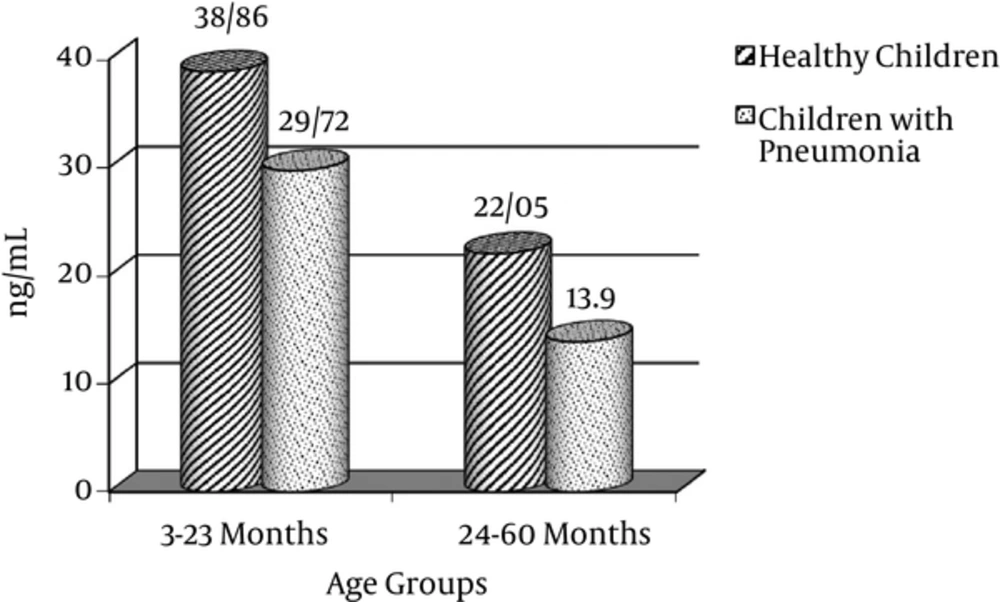
Figure 1.
Comparison of Serum Levels of Vitamin D in Children Hospitalized with Pneumonia and Healthy Children Divided Into Age Groups
5. Discussion
In this study, 67.5% of the patients with pneumonia and 57.5% of the control group had vitamin D deficiency (serum level less than 32 ng/mL). These findings indicate that in this area, vitamin D deficiency may be a common problem in children younger than 5 years and this may be associated with cloudy conditions of this area. Kashi et al. in a study in Sari, Iran, found that in humid and cloudy climates, even in the summer, exposure to sunlight is low (probably because people avoid standing outdoors due to the heat and humidity of the air), and so in these areas vitamin D deficiency is common in the summer as well as the winter (9).
In this study, a mean serum level of vitamin D in children with pneumonia was not significantly different from that of the control group. Similar results were also reported by Nally et al. (13). However, Oduwole et al. have reported that the mean serum level of vitamin D in children with pneumonia was lower than that of the control group (14).
At age 3 to 23 months, the mean serum level of vitamin D in the group with pneumonia was lower than the control group (29.72 and 38.86 ng/mL, respectively), but this difference was not statistically significant (P value = 0.051). Roth et al. in a study conducted in Bangladesh reported that serum levels of vitamin D in children aged 1 to 18 months with pneumonia were significantly lower than that of the control group (15). The difference between the results of these studies may be due to vitamin D supplementation (400 IU/daily) provided to infants younger than 24 months, implemented by Iran national program that makes vitamin D levels in this age group higher than the 24 to 60 months age group. A possible reason for the vitamin D deficiency in these children, despite the national program of prevention, is the improper use of medication or lack of parent’s compliance.
In this study, the mean serum level of vitamin D in patients with pneumonia aged 24 to 60 months was lower than that of the control group (13.9 and 22.05 ng/mL, respectively), and this difference was statistically significant (P value = 0.015). It seems that in this age group, vitamin D deficiency is associated with a greater incidence of pneumonia. Alabama et al. in a study in Egypt found that serum level of vitamin D in children aged 2 to 5 years with pneumonia was lower than that of the control group (10). Serum levels of vitamin D of patients with pneumonia and the control group children aged 24 to 60 months were lower than those aged 3 to 23 months. The reason for this stance may be Iran National Program for prophylactic administration of vitamin D that focuses on children less than 2 years. Considering the common vitamin D deficiency in children over 24 months who do not receive vitamin D supplements routinely, the national prophylactic program seems to be necessary for these children. Interestingly, Bergman and et al. performed a systematic review and meta-analysis to assess the preventive effect of vitamin D supplementation on RTI. They concluded that vitamin D has a protective effect against RTI, and dosing once-daily seems most effective, but due to the heterogeneity of included studies and possible publication bias in the field, these results should be interpreted cautiously (16).
In our study, the mean serum level of vitamin D in children with pneumonia, both females or males, was not significantly different from that of the control group.
5.1 Conclusion
According to our study, it appears that vitamin D deficiency is a common problem in Guilan province which is more common in children aged over 2 years. Although a community based study in this area is needed to prove our results, this finding beside detecting a significant difference in vitamin D levels between the 2 groups of patients with pneumonia and healthy children aged 24 to 60 months, makes it a cause for concern, and thus it may be necessary that these children receive adequate amounts of vitamin D (such as continuing the national preventive program of vitamin D deficiency with vitamin D supplements after infancy).

