The SARS-CoV-2 pandemic has greatly affected global health and economies. The emergence of the new Omicron variant poses challenges for public health systems worldwide (
24). The primary objective of this study was to examine the impact of COVID-19 vaccination on the mortality rates of hospitalized patients infected with the Omicron strain. Even as three years have elapsed since the onset of the COVID-19 pandemic and extensive vaccination campaigns have been carried out, assessing the efficacy of various vaccine formulations remains pivotal, not only for the current pandemic but also for potential future outbreaks of similar diseases.
In our investigation, we meticulously considered several confounding variables, including age, gender, blood oxygen levels (SpO2), and the duration of hospitalization. To comprehensively account for the diversity of vaccines administered, we categorized them into two groups: Vector-based and non-vector-based. Additionally, we introduced a vaccine type variable, which was a function of both the number of vaccine doses received and the specific vaccine type, into our logistic model.
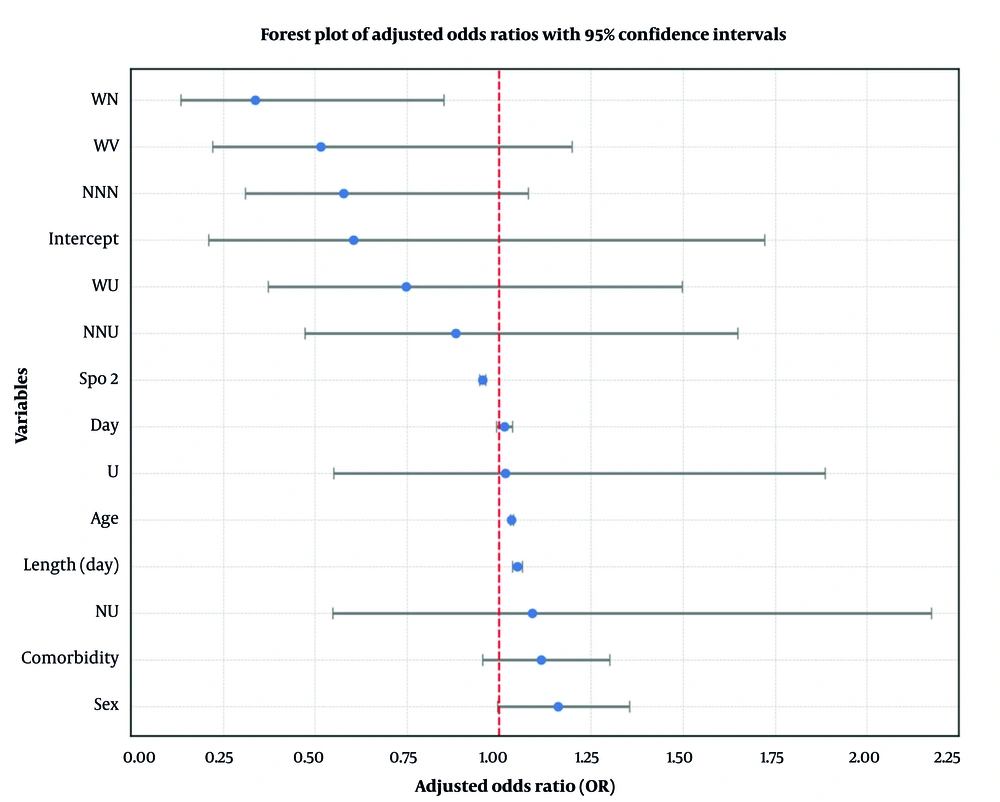
Our findings align with prior research, such as the meta-analysis conducted by Romero Starke et al., which highlighted the undeniable association between age and COVID-19 mortality. In this study, age emerged as a statistically significant factor (P < 0.001), with each year of increasing age correlating with a 3% higher likelihood of mortality among hospitalized COVID-19 patients (
25). Our study investigated the relationship between COVID-19 mortality, age, and vaccine administration, unlike Romero Starke et al.’s (
25) meta-analysis, which did not consider the vaccine variable. We found a significant association between age and COVID-19 mortality (P < 0.001).
Similarly, the study by Pan et al., which centered on 124 hospitalized COVID-19 patients, emphasized the significance of SpO
2 alongside variables like age, high blood pressure, and diabetes (
26). Our research corroborated these findings, revealing that for every incremental unit increase in SpO
2, the survival rate surged by a substantial 74% (P < 0.001).
However, our study introduced a novel perspective by examining the influence of hospitalization duration. Contrary to expectations, we observed that each additional day spent in the hospital amplified the chance of death by 5%. This may be attributed to sicker patients being more prone to extended hospital stays and consequently facing an elevated risk of contracting hospital-acquired infections (P < 0.001). Intriguingly, a study by da Costa Sousa et al. contradicted our findings, suggesting that longer hospital stays might actually diminish the likelihood of death (
27).
Based on the data analysis, there was no notable discrepancy in the mortality rates of men and women who contracted COVID-19 (P = 0.06). Furthermore, the duration of hospital stays after the onset of symptoms did not have a significant effect on the probability of death (P = 0.13). When scrutinizing the impact of vaccine dosing, our research revealed that receiving a single vaccine dose did not yield a statistically significant reduction in COVID-19-related deaths (P = 0.85). Furthermore, due to the initial predominance of non-vector vaccines in Iran, we were unable to compare the outcomes of a single dose of a non-vector vaccine with that of a single dose of a vector-based vaccine.
The study conducted by Corchado-Garcia et al. in 2021 revealed interesting findings about the effectiveness of the vector-based vaccine Ad26.COV2.S (
28). While their research focused on the risk of infection, our study went further by analyzing mortality outcomes. Despite these findings, our study detected no significant difference in the death rates between those who received two doses of vector-based vaccines, those who received two doses of non-vector-based vaccines, and the unvaccinated (P = 0.059 and P = 0.229, respectively). However, the unvaccinated group showed a slight trend toward significance when it came to those who had received two vaccine doses (
Table 6).
A study conducted by Sirison et al. in 2023, examining the cost-effectiveness of booster doses during the Omicron variant epidemic, yielded noteworthy insights. Their research explored three scenarios: No booster, a vector-based booster dose, and an mRNA booster dose, and revealed a threefold reduction in mortality rates in scenarios involving viral vector and mRNA boosters compared to the non-booster scenario (
29). In our study, the ratios of death for individuals who received two doses of vector-based vaccines and a vector-based booster, as well as those who received two doses of non-vector-based vaccines and a non-vector-based booster, were found to be significantly reduced (P = 0.013 and P < 0.001, respectively) compared to the unvaccinated.
Lastly, we delved into the impact of comorbidities on the mortality of COVID-19 patients, considering numerous studies on the subject. Our investigation assessed vaccine efficacy while controlling for the presence of at least one underlying condition, and it was revealed that having at least one comorbidity increased the risk of death by approximately 16% in COVID-19 patients (
Table 6). In the study by Adab et al., diabetes emerged as the most prevalent comorbidity among COVID-19 patients, followed closely by hypertension, with corresponding mortality rates of 17.1% and 7.8% (
30).
Our study highlights the significance of classifying vaccines by their production platforms in assessing their efficacy, despite the numerous challenges presented by different COVID-19 virus variants. Our findings suggest the need for booster shots and bring attention to the constraints related to vaccine diversity in Iran, which limited our analysis of a wider range of vaccine types.
5.1. Conclusions
In conclusion, our study examined how COVID-19 vaccination, patient demographics, comorbidities, and hospitalization outcomes are interconnected in the context of the Omicron strain. It is evident from our findings that age remains a critical factor, with each additional year significantly elevating the risk of COVID-19-related mortality among hospitalized patients. Likewise, maintaining higher SpO2 emerged as a robust indicator of improved survival. Furthermore, the duration of hospitalization, a less explored parameter, revealed an unexpected trend, suggesting that longer hospital stays might contribute to a heightened risk of mortality, potentially due to the susceptibility of sicker patients to hospital-acquired infections.
In the realm of vaccines, our study underscores the vital importance of booster doses in reducing COVID-19 mortality rates, especially in the context of the Omicron variant. Notably, our research discerned substantial reductions in mortality risk for individuals receiving certain vaccine formulations and boosters. However, the diversity of vaccine types introduced challenges in assessing their efficacy comprehensively. Additionally, our investigation found that comorbidities, particularly diabetes and hypertension, significantly increased the risk of death among COVID-19 patients, highlighting the critical need for tailored medical care for individuals with underlying health conditions.
In light of these findings, we emphasize the importance of continued research into the nuanced dynamics of COVID-19 vaccination, age-related risks, hospitalization effects, and the impact of comorbidities. Such insights are invaluable not only for managing the ongoing pandemic but also for shaping future strategies to combat emerging infectious diseases. Furthermore, our study underscores the value of standardized vaccine categorization based on production platforms to facilitate more precise assessments of vaccine effectiveness.
In conclusion, our research contributes to the evolving body of knowledge surrounding COVID-19 and provides essential insights that can inform public health strategies, vaccination campaigns, and clinical care protocols as we navigate the complex landscape of infectious disease management.