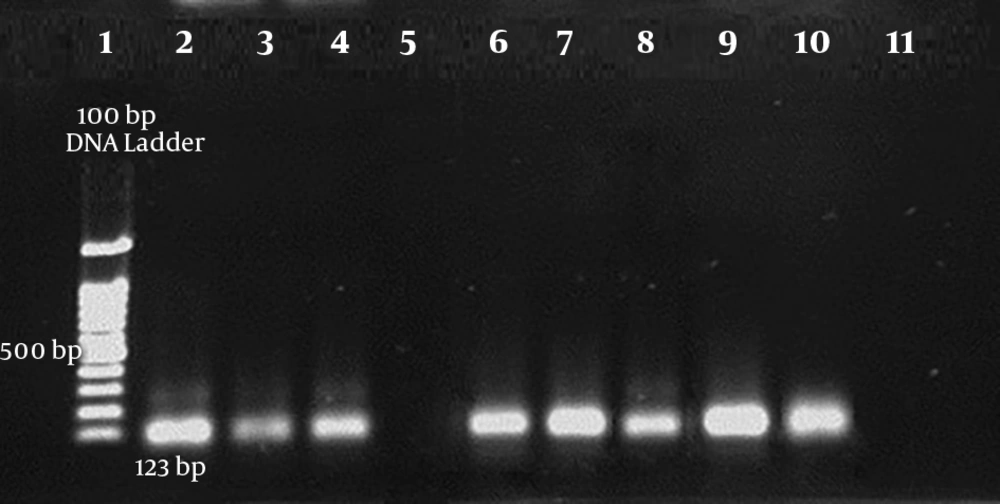
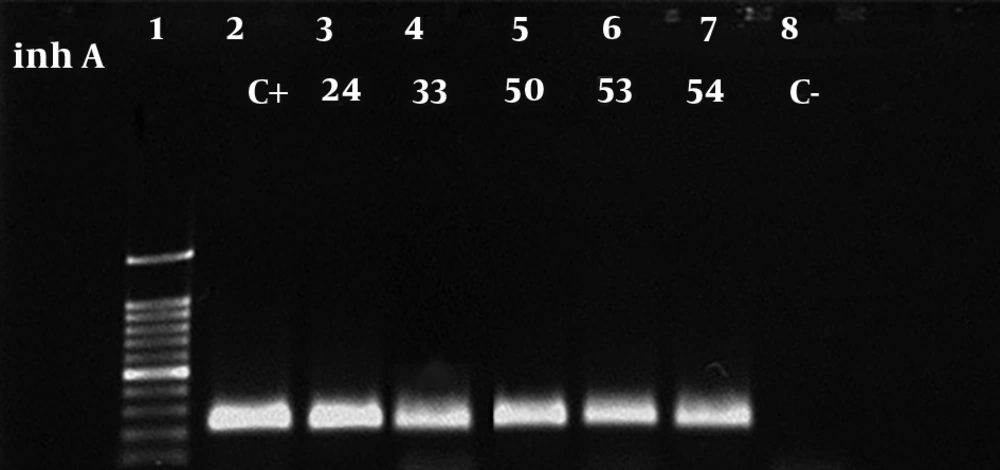
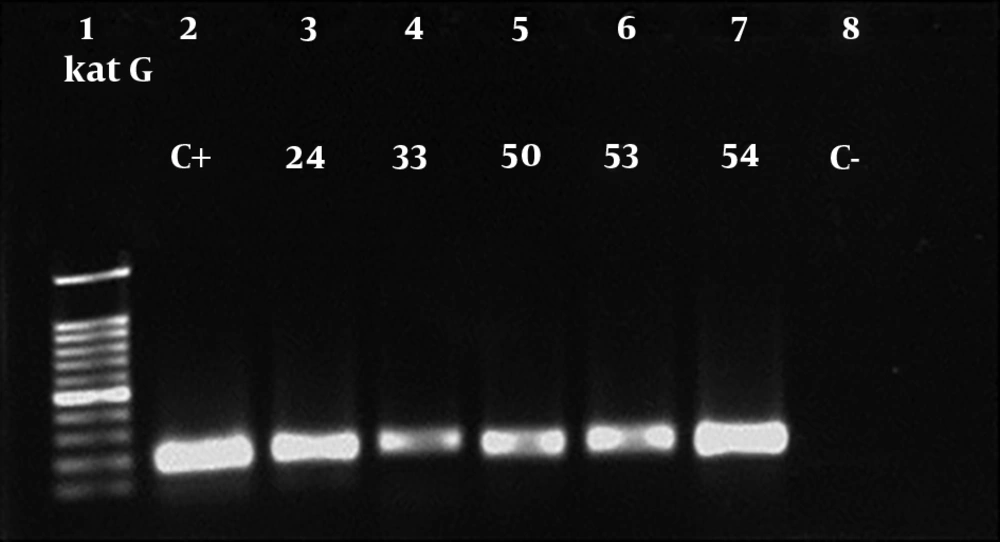
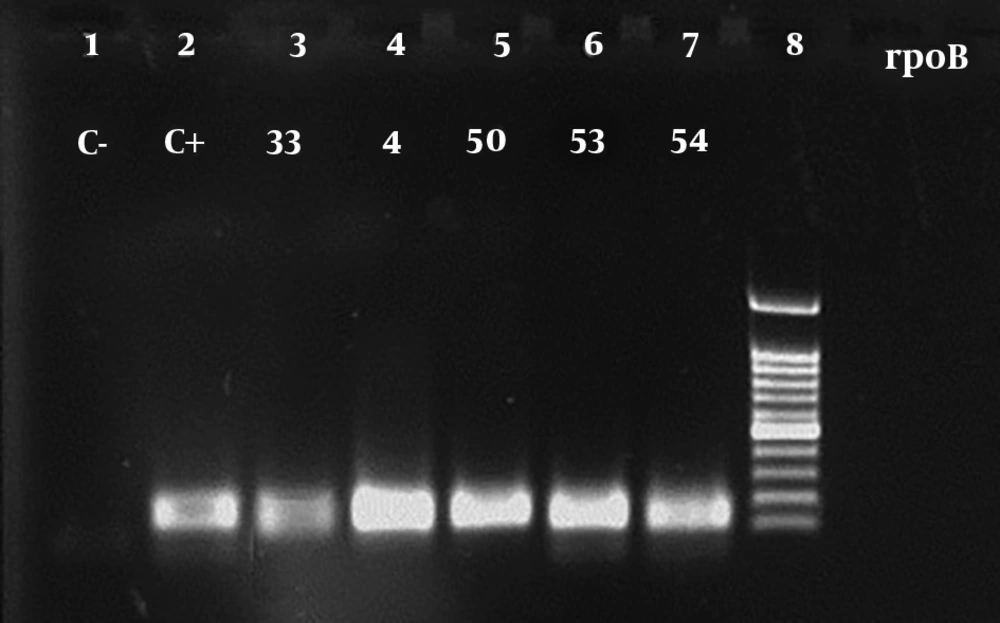
Currently, drug resistance is the main problem in the battle against tuberculosis. During the last years, the resistance rate has been steadily increased (
15). Identification of MDR-MTB within 6 weeks can provide a phenotypic drug susceptibility testing result and many transmission events can occur during this time (
16). The present study was performed according to standard laboratory guidelines and showed a 3.8% prevalence for MDR-
MTB. In this study, the highest number of
MTB was seen in the men aged 15 to 45 that can be attributed to the further communication of this group with the community. The WHO reported that 67.2% of the global tuberculosis prevalence occurs in males compared to females (
17). One well-known symptom of tuberculosis is weight loss and the highest number of MTB was found in people with body mass index (BMI) less than 18.5 (
18). Nevertheless, the association between BMI and tuberculosis infection has not been comprehensively understood (
19). Most cases of resistant tuberculosis were isolated in Khorramabad, Azna and Kohdasht cities; these communities have the most marginal population of the province. Based on the results of this study, the respondents had basic information about the communal symptoms of tuberculosis and their transmission pathways, which is consistent with previous studies in a rural community in Iran (
18), Ethiopia, and Iraq (
20,
21). A lack of knowledge of the etiology of the disease can negatively affect the attitudes of the patients towards health-promoting behaviors and preventive methods, since most people with such beliefs may not visit health centers or consider several traditional alternatives (
22). As indicated in the study, the prevalence of MDR-TB was significantly higher than in newly diagnosed cases with tuberculosis. Most importantly, patients with tuberculosis who had a history of anti-tuberculosis treatment were 8.1 times more likely to develop MDR-
M.TB infection compared with newly diagnosed cases with tuberculosis. Previously treated patients often represent a very heterogeneous group, except those who relapse after successful treatment, those who return after default, and those who start receiving a re-treatment regimen after experiencing previous treatment failure (
23). There is enormous evidence that noted that a history of anti-tuberculosis treatment is one of the main contributing factors in the acquisition of MDR-
MTB (
24,
25). Among previously treated tuberculosis, MDR generally results from the experience of a single drug that suppresses the growth of bacilli susceptible to this drug but allows the proliferation of pre-existing drug-resistant mutants (
26). It is the most common type of resistance to the first-line drugs and can emerge against any anti-tuberculosis agent during chemotherapy. The occurrence of MDR-
MTB is also due to the lack of prescription of standard drugs, it likely leads to treatment failure and intensifies drug-resistant strains of the population (
27). The results of this study showed 7.5% HIV prevalence in patients with tuberculosis. Of the 8 tuberculosis/HIV isolates, 3 were resistant to both RIF and INH. According to the reports of Tuberculosis Control and Leprosy Department of Ministry of Health and Medical Education in 2014, the HIV prevalence index among patients with tuberculosis was 2.5%. The results showed that two main factors for MDR-TB were HIV co-infection and previously tuberculosis treatment. Other studies similarly reported for MDR-
TB, which significantly related to HIV epidemics (
25,
28). It is understood that HIV infection dysregulates immunological reactions, which leads to irresistible infection, by opportunistic and drug-resistant strains (
25). Most studies have reported the prevalence of MDR-
MTB and different drug resistance types the Research Center of Tuberculosis of Masih Daneshvari Hospital and Pasteur Institute of Tehran, Iran. Bahrmand et al. reported the 4% frequency of resistance to INH + RIF among 563 patients who referred to the Pasteur Institute of Iran (
18). Shamaei et al. found 10 (2.8%)
MTB isolates resistant to RIF + INH (
29). In 2015, Tavanaee Sani et al. reported 51 of 1,251 patients with MDR from Shariati Hospital, Mashhad, Iran (
30). In this study, the frequency of
MTB was similar to other Iranian studies with 3.8% frequency. However, our data are contrary to previous studies, which were reported mutations of the codon315 of the
katG gene are associated with INH-resistant MT (
31,
32). Sadrnia et al., have shown that among of 87 isolates, 33 INH-resistant isolates had a mutation in Ser315Thr of
KatG gene, while 21 susceptible isolates had no mutation in codon315 of
katG gene (
33). Bostanabad et al., with a study on the frequency, location and type of mutations in
katG gene of
MTB isolate from Belarus that the most mutations were formed in codons315, 309 and 316 of
katG gene (
34). In 2009, Abdelaal et al., revealed that of 50 isolates, 23 were resistant to RIF and 26 were resistant to INH. The sequencing results showed that 89% of the RIF-resistant isolates had a mutation in the
rpoB gene and 92% INH-resistant isolates had a mutation in the
katG gene (
35). However, mutations in another region of
rpoB gene should be studied. It is necessary to check all
katG, inhA and
kasA gene mutations in INH-resistant isolates. The appropriate design of molecular techniques is required to identify INH + RIF-resistant isolates that had no mutations in the common areas of
rpoB and
katG genes. The prevalence of drug-resistant tuberculosis in this study, as associated with the WHO reports and national averages, indicates the requirement for management and control of drug-resistant tuberculosis. Although the fact that PCR is a quick method for the detection of
MTB resistant strains, it is desirable to use both conventional and molecular methods to obtain more accurate information concerning the resistance pattern.