



1. Background
Despite political, economic, research, and community efforts, Tuberculosis (TB) remains one of the world’s deadliest communicable diseases (1). In 2013, an estimated 9.0 million people developed TB and 1.5 million died from the disease (2). Also, an incidence rate of TB reported in Iran is 21 cases per 100,000 people (3).
An important challenge in TB control is the emergence of resistant strains to the most potent anti-TB drugs (4). Multidrug Resistant Tuberculosis (MDR-TB), is caused by mycobactria isolates which are resistant to, at least, Isoniazid (INH) and, Rifampin (RIF) (5, 6). Delayed diagnosis and inappropriate treatment of tuberculosis may result in constantly increasing severity, mortality, spreading and the emergence of MDR-TB (7-9). Annually, MDR-TB is estimated to afflict 490,000 cases, or 5% of the global TB burden. This appears to be a big challenge to TB control due to its complex diagnostic and treatment problem (10, 11).
On the other hand, successful control of TB and achievement of third Millennium Development Goals (MDGs) for elimination of TB by 2050 depends on the extent of timely diagnosis of patients with TB and their successful treatment (12). Therefore, early and rapid detection of multidrug resistance is a global priority and is essential for efficient treatment and control of Mycobacterium TB (MTB) (13). IS6110 is an insertion sequence specific to Mycobactrium TB which can be used to differentiate MTB species from other mycobacteria (14).
Isoniazid resistance is mostly associated with increased risk of treatment failures and acquiring new drug resistance (15, 16). Isoniazid enters the bacterial cell wall as a prodrug and is converted to a toxic substance in the cell by a catalase peroxides encoded by a KatG gene. Any mutation in this gene can confer bacterial resistance to isoniazid (17, 18).
Also, InhA is a part of a very long chain fatty acid, mycolic acids, in elongation system whose products represent catalysis in the last step of fatty acid elongation. Any mutation in InhA sequences makes changes in INH target and makes the bacteria resistant to isoniazid (19, 20).
Rifampin, as an anti TB drug, was introduced in 1972 and showed excellent sterilizing activity. It acts by binding to the β-subunit of RNA polymerase (rpoB) (5), the responsible enzyme for transcription and expression of mycobacterial genes, inhibits the bacterial transcription activity and results in killing the organism. Any mutation in the 81-bp core region of rpoB was reported to be responsible for drug resistance in at least 95% of the isolates (21, 22).
2. Objectives
The aim of this study was to determine the prevalence of MTB among patients who were diagnosed based on the national TB program (clinical symptoms and Acid Fast Bacilli sputum smear staining) and were treated routinely as pulmonary TB.
Also, this study aimed to detect different patterns of drug resistance, including MDR-TB among these patients to show the ratio of patients that should not be treated as TB and ratio of patients that must be treated as MDR-TB from the onset of diagnosis. Risk factors associated with resistant patterns were also examined in this study.
3. Patients and Methods
3.1. Setting
This molecular study comprised of 92 new cases (from December 2012 to August 2013) who were diagnosed based on clinical symptoms and Acid Fast Bacilli (AFB) staining and planned to be treated as pulmonary TB at TB referral centers affiliated to Shiraz University of Medical Sciences, south of Iran. Demographic data for each patient was obtained from the national TB-registry system.
3.2. Acid Fast Bacilli Staining and Culture on Solid Media
Concentrated sediment of sputum samples were collected from all patients as follows: Sputum samples were liquefied and decontaminated with N-acetyl cysteine-2.5%, Sodium Hydroxide (NAOH) and concentrated by centrifugation at 3000 rpm for 20 minutes (10). The sediment was used to inoculate onto a Lowenstein-Jensen (LJ) medium. Inoculated media were incubated at 37ºC for 8 weeks and examined weekly for colony formation.
3.3. Niacin Accumulation and Nitrate Reduction Test
Niacin test was carried out on suspected buff colonies cultured for 6 weeks. Then Niacin positive colonies were used for nitrate reduction test (25).
3.4. Drug Susceptibility Testing
For this purpose, colonies of MTB were taken from the surface of the LJ slant. Drug susceptibility testing (DST) was performed using INH (0.2 mg/L. Sigma-Aldrich) and RIF (40 mg/L. Sigma-Aldrich) according to the proportion method of Canetti (12). For each set of DST, a known MDR strain was used as positive control and H37Rv strain provided by Tehran mycobacteriology research center as negative control.
3.5. DNA Preparation
The DNA was extracted from colonies with QIAamp DNA mini kit (QIAgen, Inc., Valencia, California, and USA) according to the manufacturer’s instruction. The extracted DNAs were stored at -70ºC.
3.6. IS6110 Detection
Polymerase chain reaction (PCR) was performed on extracted DNAs using specific primers TB1 (5/-ATC CTG CGA GCG TAG GCG TCG G-3/) and TB2 (5/-CAG GAC CAC GAT CGC TGA TCC GG-3/) for a 190 bp fragment. Polymerase chain reaction was performed in a total volume of 50µL reaction mix of 5 µL PCR buffer (10x-Qiagene Inc.), 1.5 µL MgCl2 (50 mM-Qiagene Inc.), 1 µL Deoxynucleotide triphosphates (dNTPs) (0.2 mM-Qiagen, Inc.), 1.5 U Taq DNA polymerase (Qiagen, Inc.) and 1 µL of each primer (10 pmol/µL) with 5 µL of template. Nuclease free sterile double distilled water was added to a final volume of 50 μL. The mixture was amplified using thermo cycler program including 10 minutes at 95ºC for initial denaturation, followed by the PCR condition at 94ºC for 45 second, 65ºC for 1 min and 72ºC for 45 seconds, for 35 cycles with final extension at 72ºC for 10 minutes. The PCR products were run on 2% agarose gel electrophoresis, and visualized after staining with ethidium bromide.
3.7. Molecular Detection of Rifampin Resistance
In this study, a multiplex PCR was performed to detect mutation in rpoB region in all positive IS6110 gene samples using the following sets of primers: rpoB516 (5/-CAGCTGAGCCAATTCATGGA-3/), rpoB526 (5/-CTGTCGGGGTTGACCCA-3/), rpoB531(5/ CACAAGCGCCGACTGTC-3/) and RIRm (5-TTGACCCGCGCGTACAC-3) for 218bp, 185 bp, and 170 bp fragments, respectively. Polymerase chain reaction was done in a total volume of 25 µL reaction mix containing 2.5 µL PCR buffer (10x-Qiagene Inc.), 4 µL MgCl2 (5.5 mM-Qiagene Inc.), 1 µL dNTPs (0.2 mM-Qiagen, Inc.), 1.5 U Taq DNA polymerase (Qiagen, Inc.) and 1 µL of each primer (10 pmol/µL) with 5 µL of template. Nuclease free sterile double distilled water was added to a final volume of 25 μL. The mixture was amplified with the following thermo cycler program: 5 minutes at 95ºC for initial denaturation, followed by the PCR condition at 95ºC for 30 seconds, 68ºC for 30 seconds and 72ºC for 30 seconds, for 40 cycles with the 10 minutes final extension at 72ºC. The PCR products were examined for banding patterns by 8% poly acrylamide gel electrophoresis, and visualized by ethidium bromide staining. The absence of each fragment in the electrophoresis pattern represented mutation in that region and was reported as Rifampin resistance (RIFr).
3.8. Molecular Detection of Isoniazid Resistance
In this study, KatG and InhA were considered as target genes for detecting INH resistance using specific sets of primer for PCR with the following specifications: KatGOF (5/-GCA GAT GGG GCT GAT CTA CG-3/), KatG5R (5/-ATA CGA CCT CGA TGC CGC-3/) and InhAP-15 (5/-GCG CGG TCA GTT CCA CA-3/), InhAPF2 (5/-CAC CCC GAC AAC CTA TCG-3/) for a 292 bp and 270 bp fragments, respectively. To detect these two types of gene mutations, PCR was performed as described for RIFr. The absence of any fragment in the electrophoresis gel was regarded as mutation in that region and reported as INHr.
3.9. Statistical Analysis
All data were analyzed by SPSS software version 11.5 (SPSS, Chicago, Illinois, USA). The accuracy of data was ensured by randomly selecting and checking completed questionnaires against their corresponding data in the SPSS software. Chi-squared, Fisher’s exact, and t-tests were the appropriate tests used in this study. After univariate analysis, correlation of the independent variables with P ≤ 0.2 and resistance to anti-TB drugs (as dependent variables) were assessed by binary logistic regression (forward model). P values less than 0.05 were considered significant.
3.10. Ethics Statement
The protocol of this study was approved by Ethics Committee of the Health Policy Research Center affiliated to Shiraz university of medical sciences. All patients’ data were kept confidential and all drug-resistant patients were treated and cared for accordingly.
4. Results
This study was comprised of 92 patients whose mean age was 45.4 ± 15 years with male to female ratio of 1.9 (Table 1). Twenty three subjects (25%) had history of imprisonment and 14 (15.2%) were intravenous drug users (IDUs). Nine (9.8%) were HIV-positive and 8 (8.7%) had diabetes mellitus (DM). Three (3.3%) had a history of prolonged corticosteroid treatment and were on prolonged treatment course of corticosteroids and 4 (4.3%) had cancer. In the past history, 87 (94.6%) had cough for more than two weeks, 80 (87%) had weight loss and 30 (33%) exhibited hemoptysis.
Table 1. Demographic and Risk Factors of Drug Resistant Suspected Tuberculosis Patients (n = 92) Referred to Tertiary Level TB Centers Affiliated With Shiraz University of Medical Sciences, South of Iran a
| Variable | Values |
|---|---|
| Demographic items | |
| Age, y | 45.47 ± 15.05 |
| Median | 49 |
| Minimum | 11 |
| Maximum | 80 |
| Gender | |
| Male | 64 (69.6) |
| Female | 28 (30.4) |
| Nationality | |
| Iran | 75 (81.5) |
| Afghan | 17 (18.5) |
| Marital status | |
| Single | 26 (28.3) |
| Married | 66 (71.7) |
| Place of living | |
| Urban | 64 (69.6) |
| Rural | 28 (30.4) |
| Job | |
| Employed | 43 (46.7) |
| Unemployed | 49 (53.3) |
| Risk Factors | |
| History of imprisonment | |
| Yes | 23 (25) |
| No | 69 (75) |
| Prior TB or receiving Anti-TB treatment | |
| Yes | 27 (29.3) |
| No | 65 (70.7%) |
| Intravenous drug injection (IDUs) | |
| Yes | 14 (15.2) |
| No | 78 (84.8) |
| HIV infection | |
| Yes | 9 (9.8) |
| No | 83 (90.2) |
| Diabetes mellitus | |
| Yes | 8 (8.7) |
| No | 84 (91.3) |
| Being on corticosteroid | |
| Yes | 3 (3.3) |
| No | 89 (96.7) |
a Data are presented as No. (%) or Mean ± SD.
Direct smear AFBs was positive in 65 cases (70.7%) and negative in 27 (29.3%). Culture was positive in 60 cases (66.7%), including 57 direct smear AFBs positive and 3 direct smear AFBs negative. Forty six (50%) had Niacin and Nitrate reduction tests positive. Seventy one (77.2%), including 53 culture positive and 18 culture negative showed IS6110 gene in their PCR (Figure 1).
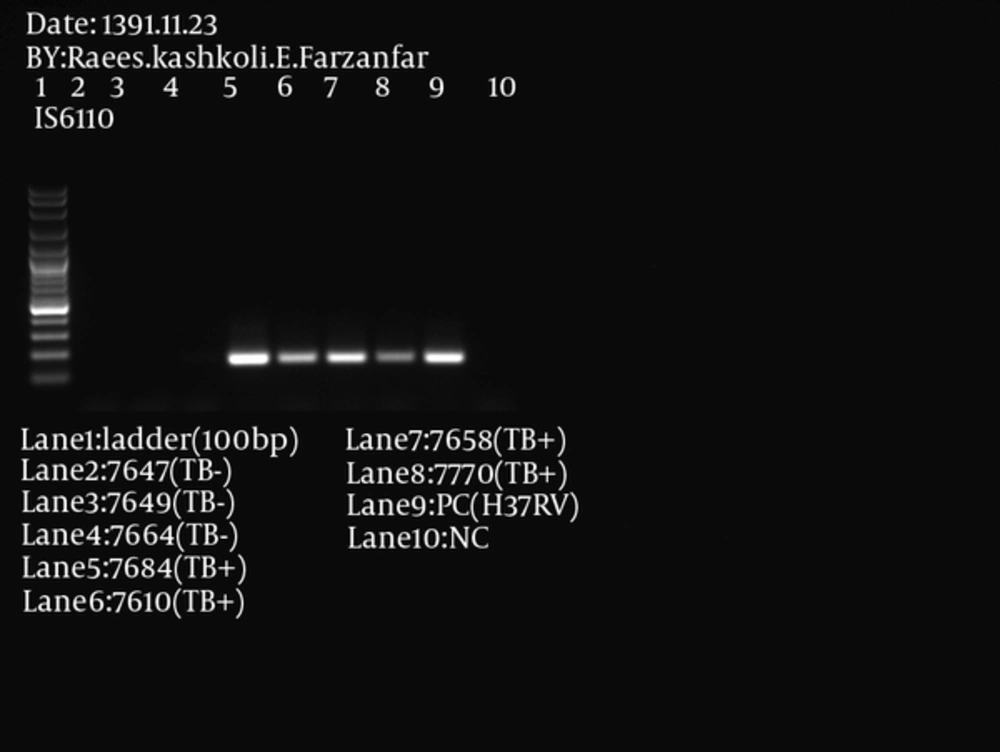
Figure 1.
Lane 1: 100 bp ladder, Lane 2 to 8 patient samples, PC: Positive Control, NC: Negative Control.
Sixteen cases (17.4%) were resistant to INH, 19 (20.7 %) to RIF and 24 (26.1%) to both INH and RIF according to DST (Table 2). The PCR amplification showed that 3 cases (3.3%) had KatG and 3 (3.3%) had InhA gene mutations (Table 2, Figure 2) and 9 (9.8%) revealed both KatG and InhA mutation (Table 2).
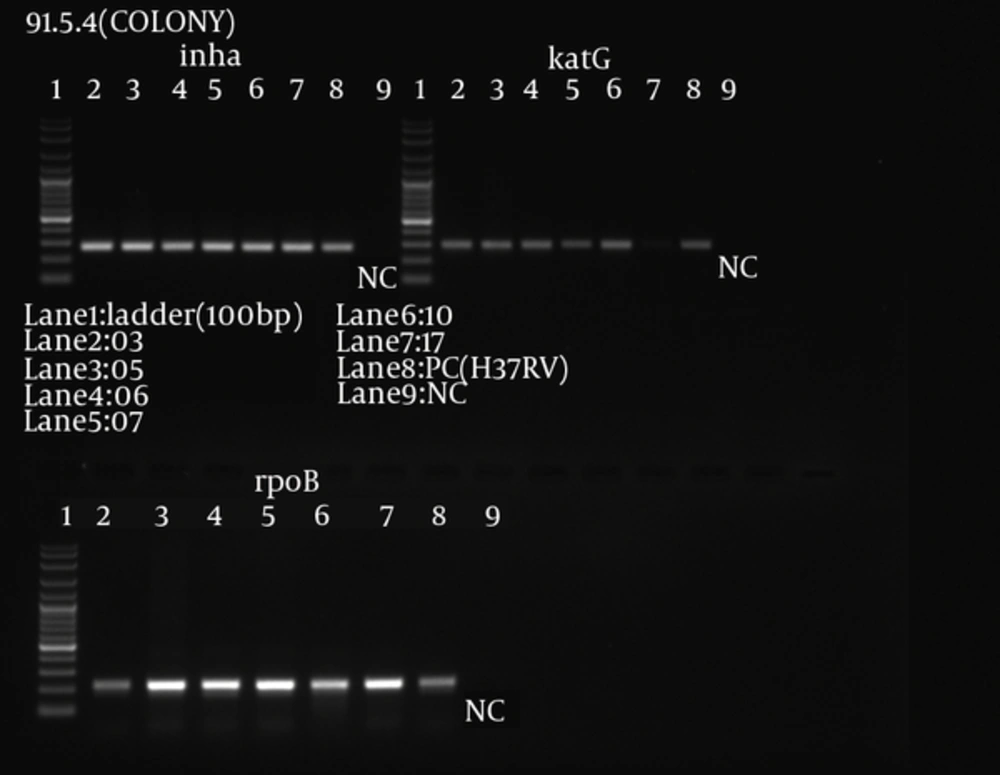
Figure 2.
Lane 1: 100 bp ladder, Lane 2 to 7 patient samples, PC: positive Control, NC: Negative Control.
Moreover, PCR detected rpoB gene mutation in 17 cases (18.5%) (Table 2, Figure 3). Twenty subjects (21.7%) harbored KatG, InhA and rpoB gene mutations (Table 2). Seventy-eight (85.7%) patients showed positive findings compatible with TB in their chest X-ray. Considering different variables and various patterns of drug resistance, only patients who were resistant to INH showed a significant correlation with resistant to RIF (OR = 7.1, CI (95%) = 1.9 - 26.8, P = 0.004).
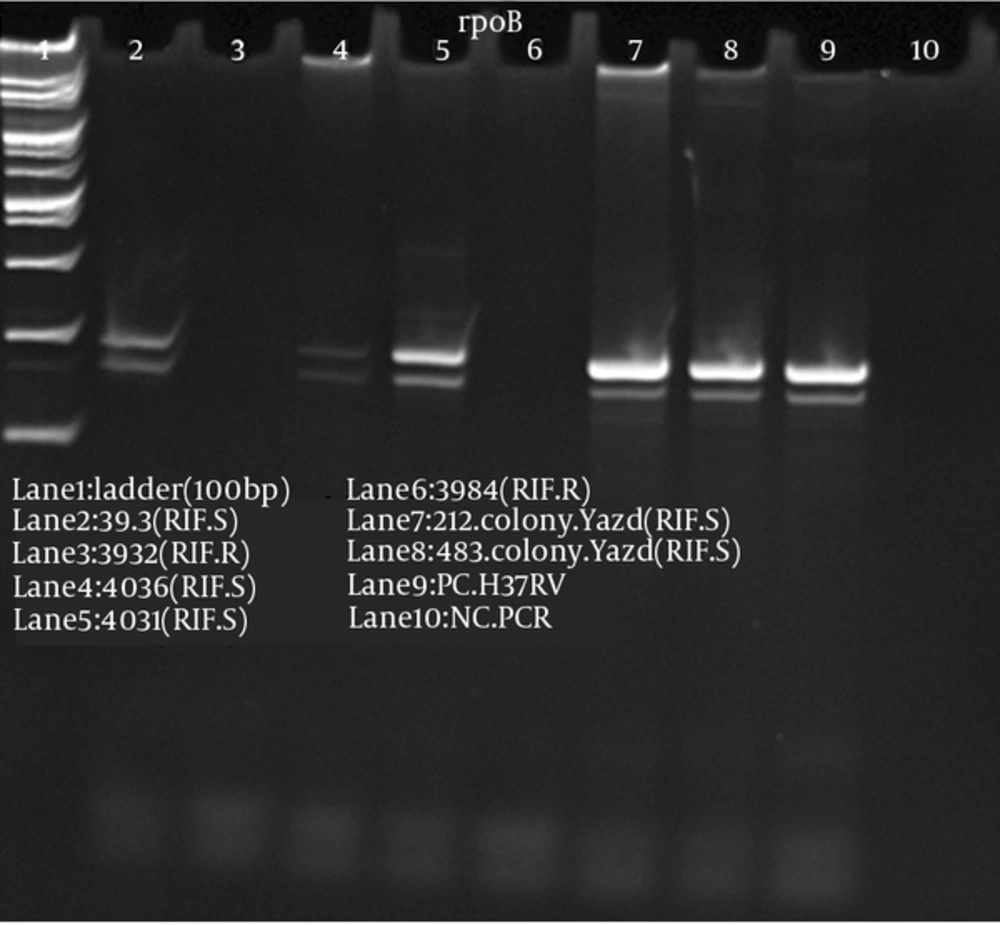
Figure 3.
Lane 1: 100 bp ladder, Lane 2 to 8 patient samples, PC: Positive Control, NC: Negative Control.
| Test Method | Test Target | Frequency |
|---|---|---|
| Resistant to Isoniazid | ||
| Culture | DST | 16 (17.4) |
| PCR | ||
| KatG | 3 (3.3) | |
| inhA | 3 (3.3) | |
| KatG/inhA | 9 (9.8) | |
| Resistant to Rifampin | ||
| Culture | DST | 19 (20.7) |
| PCR | repo B | 17 (18.5) |
| Resistant to both Isoniazid and Rifampin | ||
| Culture | DST | 24 (26.1) |
| PCR | KatG/inhA/repo B | 20 (21.7) |
a Abbreviations: DST, drug susceptibility testing; PCR, polymerase chain reaction.
b Data are presented as No. (%).
5. Discussion
Tuberculosis remains one of the most challenging issues in global health. An important challenge for TB control is the spread of strains that are resistant to the most potent anti-TB drugs (26) and have been reached an emergent and epidemic proportion in many countries (27-29). This specifically applies to MDR-TB and it’s relation to poor treatment outcomes and high rates of case-fatality (30). Approximately, 3.7% of recent and 20% of previously TB treated cases are afflicted with MDR-TB (31). However, less than 5% of the existing MDR-TB patients are currently being diagnosed as a result of serious laboratory capacity constraints which results in delayed MDR-TB diagnosis causes, prolonged treatments and ever-increasing costs (32). Therefore, the early and rapid detection of multidrug resistance using molecular techniques have the potential to significantly hasten the diagnosis and initiation of appropriate treatment (33).
Results of this study showed that no more than 80% of new cases of pulmonary TB patients that were diagnosed based on national TB protocol (clinical symptoms and AFB sputum smear staining) had MTB (IS6110 gene) and at least one-fifth of this group had MDR-TB. These results show that at least 1 out of every 5 patients who was routinely diagnosed and treated as a new case of pulmonary TB in our region, lacked the IS6110 gene. This finding is more than the result found by another study in Thailand which showed the lack of IS6110 gene in 10% of patients (34) and less than 31% of the cases in India who had low to zero copy number of IS6110 gene (35) and much less than 85% of MDR-isolates in Tehran that did not have this gene (36). Therefore, the possibility of less frequent genes markers for MTB, infection by atypical mycobacteria or other diagnosis should be kept in mind in negative IS6110 gene patients (37, 38).
According to DST in our study, 17.4%, 20.7% and 26.1% of IS6110 gene positive patients were resistant to INH, RIF and both drugs, respectively. Another study in tertiary level TB center in Iran revealed that 2.6%, 0.9% and 6.3% of new cases compared to 3.6%, 3.2% and 31.7% of previously treated TB patients had INH, RIF and MDR-TB, respectively (39). In 2003 - 2004, it was reported that 2.6% of new cases and 56% of previously treated TB patients that referred to the same center in Tehran had MDR-TB (40). In Saudi Arabia INH, RIF resistant cases composed of 33.8%, and 23.5% of cases were based on DST respectively besides the presence of MDR in 20.6% of patients (41). The discrepancy of these results could be explained in terms of different settings of studies regarding population, method, location or time of study.
In this study, 24 (68%) and 20 (62%) cases were proved to be resistant to both INH and RIF by DST and molecular assay, respectively. This was in concordance with the result of another study in Philippines that found MDR as the most frequent resistance pattern among TB patients (42). We found that 3 (3.2% of all patients, 9.3% of MDR patients and 20% of INH resistant cases) had KatG or InhA gene mutation and 9 (9.7% of all patients, 28% of MDR patients and 60% of INH resistant cases) exhibited mutation in both genes by Allele Specific PCR in this study.
Another study in Tunisia (43) detected that 96.4% and 3.6% of INH-resistant isolates had KatG and InhA gene mutations, respectively. In that study, 66% of RIF-resistant isolates yielded the rpoB gene mutation, that was less than all RIF-resistant isolates in our study that were affected by this kind of gene mutation. In a study carried out in Northwest of Iran (44), it was concluded that 76% of INH-resistant strains showed KatG gene mutation, which was much higher than 20% found in our study. Another molecular study performed in Egypt demonstrated that 92.3% and 86.9% of INH and RIF resistant cases were caused by KatG and rpoB genes mutation, respectively (45). In a study in Sudan, it was claimed that 12% (vs 3/71; 4% in our study) and 8% (vs 17/71; 23.9% in our study) of MTB isolates had KatG and rpoB genes mutation, respectively (45). In Ethiopia, 35 out of 260 cases (13.4%) of smear positive pulmonary TB showed INH resistant resulting from KatG gene mutations in 33 cases (12.7%) and InhA gene mutations in 2 cases (0.7%) (46). In that study, 12 cases (4.6%) had rpoB gene mutation and 13 (5%) were MDR-TB, compared to respective frequencies of 18.4% and 21.7% in our study (46).
Among different patterns of drug resistant and factors that were assessed, only those resistant to INH showed a significant correlation with resistant to RIF (OR = 7.1). A study in Tehran, Iran proved that anti-TB drug resistance had more correlation with age under 45 years, male sex, previous TB treatment, immigration, poor living conditions, and unemployment (39). In another study it was concluded that age > 65 years was associated with higher possibility of MDR-TB (40). In Bangladesh, younger age, peri-urban locality, history of contact and tuberculosis in the past and socioeconomic status were associated with a higher rate of MDR-TB (47). A study from China showed that, inappropriate treatment, retreating, age, financial burden, poor knowledge, side effects of TB treatment and lack of service coordination were the influencing factors in the development of MDR-TB (17). A case control study in China, showed that more than three TB foci in the lung, nonstandard or irregular therapy, and adverse effects of anti-TB drugs, were associated with MDR-TB in previously treated TB patients (48). In a systematic review, it was found that MDR-TB cases in Europe were more foreign borne [odds ratio (OR) 2.46; 95% CI 1.86 to 3.24], younger than 65 years (OR 2.53; 95% CI 1.74 to 4.83), males (OR 1.38; 95% CI 1.16 to 1.65), and HIV positives (OR 3.52; 95% CI 2.48 to 5.01) (49). Ohmori et al concluded that TB patients in Japan who are under 80, foreigners and retreated cases are more susceptible to TB drug resistance and especially MDR-TB (50). In California, previous anti-TB treatment was associated with MDR-TB (OR 6.57) (51). A review study revealed that previous TB treatment and duration of treatment, immigration, alcoholism and HIV co-infection were risk factors for developing extensively drug resistant-TB (XDR-TB) (52). We found that 18.7% and 15.7% of INH and RIF resistant cases and 16.6% of MDR-TB patients were Afghan nationals, which were considerably less than 66.5% of MDR-TB patients that had the same nationality in other tertiary level TB center study in Iran (39).
The limitation of this study was that we used sets of primers that in the mutated forms could not be annealed and amplified with specific sequences, in contrast to the studies that mutation evaluation was based on sequencing methods.
Considering the increasing rate of MDR-TB, putting patients on anti-TB drugs treatment courses based on diagnosis provided only by clinical symptoms and AFB staining may cause overtreatment in at least 20% and inappropriate treatment in about 15% of patients who are suspected to have pulmonary TB. Therefore, molecular studies as a complementary diagnostic tool help decrease mentioned pitfalls and as a result would help to achieve patients’ safety and their better outcome while saving human and financial resources in health care systems. We suggest strengthening the referral TB laboratories in Iran with molecular studies’ needed infrastructures and facilities.


