
1. Background
The epidemiological study of trauma, as a leading cause of disability in developing countries, provides us with the knowledge of trauma incidence, injury pattern, fracture type, and sex/age distribution and can generate estimates in the planning for scarce healthcare resources, training priorities, and public health education (1-3). During the pandemic by the novel coronavirus disease (COVID-19), new regulations are dictated by local authorities as the lockdown period to reduce unnecessary travels (4, 5). Besides, while emergency departments are encountering the increased volume of COVID-19-infected patients, the fear of in-hospital infection transmission has led to a significant reduction in the in-hospital admission of non-severe cases (6, 7). Hence, we expect alterations in the epidemiological pattern of injury mechanism, injury pattern, and fracture classification.
There are previously published large population-based studies in Iran on the trauma epidemiology (1, 8, 9). Here, in an attempt to correctly define the epidemiological characteristics of trauma patients during the COVID-9 pandemic, in a prospective study, we evaluated trauma patients referring to two tertiary referral centers in two cities of Iran, with a high COVID-19 infectious rate, during the first 45 days of the crisis. Although they were referral centers for orthopedic trauma, both centers were active in giving care for COVID-19 patients, as well.
2. Methods
Data were obtained prospectively from the orthopedic emergency departments of two tertiary orthopedic trauma centers, i.e., Shariati Hospital in Tehran and Poursina Hospital in Rasht, Iran, form Feb 20, 2020, to Apr 3, 2020, for 45 days. Both centers were active in giving care to COVID-19 patients and orthopedic trauma patients. The demographic data, including age, sex, injury type, injury mechanism, and fracture type (if any), were recorded. The study was confirmed ethically by the Medical Ethics Committee of the Orthopedics Department of Tehran University of Medical Sciences, and the study protocol conformed to the guidelines of the Declaration of Helsinki. Data analysis was performed using SPSS version 25 (SPSS Inc., Chicago, IL, USA) to provide descriptive statistics, frequency tables, and graphs. The Kruskal-Wallis H test was used to determine the statistically significant differences in injury classification and injury mechanism between men and women. A P value of < 0.5 was considered statistically significant.
3. Results
A total of 628 patients with a mean age of 38.9 ± 19.9 (range 1 to 96) years were admitted to the orthopedic emergency departments of both centers, consisting of 640 limb injuries (used for the final analysis). Among them, 482 (75.3%) cases were men, and 158 (24.7%) were women. There were 387 (60.5%) fractures, 176 (27.5%) lacerations, 19 (3%) dislocations, 17 (2.7%) soft tissue injuries, and 13 (2%) ligamentous injuries due to sports activities. The details on gender differences are available in Table 1.
Table 1.
Frequency of Traumatic Injuries and Mechanism of Injury in the Study Population and Male to Female Ratio
| No. (%) | Gender | |||
|---|---|---|---|---|
| Male (%) | Female (%) | Ratio | ||
| Injury classification | ||||
| Fracture | 387 (60.5) | 268 (55.6) | 119 (75.3) | 2.2 |
| Laceration | 176 (27.5) | 155 (32.2) | 21 (13.3) | 7.4 |
| Dislocation | 19 (3) | 10 (2.1) | 9 (5.7) | 1.1 |
| Soft-tissue injury | 17 (2.7) | 16 (3.3) | 1 (0.6) | 16 |
| Ligamentous sports injury | 13 (2) | 10 (2.1) | 3 (1.9) | 3.3 |
| Other | 28 (4.4) | 23 (4.8) | 5 (3.2) | 4.6 |
| Mechanism of injury | ||||
| Low-energy trauma (falling down, night stick, ankle torsion | 245 (38.3) | 136 (28.2) | 109 (69) | 1.2 |
| Sharp injury | 183 (28.6) | 159 (33) | 24 (15.2) | 6.6 |
| High-energy trauma (vehicle-related accidents) | 136 (21.3) | 119 (24.7) | 17 (10. 8) | 7 |
| Blunt injury (labor trauma) | 41 (6.4) | 39 (8.1) | 2 (1.3) | 19.5 |
| Falling from height | 35 (5.5) | 29 (6) | 6 (3.8) | 4.8 |
Low-energy trauma was the most common mechanism of injury in 245 (38.3%) patients, and its rate was specifically high as the mechanism of injury among females (69 %). In males, sharp injuries had the highest frequency (33%). Both injury mechanism and injury classification were significantly different between men and women (P value < 0.001) (Table 1). Most injuries were seen in 21 - 40-year-old patients (Figure 1). The distribution of fractures, according to the anatomic site, is shown in Figure 2. Distal radius/ulna fracture, with 70 (18.08%) cases, was the most common site of fractures, followed by proximal femur with 56 (14.4%) cases, hand fractures with 40 (10.3%) cases, and tibia diaphysis with 27 (6.9%) cases. There were 233 (36.4%) patients with self-discharge that refused further management in the centers.
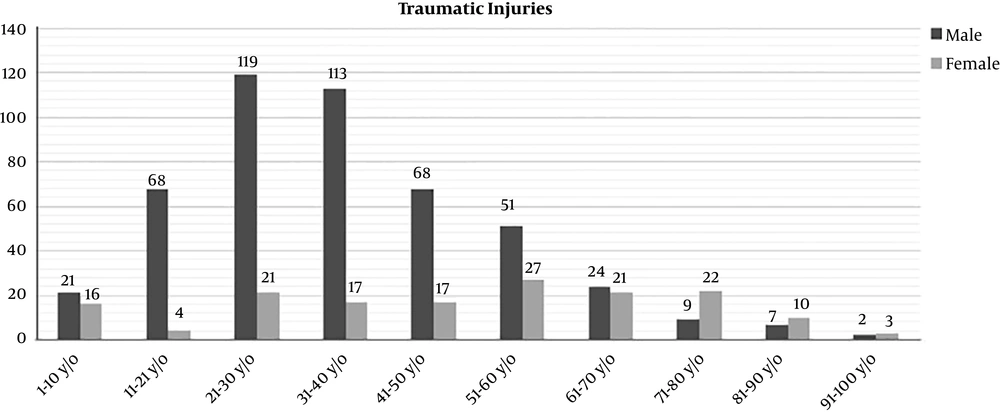
Figure 1.
The distribution curve of traumatic injuries in different age groups of men and women
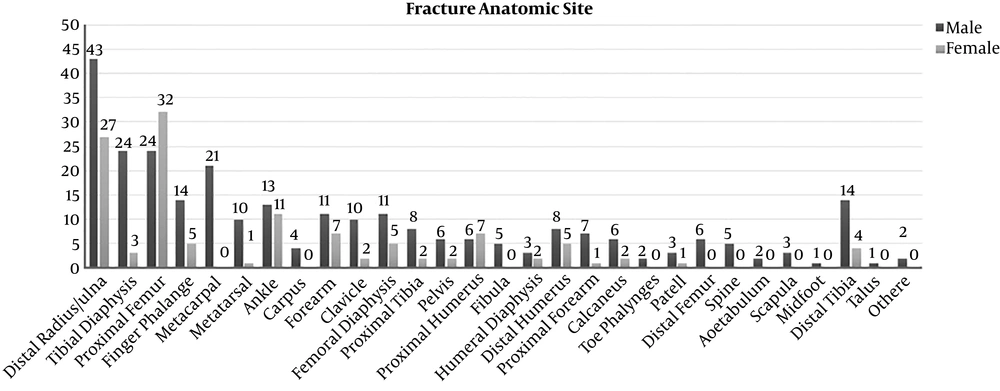
Figure 2.
The distribution curve of fractures according to the fracture site in men and women
4. Discussions
The lack of surveillance systems in low- and middle-income countries conceals the burden of new government programs on disability and the suffering of society (2). However, the prospective study of short cohorts is an affordable strategy to lower the burden of musculoskeletal injuries (2, 3, 10). Here, we reported the first population-based study of the consequences of the lockdown strategy implemented in Iran on trauma centers during the first 45 days of the crisis.
In this study, 60.5% of the patients suffered from at least one bony fracture. In previous studies from Iran, less than 45% of trauma cases were limb fractures (1, 8, 9). We interpret this finding in the context of a decrease in the patients’ referring to hospitals due to soft-tissue injuries during the lockdown period. Although we had a 73% decrease in road accidents during the New Year holidays (expressed by officials), as emergency departments were encountering the increased volume of COVID-19 patients, those with soft-tissue injuries preferred to seek treatment at outpatient clinics.
Only 13 (2%) patients were treated with ligamentous injuries due to sports activities. With the cessation of sports activities and the suspension of club activities, we were not facing much acute ligamentous injuries, including Achille tendon rupture, gamekeeper lesion, and mallet finger injuries. We expected a higher rate of stab wound injuries and rubbery during the expected economic and social disruption (4). However, by the continuation of the lockdown mandates and economic decline, the incidence of stab wound injuries must be followed as an index of social tolerance.
However, when considering injuries other than fractures and dislocations, the male to female ratio was more than seven. Sharp injuries and blunt trauma during labor were 6.6 times and 19.5 times more prevalent in men, respectively. Compared to previous reports, this sudden increase in minor trauma, including laceration, soft-tissue injury, and ligamentous injury, may indicate that women better implemented the stay-at-home strategy as men that are more risk-taking and engaged in labor activities and economic issues.
Consistent with previous reports from Iran (1, 8, 9), 38% of the traumas were caused by low-energy trauma due to falling, which was mostly the case in elderly patients. Almost a balanced male-to-female ratio signifies that home care facilities and preventing equipment among the elderly during the crisis are as necessary as before. High-energy trauma due to motor vehicle accidents is yet significantly higher in men. This would address the necessity of implementing stricter road traffic inhibitory rules to decrease the further burden on the already exhausted health care system.
The rank of fracture frequency during this period changed to put low-energy fractures on top. Distal radius and ulna fracture and proximal femur fracture remained the most frequent ones, as in most previous studies (1, 3, 11). However, the tibia diaphysis fracture, which was the second most frequent fracture among 18,890 adults in Iran, stood the third place mainly due to decreased road accidents (1, 8). The prevalence of finger phalanx fractures in our study was lower than that of other studies (1, 9, 11, 12), probably because many such patients were managed without referring to hospitals caring for COVID-19-infected patients and thus, they failed to be registered. While the centers of the study were not referral centers for spine fractures, we recorded only two vertebral fractures during this period.
Seasonal variations in fracture incidence are studied to improve strategic planning and resource allocation (13). In previous large studies in Iran, the peak incidence of trauma fractures was seen in February-March, which is concurrent with the national holidays of the New Year. Although we cannot interpret our results in this regard, we encountered a 44% decrease in trauma patients in the two centers (results not shown). Studies in centers with good surveillance systems may better reveal the impact of locking strategies on trauma reduction.
Considering the limitations, we included only two centers in our study. The results would improve if the data of more centers were analyzed. Besides, we could not provide the data on the outcome of patients in terms of developing COVID-19 or postoperative complications. This was mainly because we had a high rate of self-discharge for patients who left the public hospitals for private clinics due to the fear of COVID-19 infection transmission. This is an important issue that must be addressed by health authorities by providing patients with better access to personal protection equipment, cleaning supplies, and reassurance of the best possible practice in public hospitals (14, 15). Although the study is subjected to some limitations, the strength of the study is to provide a timely concept of the changes implemented and their difference from the shifts expected in the hospital trauma burden. This may provide the authorities with important measures in strategic planning and public health issues.
4.1. Conclusion
There were important epidemiological changes during the COVID-19 crisis in trauma patients referring to hospitals in Iran. There was a decreased admission to the hospital orthopedic emergency for minor injuries and lacerations compared to fractures. The cessation of sports activities resulted in reduced ligamentous injuries of sports origin. The high rate of self-discharge, most probably due to the fear of in-hospital contamination, is of critical importance. Thus, the authorities should be informed of providing patients with safety assurance and the best possible practice in public trauma centers.