
1. Background
Elite and professional athletes are looking for ways to improve their performance. In addition to rigorous training and diets, they often turn to nutritional supplements. The American College of Sports Medicine has estimated that nearly 50% of athletes use vitamins to maintain fitness and improve endurance (1, 2). Recently, the use of antioxidant supplements among athletes has been considered an attractive way to reduce exercise-induced muscle damage (3).
Vitamin C and E consumption is varied widely around the world. Inadequate vitamin E and C intake has been reported in different social groups (4). The current recommended vitamin E dietary allowance (RDA) is 15 mg daily for adult men and women. The RDA states that the recommended amount of vitamin C for adults aged 19 years and over is 75 mg for females and 90 mg for males (5). Recently, using antioxidant supplements has been considered because antioxidants suppress or decrease the signaling of necessary adaptations, such as muscle mitochondrial hypertrophy and biogenesis (6).
Vitamins E and C (as antioxidants) are found in natural foods with potent antioxidant activity to inhibit oxidative damage. Vitamin E (as a lipid-soluble antioxidant) can scavenge free radicals damaging membrane phospholipids or lipoproteins. Vitamin C (as a water-soluble antioxidant) directly suppresses free radicals in the aqueous environment (inside cells). Vitamin E and other antioxidants may also reduce oxidative damage by returning free radicals to a reduced state. Adding vitamin E to the diet protects against muscle damage caused by high-intensity exercises (7).
In this regard, vitamin E and C supplements can reduce muscle development and progress caused by endurance activities; this problem occurs due to impaired adaptation of trained muscles. The statistical analysis showed that supplements did not affect the maximum amount of oxygen received. However, they reduced the production of new mitochondria due to exercise in the muscles. More precisely, the number and size of muscle mitochondria increased only in the group that did not receive the supplement. According to this study, high amounts of vitamins E and C can reduce the adaptation effects of endurance sports training in muscles (1).
Creatine kinase (CK) catalyzes creatine and adenosine triphosphate (ATP) to phosphocreatine and adenosine diphosphate (ADP) conversion as an essential element of ATP recycling and energy metabolism. Increased serum CK levels commonly indicate damage to tissues rich in CK, such as muscle. CK is an attractive biomarker due to its easy access (8).
On the other hand, myoglobin is a protein rich in iron with 153 or 154 amino acid residues, containing a synthetic group of iron-containing porphyrin (heme). Myoglobin transports molecular oxygen in muscle tissue. Histidine amino acid consists of distal and proximal groups. The proximal His group binds to the iron center, and the distal histidine group binds to the iron reversely. Myoglobin is another biomarker of muscle damage (9).
Increased levels of vitamins E, C, and other antioxidants through endurance exercise reduce effective physiological adaptations caused by exercises, such as mitochondrial biogenesis and oxidative muscle capacity (10). However, some studies have not indicated adverse physiological effects during heavy training (11). Therefore, short-term supplementation may be more favorable.
Sanda is one of the most capable martial arts, which is considered in the category of mixed martial arts. This method combines wrestling, kickboxing, gymnastics, kung fu, and western boxing. This combat sport needs to perform high-intensity movements, such as intense sidekicks, fast defensive moves, spinning kicks, jumping, and powerful punches. Based on the rules of the Olympics and different international competitions, the athletes of this sport must participate in at least 4 consecutive competitions in 1 day and win to reach the finals. These points indicate that the elite athletes of this sport experience an increase in muscle injuries after intense training and competition. In this field, most studies have been conducted on non-athletes or amateur athletes (4, 12). For this reason, more research is needed in this field.
2. Objectives
This study investigated the impact of short-term intake of high-dose vitamins C and E on CK and resting myoglobin in elite Wushu (Sanda) athletes.
3. Methods
This study is a parallel randomized clinical trial conducted in the field.
The statistical population of this research included the elite athletes of Sanda in Zahedan, Iran. We referred to the Wushu Sports Board in Sistan and Baluchistan Province. We identified the elite athletes of Sanda who had a history of membership in the Iranian national team, as well as those who were invited to the Iranian national team camp. Then, based on the inclusion criteria, 20 samples were selected from eligible subjects by non-probability sampling method and were randomly divided into 2 supplement and placebo groups. Inclusion criteria were male elite athletes with at least 2 years of official participation in national championships who had not taken antioxidant supplements for a minimum of 2 months. Exclusion criteria included a history of bone fracture, not regularly participating in exercises, and cardiovascular, pulmonary, liver, kidney, and metabolic diseases. In this research, we used a single-blind method; the participants were not informed about the nature of the prescribed substance (supplement or placebo).
First, the subjects’ personal, medical, and sports information was collected through a questionnaire. Then, informed consent was obtained from the eligible volunteers. The subjects were asked to consume the packaged supplements with specific doses already provided to them with breakfast 72 hours before and on the morning of the competition. The dosage of vitamin E was 1400 U per day, and vitamin C was 2000 mg per day (7). Vitamin E and C supplements were purchased from OPD Pharma, Iran. Also, the placebo, a dextrose tablet, was prepared in the same packaging as the vitamins and was provided to the placebo group. In this research, blood samples were collected in 2 stages. The first stage was at 7 AM on the competition day. The second stage was at 7 AM the day after the competition. The subjects fasted for about 10 to 12 hours. In both the pre- and posttest stages, 5 mL of blood was taken from the brachial vein after sitting on the chair for 5 minutes under the same conditions. Immediately after blood collection, the blood samples were slowly transferred into test tubes to clot. Then, the blood serum was separated by centrifugation. The amount of serum CK was measured photometrically using a laboratory kit (Pars Azmoun Company, Iran) and a Hitachi brand autoanalyzer (jointly manufactured by Japan and the United States). The serum level of myoglobin was also measured by an enzyme-linked immunosorbent assay (ELISA) using a kit (Pars Azmoun Company, Iran) and a photometer (China).
After blood sampling at 7:30, the subjects ate a prepared breakfast (564 kcal) with vitamin C and E supplements or a placebo. Then, the subjects participated in 4 competitions (simulated model of world championships) from 9:00 AM. All participants competed against an opponent in the same World Championship weight class as their weight. According to the coach, athletes with similar experience and skill levels were included in this research. To create the necessary motivation, these simulated competitions were considered a selection competition to participate in national competitions; thus, the subjects participated in these competitions with their maximum intensity and strength. Each match consisted of 3 rounds of Sanda fighting; if an athlete won the first 2 rounds, the match ended. In case of a tie, a third round was held to determine the winner. Each round consisted of 2 minutes, with a 1-minute rest between rounds. Competitors competed in 4 consecutive matches with a time interval of 2 to 3.5 hours between each match against opponents during the competition day. A snack was given to the competitors immediately after each match. A total of 3 snacks (with an average of 449 kcal for each snack) were provided to the subjects. They were also asked to eat their snack no later than 20 minutes after the competition. Light lunch (337 kcal) was served at 12:30. Dinner (839 kcal) was provided to the athletes at 18:30. Water was the only drink allowed during the tournament day. Athletes were allowed to drink as much as they wanted. We used an online site to calculate the energy of athletes’ food (13). All information about main meals and snacks is presented in Tables 1 and 2.
Table 1.
Information About Participants’ Main Meals and Snacks
| Meal and Food Item | Weight (g) | Energy (kcal) |
|---|---|---|
| Breakfast | ||
| Honey | 20 | 57.6 |
| Butter, light (60% fat) | 15 | 82.05 |
| Cheese | 30 | 98.04 |
| Tea | 100 | 0 |
| Walnuts, kernel only | 10 | 29.5 |
| Sugar, white | 10 | 39.4 |
| Bread | 50 | 108.5 |
| Orange juice | 80 | 148 |
| First snack | ||
| Cookie | 50 | 235.5 |
| Pear | 70 | 30.1 |
| Chocolate | 30 | 153 |
| Second snack | ||
| Biscuit, digestive | 45 | 219.6 |
| Apple | 120 | 61.2 |
| Chocolate | 30 | 153 |
| Lunch | ||
| Rice, white | 150 | 175.5 |
| Chicken, breast, grilled | 100 | 148 |
| Salad | 30 | 13.5 |
| Third snack | ||
| Biscuit, wafer | 45 | 241.65 |
| Banana | 120 | 97.2 |
| Chocolate | 30 | 153 |
| Dinner | ||
| Rice, white | 350 | 409.5 |
| Salmon, grilled | 200 | 416 |
| Salad | 30 | 13.5 |
Table 2.
Information About the Weight and Energy Values of the Main Meals and Snacks of the Participants
| Meal | Carbohydrate (g) | Protein (g) | Fat (g) | Energy (kcal) |
|---|---|---|---|---|
| Breakfast | 83.23 | 15.7 | 20.97 | 563.45 |
| First snack | 56.68 | 4.41 | 20.92 | 418.6 |
| Second snack | 60.78 | 5.05 | 20.56 | 433.8 |
| Lunch | 41.22 | 36.38 | 4.06 | 337 |
| Third snack | 73.11 | 5.06 | 22.06 | 491.85 |
| Dinner | 94.22 | 52.78 | 30.46 | 839 |
| Total nutrient intake (g) | 409.24 | 119.38 | 119.03 | N/A |
| Total energy intake (kcal) | 1636.96 | 477.52 | 1071.27 | 3084 |
This parallel trial study was approved by the Research Ethics Committee of the Sport Sciences Research Institute (code: IR.SSRC.REC.1402.030). Data were analyzed using SPSS version 23 (SPSS Inc, Chicago, Ill, USA). Descriptive statistics (including mean and SD) were used to analyze the results of this research. We used the Kolmogorov-Smirnov test to check the normal distribution of the data. An independent t test was used to explain the differences between groups. Also, a paired t test determined the intragroup alterations from the pretest to the posttest. P values less than or equal to 0.05 were considered statistically significant.
4. Results
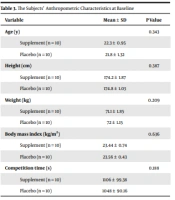
The findings of this research are presented in the form of tables. According to the independent t test, no significant difference was found in age (P = 0.343), height (P = 0.387), weight (P = 0.209), and body mass index (P = 0.636) between the groups (Table 3).
Table 3.
The Subjects’ Anthropometric Characteristics at Baseline
| Variables | Mean ± SD | P Value |
|---|---|---|
| Age (y) | 0.343 | |
| Supplement (n = 10) | 22.3 ± 0.95 | |
| Placebo (n = 10) | 21.8 ± 1.32 | |
| Height (cm) | 0.387 | |
| Supplement (n = 10) | 174.2 ± 1.87 | |
| Placebo (n = 10) | 174.8 ± 1.03 | |
| Weight (kg) | 0.209 | |
| Supplement (n = 10) | 71.1 ± 1.85 | |
| Placebo (n = 10) | 72 ± 1.15 | |
| Body mass index (kg/m2) | 0.636 | |
| Supplement (n = 10) | 23.44 ± 0.74 | |
| Placebo (n = 10) | 23.56 ± 0.43 | |
| Competition time (s) | 0.188 | |
| Supplement (n = 10) | 1106 ± 99.38 | |
| Placebo (n = 10) | 1048 ± 90.16 |
Table 4 shows that the CK index in the supplement group has a significant reduction compared to the pretest (pretest, 307.7 ± 5.56; posttest, 237.2 ± 19.28; P = 0.001). Also, the serum myoglobin level significantly increased (pretest, 24.2 ± 2.7; posttest, 41.1 ± 1.97; P = 0.001). However, these variables did not show a significant difference in the placebo group compared to the pretest values (P = 0.893 and P = 0.083, respectively). Also, the level of serum CK significantly decreased in the supplement group than in the placebo group (supplement group, 70.5 ± 21.96; placebo group, -0.1 ± 2.28; P = 0.001); on the other hand, the serum myoglobin values of the supplement group significantly increased compared to the placebo group (supplement group, -16.9 ± 4.28; placebo group, 0.65 ± 1.06; P = 0.001; Table 4).
Table 4.
Comparison Results of Pre- and Posttest Serum Levels of Creatine Kinase and Myoglobin at Rest
| Variables | Pretest | P Value | Posttest | P Value | Difference of Means | P Value |
|---|---|---|---|---|---|---|
| Creatine kinase | 0.55 | 0.001 a | ||||
| Supplement | 307.7 ± 5.56 | 237.2 ± 19.28 | 70.5 ± 21.96 | 0.001 a | ||
| Placebo | 303.7 ± 2.67 | 303.8 ± 2.97 | -0.1 ± 2.28 | 0.893 | ||
| Myoglobin | 0.328 | 0.001 a | ||||
| Supplement | 24.2 ± 2.7 | 41.1 ± 1.97 | -16.9 ± 4.28 | 0.001 a | ||
| Placebo | 25.3 ± 2.16 | 24.65 ± 2.58 | 0.65 ± 1.06 | 0.083 |
a P < 0.05
5. Discussion
The short-term consumption of high-dose vitamins C and E reduced serum CK levels in elite Wushu Sanda athletes than the pretest values. Nonetheless, no significant difference was observed in the placebo group. Also, serum CK significantly decreased in the supplement group than in the placebo group (P = 0.001). The results of this research are consistent with the results of Pouya. He showed a decrease in CK levels in elite soccer players in the vitamins C and E group (14). Also, Sari et al. reported similar results. They assessed the effect of 14 days of supplementation with vitamins C and E on muscle damage indicators after anaerobic activity in teenage speed skater boys. The supplement group received 400 mg of vitamin C and 200 U of vitamin E (15). The results showed that the supplement group significantly decreased CK levels (15). In addition, Fallah Mohammadi et al. reported a significant decrease in CK levels following vitamin E intake (16). Subjects in the supplement group consumed 800 U of vitamin E twice daily, 45 minutes before lunch and dinner (16). The results of Taghiyar et al. are consistent with our findings. They showed that the CK levels decreased significantly after the study (17). Similar to the findings of the mentioned research, Chou et al. assessed the effect of high-dose vitamin E and C supplements on muscle damage in taekwondo athletes; their results are consistent with our results. In their research, 18 elite male taekwondo athletes were randomly allocated to vitamin (C and E) and placebo groups in a randomized, single-blind study design (7). Vitamin C + E supplements and placebo were taken daily (2000 mg/day of vitamin C and 1400 U/day of vitamin E) for 4 days (3 days before and on the day of the competition) before participating in 4 continuous taekwondo competitions. The results showed that plasma CK levels were lower in the vitamin C + E group (7). In explaining the research results, it can be said that intense competition or exercise could significantly increase acute micro-muscular damage and enhance physiological stress because of high training intensity and many abnormal movements (18, 19). In high-intensity exercise, the continuous abnormal mechanical force can damage the muscle cell membrane and change the permeability of the membrane; as a result, it leads to the leakage of large amounts of enzymes and proteins in the muscles (20, 21). Also, the production of reactive oxygen species (ROS) causes muscle damage (22-24). Various physical activities, such as high-intensity, long-term, and resistance exercises, cause muscle injuries; the bio-functional activities of vitamins C and E reduce these damages and oxidative cell damage (25, 26). Exercise-induced increases in ROS are essential for muscle adaptation for exercise training (27). Chronic antioxidant therapy can prevent chronic exercise adaptation (11, 28). However, stimulating chronic adaptation is not a top priority in competitive events, in which the aim is to optimize performance in the event in question. Thus, a short-term advantage in inflammatory profile and muscle damage can be translated into acute advantages for performance and recovery.
In addition, a short period of supplementation (only 3 days prior to and on the competition day) can impair training adaptations more than longer periods of high-dose supplementation; however, this issue needs further investigation. Sanda competitions are held in 2 rounds, with a 1-minute rest between the 2 rounds. The athlete endures high work pressure in a short time; therefore, the ability to quickly recover after endurance training is vital in this combat sport. Also, it is essential to maintain the aerobic system in high-intensity activity and facilitate recovery between continuous bouts in competitive events (29-31) because higher aerobic capacity is linked to greater recovery following intense exercise (32).
Our findings showed that the acute consumption of high-dose vitamins C and E increased the serum levels of myoglobin in elite Wushu Sanda athletes compared to the pretest values. However, the placebo group did not significantly differ (P = 0.083). Also, serum myoglobin increased significantly in the supplement group than in the placebo group. Mardaniyan Ghahfarrokhi et al. examined the impact of acute aerobic activity following vitamin C supplementation on the hematological indices of football players; their results are consistent with our results (33). In a study, Dawson et al. sought to answer the question that 1 month of daily vitamin C supplementation of 500 or 1000 mg and vitamin E equivalent to 500 or 1000 international units can change muscle and biochemical damage indicators after running a half marathon or not; their results are also consistent with our results (34).
On the other hand, our results contradict the findings of Biniaz et al. (35). They showed that taking 250 mg of vitamin C 3 times a week caused a significant decrease in myoglobin (35). Also, Chou et al. reported a decrease in myoglobin after a short intake of vitamins E and C in their research (7). In explaining the reasons for our research results, we point out that antioxidant supplements, including vitamins E and C, have recently been recognized among athletes as a possible way to increase sports performance. Increased oxidative stress during exercise produces free radicals, muscle damage, fatigue, and dysfunction. Despite the adverse effects on function, free radicals can function as signaling molecules that enhance protection from further physical stress. Antioxidant supplements may disrupt these adaptations. Also, short-term high-dose vitamins C and E supplementation showed anti-inflammatory effects and functional physiological protection. The combined advantages of vitamins C and E’s physiological protection and anti-inflammatory action may enhance recovery between competitions. In this study, it was observed that resting myoglobin levels were significantly higher in the vitamin C + E group than in the placebo group. Also, we found that a short period of supplementation (4 days) with high-dose vitamins C and E did not effectively reduce the increase in biomarkers of muscle damage due to continuous Wushu matches in the Sanda discipline compared with the placebo group. Vitamin E is a lipid-soluble antioxidant that protects plasma membrane integrity against different chemical and physical challenges (36, 37); nevertheless, many similar findings are available (38, 39). However, this difference can be due to the short period of taking the supplement. In this study, vitamin E and C supplements were combined. Since vitamins C and E have synergistic effects and more biological functions, the increase in myoglobin may be due to the combination of these 2 antioxidants.
5.1. Conclusions
Continuous intense competition causes acute muscle injuries. The increase in mechanical force during this type of physical activity damages the muscle cell membrane and the tissue inside it. The sport of Sanda has a competitive nature with physical contact and heavy blows to the opponent, which increases these injuries. Short-term administration of high-dose vitamins C and E, starting 72 hours before competition, can probably improve the performance and recovery of athletes and have a positive and significant effect on the levels of CK and serum myoglobin of athletes.