


1. Introduction
Golf has been shown to be a very popular sport (1) with substantial potential for future growth, particularly in light of its reintroduction into the Summer Olympics in 2016. Its popularity is likely due to a variety of reasons including more leisure time in aging populations and multiple perceived health benefits (2, 3). Such benefits are supported by research studies which demonstrated that playing golf provides a sufficient amount of physical activity to improve overall health and well-being, especially for older golfers whose physiological training threshold is lowered by age (3-7). Equally important though is the fact that although golf may provide health and fitness benefits, the sport also appears to have certain injury risks that may significantly affect players’ enjoyment of the game, and even deter some potential participants at older ages (8-10).
While a properly executed golf swing may not appear overly stressful, biomechanical studies show that many body parts are moving at high velocity and through extreme ranges of motion (ROM) (11-16). Additionally, these movements are complex and require a high degree of coordination (17). Mastering these motions, as demonstrated by elite amateur and touring professionals, requires dedicated practice where these powerful movements may be repeated several hundred times per day. The physical stresses associated with such practice may lead to injury of various parts of the body including the lower back (18, 19). Furthermore, since swing mechanics may contribute to injury susceptibility (20), the less efficient and inappropriate movement patterns demonstrated by less skilled recreational golfers may further increase injury susceptibility (21). The purpose of this paper is to review the current understanding of how participation in the sport of golf may contribute to the development of lower back pain (LBP). Suggestions for minimizing injury susceptibility and recovering from lower back injury will also be discussed.
2. LBP Incidence Amongst Golfers
Low back pain is a very common musculoskeletal problem affecting golfers of all ages (22, 23) and skill levels (24, 25). Epidemiological studies have shown that low back conditions account for approximately 25% of all golf injuries (18, 25, 26) although incidence rates of between 18.2% (27) to as high as 54% (28) have been reported. Cabri and colleagues (9), in their review of golf-related injuries, reported that injury to the lower back represented the most common musculoskeletal complaint experienced by both amateur and professional golf players. Meanwhile, in a survey of 196 golfers just taking up the sport, Burdorf, Van Der Steenhoven, Tromp-Klaren (29) reported that while 25% suffered back pain during the one year study period, the vast majority of these participants did not feel that golf was the cause of their LBP. The authors concluded that golf could aggravate pre-existing back pain due to the forceful nature of the movements associated with playing and practicing.
It is evident from the above epidemiological information that LBP is a common complaint amongst golfers. The specific causes are likely multi-factorial and include biomechanical elements, equipment aspects, the methods used to transport clubs and possibly the fact that golf may irritate pre-existing lower back conditions as participants play and practice more. The following sections review a number of factors identified in the scientific literature that appear to contribute to LBP from golf participation.
3. Biomechanical Forces on the Lumbar Spine
The forceful nature of the full golf swing clearly incorporates large magnitude trunk, shoulder and lead hip movements (Figure 1). This trunk torsion potentially results in considerable spinal stress. In general terms, the golf swing involves a slow deliberate rotation of the trunk away from the target on the backswing followed by a very powerful rotation of the trunk towards the left (right-handed golfer) on the downswing. While it is clear that other spinal motions besides rotation occur during a golf swing, aggressive axial twisting has been identified as a significant risk factor for low back disorders in occupational settings (30, 31).
Hosea and colleagues (32) were some of the first researchers to investigate forces on the lower back during a full golf swing. They calculated the compressive, shear, lateral-bending and rotational loads on the L3-4 segment of the lumbar spine during golf swings using a five iron. Kinetic, kinematic and surface EMG data were collected from four professional (mean age-37 years) and four amateur (mean age-34 years) golfers. The amateur golfers recorded higher average peak shear loads (596 N compared with 329 N for the professionals), while compressive load was considerably higher amongst the professionals (7584 N versus 6100 N). These average compressive loads represent forces equivalent to about 8 times body weight. In comparison, running produces spinal compression forces equal to approximately 3 times body weight (19). The magnitude of the compressive loads recorded by Hosea et al. (32) may further be realized when compared to results from a similar study by the same authors on college football players. Gatt et al. (33) reported compression forces of 8,679 ± 1,965 N when football linemen forcibly made contact with a heavy blocking sled. It is worth noting that cadaveric studies have shown disc prolapse to occur with compressive loads of around 5,500 N (34).
The results from Hosea et al. (32) experiment would appear to show that the golf swing produces sufficient force to potentially injure the lumbar spine. In some cases the injury may occur as a traumatic event while in other cases the mechanism may have a more insidious onset. Insidious LBP is thought to be associated with a process known as the cumulative load theory (35). This theory takes into account the total stress placed on the system over time. Kumar (36) reported that workers who developed LBP were found to have consistently worked for more hours over their lifetimes than their pain-free colleagues, lending support to the cumulative load theory. In golf, the combination of large magnitude spinal forces combined with a high frequency of swing repetitions, likely results in lower back injury over time through the cumulative load process. The influence of cumulative load on golf-related LBP is likely why elite players identify overuse rather than a traumatic event as the cause of their LBP (37). Furthermore, Lindsay and Horton (38) showed that elite players who consistently suffered LBP during golfing activities tended to have a higher frequency of swing repetitions (i.e. spend more time playing and practicing) than healthy golfers.
As mentioned, the golf swing involves an asymmetrical trunk rotational velocity when comparing the relatively slow backswing with the powerful downswing and follow-through. This asymmetry in movement pattern would lead to differences in spinal loading patterns between the lead and trail sides of the lumbar spine at different parts of the swing which in turn could affect injury characteristics. In a survey of 283 Japanese professional golfers, Sugaya et al. (28) reported that LBP predominantly occurred on the trail (i.e. right) side. Furthermore, radiological investigations of elite players revealed a significantly higher rate of trail side vertebral body and facet joint arthritic change than age-matched control subjects. The authors concluded that both the repetitive and asymmetric nature of the golf swing contributed to LBP and injury in elite golfers. In a related study, Morgan et al. (39) noted that on the downswing both left axial rotation velocity and right side-bending angles reached peak values almost simultaneously and just after ball impact which coincided when the majority of players in their study reported experiencing LBP. They concluded that a large amount of side bend angle in association with trunk rotation through the impact phase was damaging to the lumbar spine by creating excessive intervertebral lateral shear. This shearing motion is potentially harmful since it is resisted primarily by disc strength rather than bony architecture (31), thereby resulting in injury and pain, particularly on the trail side.
It would appear from the above that decreasing lateral shear by decreasing right side bending would help control harmful spinal forces that contribute to LBP. It is interesting to note that Lindsay and Horton (38) in their investigation of spinal kinematics in elite golfers with and without LBP were able to show that golfers with LBP tended to use more left side-bend during the backswing and more right side-bend on the downswing - although only the former difference was statistically significant. Meanwhile, Grimshaw and Burden (40) reported successfully eliminating golf-related LBP in a professional golfer in part by reducing the amount of trunk flexion and side-bend during the downswing.
Decreasing the amount of right side-bend on the downswing may be as simple as using better posture when setting up over the ball. Lindsay, Horton and Paley (12) found that using a shorter club (i.e. a 7-iron) resulted in a significant increase in spinal flexion at the address position compared to the longer driver club. This increase in flexion remained throughout the dynamic portions of the golf swing. Furthermore, the authors found that right side bend velocity on the downswing was significantly higher when using the shorter club. The authors postulated that the increased spinal flexion caused increased side bending on the downswing due to a steepening of the swing plane. It is interesting to note that a subsequent study by Lindsay and Horton (38) showed that elite players with LBP addressed the ball with more spinal flexion (i.e. they slouched more) and, as previously mentioned, used more side-bend during the swing than healthy golfers.
It has already been mentioned that the golf swing involves considerable spinal torsion (11, 14). At the top of the backswing, this torsion or rotation of the trunk is sometimes referred to as the “X-factor” which can be defined as separation in the transverse plane between a line connecting the left and right anterior superior iliac spines and a second line drawn through the acromion processes. When a golfer initially sets up over the ball, both pelvic and shoulder lines are reasonably parallel with each other. However, as the player rotates their body towards the top of the backswing, the X-factor approaches maximum, meaning the shoulder line (representing the top of the spine) turns considerably more than the pelvic line (which represents the lower portion of the spine) resulting in near maximal lumbar and thoracic rotation. During the initial stage of the downswing, the X-factor increases even further as the pelvis starts rotating towards the target a fraction before the shoulder or acromion line. The term “X-factor stretch” has been used to describe this increase in trunk rotation during the early downswing phase. Cheetham et al. (41) showed that higher skilled players increased the X-factor stretch by 19% during the early part of the downswing. The authors went on to state that the extra stretch on the trunk rotation muscles can increase muscular contraction forces leading to more force production on the downswing and a resultant higher club head speed through impact. However this extra stretch would also increase stress to the spinal structures and likely increase injury susceptibility.
Other researchers have provided support for the association between extreme trunk rotation and LBP. Lindsay and Horton (38) noted that compared to healthy golfers, the players with LBP tended to use more trunk rotation ROM during their golf swing than the maximum ROM these same subjects could produce in a clinical setting from a neutral posture and controlled speed. The authors suggested that this relative over-rotation or supra-maximal twisting of their trunks while performing the golf swing likely causes spinal irritation and subsequent LBP. In a single case study design, Grimshaw and Burden (40) reported successfully eliminating golf-related LBP in a professional golfer by, amongst other things, increasing the range of hip turn on the backswing to reduce the relative amount of spinal rotation or torsion. Bulbulian et al. (42) also postulated that excessive rotation of the trunk during the golf swing could contribute to LBP. These authors investigated using a shortened backswing on ball-contact accuracy and club head speed. Results showed that restricting the backswing by almost 20% had no negative effect on swing performance (e.g. ball-contact accuracy and club head speed).
The potential negative effects associated with extreme trunk rotation or X-factor has led some researchers to suggest that players with LBP adopt a more “classic” golf swing (35). The classic swing, utilized by great players of a previous era such as Bobby Jones, incorporated a reduced magnitude of hip-shoulder separation angle (i.e. X-factor) which would decrease the torque and subsequent stress on the lumbar spine. This was accomplished by allowing the lead (i.e. left) heel to lift during the backswing to allow the pelvis (and not just the shoulders) to turn away from the target.
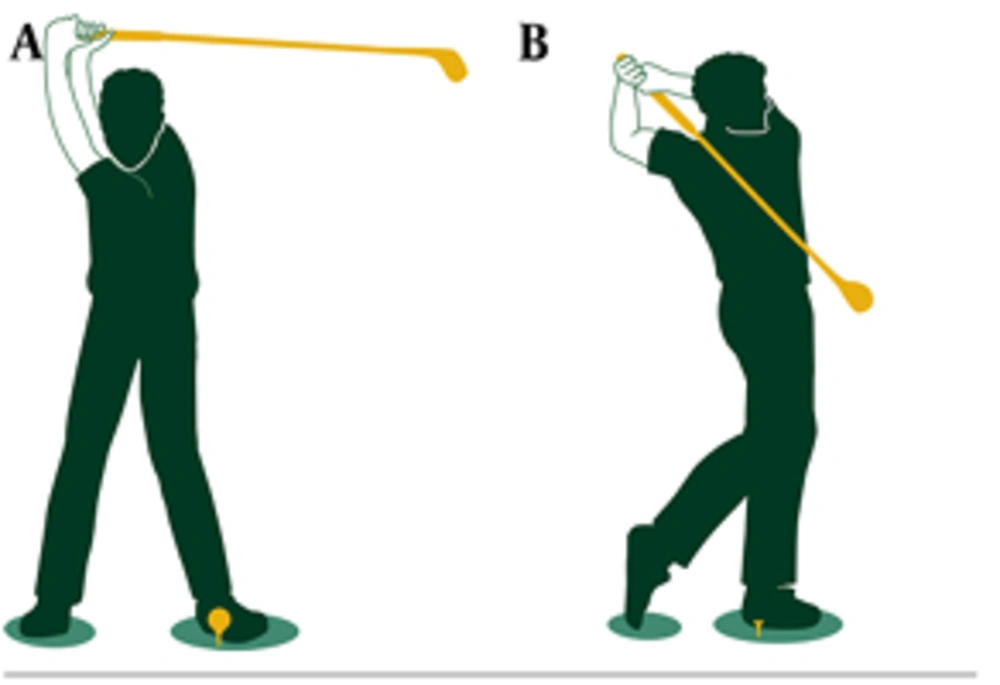
Figure 1.
Large Amplitude Movements of the Trunk, Both Shoulders and the Lead Hip as the Body Rotates From the Top of The Backswing into the Finish Position (Showing Right-Handed Golfer)
4. Trunk Muscle Influences on LBP From Golf
Another area of investigation into the cause of golf-related LBP has been based on the speculation that golfers with LBP may use key trunk muscles, such as the abdominals, differently during the downswing phase than golfers without LBP (43). Horton, Lindsay and Macintosh (44) attempted to quantify abdominal muscle activity during the golf swings of elite golfers with and without LBP. Results indicated that the magnitude of the muscle activity for the rectus abdominis, external oblique and internal oblique did not differ significantly between those golfers with LBP and those without. However, the authors found onset times of major bursts of activity from some of the abdominal muscles were delayed in the golfers suffering LBP. In particular, the lead external oblique (left in right-handed golfers) was activated significantly later during the backswing in the golfers with LBP when compared to the asymptomatic controls. Furthermore, lead internal oblique onset times on the downswing were also delayed in the chronic LBP golfers, although this difference did not reach statistical significance.
Cole and Grimshaw (45) also investigated EMG activity in the abdominal and trunk muscles of golfers with and without LBP. The researchers found that highly skilled players tended to demonstrate reduced erector spinae activity at the top of the backswing and at impact. They went on to state that the reduced activity may be associated with a reduced capacity to protect the lower back during key parts of the swing when the magnitude of the stress on the spine is high.
The EMG findings of Horton, Lindsay and McIntosh (44) and Cole and Grimshaw (45) provide evidence that golfers with LBP appear to activate their trunk muscles differently than healthy golfers. It is possible these differences may, over time, contribute to reduced trunk muscle strength and endurance. Localized trunk muscle fatigue is known to compromise precise motor control (46) and thus the ability of the spine to withstand repetitive stress (47). Weakening of the trunk muscles is particularly relevant if the type of movement performed involves rapid and repeated movement of the extremities (48). The effective execution of the golf swing not only requires rapid movement of the extremities but also substantial strength and power of the trunk muscles. These movements are often repeated over long durations when playing or practicing which may lead to fatigue and ineffective trunk muscle recruitment patterns. Reduced muscular support may create abnormal stress on the passive tissues of the spine (ligaments, bones, discs etc.) thus increasing the likelihood of suffering an injury to the low back (49, 50).
A small number of studies have examined trunk muscle endurance in golfers with and without LBP. Evans and Oldreive (51) investigated the total time golfers with and without LBP could maintain an isometric transverse abdominis contraction. Transverse abdominis has been shown in non-golf studies to be very important for protecting the lumbar spine by tensioning the thoraco-lumbar fascia (52). Results from Evans and Oldreive (51) showed that golfers with LBP had a significant reduction in the ability to maintain the static contraction compared to the healthy golfers.
Suter and Lindsay (53) investigated static trunk endurance in low handicap golfers experiencing non-debilitating LBP. This study found isometric trunk extensor (e.g. erector spinae) holding times for golfers with LBP to be significantly lower than values reported from healthy subjects (no comparisons were made with normal golfers). Evans et al. (54) also examined isometric trunk endurance, as well as other physiological measures that were considered risk factors for LBP, in a group of Australian golfers training to become golf professionals. This was a prospective study where, at the time of testing, none of the 16 participants had LBP. The trainee golfers were then followed for a one-year period where they were required to compete in at least 15 sanctioned golf tournaments. All players were surveyed to see how many experienced LBP and which risk-factor test parameters best correlated with the golfers that developed LBP. Potential risk factors included anthropometric variables, flexibility (active knee extension, Thomas test, sit and reach, trunk flexion, trunk extension and trunk side bend), muscle strength (isometric hip extension and trunk extension), and static muscle endurance (trunk flexor, trunk extensor and side-bridge). Results showed that golfers with a body mass index (BMI) < 25.7 kg/m2 and those with a trail (i.e. right) side deficit of 12.5 sec on the static side-bridge endurance test reported more frequent episodes of moderate-to-severe LBP.
These previous attempts to measure trunk muscle endurance have used a variety of static test procedures. However, dynamic movements similar to the golf swing (i.e. axial rotation) have only been studied in a very limited capacity. Lindsay and Horton (55) examined isokinetic axial rotation strength and endurance in elite golfers with and without LBP as well as healthy age-matched controls who did not golf. Results demonstrated that there was neither significant magnitude nor side-to-side differences in strength and endurance measures between the elite healthy golfers and the healthy control subjects. However, golfers with LBP had less rotational strength and endurance compared to the other groups, although only the endurance results were statistically significant.
Given the importance of trunk rotation in the golf swing, it would seem beneficial for dedicated golfers, irrespective of whether or not they suffer from LBP, to place more emphasis on conditioning programs to help strengthen the trunk muscles. Furthermore, although statistical significance was not found, Lindsay and Horton’s (55) study did show that elite golfers tended to have greater axial rotation strength in the direction they normally swing a golf club (i.e. to the left for a right-handed player). This asymmetry or imbalance was even more evident in the golfers with LBP. Rehabilitation programs should attempt to reduce this side-to-side disparity or at the very least all golfers should be encouraged to take warm-up or practice swings both left and right handed.
It is unclear what factors are responsible for the deficiencies in trunk muscle endurance found in golfers suffering LBP. Rectifying these deficits through exercise rehabilitation would seem an important strategy for controlling or eliminating the LBP. While outlining a comprehensive fitness program for golfers with LBP is beyond the scope of this paper, exercises that emphasize transverse abdominis conditioning (51) as well as trunk rotation (55), lateral flexion (e.g. side bridging) (54) and extension (53) would appear to be particularly beneficial. However, in addition to exercise, changes in swing technique may also be necessary. Archambault et al. (56) recommended the use of a stabilized-spine golf swing, to facilitate the use of the abdominal and other large trunk muscles to control LBP during the swing motion. This technique involves setting up with a “proper” spine angle and initiating the backswing with the hips and shoulders moving together. Kinetic testing showed the stabilized-spine swing significantly increased trunk rotation velocity on the downswing while reducing spinal lateral bending force, shear force, compression force, as well as axial torsion force compared to a more traditional “modern” golf swing. Although Archambault et al. (56) do not specifically define the recommended spine angle when addressing the ball; Figure 2 demonstrates an appropriate biomechanically efficient set-up posture (8).
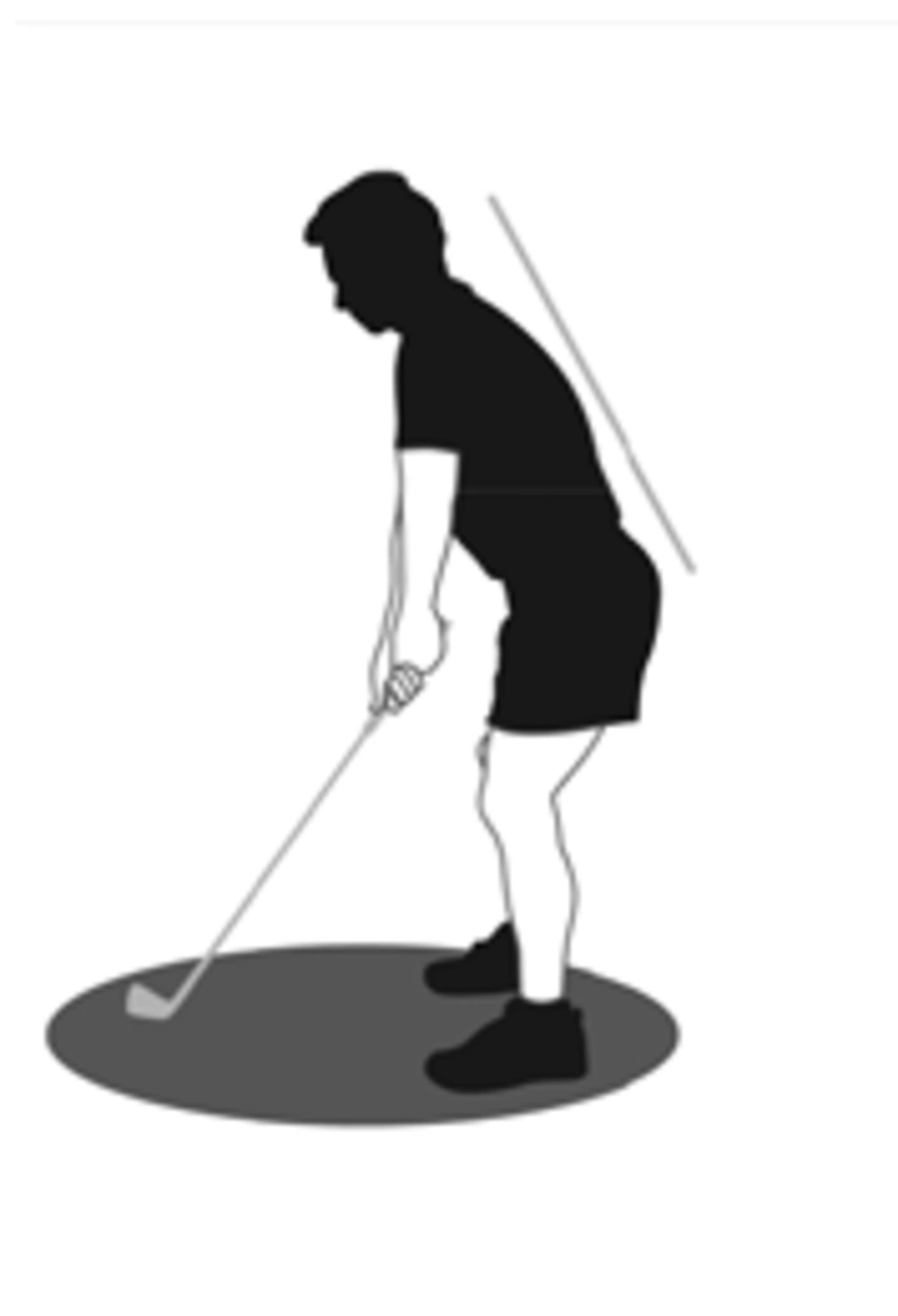
Figure 2.
ADAPTED From Cann et al. (8)
5. Other Considerations
While the causes of LBP from golf are usually focused on what happens around the spine, the hip region may also play a role. Vad et al. (57) examined hip ROM and LBP amongst 42 professional golfers attending a 2001 Professional Golfers Association (PGA) Tour event. The 14 players with a history of LBP demonstrated a significant restriction of lead side hip internal and external hip rotation as well as lumbar extension compared to the 28 asymptomatic golfers. The authors speculated that as the body pivots onto the lead side during the swing, the decreased amount of hip rotation on the lead side might cause increased ROM and force to be transmitted to the lumbar spine resulting in LBP.
The findings of Vad et al. (57) highlights the need for healthcare providers treating golfers suffering LBP to assess hip rotation ROM and, where indicated provide appropriate exercises to improve hip mobility. However, in some cases restriction in hip rotation ROM may be the result of osteoarthritis and as such may not respond to exercise. In these situations, reduction in the kinetic forces on the hip and lower back may be as simple as altering the ground reaction forces beneath the anchored feet and up through the kinetic chain via modified footwear. Evidence for this was provided by an interesting biomechanical case study conducted at the Sports Science Institute of the Eberhard Karls University in Tubingen, Germany. The researchers tested a golf shoe that allowed the upper portion of the lead side shoe to “release” or rotate further towards the target after impact than the sole-plate portion of the same shoe. At the finish position, the free-release mechanism allowed the left foot to turn about 20-25º further towards the target than when the foot was constrained within a standard golf shoe. This release of the shoe decreased the amount of lead hip internal rotation at the finish position by approximately 10º and decreased spinal rotation by approximately 5º. The manufacturer claims that this results in a considerable decrease in the force moments about the ankle, knee, hip and spine which would in turn decrease the risk of injury to these areas (www.free-release.com). Further research is needed to substantiate the proposed benefits of this unique shoe design.
Another interesting shoe design has been investigated for helping reduce golf-related LBP. Nigg and colleagues (58) examined the effect of wearing rocker-soled sandals for 6 weeks on a group of 40 golfers with non-specific LBP. The rocker-sole, being somewhat “unstable”, is believed to train neuromuscular control and/or to strengthen muscles throughout the human loco motor system including the lower back. At the completion of 6 weeks, there was a statistically significant 44% reduction in subjective pain for the unstable shoe group but no significant difference in the control group. The authors postulated the improvement in perceived pain may have resulted from a reduction in joint forces caused by excessive muscular co-contraction.
6. The Influence of Club Transportation Method on Lbp
Gosheger et al. (18) reported that golfers who carried their bag on a regular basis suffered significantly more injuries to the lower back, shoulder, and ankle. Research by Wallace and Reilly (59) showed that carrying a back pack weighing the equivalent of a set of clubs (i.e. approximately 8 kg) required about 15% more energy than walking the same distance without clubs. Carrying the 8 kg during a simulated 9 holes of golf also caused the spine to shrink about 6 millimeters. However, the same research also showed the spine shrank a total of about 4 millimeters when subjects simply walked the same distance without hitting golf balls or carrying anything. Although statistical significance was not found, the results from Wallace and Reilly’s (58) study, when combined with those from Gosheger et al. (18), suggest that golfers with LBP should consider other club transportation methods when playing such as pushing the clubs using a two or three wheel trolley.
The motorized golf cart or “buggy” is another way players can transport their golf clubs from tee to green and would provide the benefit of not having to physically carry the weight on their back. However, sitting in a golf cart, while driving over rough terrain, would likely increase spinal compression forces within the low back. Furthermore, sitting would negate the warm-up and calorie burning benefits that come with walking. An appropriate warm-up would appear particularly good advice for golfers. Gosheger et al. (18) reported that golfers who perform a pregame warm-up routine greater than 10 min experienced less than half the injuries per player than those who warm-up for 10 min or less. Not only is the incorporation of a warm-up period greater than 10 minutes good advice for injury prevention, many performance improvements may also be obtained (60, 61).
7. Conclusions
As can be seen above, there are many possible factors contributing to LBP from golf including overuse, poor conditioning, inappropriate warm-up and club transportation methods and biomechanical factors creating excessive stress on the spine. In addition to appropriate exercise rehabilitation, it is important for healthcare providers treating injured golfers to investigate factors such as swing technique when determining appropriate rehabilitation strategies. Correction of biomechanical deficiencies in a player’s swing does not rest exclusively on the healthcare provider but will often involve collaboration between the healthcare provider and a certified golf coach.
A summary of the findings from the scientific literature dealing with golf-related LBP is presented below, followed by strategies that can be adopted to assist the golfer overcome their injury.
7.1. Summary 1-Factors Contributing to LBP From Golf
- A typical golf swing creates sufficient stress (e.g. compressive load) on the lumbar spine to potentially injure the intervertebral discs.
- LBP from golf is usually more related to cumulative load (i.e. repetition) than trauma associated with a single swing.
- Spinal stress from golf is asymmetrical, i.e. it primarily affects the trail side and can lead to degenerative changes of the trail side lumbar facet joints and vertebral bodies.
- Side bending through impact is one of the main contributing factors to trail side spinal injury / degeneration.
- Golfers suffering from LBP typically “slouch” more at address which may contribute to a steeper swing plane and increased lateral sheer on the downswing.
- Golfers with LBP may be over-rotating their spine at the top of the backswing and at the finish position.
- Golfers with LBP appear to have abnormal trunk muscle recruitment patterns and less muscle endurance which may diminish the ability of the lower back support musculature to protect the spine.
- Lead hip rotation restrictions may lead to swing compensations that in turn over-stress the lumbar spine causing LBP.
7.2. Summary 2-Key Factors For Decreasing LBP From Golf
- Don’t play / practice excessively. Obviously playing and practicing can improve performance (a goal of many golfers) but a common sense approach should be adopted where the player must listen to their body and find a balance between overall participation volume and recovery from LBP.
- Seek professional assistance from a properly credentialed golf coach and possibly a knowledgeable healthcare provider to assess swing mechanics and determine if there is a need to decrease the amount of spinal side bend on the downswing and through impact. Improving address posture (i.e. not slouching) is one potential way to accomplish this.
- Improve trunk rotation flexibility to help control relative over-rotation of the spine during the golf swing. Allowing the lead heel to lift slightly at the completion of the backswing may avoid excessive spinal torsion by allowing more pelvic turn.
- Asymmetry in trunk rotation forces between the back and down-swings may create an adaptive asymmetry in trunk rotation strength between the lead and trail sides in golfers who play and practice a lot. Golfers should therefore be encouraged to take practice swings both left and right handed.
- Improve the strength and especially the endurance of the spinal stability musculature. The incredible vitality and longevity of professional golfer Gary Player through six decades of competition is an example of the value of habitual, life-long exercise.
- Maintain good hip rotation mobility especially on the lead side.
- Warm-up for more than 10 minutes prior to playing and practicing and don’t carry clubs on shoulders when playing. Push carts or caddies are preferable.
- Consider “free-release” or rocker-soled “unstable” shoes to help alleviate LBP.
