1. Background
Wrestling is a popular sport in many countries around the world. Its origin can be traced back to the Sumerians as early as 5000 BC. (1). The two internationally recognized styles of wrestling are; Greco-Roman (GR), which made its debut in the first modern Olympics in Athens (1896), and freestyle (FS) which was included in the Olympic program in Saint Louis (1904) (2).
Like all sports, wrestling is beneficial to its participants and has been linked to better grades, fewer school absences and better behavior (3). However, the sport’s arduous nature has led to reported match injury rates as high as 30.7 injuries per 1000 athlete-exposures among college wrestlers second only to injury rates among college football players (4).
According to the data from the centre for injury and policy, football and wrestling are the two sports with the highest risk of serious injury to athletes (1). In a study by Powell et al. the highest proportion of injuries for which a player missed more than 7 days was for baseball (31.0%) and wrestling (32.6%), with the lowest proportions for field hockey (20.4%) and softball (22.9%) (5).
Of all the wrestling injuries, those to the knee and shoulder joints are most frequent (6, 7). Jarret et al. (4) evaluated collegiate wrestling injuries over an 11-year period and found that, next to spring football, wrestling had the highest injury rate. The authors reported the knee to be the most frequently injured body part.
2. Objectives
Hence the purpose of our study was to study the knee injuries in the Indian wrestlers. Not only did we study the type of knee injuries sustained by these wrestlers but also the category of wrestlers who were more prone to these injuries and other factors which contributed to these injuries.
3. Methods
Permission was taken from the institutional post graduate board of studies to conduct this study and informed consent was taken from the study population before starting the study.
3.1. Study Population
All the wrestlers enrolled in the largest akhada/ wrestling school of the city were included in the study. Over a period of 2 years we studied 196 wrestlers prospectively. They were of all age groups, weight class, height and experience. Their knee injuries were documented by means of a structured questionnaire which they completed with assistance from their athletic trainers. The structured questionnaire included the date of injury, the type of injury (whether new or recurrent), clinical impression, player position, player activity, playing surface, imaging findings, management of injury and the date of return to sport. In addition it also included the player information e.g age, weight (wt), height (ht), duration for which the player had been practicing and style of wrestling (FS or GR). The athletic trainers were also required to report daily participation, the type of session and the injuries sustained. The structured questionnaire was presented in the paper form.
All old injuries sustained before the study period, injuries due to systemic diseases and soft tissue or bony pathologies unrelated to the practice of wrestling were excluded from this study. Aggravation of previous injuries was also excluded from the study. All skin infections and dental injuries related to wrestling were also excluded. However, recurrent injuries at the same site sustained during the period of study were included and were recorded as recurrent injuries.
3.2. Operational Definitions used in the Study
Definitions of injury: An injury was defined as any significant condition that limited function prompting the wrestler to seek the help of professionals from the area of health or that which caused abandonment of a fight or of training, and resulted in lost time from athletic participation for one day or more.
A recurrent injury was defined as injury involving a body site that had sustained an injury at the same location earlier with an injury free period in between.
An athlete exposure consisted of 1 athlete participating in 1 wrestling practice or match.
Return to game: Follow-up was performed until the wrestler returned to practice/ competition or quit the game.
3.3. Study Design
All wrestlers included in the study were subjected to a detailed clinical history and physical examination and were investigated by an appropriate imaging modality depending on the type of injury.
Radiographs were performed either on digital radiography system or on computed radiography system. Image processing or enhancement was applied on DR images as well as CR images depending on requirement.
Ultrasound was performed using a 5 - 13 MHZ linear probe but in large patients a lower frequency probe i.e. 2 - 6 MHZ was necessary. Computed tomography (CT) was done on 4 slice CT scanner.
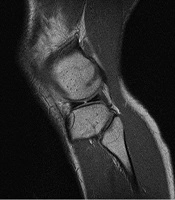
Magnetic resonance imaging was performed in sagittal, coronal and axial plains. In all patients T1 weighted and T2 weighted images were obtained. In addition to these, T1 gradient echo sequence (GRE), T2 fast spin echoes (FSE), T2 fat suppressed and other sequences like PD weighted and PD weighted fat suppressed, were done as and when required.
All investigations were performed by a radiologist with 11 years of experience as a general radiologist and 01 year as musculoskeletal radiologist. Radiographs were performed in cases of suspected fractures followed by CT scan if the diagnosis was in doubt, while ultrasound was performed in all cases of suspected soft tissue injuries followed by MRI for further characterization in case of clinical indication. CT scan was also performed in cases of suspected osseous injury.
3.4. Statistical Analysis
Data was collected and analyzed using SPSS software and EPINFO for Chi- square analysis. Injury rates were calculated as ratio of injuries per 1000 athlete -matches.
Case rate per 100 players was calculated by dividing number of injuries divided by total number of players. While, Player rate per 100 players was calculated by dividing the number of players sustaining at least 1 injury by the total number of players. The case rate per 100 players is different from the player rate per 100 players in that it includes multiple injuries to the same players.
Incidence density ratio (IDR) was calculated as follows:
IDR= Game injury rate /practice injury rate.
An IDR of 1 indicates no difference in the injury rates. An IDR greater than 1 indicates that the games have the higher injury rates, and an IDR less than l indicates higher injury rates in practice.
Definition of injury proportion rate (IPR) is as follows:
4. Results
The study included 196 wrestlers, with age range of 9 years to 34 years (mean age= 19.23 ± 0.279 yrs), weight range of 38 kg to 120 kg (mean wt= 67.94 ± 1.07 kg) and height range of 123 cms-195 cms (mean ht= 165.62 ± 10.6 cms), practicing freestyle (FS) (160/196) and Greco-Roman (GR) (36/196) type of wrestling.
There were 188 injuries in 121 wrestlers. Injured wrestlers sustained 188 injuries and had 36626 athlete exposures. Hence, the overall injury rate was 5.13 Injuries /1,000 athlete-exposures. Case rate was 0.95 while, player rate was 0.61.
Maximum number of injuries occurred to the knee i.e 37.77% (71/188) (Table 1). Total of 35 wrestlers sustained 71 injuries. Hence, the case rate for knee injuries was 2.02, while player rate is was 0.17. A higher no. of injuries at the knee joint (51/71; 71.83%) were new as against the injuries to the other body parts. This was found to be statistically significant (P = 0.012). IDR was 20.7 as 93.33% injuries occurred in matches while 4.49% occurred during practice.
Table 1.
Injuries vs. Location
| Injury Location | No. (%) of Total Injuries, N = 188 |
|---|---|
| Head and Neck | |
| Concussion | 0 (0.00) |
| Ear | 1 (0.53) |
| Nose | 3 (1.60) |
| Neck | 1 (0.53) |
| Spine | 21 (11.17) |
| Trunk | |
| Clavicular region | 3 (1.60) |
| Chest | 11 (5.85) |
| Abdomen | 5 (2.66) |
| Pelvis/Hip | 1 (0.53) |
| Upper Extremity | |
| Shoulder | 35 (18.62) |
| Elbow | 12 (6.38) |
| Hand and wrist | 14 (7.45) |
| Lower Extremity | |
| Upper leg | 4 (2.13) |
| Knee | 71 (37.77) |
| Lower leg and foot and ankle | 6 (3.19) |
| Catastrophic injury | 0 (0.00) |
More number of injuries to knee (34/71; 47.88%) occurred in attack position. This was also statistically significant (P = 0.000). The number of injuries occurring in defense position was 29/71 (40.8%), while 8/71 (11.26%) injuries occurred accidentally (Figure 1).
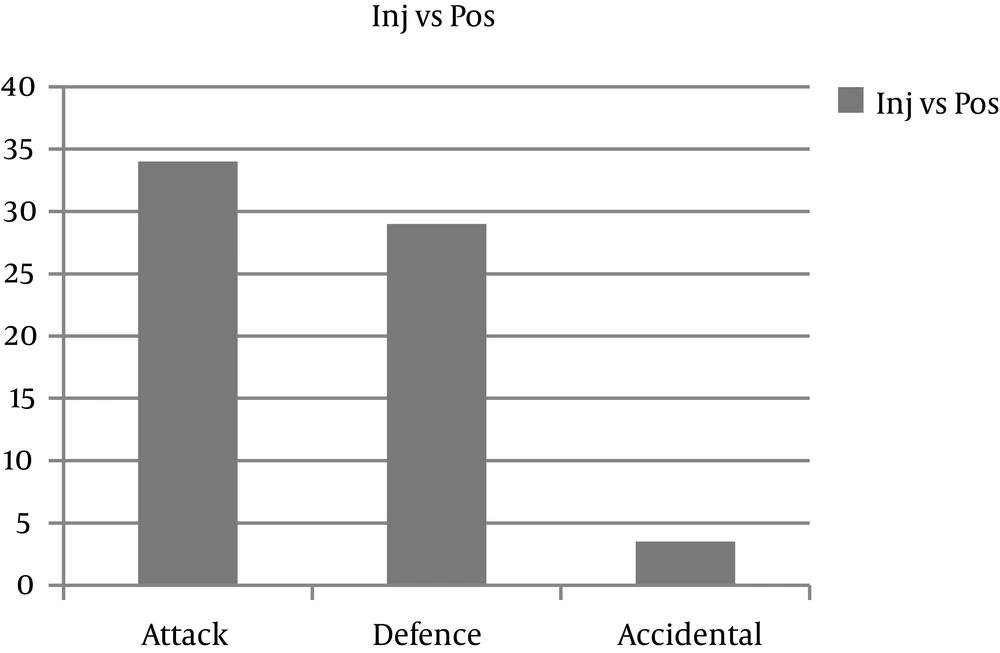
Figure 1.
Knee Injuries (n = 71) Vs. Wrestling Position
There were 59 (59/71; 83.09%) injuries in wrestlers practicing FS, while 12 (12/71; 16.90%) occurred in wrestlers practicing GR. There was however, no statistically significant association between injury outcome and the wrestling style for these injuries. The IPR was 1.37 (95% CI: (-.9566-.9759) signifying that a higher number of injuries occurred in wrestlers practicing freestyle wrestling.
There was a statistically significant association between knee injuries and age (P = 0.024) (Figure 2). Similarly, these injuries also correlated significantly with duration of practice (P = 0.001) (Figure 3). No statistical association was found between wt (P = 0.159) and height category (P = 0.068) and knee injuries.
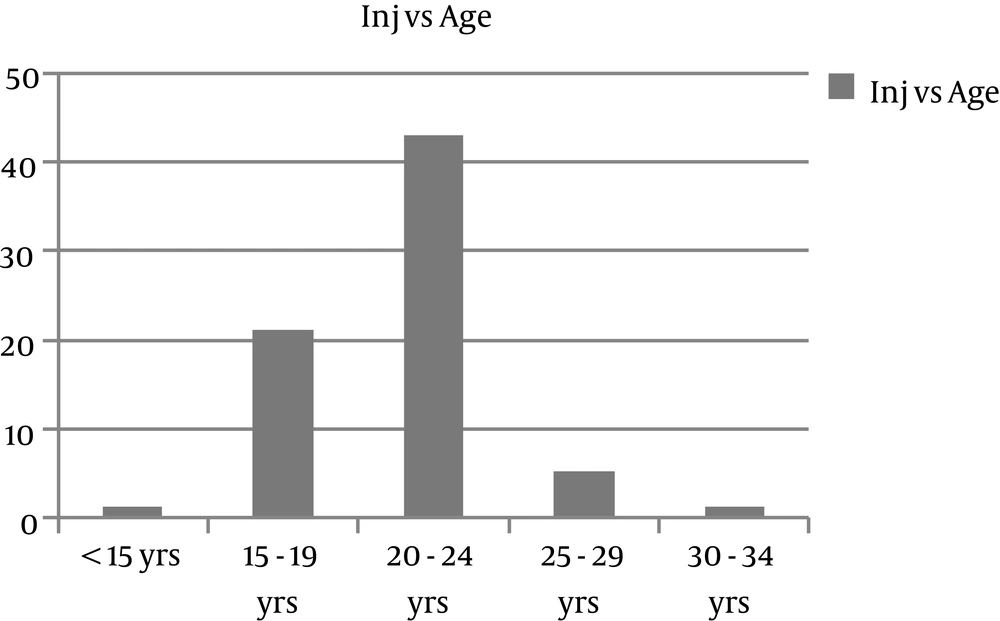
Figure 2.
Knee Injuries (n = 71) Vs. Age
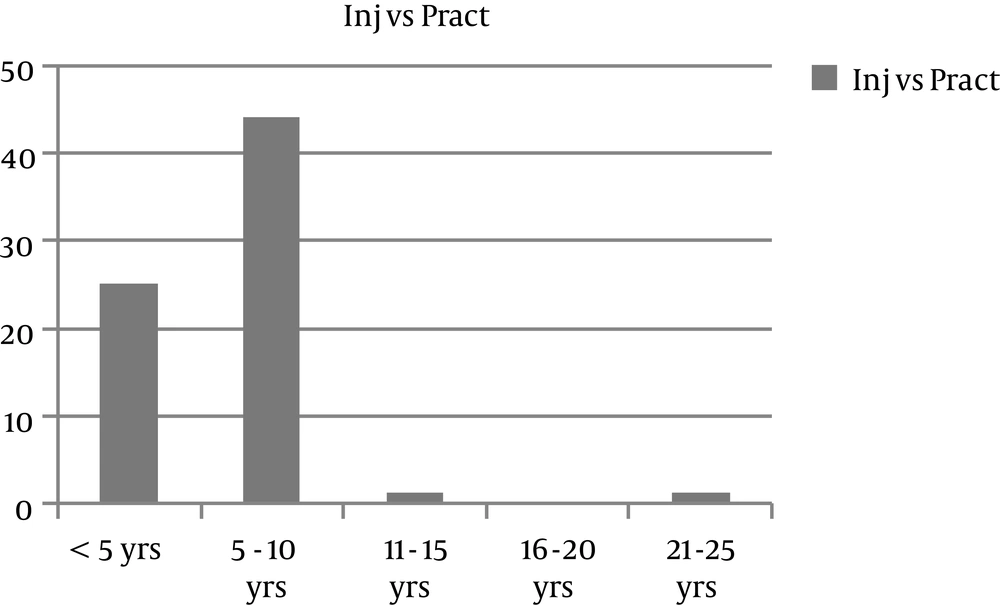
Figure 3.
Knee Injuries (n = 71) Vs. Duration of Practice
Ligamentous and muscular sprain and strain were the commonest lesions with the knee being the second commonest site after shoulder. Out of 18 contusions overall there were 9 to the knee which was the commonest site. Various knee lesions seen on imaging have been tabulated in Table 2.
Table 2.
Knee Lesions
| Knee Lesions | N = 77 | |
|---|---|---|
| Medial Meniscus | 5 | (5/77) 6.49% |
| Lateral Meniscus | 7 | (7/77) 9.09 % |
| Anterior Cruciate Ligament | 8 | (8/77) 10.38 % |
| Posterior Cruciate Ligament | 2 | (2/77) 2.59 % |
| Medial Collateral Ligament | 5 | (5/77) 6.49% |
| Fibular Collateral Ligament | 3 | (3/77) 3.89% |
| Effusion | 9 | (9/77) 11.68% |
| Bone Contusion | 9 | (9/77) 11.68% |
| Strains | 14 | (14/77) 18.18% |
| Cartilage lesions | 2 | (2/77) 2.59% |
| Prepatellar bursitis | 13 | (13/77) 16.88% |
More number of wrestlers i.e. 26/35 were treated conservatively. While, 9/35 wrestlers underwent operative treatment.
5. Discussion
Each sport has its characteristic injury profile and degree of risk, and the injuries vary widely among sports (8). The lower extremity is classically the most commonly injured area in wrestling with more number of injuries occurring at the knee followed by the ankle (7, 9).These injuries are usually season ending and often require surgical intervention. Prepatellar bursitis is a very common type of knee injury, and is fairly unique to wrestling (9, 10).
In prospective studies, knee injuries have ranged from 7.6 to 44% of all wrestling injuries (9, 11). In the only study with the percentage of knee injuries below 10%, Lorish et al. described injuries in tournaments to wrestlers aged 6 - 16 years (12). The knee injuries, in our study also were quite high comprising 37.7% of all of all injuries reported. These injuries tend to be severe. Over an 11 year period in NCAA wrestling, 65% of injuries requiring surgery involved the knee. In the same study, 21% of injuries leading to greater than one week absence from competition involved the knee (4).
Barroso et al. in their study found that the highest number of lesions involved the knee (25.5%), followed by the shoulder (20%) (6). However, more number of injuries occurred to the shoulder (24%) followed by the knee (17%) in a study by Pasque et al. (7). According to Wroble et al. (13) wrestlers with previous knee injuries were at high risk for re-injury. There were 9 wrestlers with previous knee injuries in our study.
Kordi et al. reported that 77% of all injuries were acute ones (new injuries), 10% of injuries were recurrent, 2% of injuries were unresolved injury from the preceding year and 1% of them were due to a recent worsening of an unresolved injury (14). In our study 71.83% of the knee injuries were new injuries while, 28.16% were recurrent.
The most common knee injuries are sprains, which constitute 30 - 65% of all knee injuries. Meniscal injuries are also common, with a relatively high proportion of lateral to medial meniscus tears (11) Wroble et al. reported that the most frequent knee injuries included prepatellar bursitis, lateral and medial collateral ligament sprains and meniscal tears (13). Ligament and muscular sprains (23.37%) and strains (18.18%) were maximum in our study as well.
Lateral meniscus injuries represented 46% of the total number of meniscal injuries in a study and there were 45% lateral versus medial meniscectomy in a study on 56 meniscectomies in wrestlers (9, 15). Lateral meniscus injuries were 58.3% of all meniscal injuries in our study. Mysnyk et al. documented 28 cases of prepatellar bursitis, representing 21% of all knee injuries (10). Prepatellar bursitis represented 16.88% of all lesions in our study. Of these 46.15% were recurrent and there were no cases of septic bursitis. Anterior cruciate ligament tears were noted in 14 of 256 knee injuries in one study (9) Similarly, three of the 64 knee injuries were ACL tears in a study by Wroble et al. (13) In our study 8/77 injuries were ACL tears.
Defensive wrestlers are particularly vulnerable because they are more likely to be off balance, may have one or both arms held, and have his opponent land on top of him (16). The most common wrestling situation reported to result in injury is the take down position in which both wrestlers are in the standing position attempting to take the other down to the mat (9, 17). Boden et al. concluded from their study that the position most frequently associated with injury was the defensive position during the takedown maneuver (74%), followed by the down position (23%), and lying position (3%) (16). However, in our study more number of knee injuries occurred in attack position. This can possibly be attributed to poor technique.
Exposure data has revealed injury rates in matches to be almost 40 times those of practice (14). Boden et al. and Snook et al. found that the majority of injuries occurred in match competitions (16, 17). Pasque et al. (7) however, reported that 63% of their injuries occurred in practice. In terms of exposure, a rate of 5 injuries per 1,000 practice-exposures as compared to 9 per 1,000 match-exposures occurred. Hard wrestling during practice and the takedown position resulted in the highest occurrence of injury. More number of knee injuries i.e. 93.33%, were sustained in competitions while only 4.49% injuries occurred during practice in our study (incidence density ratio = 20.7).
According to a study by Myers et al. the frequency of injury in scholastic (12 - 17 years) wrestlers was approximately ten times greater than that of youth (7 - 11 years) wrestlers (2). Strauss et al. (9) also found that the youngest wrestlers (8 - 14 years old) were injured at a rate of 3.78/100 tournament participants, whereas in the high school wrestlers’ the rate was 11.15/100 tournament participants. Pasque et al. also found that the older and more experienced wrestlers were more at risk of injury (7). In our study 60.56% knee injuries occurred in the age group of 20 - 24 years, while 29.57% injuries were seen in the age group of 15 - 19 years.
Pasque et al. (7) found that the injured wrestlers had significantly more years of wrestling experience. Varsity wrestlers comprised 44% of the study, but accounted for 60% of the injuries. This may be the result of more aggressive wrestling at that level. They also found a slightly higher rate of injury for those who wrestled year round, though not statistically significant. There was a statistically significant association with duration of practice in our study. Out of total knee injuries, 61.97% injuries occurred in wrestlers practicing for 5 - 10 years, while 35.21% occurred in wrestlers practicing for 0 - 5 years.
Use of legs in FS and hands and arms in GR as per rules possibly makes these wrestlers more vulnerable to lower and upper extremity injuries, respectively. In a study by Yard et al. in FS wrestling, the majority of sprains/strains were to the lower extremity (56.8%), followed by the upper extremity (24.3%) and trunk (18.9%). In contrast, the majority of GR sprain/strains were to the upper extremity (55.6%), followed by the head/face/neck (22.2%) and trunk (16.7%). FS fractures were most frequently to the upper extremity (40.0%). GR fractures were to the head/face/neck (40.0%) (18). A study revealed that Olympic-level FS wrestlers had a higher risk of injuries compared with GR wrestlers (6). In our study 83.09% injuries occurred in FS wrestlers while 16.90% occurred in GR wrestlers. The proportion of injuries i.e. total knee injuries in wrestlers practicing FS wrestling was also more (IPR = 1.39).
In a prospective injury surveillance study conducted at the US 2006 Cadet and Junior national championships, the rate of injury per1000 athlete-matches was higher for FS (7.0) compared with GR (4.6) wrestling (rate ratio 51.51). Compared with GR wrestling, there was a greater proportion of knee injuries in FS wrestling as was the case in our study also (18).
There are no universally accepted criteria for evaluation of the severity of sports injuries (4). Barroso et al. (6) used the need for surgical treatment as a severity parameter. In their study on wrestling athletes 13 (9%) lesions were operated and most of these lesions, were located in the knee. Agel et al. (19) and Wroble et al. (13) reported that most of the lesions in wrestling athlete that required surgical treatment occurred in the knee. In our study 10 wrestlers underwent operative intervention and out of these 09 were for knee injuries.
A study by Wroble et al. revealed that there were 11.5 knee injuries per 100 wrestlers per year requiring a week or greater time loss (13) . Pasque et al. (7) found that the mean total time lost from injury was 5 days (range, 1 - 39days). There were 18.11 knee injuries per 100 wrestlers per year requiring a week or greater time loss in our study.
5.1. Limitations/Weakness of Our Study
This study is first of its kind from the Indian subcontinent. Hence, we kept the study very simple. In spite of that we observed the following during the course of this study:
1) Ignorance of study population and trainers who persist in treating injuries according to traditional methods.
2) Ignorance about importance of reporting injuries/ avoidance to continue practicing.
3) Lack of proper follow up to continue playing in competitions.
4) All wrestlers start their career practicing freestyle and generally shift to GR style on sustaining injuries to lower limb.
5) Lack of proper supervision during the time away from sport following injury.
6) Lack of regular medical check ups and information regarding their injuries.
5.2. Conclusion
The best way to minimize injuries to the athletes is by developing a well-designed and operational injury prevention program by consistently and professionally evaluating the injury patterns. Even though not all injuries can be avoided, the best way to minimize them is by well defined injury prevention strategies. The aim of our study was to understand the variables leading to injuries in the Indian wrestlers.