





1. Background
Hospital wastewater is one of the most dangerous environmental contaminants, with numerous adverse effects. Antibiotics used in hospitals that are released into the wastewater are an important source of antibiotic resistance spread by creating selective pressure on bacteria. Indeed, the abundance of bacteria and their resistance patterns may differ according to the type of hospital and the characteristics of the wastewater. The most commonly found bacterial pathogens in hospital wastewaters include Salmonella, Shigella, Staphylococcus, Enterococcus, and coliforms. Although coliforms are the most important indicators of wastewater contamination, Enterococcus faecalis and Staphylococcusaureus are also considered important bacterial contaminants of water and wastewater. The presence of various pathogenic factors and the antibiotic resistance of enterococci and staphylococci are major health threats for humans (1, 2).
Staphylococci, followed by enterococci, are the main causes of hospital-acquired infections, bacteremia, and hospital-associated endocarditis, and are the third most common cause of community-acquired endocarditis, especially in North America. These bacteria have a unique ability to gain resistance to high doses of certain antibiotics, such as aminoglycosides, lincosamides, beta-lactams, and glycopeptides. The spread of these bacteria in the environment is primarily caused by ineffective infection control programs and improper management of hospital wastewater, posing a significant issue in developing countries (3, 4). According to recent reports, the prevalence of antibiotic-resistant enterococci and staphylococci is on the rise. These strains have been reported from wastewater treatment plant effluents, hospital wastewater, raw municipal effluents, and surface waters (5-7). Reports have also indicated an increase in antibiotic resistance rates among vancomycin-resistant enterococci strains in patients over the last two decades. Previous studies on wastewater treatment plants have demonstrated the presence of staphylococci with high resistance to vancomycin and several other antibiotics (8).
2. Objectives
According to the multidrug-resistant (MDR) patterns observed in bacterial isolates from hospital wastewater samples and the reports of the transfer of drug resistance to other bacterial pathogens (9), which may ultimately lead to treatment failure, the present study aimed to determine the frequency and phenotypes of antibiotic resistance among two Gram-positive pathogens isolated from hospital wastewaters in northern Iran, a Middle Eastern country. The findings of this investigation could help assess the role of such wastewater as a reservoir of antibiotic-resistant bacteria.
3. Methods
3.1. Study Location and Sampling
In this descriptive cross-sectional study, a total of 42 wastewater samples were obtained from fourteen different hospitals (eleven cities within the Golestan Province, Iran) from March 2022 to March 2023. Four of these hospitals were situated in the center of Golestan Province, i.e., Gorgan, while the remaining ten hospitals were located in other cities within the province. The sample size was determined at a confidence level (Z) of 99% using the following formula: Z² P (1 - P)/d², where P is the expected prevalence and d represents the desired precision. The samples were procured before the commencement of the chlorination and purification processes in the embedded systems. The samples were taken from a depth of 50 - 70 cm of wastewater and then collected in sterile bottles (4). The samples were transferred to one-liter flasks, placed on ice, and sent to the microbiology laboratory for analysis within 3 hours.
Physicochemical analyses, including the measurement of dissolved oxygen, pH, turbidity, and temperature, were carried out by calibrated portable devices at the sampling site to compare and balance the selected samples. To isolate bacteria, in addition to filtering appropriate volumes of water, 15 mL of each sample were centrifuged at 1500, 3000, and 6000 rpm for 15 minutes at 4°C. Then, the resulting sediment was inoculated into 0.5 mL BHI broth (Merck, Germany) and incubated for 2 hours at 37°C for further experimentation.
3.2. Bacterial Isolation
To isolate enterococci, sediments and filtrates were inoculated onto Enterococcus agar culture medium (Merck, Germany) and incubated at 37°C in the presence of 5% CO2. The genus Enterococcus was identified based on microbiological phenotypic tests such as Gram staining, catalase, sensitivity to SXT, growth on Sodium Azide agar, growth in 6.5% NaCl solution, hydrolysis of sodium hippurate, methyl red, Voges–Proskauer, indole, and citrate tests (4). For final confirmation, after extracting the bacterial DNA from positive samples using the boiling method, polymerase chain reaction (PCR) was carried out using the following specific primers (10): 5'-CACCTGAAGAAACAGGC-3' (forward) and 5'-ATGGCTACTTCAATTTCACG-5' (reverse) to amplify the ddlE gene (encoding D-alanine-alanine ligase; an essential enzyme for enterococcal peptidoglycan biosynthesis). The PCR reaction was carried out in a final volume of 25 µL, and the PCR product was electrophoresed on a 1.5% agarose gel. The detection of 690 bp fragments confirmed the Enterococcus genus. The standard strain of E. faecalis ATCC 29212 was used as a positive control, and a DNA-free microtube was used as the negative control. Enterococcus faecalis was identified and confirmed by hydrolysis of lactose, inositol, glucose, maltose, mannitol, mannose, ribose, sorbitol, and sucrose.
In order to identify S. aureus, first, the filtrates and sediments were inoculated on Columbia agar (Merck, Germany) with 5% horse blood and incubated in the presence of 5% CO2 at 37°C for 24 - 48 hours. To separate coagulase-negative staphylococci from S. aureus, the samples were cultured on mannitol salt agar (Merck, Germany). After 48 hours of incubation at 37°C, S. aureus strains were analyzed by examining mannitol positivity, observing colony morphology, Gram staining, hemolysis, catalase, coagulase (clamping), and DNase tests, and finally identified using the VITEK-2 card system (Biometrics, France) for Gram-positive bacteria.
3.3. Determination of Antibiotic Susceptibility
In the Kirby-Bauer disk diffusion test, a suspension of E. faecalis and S. aureus with a turbidity of 1.5 × 10⁸ CFU/mL was cultured on Mueller Hinton agar (Merck, Germany) and later treated with penicillin (P), amoxicillin (AMX), gentamicin (GM), vancomycin (V), linezolid (LZ), fosfomycin (FOS), chloramphenicol (C), ciprofloxacin (CP), azithromycin (AZM), tetracycline (TE), imipenem (IPM), and cotrimoxazole (SXT) disks, purchased from Padtan Teb Co., Iran. After incubation for 16 -18 hours at 37°C, antibiotic susceptibility was determined by measuring the growth inhibition halo around each disk, and the results were interpreted according to the CLSI-2021 standard (11). For greater accuracy, the minimal inhibitory concentration (MIC) of V was determined by the microdilution broth method (11) for the identification of vancomycin-sensitive S. aureus (VSSA), vancomycin-intermediate S. aureus (VISA), and vancomycin-resistant S. aureus (VRSA) and adapted to the results of the disk diffusion test. Finally, MDR and extensively drug-resistant (XDR) isolates were identified according to the definition of Magiorakos et al. (12).
3.4. Data Analysis
After obtaining the results of wastewater contamination and identifying enterococci and staphylococci isolates and their antibiotic resistance patterns, the findings were presented in the form of frequency tables, graphs, and numerical indices. All data were analyzed in SPSS (version 23) software using descriptive statistics. Quantitative parameters were compared between groups using the t-test at a significance level of 0.01. Graphs were drawn using Microsoft Excel 2016.
4. Results
Among 308 bacterial isolates (77.5%), the highest level of contamination was found in hospital wastewater (80.38%), followed by hospital laboratory wastewater (18.22%) and operating room wastewater (1.4%), respectively. Based on the results, 214 Gram-positive isolates, including Enterococcus, coagulase-positive and coagulase-negative staphylococci, and Streptococcus, were detected. Additionally, 94 Gram-negative bacteria, including Escherichia coli (n = 39; 41.49%), Salmonella (n = 29; 30.85%), and Campylobacter (n = 26; 27.66%), were isolated.
Based on phenotypic and genotypic analyses (Figure 1), the most abundant isolates from hospital wastewaters in the province were E. faecalis (n = 65; 30.37%), S. aureus (n = 57; 26.63%), coagulase-negative staphylococci (n = 54; 25.23%), and streptococci (n = 38; 17.77%). Among E. faecalis isolates, the highest level of resistance and sensitivity was observed for SXT (84.62%) and LZ (90.77%), respectively. For S. aureus isolates, the highest level of resistance was to P (78.95%), and the highest level of sensitivity was to LZ (87.72%) (Table 1). There was a significant difference in terms of resistance to SXT, V, and GM between E. faecalis and S. aureus isolates (P < 0.05).
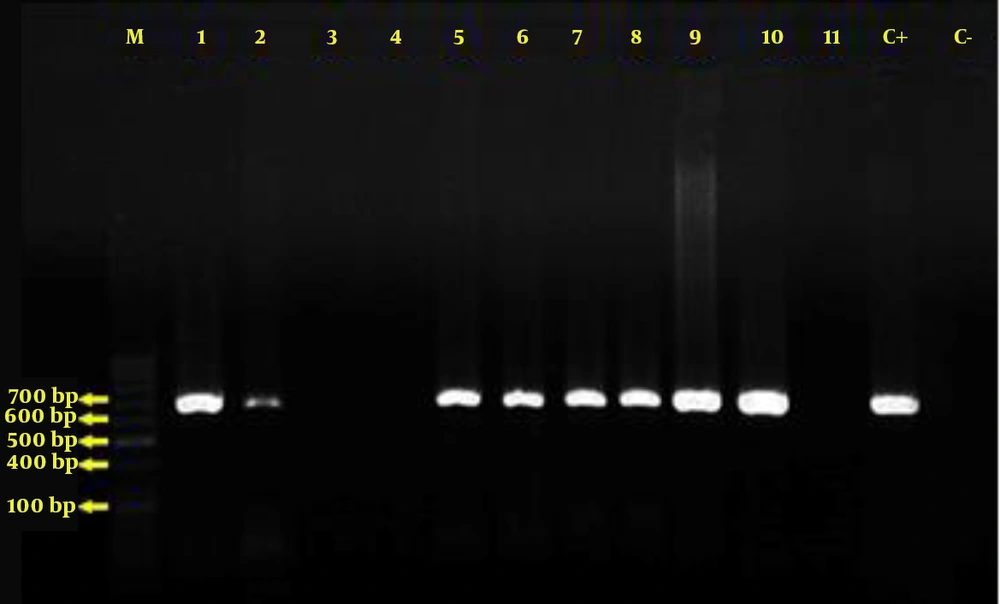
Figure 1.
Amplification of the ddlE gene in Enterococcus isolates. M: 100 bp DNA marker; 1, 2, 5, 6, 7, 8, 9, 10: Positive samples containing the specific gene; C+: Positive control; C-: Negative control
Table 1.The Average Frequency of Antibiotic Resistance Among Staphylococcus aureus and Enterococcus faecalis Isolates from Hospital Wastewater Samples a
| Variables | Antibiotics | |||||||||||
|---|---|---|---|---|---|---|---|---|---|---|---|---|
| Microorganism | SXT | IPM | TE | AZM | CP | C | FOS | LZ | V | GM | AMX | P |
| S. aureus | 29 (50.87) | 23 (40.35) | 28 (49.12) | 39 (68.42) | 35 (61.40) | 20 (35.09) | 9 (15.79) | 7 (12.28) | 9 (15.79) | 19 (33.34) | 26 (45.61) | 45 (78.95) |
| E. faecalis | 55 (84.62) | 35 (53.85) | 44 (67.70) | 31 (47.69) | 42 (64.62) | 36 (55.38) | 16 (24.62) | 6 (9.23) | 37 (56.92) | 43 (66.15) | 33 (50.77) | 42 (64.42) |
| P-value | S | NS | NS | NS | NS | NS | NS | NS | S | S | NS | NS |
Abbreviations: NS, not statistically significant; S, statistically significant.
a Values are expressed as No. (%).
Based on the type of hospital wastewater, the highest rate of antibiotic resistance among E. faecalis isolates was observed in samples collected from cities number 2 and 11. In contrast, antibiotic resistance was higher among S. aureus isolates from samples collected from city number 1 (Table 2). Among the eleven cities in the Golestan province, enterococci isolates showed more resistance (53.85%), and staphylococci isolates showed more sensitivity (40.79%) to antibiotics.
Table 2.Comparison of Antibiotic Resistance Pattern of Enterococcus faecalis and Staphylococcus aureus Isolates from Hospital Wastewater in Different Cities of Golestan Province a
| Sampling Sites | E. faecalis | S. aureus | ||||
|---|---|---|---|---|---|---|
| Resistant | Intermediate | Susceptible | Resistant | Intermediate | Susceptible | |
| City 1 | 150 (56.82) | 32 (12.12) | 82 (31.06) | 133 (50.38) | 34 (12.88) | 97 (36.74) |
| City 2 | 35 (48.61) | 13 (18.06) | 24 (33.33) | 40 (37.04) | 21 (19.44) | 47 (43.52) |
| City 3 | 14 (58.33) | 4 (16.67) | 6 (25.00) | 20 (33.33) | 11 (18.33) | 29 (48.34) |
| City 4 | 30 (62.50) | 8 (16.67) | 10 (20.83) | 10 (41.67) | 2 (8.33) | 12 (50.00) |
| City 5 | 16 (44.45) | 8 (22.22) | 12 (33.33) | 17 (47.22) | 4 (11.11) | 15 (41.67) |
| City 6 | 39 (46.43) | 19 (22.62) | 26 (30.95) | 18 (37.50) | 12 (25.00) | 18 (37.50) |
| City 7 | 38 (52.78) | 12 (16.67) | 22 (30.55) | 10 (41.67) | 8 (33.33) | 6 (25.00) |
| City 8 | 12 (50.00) | 5 (20.83) | 7 (29.17) | 0.00 (0.00) | 0.00 (0.00) | 0.00 (0.00) |
| City 9 | 20 (55.55) | 6 (16.67) | 10 (27.78) | 3 (25.00) | 3 (25.00) | 6 (50.00) |
| City 10 | 37 (51.39) | 17 (23.61) | 18 (25.00) | 26 (36.11) | 12 (16.67) | 34 (47.22) |
| City 11 | 29 (60.42) | 7 (14.58) | 12 (25.00) | 12 (33.33) | 9 (25.00) | 15 (41.67) |
| Total | 420 (53.85) | 131 (16.79) | 229 (29.36) | 289 (42.25) | 116 (16.96) | 279 (40.79) |
a Values are expressed as No. (%).
Based on the results, MDR pathogens were the most abundant group for both bacterial genera isolated from hospital wastewaters. MDR E. faecalis was detected in samples from all cities within the province, with an average occurrence of 55.2%, while MDR S. aureus was identified in 8 out of 11 cities, with an average frequency of 22%. However, XDR E. faecalis, with an average frequency of 17%, and XDR S. aureus, with an average frequency of 8%, were identified in 7 and 4 cities within the province, respectively. Co-presence of XDR E. faecalis and S. aureus isolates was found in cities 2, 3, and 4 (Figure 2).
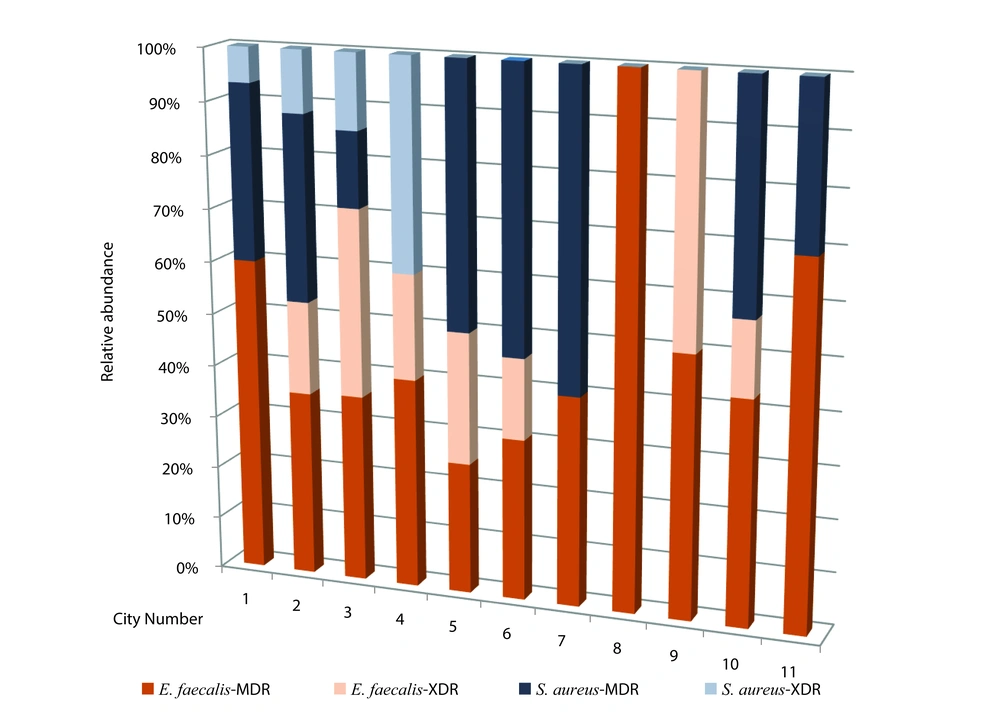
Figure 2.
Characteristics and abundance of multidrug-resistant (MDR) and extensively drug-resistant (XDR) isolates from different hospital wastewaters
5. Discussion
Hospital wastewater presents a distinct category from agricultural, domestic, industrial, and commercial wastewater due to its potential for serious adverse health effects. It encompasses a broad spectrum of contaminants originating from operating rooms, wards, laboratories, laundries, research units, radiology, and hospital kitchens (13). Since, in many countries, wastewater is discharged directly into the municipal sewer system without pretreatment, the wastewater treatment process cannot be sufficient to remove the micropollutants within hospital effluents. Therefore, various pathogenic microbes may act as reservoirs of antibiotic-resistant genes, which can threaten public health (14, 15).
In this study, the occurrence rates of E. faecalis and S. aureus isolates exceeded 30% and 26%, respectively, in the wastewater samples obtained. In the majority of studies conducted worldwide at different times, the frequency of E. faecalis was higher than that of E. faecium (16, 17). In the present study, all enterococci were identified as E. faecalis species. In 2020, a study in Iran on isolates from raw and treated sewage samples reported E. faecalis as the most abundant isolate (70.6%), exceeding the frequency of E. faecium and Enterococcus asini (4). Studies in South Africa in 2015 (18) and 2021 (19), as well as a study in Canada in 2020 (20), also reported E. faecalis as the most frequently found Enterococcus. Wastewater contamination indices may differ in different regions depending on processes such as natural competition. Numerous studies have reported the presence of antibiotic-resistant S. aureus in hospital wastewater using culture and molecular methods (21, 22). A study has also reported the presence of Staphylococcus species in 80% of municipal wastewater treatment plants in Spain (23). Similar to these studies, we found coagulase-positive staphylococci in 85% of wastewater samples. Considering the increasing trend of drug resistance in recent years, regular and periodic evaluation of antibiotic susceptibility among microbial isolates and the pattern of antibiotic resistance is essential. Such studies can be beneficial for choosing a suitable and effective antibiotic for treating infectious diseases and limiting the spread of resistant pathogens (4).
In the present study, E. faecalis isolates were 3.5 times more vancomycin-resistant compared to S. aureus isolates, which requires immediate attention. In recent years, V has been regarded as an effective antibiotic of choice for eliminating Gram-positive bacteria, but the excessive use of this antibiotic in the treatment of enterococcal and other infections has led to an increase in V resistance rates (18, 19, 24). In the present study, the level of susceptibility to GM differed significantly between enterococcal and staphylococcal isolates. This finding is in line with the results of a study in Denmark, which showed a high frequency of GM resistance in bacteria isolated from wastewater, almost two decades ago (25). In addition, studies in different parts of the world have indicated high resistance to SXT in bacteria isolated from sewage (26). In our study, the highest rate of SXT resistance was observed among E. faecalis isolates (85%).
The frequency of MDR bacteria in hospital wastewater depends on the size and origin of hospital effluents and can vary from 5.8% to 40% (27). In our study, E. faecalis isolates showed more resistance (53.85%), while S. aureus isolates showed more sensitivity (40.79%) to antibiotics. In addition, the rate of antibiotic resistance (48.43%) was higher than the rate of complete sensitivity (34.70%) or relative sensitivity (16.87%), which can be a warning for the occurrence of interspecies genetic communication and gene transfer. This may ultimately increase antibiotic resistance and the risk of treatment failure.
In our study, the frequency of MDR and XDR E. faecalis strains was twice as high compared to that of MDR and XDR S. aureus strains. However, in terms of LZ resistance, S. aureus isolates were 1.3 times more resistant to LZ compared to E. faecalis isolates. Although LZ has high antibacterial activity, in this study, 12% of S. aureus isolates showed resistance to this oxazolidinone. In this regard, some studies have demonstrated the greater efficacy of LZ compared to other antibiotics against enterococcal and staphylococcal pathogens. For example, in 2022, a study in Iran confirmed the synergistic activity of LZ and rifampin when combating MDR enterococcal environmental isolates from wastewater treatment plants in Golestan Province (16). Another study also reported the success rate of LZ therapy to be 85%, compared to V, which had a success rate of 69% (28). When evaluating nosocomial pneumonia, Jiang et al. reported that LZ was more effective than glycopeptide in microbiological eradication (29).
5.1. Conclusions
Similar to other research, our results show that wastewater can be a major source of environmental microbial contamination. Therefore, there is an urgent need for continuous and simultaneous monitoring of environmental and clinical samples to evaluate antibiotic resistance patterns. In addition, appropriate control measures should be taken to prevent the spread of linezolid-resistant isolates. We also suggest the use of metagenomics tools for the analysis of microbial abundance in hospital wastewater. Hence, it is important to collaborate with scientific communities and government authorities to develop and implement additional strategies, policies, and experimental practices. This collaboration will help limit the use of antibiotics and identify resistant strains in wastewater. It will also lead to better microbiological approaches for developing advanced treatment technologies to effectively remove microbes from hospital wastewater and contaminated water.

