
1. Background
Nurses frequently encounter ethical challenges in daily practice (1), which require the knowledge and skills necessary for ethical decision-making. Nursing is globally recognized as an ethical profession. In a Gallup poll conducted in June 2020, nurses ranked first in ethical performance among 22 professions and maintained this position for 18 consecutive years. This recognition places greater responsibility on nurses to uphold ethical standards.
Every decision made by a nurse inherently has an ethical dimension, extending beyond life-or-death situations to encompass all aspects of daily activities (2, 3). Ethical issues are integral to nursing care, and nurses are expected to consistently prioritize ethical considerations in various circumstances (4). When faced with moral dilemmas, nurses who can distinguish right from wrong and commit to doing good while avoiding harm contribute to the development of ethical care. In addition to practical skills, nurses must demonstrate proficiency in critical thinking, ethical decision-making, moral judgment, reasoning, and effective communication with patients.
Therefore, nurses require a high level of moral competence (1). By respecting societal and professional moral principles and values, nurses can safeguard patient well-being, prevent harm, and ensure that patients' rights are upheld through appropriate decision-making. The American Nurses Association has developed nursing ethics codes to guide nurses in practice. These codes emphasize respectful, humane, and dignified care across nine key principles. Adherence to professional ethics codes obligates nurses to prioritize patients' health and well-being, act in accordance with professional standards, and continuously strive to uphold and enhance professional dignity (5).
A nurse's primary responsibility is to uphold moral values while providing care and when confronted with ethical conflicts. This requires the ability to assess situations, apply critical thinking, and make ethical decisions when facing ethical challenges (6). However, moral dilemmas may conflict with a nurse's personal moral principles or values (7). Consequently, nurses seek to enhance their moral competence through individual strategies, such as relying on internal values, and organizational strategies that support ethical performance (4). Several studies have examined nurses' ethical levels based on Kohlberg's theory, which categorizes moral development into pre-conventional, conventional, and post-conventional levels. The post-conventional level represents the highest ethical level. Findings from these studies indicate that nurses often function at the conventional and post-conventional levels. However, these studies are predominantly quantitative, and qualitative research exploring how nurses achieve this level of ethical competence is limited (8-11).
Although qualitative studies have examined moral development among nursing students (12), research on how nurses attain moral competence after graduation remains limited. In addition, based on the researcher's clinical experience, some nurses, even with limited work experience, demonstrate a greater ability to provide moral care and manage ethical tensions than more experienced nurses.
2. Objectives
This study aimed to explore nurses' experiences throughout their journey toward moral development.
3. Methods
3.1. Study Design
The present study formed part of a larger research project conducted between February 2017 and September 2019, using a qualitative content analysis approach. Qualitative content analysis involves the description and interpretation of both explicit and implicit content within data (13).
3.2. Setting and Participants
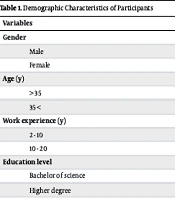
The study was conducted at Guilan University of Medical Sciences in Rasht, Iran, and in Tehran, Iran. The participants were 25 nurses who met the inclusion criteria of holding at least a bachelor's degree in nursing and having at least 2 years of bedside work experience. The first author (H.H.) initially selected one participant from among colleagues based on extensive career history and expertise in ethical decision-making. Subsequently, as initial codes and categories emerged, additional participants were selected. Maximum diversity was sought in terms of work records, including general and specialized hospitals and departments such as emergency, internal medicine, surgery, burn units, pediatrics, ICU, and CCU. Participants were also selected to represent different age groups and educational levels. Table 1 presents the characteristics of the participants.
Table 1.
Demographic Characteristics of Participants
| Variables | No. |
|---|---|
| Gender | |
| Male | 7 |
| Female | 18 |
| Age (y) | |
| > 35 | 13 |
| 35 < | 12 |
| Work experience (y) | |
| 2 - 10 | 11 |
| 10 - 20 | 14 |
| Education level | |
| Bachelor of science | 19 |
| Higher degree | 6 |
3.3. Data Collection
Data were collected through in-depth, semi-structured interviews. The researcher personally contacted potential participants and invited them to participate. The interviews were conducted individually by the first author at a time and location convenient for the participants. The purpose of the study was explained, and written informed consent was obtained before the interviews.
The initial interviews were guided by an interview guide developed by the research team, which consisted of a doctoral student in nursing with extensive clinical and teaching experience, two nursing professors specializing in nursing ethics and qualitative research, and an assistant professor of nursing whose work focuses on the moral development of nurses and nursing students. The interview guide comprised three sections: open general questions, intermediate questions, and final questions. Open-ended general questions were used to initiate the interviews, such as questions about the ethical aspects of participants' daily nursing care or their experiences with decision-making in ethically challenging situations. Probing questions were used to explore participants' responses in greater depth, such as asking them to explain the reasoning behind their decisions or the moral changes they had undergone. The interviews concluded with the question, "Do you have anything else to add?" To clarify participants' perspectives, follow-up questions were used, such as requests for examples or further explanation.
Based on the analysis of each interview, guiding questions for subsequent interviews were adjusted in line with emerging concepts. For example, to explore ethical responsibility, a question might be posed as follows: "What actions do you take when you encounter a mistake made by a colleague?" The interviews lasted 30 to 70 minutes. The first author listened carefully to the recorded interviews multiple times and transcribed them verbatim. After 23 interviews, the characteristics of the identified categories were determined, and no new categories emerged. To ensure saturation, two additional interviews were conducted.
3.4. Data Analysis
Data analysis was conducted using the comparative thematic analysis approach described by Braun and Clarke. Thematic analysis is a widely used and flexible approach in qualitative research that aims to identify, analyze, and report patterns within data (14). The first step involved familiarization with the data. After transcription, the first author read the interview texts multiple times to develop a deep understanding of the content and meanings conveyed. The second step involved coding, in which sections of text containing meaningful content and ideas within sentences or paragraphs were identified and assigned short labels (codes). The third step focused on searching for themes. The codes were examined, and similar codes were grouped to form potential themes, which were then organized to develop an overall thematic structure. Regular meetings were held with the research team to discuss and refine the themes. In the fourth stage, the compiled themes were reviewed and revised, leading to the extraction of three main classes or overarching themes. The fifth stage involved naming the classes and the main theme. This final naming process was conducted through discussions within the research team to ensure a collaborative and rigorous approach. The final step involved analysis and report writing. Codes and relevant quotations were used to illustrate and support the identified themes. By following these steps, the researchers used thematic analysis to explore and report patterns in the data, providing insights into nurses' experiences in their journey toward moral improvement.
3.5. Rigor
To ensure scientific rigor, the researchers applied the criteria of Guba and Lincoln, including credibility, dependability, fittingness, and confirmability. To achieve credibility, the researchers maintained prolonged engagement with the data and devoted sufficient time to data collection and analysis. They constantly compared data with data, data with codes, codes with themes, and themes with each other. This process enabled an in-depth understanding of the data and ensured that interpretations were grounded in the evidence. Dependability was enhanced through member checks and peer checks. One participant contributed to discussions of the themes and categories to validate the findings. Coding, identification of patterns, and naming of the main theme and classes were conducted under the supervision of all members of the research team. These collective efforts reduced the influence of individual biases on the analysis and results. To reduce the impact of researchers' assumptions, a limited literature review was conducted before data analysis. This approach helped ensure that the analysis was driven by participants' perspectives rather than preconceived notions. To strengthen credibility, three audit sessions were conducted with four external evaluators. These evaluators critically reviewed the research process, findings, and interpretations and provided feedback and insights. To enhance transferability, the researchers provided detailed explanations of the research process, allowing other researchers to understand and potentially apply the study methods and findings in different contexts.
3.6. Ethical Considerations
Ethical considerations were integrated into the study design. The research was approved by the Research Ethics Committee of Iran University of Medical Sciences (IR.IUMS.REC1396.9323199002). Participation was voluntary, and written consent was obtained from all participants. All interviews were recorded with the participants' permission, and the recordings were stored anonymously in encrypted files. Except for the first author, the remaining members of the research team were unaware of the participants' identities.
4. Results
The main theme extracted from the data was “moral uplift.” This indicates that nurses enter the profession with moral values aimed at promoting ethics and professional progress through a strategy of moral perfection. This process ultimately leads to moral integrity. Moral uplift comprises three categories: moral foundations, moral perfectionism, and moral integrity. Codes, subcategories, categories, and themes are shown in Table 2.
Table 2.
Codes, Subcategories, Categories, and Main Theme
| Moral Uplifts, Categories and Subcategories | Codes |
|---|---|
| Moral foundations | |
| Family training | Familiarity with professional ethics in ethics class |
| Nursing professors as role models | |
| Sharing experiences and viewpoints with classmates | |
| Religious beliefs | Applying personal experiences |
| Intelligent imitation | |
| Listening to the voice of conscience | |
| Ethical self-assessment | |
| Reflecting on one’s own performance | |
| Previous training | Accepting the nursing profession |
| Increasing professional knowledge | |
| Moral perfectionism | |
| Self-regulation | Increasing ethical knowledge |
| Having ethical sensitivity | |
| Having moral courage | |
| Putting the patient as the first priority | |
| Establishing effective communication with the patient | |
| Putting oneself in the patient’s place | |
| Self-promotion | Considering the patient as a loved one |
| Meeting the patient’s needs | |
| Respecting the patient> | |
| Orbital ethics | Preserving patient privacy |
| Not judging the patient | |
| Providing peace to the family | |
| Moral integrity | |
| Compassionate care | Reporting one’s own error |
| Reporting a colleague’s error | |
| Reporting violation of patient rights | |
| Compensating for unethical behavior | |
| Preserving human dignity | Familiarity with professional ethics in ethics class |
| Nursing professors as role models | |
| Sharing experiences and viewpoints with classmates | |
| Applying personal experiences | |
| Moral responsibility | Intelligent imitation |
| Listening to the voice of conscience | |
| Ethical self-assessment | |
| Reflecting on one’s own performance |
4.1. Moral Foundations
Nurses’ personality traits and moral values are shaped by family and social upbringing. They enter the nursing profession with moral values and religious beliefs that they have already acquired.
4.1.1. Family Education
Some participants regarded their parents’ moral behavior as a model for their own moral conduct in nursing. For example, one nurse considered her father to be her moral model:
“When I think something is right, I will do it for the patient at any cost. I learned this courage from my father. My father was a brave person. When I praised that I did something, he encouraged me. Therefore, having the courage gradually strengthened in me.” (Sh. 10)
Several participants stated that they learned responsibility and helping others from their family:
“I didn't learn to be bad; my family always taught me to be responsible. The responsibility they give you is to do it correctly until the end.” (Sh. 18)
4.1.2. Religious Beliefs
Having religious beliefs motivates nurses to act ethically:
“I believe that God always watches over our work. I'm not supposed to work for the patient however I want because no one sees me.” (V. 13)
Another participant said:
“. I don't like to have done my work in such a way that someone would complain about me.” (V. 23)
Some nurses believed that by caring for patients, they would receive God’s care:
“I believe that when you untangle the work of two people, God will pay attention to you and take your hand.” (Verse 12)
Some nurses noted the emphasis in religious teachings on the value of patient care at work:
“I always try to give the best care. In our religion, one night of caring for a patient is equal to 70 years of worship. When this issue is so important, then I have to pay attention to my work.” (Sh. 1)
4.2. Moral Perfectionism
The nurses participating in this study accepted responsibility for their actions. They sought to make correct decisions through moral judgment and to implement their moral decisions with courage; in some cases, they supported and protected patients through self-sacrifice.
4.2.1. Moral Responsibility
Some participants stated that if they made a mistake, they would report it. A nurse with 14 years of experience said:
“If I make a mistake, I will definitely go and report it because the patient's life is in danger. Once, a patient was prescribed 2 mL of midazolam for a CT scan. I gave him 5 mL. At that moment, I yelled, 'Hey, I did 5. Now he's apneic,' and he immediately recovered. If the mistake is not reported, something irreparable may happen to the patient.” (Section 22)
In addition to accepting responsibility for their own mistakes, some nurses felt responsible for and reported errors observed among colleagues:
“Once I noticed that one of my colleagues does not give oral medicines to the patient. I told him why not. He said that there is no use. These injections are enough. I also reported it.” (Sh. 1)
Several participants stated that they report to the responsible person if they observe violations of patients’ rights:
“. the ward nurse hit the patient who was agitated and hit him hard in the face. I argued with him that you had no right to treat my patient like that, but he didn't pay attention to me. I wrote a written report for them to follow up.” (Sh. 18)
Guiding colleagues can correct wrong and unethical behavior and protect patients from nursing errors:
“Here, the children do not take cefazolin, which should be administered every six hours; for example, they give cefazolin at 9 o'clock, at 12 o'clock at night, and at 6 o'clock in the morning, so the interval is 8 hours for some and 4 hours for others. I explained this to the staff as well. I tried to improve my own performance; after all, now most of the kids do like me.” (V. 21)
4.2.2. Moral Judgment
Some participating nurses assessed a procedure before performing it and proceeded if it passed an ethical screen:
“We once had a young boy who had a broken leg. The doctor said to get consent for amputation and send him to the operating room. It was possible that they wouldn't stop it with the advice of another doctor. I finally decided to tell his father.” (V. 13)
Conscience guides moral judgment, and the stronger it is, the more ethical the nurse’s decision-making will be:
“In the ICU, you are an unconscious patient and your conscience is there. There is no one to monitor you. You must have a high conscience to be able to take good care.” (Sh1)
4.2.3. Moral Courage
Moral courage reflects that participating nurses take action in the face of external threats and persistently strive to act morally:
“Once, the doctor said that we should take an arterial sample from the patient in order to do research. I told him that he should be with the patient. He said that this is a medical order. If you don't follow it, there will be consequences for you. But I didn't care, so I didn't do it.” (Sh6)
One participant said:
“I dissolve oral medicines with 5% sugar solution, but our supervisor is against this. He says that you are desecrating my head. If you continue, I will have to reduce your dosage. But I will do this when I feel like it.” (No. 11)
Some nurses went beyond their job description to perform ethical actions:
“Anesthesiologist CCU could not make the patient repent; our resident doctor was not present either. I knew, I went sick and repented. I should not have done this because it is not in my job description, but this issue was a moral issue.” (P2)
Some nurses ignored a doctor’s threat when acting ethically:
“. Once, the head of the department, Dr. X, told me to reduce the device support. I didn't do it. When the visit was over, I didn't change it. He yelled at me that he was doing something to get me out of this department. He put the device on the speaker and left, but I again put it on SIMV.” (P. 6)
4.2.4. Self-Sacrifice
Some participants supported and protected patients by risking their own health:
“They brought a patient who had H1N1 and had an arrest. Everyone was afraid to approach him because we didn't have a filter mask, but Dr. X and I went to resuscitate him. The patient is guilty of not being able to do anything for him because he didn't have the equipment.”
Another participant spoke about prioritizing the patient over job position:
“The hospital cannot prepare some medicines. According to the law of the hospital, we do not have the right to give a prescription to the patient's family to obtain the medicine outside the hospital. But I have written more than 500 prescriptions so far and gave them to obtain it outside. I have nothing to do with if they find out, they will reprimand me.” (P. 22)
Some nurses cared for patients beyond their own ability:
“I am always sick from night to morning; I don't even go to sleep when I rest. I say to myself one more night, tomorrow I will go to sleep. But I do this for the sake of the patient.” (S1)
4.3. Moral Integrity
Participating nurses achieved ethical integration by using the strategy of moral perfection. This model shows that different cognitive, emotional, and functional aspects of ethics are linked like a chain and are integrated and coherent. This category includes the subcategories “adherence to ethical principles,” “preservation of human dignity,” and “empathy.”
4.3.1. Adherence to Ethical Principles
Adherence to moral principles and values is necessary for moral integrity:
“When I finished my studies, I swore that I would do everything I could in a correct and ethical way for the patient. That's why I always try to act according to it.” (Sh18)
Another participant said:
“I believe in a principle that I should bring a halal day to my family's table; that's why I try to do the right thing. I will always respect the patient.” (P. 18)
4.3.2. Preservation of Human Dignity
Preservation of human dignity is another consequence of using the strategy of moral perfection:
“. we had a patient whose clothes were very dirty. He smelled bad until he came in front of the children's station to pick their noses. I was very upset. I went to admit him myself. When I gave him hospital clothes, I told him that you should take a shower here to be ready for the operation. Then I told the service to take his clothes, take him to the laundry room, and wash them. Don't tell him anything; he might get upset.” (Sh6)
Another participant said regarding patient privacy:
“Preservation of the patient's privacy is very important to me. Always when I am doing something for the patient, for example, I am dressing, I make sure to cover all the parts and only take out the part that I want to bandage.” (Sh2)
Some nurses sought to maintain their relationship with the patient by stating that they do not judge the patient’s inappropriate behavior:
“When I deal with an angry patient or companion, I try not to judge him. I tell myself that his illness must be bothering him; otherwise, he is a respectable person, so I talk to him gently to find out the reason for his anger.” (S4)
4.3.3. Empathy
A sense of responsibility toward the patient leads to humanitarian behaviors and fosters empathy in the nurse.
Some nurses stated that they liked patients and enjoyed communicating with them:
“I love patients even if the patient's culture is different from mine. I get energy by talking with patients.” (Sh16)
Some nurses perceived patients as their loved ones:
“I always feel that the patients are like my person and work; it doesn't matter the patient's age. Everyone is a dear person, and this is very tangible for me. That's why I can't make them upset.” (Sh24)
Some participants put themselves in the patient’s place and did whatever they would want for the patient:
“When I talk to the patient and work with him, I put myself in his place. For example, if it were you, you would like to be treated like this. You would like to be given IV cefazolin directly.” (S21)
5. Discussion
The results of the study revealed a pattern of moral uplift across three main categories: Moral foundations, moral perfectionism, and moral integrity. These categories encompassed various subcategories, including family education, religious beliefs, moral responsibility, moral judgment, moral courage, selflessness, adherence to moral principles, preservation of human dignity, and empathy.
Moral uplift was identified as a key aspect of nurses’ efforts to provide ethical care in any situation. It underscored the importance of nurses demonstrating courage, adhering to their inner values, and even sacrificing themselves when doing the right thing may pose risks or challenges (15). By embodying these qualities, nurses can integrate and achieve moral uplift.
Each nurse possesses a set of moral values shaped and developed throughout life. The family, as the primary institution for ethics education, plays a significant role in forming these values. The moral foundations established through family upbringing and religious beliefs serve as the basis for moral reasoning among the participating nurses. Before entering the nursing profession, nurses further develop morally by embracing profession-related values, strengthening moral skills, and acquiring professional qualifications (12).
The study also referenced the moral foundations theory proposed by Jonathan Haidt and colleagues. This theory describes a framework of moral judgments, values, and attitudes rooted in moral intuition and emotions (16). It explains the underlying moral motivations driving behavior (17).
Overall, the findings of this study shed light on how nurses achieve moral uplift throughout their professional journey, emphasizing the significance of moral foundations, moral perfectionism, and moral integrity in ethical practice.
The experiences of the participating nurses highlighted the importance of virtues such as kindness, responsibility, and honesty, which they had learned from their families. Personal values and beliefs are believed to significantly influence moral judgment, as stated by Smith (18). Previous research also emphasized the influential role of family, religious figures, and friends in shaping moral decision-making, which is closely tied to personal values and beliefs (19, 20).
Virtue ethics theory suggests that character formation plays a crucial role in determining behavior. According to this theory, the core focus of ethics lies in cultivating one’s character, regardless of whether an individual has encountered moral dilemmas (21). Additionally, Gassas and Salem (22) found a positive association between religious beliefs and nurses’ organizational commitment. Therefore, nurses enter the nursing profession with pre-existing moral values, often shaped by religious beliefs and family upbringing.
To enhance their moral development, nurses use a strategy known as moral perfection. This strategy involves assuming responsibility for their care actions and for others, as well as demonstrating moral courage to advocate for and protect patient well-being at all times. Hakimi et al. (3) conducted a qualitative study that supported the notion that nurses perform well when they have a sense of moral responsibility for their actions. Hassanian et al. (23) reported that nurses generally exhibit a high level of responsibility, with responsibility increasing in tandem with age and work experience.
In this study, nurses demonstrated a sense of responsibility by relying on their inner values and heeding the call of conscience when judging moral situations and making moral decisions. According to James Rest’s theory, for individuals to behave morally, they must first interpret the moral situation, judge which action is morally correct, prioritize moral values over personal values, and finally possess the perseverance, self-strength, and skills to carry out moral behavior despite fatigue and obstacles (24).
Previous research has shown that nurses’ level of moral judgment increases with experience (25). However, moral judgment alone does not guarantee moral action. Nurses must exert significant effort to act morally, especially in challenging situations, and display moral courage by standing firmly behind their moral decisions. Nurses with moral courage understand that doing the right thing may come at a personal cost, including threats, shame, anxiety, rejection from colleagues, or even job loss. Nonetheless, nurses with courageous moral performance can overcome personal fears and provide the greatest benefits to their patients (15).
Several studies have indicated that Iranian nurses exhibit a favorable level of moral courage (26-29). Some participating nurses went beyond bravery and demonstrated sacrifice and self-sacrifice in their ethical practices. For example, one nurse with 14 years of experience risked their own health to save a patient’s life. In the context of the COVID-19 pandemic, nurses in Iran have shown acts of self-sacrifice to protect human lives (30).
Sillero Sillero et al. (31) stated that nurses who feel more responsible for preventing harm to patients prioritize patients’ well-being over their own safety. They are willing to take action to prevent harm to patients, even if it means risking harm to themselves. Self-sacrifice is considered one of the primary values of nursing and is viewed as a necessary and positive characteristic that leads to personal growth.
The application of moral perfection ultimately leads to the maintenance of moral integrity. Nurses with moral integrity establish a connection between their actions and their values and beliefs, resulting in consistent moral performance (32). Moral integrity reflects an individual’s moral responsibility and adherence to moral principles and values (33). In a qualitative study, Kelly (34) found that new nurses attempted to maintain their professional identity by upholding moral integrity. Moral integrity is also considered a strategy to reduce moral distress, as nurses who possess moral integrity are honest, trustworthy, self-confident, and consistently do what is right (35).
However, some studies have indicated a decrease in moral integrity among nurses (3, 36). Findings have shown that although new graduates initially act based on their moral values, they may gradually succumb to environmental pressures and conform to expectations and the prevailing moral atmosphere (37).
Despite challenges in Iran’s healthcare system, including workforce shortages and insufficient support for nurses (3, 38), the results of this study indicate that nurses persist in maintaining moral integrity. It appears that the institutionalized moral values within nurses mitigate the influence of the environment on their moral uplift.
5.1. Conclusions
The results of the study indicate that a number of nurses can recognize the ethical aspects of their work and make ethical decisions with sound judgment. They demonstrate bravery in resisting environmental pressures by relying on their moral values and strive to implement their ethical decisions. Additionally, they take responsibility for their actions, thereby maintaining moral integrity in all situations. This process boosts nurses’ morale, which plays a crucial role in the quality of care provided. Hospital managers should create a supportive atmosphere that encourages nurses’ ethical practice, fostering an environment in which nurses can experience moral uplift without being burdened by environmental pressures. This would enable more nurses to undergo this process successfully.
5.2. Limitations
Several limitations should be considered. Qualitative studies are subject to language limitations, and efforts were made to present the findings in a manner understandable across different cultures. The culture and moral climate within Iran’s healthcare system may differ from those of other countries. Therefore, the researchers have provided an explanation of the findings that enables other researchers to transfer the results to their own contexts.