
1. Background
Currently, disease patterns have changed considerably compared with those in the past. Since the late nineteenth century, improvements in nutrition, sanitation, and personal hygiene have led to a substantial decline in infectious diseases, whereas chronic noncommunicable diseases have become the leading causes of morbidity and mortality. These chronic diseases are largely associated with unhealthy lifestyles and behavioral risk factors. Consequently, increasing attention has been directed toward modifying lifestyle and health-related behaviors as a primary disease prevention strategy. Factors such as unhealthy nutrition, physical inactivity, and other behavioral risks are among the leading contributors to mortality worldwide (1). According to the World Health Organization (WHO), unhealthy lifestyles account for approximately 75% of global deaths, with more than 80% of these deaths occurring in low- and middle-income countries. This burden is expected to increase further if current trends continue. Evidence indicates that the timely identification and modification of unhealthy behaviors can substantially reduce their adverse health consequences. Therefore, promoting a healthy lifestyle has become one of the major priorities of modern healthcare systems (2).
A health-promoting lifestyle (HPL) is a key determinant of health and plays a crucial role in preventing many chronic diseases. Health-promoting behaviors contribute directly to disease prevention and health enhancement across six major dimensions: health responsibility, physical activity, nutrition, spiritual growth, interpersonal relationships, and stress management (3). The reproductive period is a critical stage of life during which adopting a health-promoting lifestyle is particularly important. Women of reproductive age play a fundamental role in maintaining family health through their influence on pregnancy outcomes, child health, family nutrition, and health-related decision-making. Consequently, improving women’s health behaviors has long-term benefits not only for their own health but also for the health of their children and the wider community (4, 5). Furthermore, women’s health is recognized as a fundamental human right and is a key determinant of family and community well-being. Throughout their lives, women experience unique physiological conditions, including pregnancy and lactation, which require increased attention to healthy lifestyle behaviors. Therefore, promoting the health of women of reproductive age should be considered a public health priority (4).
Health promotion strategies primarily focus on modifying unhealthy behaviors through educational interventions. Previous studies have shown that adopting healthy lifestyle behaviors contributes not only to the prevention of chronic diseases but also to improvements in psychological well-being, social health, and overall quality of life among women (5, 6). Among available behavioral theories, the Health Belief Model (HBM) is one of the most widely used frameworks for designing health education interventions. According to the HBM, individuals are more likely to adopt healthy behaviors when they perceive themselves to be susceptible to health problems, recognize the seriousness of these conditions, understand the benefits of preventive actions, overcome perceived barriers, receive appropriate cues to action, and have sufficient confidence in their ability to perform the recommended behavior (7). The model proposes that behavioral change is influenced by six key constructs: perceived susceptibility, perceived severity, perceived benefits, perceived barriers, self-efficacy, and cues to action. Together, these constructs explain individuals’ motivation to engage in preventive health behaviors and have been successfully applied to a wide range of health promotion programs (7).
Previous studies have demonstrated the effectiveness of HBM-based educational interventions in improving health-related behaviors, including healthy nutrition, physical activity, self-care, and the prevention of chronic diseases (5, 8). However, to the best of our knowledge, no randomized controlled trial has specifically evaluated the effectiveness of an HBM-based educational program to promote healthy lifestyle behaviors among women of reproductive age in Iran.
2. Objectives
Based on these findings, we hypothesized that women receiving HBM-based education would achieve significantly greater improvements in health-promoting lifestyle behaviors than those receiving routine care. Therefore, this study was conducted to evaluate the effect of Health Belief Model-based education on health-promoting lifestyle behaviors in women of reproductive age.
3. Methods
3.1. Study Design and Participants
In this randomized controlled trial (RCT), eligible women attending health centers in Buin-Zahra were assessed for study eligibility and subsequently randomly assigned to the intervention or comparison group. Participants were not informed of their group assignment to avoid bias. Participants in the comparison group received standard health services and had no interaction with members of the intervention group. To prevent contamination, Buin-Zahra health centers were asked not to allow any other similar interventions during the study period. However, after data collection was completed, the same educational content was provided to participants in the comparison group. The two groups did not differ significantly at baseline.
Eligibility criteria included voluntary participation; being a woman of reproductive age (15 to 49 years); being married; having a minimum ability to read and write; having an electronic record in the integrated health system, abbreviated as SIB in Persian; and not being pregnant or breastfeeding. For sampling, the three most populous urban centers and the three most populous rural centers were randomly selected from among 11 urban and rural centers in Buin-Zahra. In the next step, 100 eligible individuals were recruited by convenience sampling, in accordance with predefined selection criteria, from those attending urban and rural health centers.
Stratified randomization was used, with rural and urban areas as strata. A random allocation rule was applied within each stratum to allocate subjects to the intervention and control groups. For the 50 subjects from urban centers, the word "intervention" was written on 25 pieces of paper and "control" on the other 25 pieces of paper, which were then placed in a bag. After confirming that the participant fulfilled all eligibility requirements and provided written and oral informed consent, one paper was drawn by lot. Based on the word written on the paper, the subject was assigned to one of the two groups. The same process was followed separately for the 50 subjects from rural centers.
Women with severe chronic diseases requiring continuous medical treatment, such as uncontrolled diabetes mellitus, advanced cardiovascular disease, chronic renal disease, or active malignancy, as well as severe psychiatric disorders or cognitive impairment that could interfere with participation in the educational sessions, were excluded. Discontinuation criteria included unwillingness to continue participation and pregnancy during the study. In the present study, 32 subjects were not included because they did not meet the inclusion criteria, and three other subjects did not continue the study. After selecting the subjects, questionnaire data were collected by phone and in person at the centers.
The sample size was determined based on the formula recommended by Roosta et al. (1), with a standard deviation (s) of 4.52, type I error of 0.05, statistical power of 0.90, and mean difference of 3.2. The sample size for each group was n = 43, with an additional 15% added to account for dropouts, resulting in n = 50 per group. After collecting baseline data, participants were assigned either to a one-month educational program or to a comparison condition in which they continued receiving standard educational services at the health center. Outcomes in both study arms were reassessed one month after completion of the program (Figure 1).
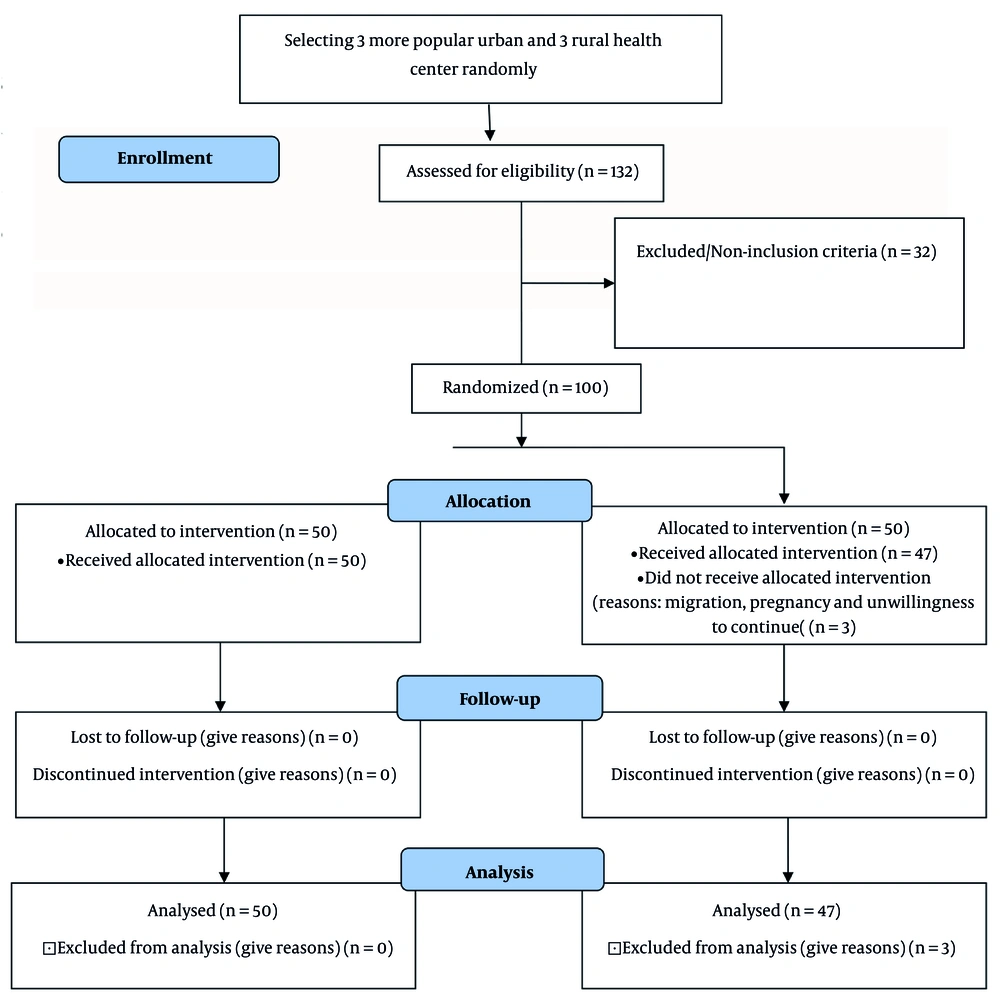
Figure 1.
Consort Flow Diagram (Selecting 3 More Populous Urban and 3 Rural Health Centers Randomly)
3.2. Intervention
The educational intervention program for the experimental group was designed based on HBM principles and focused on lifestyle dimensions, including enabling factors, self-efficacy, attitude, and subjective norms. It was delivered through four structured group sessions, each lasting approximately 60 to 90 minutes, over a one-month period.
The first session focused on introducing the program objectives and addressing participants' questions about the intervention process and timetable. Participants also received a CD-ROM and a health education package outlining the potential risks and negative consequences associated with unhealthy lifestyle practices. To address perceived susceptibility and severity, the second session began with a presentation on unhealthy behaviors and a report of statistics on unhealthy behaviors globally, across the Middle Eastern region, within Iran, specifically among female populations, and among reproductive-aged women in particular. In the third session, a dedicated WhatsApp communication platform was created for participants assigned to the intervention arm, and the benefits and likely positive consequences of a healthy lifestyle were taught.
The final session addressed barriers or difficulties participants might face when attempting to change health-related beliefs and perceptions regarding behavioral outcomes, which are subcomponents of attitude. In addition, to enhance cues to action and self-efficacy, instructional multimedia materials and behavioral role models were used. Upon completion of the intervention period, women in the control group were given one day of training and received an educational pamphlet.
3.3. Outcome Measures
Data collection tools included the Health-Promoting Lifestyle Profile (HPLP) by Walker et al. (8) and a researcher-made questionnaire. The validity and reliability of the HPLP had previously been assessed. This questionnaire contains six dimensions with 52 items, including spiritual development (9 items), responsibility for health (9 items), interpersonal interaction (9 items), stress-control practices (8 items), engagement in physical activity (8 items), and nutritional behaviors (9 items). The questionnaire is evaluated using a four-category Likert response scale (1: never, 2: sometimes, 3: often, and 4: consistently). Scores range from 52 to 208.
The second instrument was developed according to the core components of the Health Belief Model and included 41 questions. The instrument contained questions addressing participants' demographic information (7 items) and knowledge (4 items, minimum score 0, maximum score 4). In addition, the HBM section had six dimensions: perceived susceptibility (5 items, minimum score 5, maximum score 25), perceived severity (5 items, minimum score 5, maximum score 25), perceived benefits (5 items, minimum score 5, maximum score 25), perceived barriers (5 items, minimum score 5, maximum score 25), cues to action (5 items, minimum score 5, maximum score 25), and self-efficacy (5 items, minimum score 5, maximum score 25). Each question used a response format ranging from completely disagree (1) to completely agree (5), with higher scores indicating better awareness, attitudes, and behaviors. Participants' knowledge was assessed using true, false, and "do not know" items.
Content validity was assessed by a panel of 15 experts in health education and health promotion. The Content Validity Ratio (CVR) and Content Validity Index (CVI) were 0.85 and 0.95, respectively. According to Lawshe's table, the minimum acceptable CVR for a panel of 15 experts was 0.49 (9). In addition, a CVI of 0.79 or higher was considered acceptable. Therefore, the obtained CVR of 0.85 and CVI of 0.95 confirmed that the questionnaire had satisfactory content validity (10). Reliability was evaluated using the Cronbach alpha coefficient and the test-retest method. The questionnaire was pilot-tested in 15 women who were not included in the main study. The results demonstrated high internal consistency for the overall questionnaire (Cronbach alpha = 0.88) and its subscales (Cronbach alpha = 0.86 to 0.92). The test-retest reliability coefficient for the overall questionnaire was 0.91, while the corresponding coefficients for the subscales ranged from 0.90 to 0.95.
3.4. Statistical Analysis
Data were analyzed using IBM SPSS Statistics for Windows, Version 26.0 (IBM Corp., Armonk, NY, USA). The normality of the study variables was assessed using skewness, kurtosis, histograms, and Q-Q plots. Differences in quantitative demographic variables between the two groups were evaluated using the Mann-Whitney U test, while the chi-square test or Fisher exact test was used for qualitative variables, as appropriate. Initially, paired-samples t tests and independent-samples t tests were performed to compare lifestyle and Health Belief Model construct scores. Subsequently, analysis of covariance (ANCOVA) was used to compare postintervention scores between the two groups while controlling for baseline values. Before ANCOVA was performed, the assumption of homogeneity of regression slopes was evaluated by testing the interaction between the covariate (baseline score) and the intervention group. The interaction was not statistically significant (P > 0.05), indicating that the assumption of homogeneity of regression slopes was satisfied. In addition, the assumptions of normality of the outcome variable, homogeneity of variances, independence of the covariate and the independent variable, and linearity between the covariate and the outcome variable were assessed and confirmed before ANCOVA was conducted. A two-sided P value of less than 0.05 was considered statistically significant.
4. Results
The mean ± standard deviation (SD) number of family members was 3.42 ± 1.32 and 3.55 ± 1.44 in the intervention and control arms, respectively, and the corresponding number of children was 1.19 ± 1.32 and 1.19 ± 1.33, respectively. Other demographic characteristics are presented in Table 1. Statistical testing indicated that demographic characteristics were comparable between the two study groups, with no statistically significant differences observed.
Table 1.
Distribution of Demographic Variables in the Experimental and Control Groups a
| Variables and Levels | Intervention | Control | P-Value b |
|---|---|---|---|
| Education | |||
| Illiterate | 4 (8.3) | 6 (12.8) | 0.714 |
| Lower than high school | 17 (35.4) | 12 (25.5) | 0.714 |
| Diploma | 22 (45.8) | 23 (48.9) | 0.714 |
| University degree | 5 (10.4) | 6 (12.8) | 0.714 |
| Occupation | |||
| Worker | 1 (2.1) | 3 (6.4) | 0.606 |
| Employee | 4 (8.3) | 3 (6.4) | 0.606 |
| Housewife | 40 (83.3) | 36 (76.6) | 0.606 |
| Self-employed | 3 (6.3) | 5 (10.6) | 0.606 |
| Monthly income, million Iranian rials | |||
| Lower than 10 | 1 (2.1) | 1 (2.1) | 0.598 |
| 10 - 20 | 19 (39.6) | 24 (51.1) | 0.598 |
| 20 - 30 | 24 (50.0) | 17 (36.2) | 0.598 |
| > 30 | 4 (8.3) | 5 (10.6) | 0.598 |
| Place of residence | |||
| Urban areas | 26 (54.2) | 27 (57.4) | 0.837 |
| Rural areas | 22 (45.8) | 20 (42.6) | 0.837 |
| Number of family members | 3.42 ± 1.32 | 3.55 ± 1.44 | 0.631 |
| Number of children | 1.19 ± 1.32 | 1.19 ± 1.33 | 0.926 |
a Values are expressed as mean ± SD or No. (%). Abbreviation: SD, standard deviation.
b Chi-square test, Fisher exact test, or Mann-Whitney U test.
Table 2 compares the mean scores of HBM constructs between the two groups. Before the educational program, the two groups had comparable mean values across all HBM constructs, with no significant between-group differences. After completion of the intervention, all HBM-related indicators differed significantly between participants who received the program and those in the comparison group, including awareness, perceived susceptibility, perceived severity, perceived benefits, perceived barriers, cues to action, and self-efficacy (P < 0.05). Within-group analyses showed marked improvements in awareness, perceived susceptibility, perceived severity, perceived benefits, cues to action, and self-efficacy after implementation of the educational sessions, as well as a significant decrease in perceived barriers in the experimental group after the intervention (P < 0.001). Conversely, participants assigned to routine care showed no meaningful changes in any measured constructs during the study period (P > 0.05).
Table 2.
Comparison of the Mean Scores of Health Belief Model Structures Between the Experimental and Control Groups Before and After the Intervention a
| Variables and Groups | Before the Intervention | After the Intervention | P Value b |
|---|---|---|---|
| Awareness | |||
| Experimental | 2.74 ± 2.56 | 7.97 ± 0.62 | < 0.001 |
| Control | 2.50 ± 2.37 | 2.54 ± 2.34 | 0.322 |
| P value c | 0.630 | < 0.001 | - |
| Perceived sensitivity | |||
| Experimental | 21.36 ± 8.63 | 29.28 ± 7.52 | < 0.001 |
| Control | 22.52 ± 8.29 | 22.40 ± 8.26 | 0.312 |
| P value c | 0.545 | < 0.001 | - |
| Perceived severity | |||
| Experimental | 13.94 ± 4.67 | 19.00 ± 3.34 | < 0.001 |
| Control | 14.32 ± 4.66 | 14.34 ± 4.70 | 0.322 |
| P value c | 0.695 | < 0.001 | - |
| Perceived benefits | |||
| Experimental | 13.87 ± 5.20 | 19.17 ± 3.31 | < 0.001 |
| Control | 15.33 ± 5.10 | 15.29 ± 5.07 | 0.159 |
| P value c | 0.171 | < 0.001 | - |
| Perceived barriers | |||
| Experimental | 22.60 ± 5.06 | 17.96 ± 5.07 | < 0.001 |
| Control | 23.17 ± 4.63 | 23.23 ± 4.67 | 0.685 |
| P value c | 0.568 | < 0.001 | - |
| Cues to action | |||
| Experimental | 14.28 ± 5.39 | 17.53 ± 4.97 | < 0.001 |
| Control | 14.96 ± 5.91 | 14.92 ± 5.88 | 0.159 |
| P value c | 0.559 | 0.021 | - |
| Self-efficacy | |||
| Experimental | 19.06 ± 5.48 | 23.00 ± 3.89 | < 0.001 |
| Control | 20.13 ± 5.35 | 19.90 ± 5.26 | 0.154 |
| P value c | 0.342 | 0.002 | - |
a Values are expressed as mean ± SD.
b Paired t-test.
c Independent t-test.
Table 3 summarizes the comparison of lifestyle-related outcomes between the study groups. No statistically significant difference was observed in mean scores between the experimental and control groups before the intervention (P > 0.05). However, after the intervention, a statistically significant difference was observed between the experimental and control groups in mean lifestyle scores (P < 0.05). Repeated measurements indicated a substantial improvement in overall lifestyle performance within the intervention group (P < 0.001), whereas the mean lifestyle score in the control group after the intervention did not differ significantly from that before the intervention.
Table 3.
Comparison of the Mean Scores of Lifestyle Between the Experimental and Control Groups Before and After the Intervention a
| Variables and Groups | Before Intervention | After Intervention | P Value b |
|---|---|---|---|
| Overall lifestyle score | |||
| Experimental | 109.17 ± 19.99 | 132.89 ± 16.15 | < 0.001 |
| Control | 105.27 ± 18.42 | 105.23 ± 18.57 | 0.146 |
| P value c | 0.325 | < 0.001 | |
| Nutrition | |||
| Experimental | 21.94 ± 4.76 | 26.74 ± 2.94 | < 0.001 |
| Control | 21.42 ± 4.51 | 21.38 ± 4.53 | 0.312 |
| P value c | 0.586 | < 0.001 | - |
| Stress | |||
| Experimental | 14.64 ± 3.82 | 17.32 ± 2.72 | < 0.001 |
| Control | 14.73 ± 3.90 | 14.75 ± 3.90 | 0.322 |
| P value c | 0.909 | < 0.001 | - |
| Spiritual growth | |||
| Experimental | 22.62 ± 5.77 | 25.68 ± 4.75 | < 0.001 |
| Control | 21.13 ± 5.40 | 21.07 ± 5.30 | 0.159 |
| P value c | 0.196 | < 0.001 | - |
| Interpersonal relationships | |||
| Experimental | 19.88 ± 4.27 | 24.15 ± 3.52 | < 0.001 |
| Control | 19.14 ± 4.49 | 19.45 ± 4.47 | 0.685 |
| P value c | 0.629 | < 0.001 | - |
| Physical activity | |||
| Experimental | 12.66 ± 4.27 | 17.09 ± 3.76 | < 0.001 |
| Control | 11.65 ± 3.42 | 11.70 ± 3.43 | 0.159 |
| P value c | 0.204 | 0.001 | - |
| Responsibility | |||
| Experimental | 17.45 ± 4.99 | 21.92 ± 4.12 | < 0.001 |
| Control | 16.73 ± 4.55 | 16.67 ± 4.54 | 0.154 |
| P value c | 0.465 | 0.001 | - |
a Values are expressed as mean ± SD.
b Paired t-test.
c Independent t-test.
ANCOVA findings, adjusted for baseline measurements, confirmed the effectiveness of the intervention in improving both lifestyle and HBM-related outcomes. After controlling for baseline scores, the intervention had a significant effect on increasing lifestyle and HBM construct scores in the intervention group compared with the control group (P < 0.001). The magnitude of the effects was substantial for all constructs. Among the constructs of this model, awareness showed the greatest effect, and cues to action showed the smallest effect, on enhancing lifestyle behaviors (Table 4).
Table 4.
ANCOVA Comparison of Health Belief Model Structures and Lifestyle Scores Between the Intervention and Control Groups After the Intervention, Adjusted for Baseline Score
| Variables and Sources | Mean Square | F | Partial eta Squared | P Value |
|---|---|---|---|---|
| Awareness | ||||
| Baseline score | 140.72 | 95.84 | 0.51 | < 0.001 |
| Group effect | 621.86 | 423.55 | 0.82 | < 0.001 |
| Perceived sensitivity | ||||
| Baseline score | 3301.75 | 120.97 | 0.56 | < 0.001 |
| Group effect | 1374.82 | 50.37 | 0.35 | < 0.001 |
| Perceived severity | ||||
| Baseline score | 897.28 | 127.90 | 0.58 | < 0.001 |
| Group effect | 573.23 | 81.71 | 0.47 | < 0.001 |
| Perceived benefits | ||||
| Baseline score | 918.70 | 107.008 | 0.54 | < 0.001 |
| Group effect | 529.36 | 61.660 | 0.40 | < 0.001 |
| Perceived barriers | ||||
| Baseline score | 889.87 | 62.09 | 0.40 | < 0.001 |
| Group effect | 569.94 | 39.77 | 0.30 | < 0.001 |
| Cues to action | ||||
| Baseline score | 1975.30 | 231.189 | 0.71 | < 0.001 |
| Group effect | 237.80 | 27.84 | 0.23 | < 0.001 |
| Perceived self-efficacy | ||||
| Baseline score | 1208.37 | 141.057 | 0.60 | < 0.001 |
| Group effect | 341.58 | 39.88 | 0.30 | < 0.001 |
| Lifestyle | ||||
| Baseline score | 17091.44 | 144.37 | 0.61 | < 0.001 |
| Group effect | 14528.67 | 122.71 | 0.57 | < 0.001 |
5. Discussion
The educational intervention in the present study was developed in response to the documented need for health-promoting lifestyle education among women of reproductive age, as highlighted in previous studies. The findings demonstrated that an educational intervention based on the Health Belief Model (HBM) significantly improved health-promoting lifestyle behaviors among women of reproductive age. These results suggest that modifying health beliefs through a theory-based educational approach can effectively facilitate the adoption of healthier lifestyle behaviors. Our findings are consistent with those of previous randomized controlled trials showing that theory-based educational interventions improve health-promoting behaviors among women. Similarly, a WhatsApp-based self-care education program significantly enhanced self-care behaviors and lifestyle outcomes among pregnant women, highlighting the effectiveness of theory-driven educational strategies regardless of the mode of delivery (5).
Previous studies conducted in Iran have reported that women of reproductive age generally do not exhibit optimal health-promoting lifestyles. These studies have recommended educational interventions as one of the most effective strategies for empowering women to modify unhealthy behaviors and adopt healthier lifestyles (11). Consistent with these findings, the present study demonstrated that HBM-based education significantly improved overall health-promoting lifestyle scores, as well as all six dimensions of the Health-Promoting Lifestyle Profile, including physical activity, nutrition, stress management, spiritual growth, interpersonal relationships, and health responsibility. Similar findings have been reported in previous studies evaluating educational interventions based on behavioral theories, which demonstrated significant improvements in overall lifestyle scores and related dimensions following structured educational programs (5, 12, 13).
Lifestyle improvement may also confer benefits beyond physical health. Previous studies have demonstrated that healthier lifestyles are associated with improved psychological well-being, better social health, and enhanced quality of life among women (5, 6). These findings emphasize that lifestyle interventions may contribute not only to disease prevention but also to broader aspects of women’s health and overall well-being.
Regarding physical activity, previous studies have shown that HBM-based educational interventions effectively improve physical activity by increasing perceived susceptibility, perceived severity, perceived benefits, and self-efficacy while reducing perceived barriers (14, 15). In the present study, improvements were observed in all HBM constructs, suggesting that the intervention successfully addressed the major determinants of behavior proposed by the model. These findings further support the usefulness of the Health Belief Model as an effective theoretical framework for promoting healthy lifestyle behaviors among women.
Regarding dietary behaviors, women who participated in the educational intervention achieved significantly higher nutrition scores after the intervention than at baseline. This finding is consistent with previous studies reporting that the Health Belief Model effectively improves nutritional knowledge and healthy dietary behaviors by enhancing perceived susceptibility, perceived severity, perceived benefits, and self-efficacy while reducing perceived barriers (16-18).
Regarding the spiritual growth dimension, our findings are consistent with previous studies demonstrating that educational interventions positively affect individuals’ mental and spiritual well-being (18). Similarly, Babaei et al. reported that an HBM-based educational intervention significantly improved several dimensions of the health-promoting lifestyle, including nutrition, physical activity, interpersonal relationships, stress management, and health responsibility. Their study also demonstrated significant improvements in perceived susceptibility, perceived severity, and perceived benefits following the intervention (19, 20).
Another important finding of the present study was the improvement of participants’ health beliefs following the educational intervention. Before the intervention, many women underestimated their susceptibility to health problems associated with unhealthy lifestyle behaviors. Following the intervention, scores for all HBM constructs, including perceived susceptibility, perceived severity, perceived benefits, perceived barriers, cues to action, and self-efficacy, improved significantly compared with the control group. These findings indicate that the educational program successfully increased participants’ awareness of their health risks, strengthened their perception of disease severity, enhanced their confidence in performing healthy behaviors, and reduced perceived barriers to behavioral change. As participants’ knowledge increased, their intention to adopt healthy lifestyle behaviors also improved. These findings are consistent with previous studies evaluating HBM-based educational interventions (19-22).
Contemporary evidence suggests that health-promotion programs are more effective when educational activities are guided by established behavioral theories and the systematic application of conceptual frameworks. The use of well-established health behavior theories, such as the Theory of Planned Behavior, Social Cognitive Theory, and the Health Belief Model, has been shown to improve both health knowledge and behavioral outcomes. Theory-based educational interventions allow health education strategies to be tailored to individuals’ perceived risks, self-efficacy, readiness for behavioral change, and social context, thereby increasing the likelihood of sustainable behavioral change. Consequently, theory-driven educational programs are increasingly recognized as an essential component of effective health promotion initiatives (22).
5.1. Practical Implications
The findings of this study suggest that integrating Health Belief Model-based educational programs into routine services provided by comprehensive health centers may be an effective and low-cost strategy for promoting healthy lifestyle behaviors among women of reproductive age. Such interventions could be incorporated into existing primary healthcare programs to strengthen disease prevention efforts and improve women’s overall health.
5.2. Strengths
A major strength of this study is its randomized controlled design and the implementation of a theory-based educational intervention grounded in the Health Belief Model. Furthermore, recruiting participants from both urban and rural comprehensive health centers enhances the applicability of the findings to primary healthcare settings.
5.3. Limitations
This study has several limitations. First, behavioral outcomes were assessed using self-reported questionnaires, which may have introduced reporting bias. Second, the follow-up period was limited to eight weeks; therefore, the long-term sustainability of the observed behavioral changes could not be evaluated. Finally, the study was conducted in a single city, which may limit the generalizability of the findings to other populations and healthcare settings.
5.4. Conclusions
The findings of this randomized controlled trial demonstrated that education based on the Health Belief Model significantly improved health-promoting lifestyle behaviors among women of reproductive age. Participants who received the HBM-based educational intervention showed significant improvements in all dimensions of the Health-Promoting Lifestyle Profile, including physical activity, nutrition, stress management, spiritual growth, interpersonal relationships, and health responsibility. In addition, significant improvements were observed across all HBM constructs, including perceived susceptibility, perceived severity, perceived benefits, perceived barriers, cues to action, and self-efficacy. These findings indicate that theory-based educational interventions can effectively modify health beliefs and facilitate the adoption of healthier lifestyle behaviors. Incorporating Health Belief Model-based educational programs into routine primary healthcare services may represent a practical, feasible, and cost-effective strategy for improving the health of women of reproductive age and, consequently, promoting family health. Future studies with larger multicenter samples and longer follow-up periods are recommended to evaluate the long-term sustainability and generalizability of these findings.