
1. Background
Training is a primary task in the process of teaching and learning in the university. Effective training is defined as the most important factor in educational progress (1, 2). The inherent elements of training and learning in the university are teacher, students, and the educational environment, and the disruption of each of these elements reduces the quality of education (3). Several factors influence the educational environment, such as the characteristics of the teacher, construction of the educational system, and planning (4). Based on the systematic design approach, teacher is the main factor leading to success in achieving educational goals; as such, the characteristics of a capable teacher have been extensively investigated (5, 6).
In the study performed by Ramsbottom et al. (7), public knowledge, professional competency, interpersonal communication, teaching skills, personal characteristics, and the availability of teachers were respectively the most import characteristics of a capable university teacher.
Given their presence in the educational environment, direct interactions with teachers, and easy access to their recorded comments, many of the major universities in the world have applied the viewpoints of students to evaluate the characteristics of a capable teacher (8, 9). Furthermore, several studies have recently assessed the characteristics of a capable teacher in the viewpoint of students (10-13). Self-declaration is considered to be a useful criterion in these evaluations (2, 14), which was also the backbone of the current research with the participation of professors.
2. Objectives
The present study aimed to identify the characteristics of a capable clinical teacher in the viewpoint of the students and professors of the medical, dentistry, and pharmacy schools of Kermanshah University of Medical Sciences in order to improve the quality of teaching and learning.
3. Methods
This descriptive-analytical study was performed in 2019. The sample population consisted of 490 incoming students during 2013 - 2018 and 170 professors, who were selected from the Medical, Dentistry, and Pharmacy schools of Kermanshah University of Medical Sciences. In total, 192 students and 42 teachers were selected via random sampling. Among the participants, there were 64.3% and 47.9% male teachers and students, respectively, and the remaining subjects were female.
In terms of the schools, 49.2% of the teachers were selected from the dentistry school, 28.6% were selected from the pharmacy school, and 28.6% were selected from the Medical school. as for the students, 41.7% were selected from the dentistry school, 27.1% were selected from the pharmacy school, and 31.3% were selected from the medical school.
Data were collected using a questionnaire that was verified by a panel of dentistry professors of Mashhad University of Medical Sciences. The validity of the questionnaire was confirmed by these experts, and the reliability has been previously confirmed at the Cronbach’s alpha coefficient of 0.85 (14). The questionnaire consisted of 26 closed questions in three sections, including the general characteristics of a teacher in theoretical teaching (18 items), clinical teaching (four items), and evaluation (four items). The items in the scale were scored based on a four-point Likert scale (1 = low importance, 2 = average IMPORTANCE, 3 = high importance, 4 = very important).
Data analysis was performed in SPSS version 16.0 (SPSS Inc., Chicago, IL, USA) at the significance level of 0.05 using descriptive and inferential statistics, with the former applied to assess the normality of data distribution by the Kolmogorov-Smirnov test. In addition, data with normal distribution were analyzed using paired t-test or the analysis of variance (ANOVA), and the data with non-normal distribution were analyzed using Mann-Whitney U-test or Kruskal-Wallis test.
4. Results
4.1. Role of Teachers’ Characteristics in Theoretical Teaching
4.1.1. Based on Schools
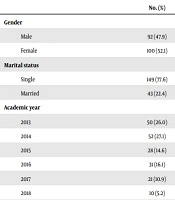
The outcomes obtained from the statistical analysis indicated no significant difference in the mean importance of teachers’ characteristics in theoretical teaching between the viewpoints of the students and teachers viewpoint in the dentistry school (P = 0.377), while a significant difference was observed between the viewpoint of the students and teachers in the schools of pharmacy (P = 0.001) and medicine in this regard (P = 0.20) (Table 1).
Table 1.
Demographic Characteristics of Students
| No. (%) | |
|---|---|
| Gender | |
| Male | 92 (47.9) |
| Female | 100 (52.1) |
| Marital status | |
| Single | 149 (77.6) |
| Married | 43 (22.4) |
| Academic year | |
| 2013 | 50 (26.0) |
| 2014 | 52 (27.1) |
| 2015 | 28 (14.6) |
| 2016 | 31 (16.1) |
| 2017 | 21 (10.9) |
| 2018 | 10 (5.2) |
| Clinical experience | |
| Yes | 140 (72.9) |
| No | 52 (27.1) |
| School | |
| Dentistry | 80 (41.7) |
| Pharmacy | 52 (27.1) |
| Medicine | 60 (31.3) |
4.1.2. Based on Degree
The obtained results indicated a significant difference in the mean importance of teachers’ characteristics in theoretical teaching in the viewpoint of the students between the three schools (P = 0.003). Accordingly, the mean importance of teachers’ characteristics in theoretical teaching was higher in the viewpoint of the students of the pharmacy school compared to the other schools. Furthermore, a significant difference was denoted in the mean importance of teachers’ characteristics in theoretical teaching in the viewpoint of the teachers between various schools (P = 0.001), and the mean importance of teachers’ characteristics in theoretical teaching was higher in the viewpoint of the teachers of the dentistry school compared to the other schools (Table 2).
Table 2.
Demographic Characteristics of Teachers
| No. (%) | |
|---|---|
| Gender | |
| Male | 27 (64.3) |
| Female | 15 (35.7) |
| Marital status | |
| Single | 21 (50.0) |
| Married | 21 (50.0) |
| School | |
| Dentistry | 18 (42.9) |
| Pharmacy | 12 (28.6) |
| Medicine | 12 (28.6) |
4.2. Importance of Teachers’ Characteristics in Clinical Teaching
4.2.1. Based on School
The results of the statistical analysis indicated no significant difference in the mean importance of teachers’ characteristics in clinical teaching between the viewpoints of the students and teachers in dentistry school (P = 0.320), while a significant difference was observed between the viewpoint of the students and teachers in the pharmacy school (P = 0.019) and medical school (P = 0.036) (Table 1).
4.2.2. Based on Degree
The results of the present study indicated no significant difference in the mean importance of teachers’ characteristics in clinical teaching in the viewpoint of the students between different schools (P = 0.463). The same results were observed in terms of the mean importance of teachers’ characteristics in clinical teaching in the viewpoint of the teachers (P = 0.855) (Table 2).
4.3. Importance of Teachers’ Characteristics in Evaluation
4.3.1. Based on School
The obtained results showed no significant difference in the importance of teachers’ characteristics in evaluation between the viewpoints of the students and professors of the schools of dentistry, pharmacy, and medicine (P = 0.719, P = 0.891, and P = 0.849, respectively) (Table 1).
4.3.2. Based on Degree
Our findings demonstrated no significant difference in the importance of teachers’ characteristics in the viewpoint of the students of the three schools (P = 0.728), and the same results were observed regarding the teachers’ viewpoints (P = 0.919) (Table 2).
4.4. Importance of Teachers’ Characteristics in Theoretical and Clinical Teaching and Evaluation in Three Selected Schools
The obtained results indicated a significant difference in the importance of teachers’ characteristics in theoretical teaching between the selected schools (P = 0.029). However, no significant difference was observed in the importance of teachers’ characteristics in clinical teaching (P = 0.613) and evaluation (P = 0.719) between the schools (Tables 3-5).
Table 3.
Mean Importance of Teachers’ Characteristics Based on School
| School | Numbers | Mean ± SD | ||
|---|---|---|---|---|
| Theoretical Teaching | Clinical Teaching | Evaluation | ||
| Dentistry | ||||
| Student | 80 | 2.87 ± 0.58 | 3.08 ± 0.56 | 0.49 ± 2.83 |
| Teacher | 18 | 3.00 ± 0.49 | 2.93 ± 0.57 | 2.88 ± 0.55 |
| P-value | 0.37 | 0.32 | 0.71 | |
| Pharmacy | ||||
| Student | 80 | 3.13 ± 0.31 | 3.19 ± 0.47 | 0.59 ± 2.76 |
| Teacher | 18 | 2.47 ± 0.32 | 2.85 ± 0.29 | 2.79 ± 0.71 |
| P-value | 0.00a | 0.01a | 0.89 | |
| Medicine | ||||
| Student | 80 | 2.83 ± 0.51 | 0.55 ± 3.10 | 0.46 ± 2.83 |
| Teacher | 18 | 2.47 ± 0.32 | 2.85 ± 0.29 | 2.79 ± 0.71 |
| P-value | 0.02a | 0.03a | 0.84 | |
aP < 0.05 significant difference of students with teachers.
Table 4.
Mean Importance of Teachers' Characteristics Based on Degree
| Degree | Numbers | Mean ± SD | ||
|---|---|---|---|---|
| Theoretical Teaching | Clinical Teaching | Evaluation | ||
| Student | ||||
| Dentistry | 80 | 2.87 ± 0.58 | 3.08 ± 0.56 | 0.49 ± 2.83 |
| Pharmacy | 52 | 3.13 ± 0.31 | 3.19 ± 0.47 | 2.76 ± 0.59 |
| Medicine | 60 | 2.83 ± 0.51 | 3.10 ± 0.55 | 2.83 ± 0.46 |
| P-value | 0.003a | 0.463 | 0.728 | |
| Teacher | ||||
| Dentistry | 18 | 3.00 ± 0.49 | 2.93 ± 0.57 | 0.55 ± 2.88 |
| Pharmacy | 12 | 2.47 ± 0.32 | 2.85 ± 0.29 | 2.79 ± 0.71 |
| Medicine | 12 | 2.47 ± 0.32 | 2.85 ± 0.29 | 2.79 ± 0.71 |
| P-value | 0.001a | 0.855 | 0.919 | |
aP < 0.05 significant difference between schools.
Table 5.
Mean Importance of Teachers’ Characteristics between Schools
| School | Numbers | Mean ± SD | ||
|---|---|---|---|---|
| Theoretical Teaching | Clinical Teaching | Evaluation | ||
| Dentistry | 98 | 2.89 ± 0.57 | 3.05 ± 0.57 | 0.50 ± 2.84 |
| Pharmacy | 64 | 3.00 ± 0.41 | 3.13 ± 0.46 | 2.77 ± 0.61 |
| Medicine | 72 | 2.77 ± 0.50 | 3.06 ± 0.52 | 2.83 ± 0.51 |
| P-value | 0.029a | 0.613 | 0.719 | |
aP < 0.05 significant difference between schools.
5. Discussion
Educators, students, educational environment, and planning are critical elements in the educational system. Teachers are the most influential elements in determining the quantity and quality of the outputs of every educational system. Using evaluative methods is the most common solution in the training system to assess the performance of teachers (10, 15). Considering that the criteria for teacher evaluation vary, we investigated the characteristics of a capable teacher in three categories of the factors related to theoretical teaching, clinical teaching, and evaluation in the viewpoint of students and teachers.
In the first category of the questions in the present study, the importance of teachers’ characteristics in theoretical teaching was evaluated, and the obtained results indicated that the participants selected from the pharmacy school (professors and students) placed greater emphasis on theoretical teaching compared to the other schools. Given the nature of pharmaceutical fields at the doctoral degree, the students are less able to provide theoretical teaching, and their attention is mostly focused on learning theoretical subjects.
Recent studies have shown that the most prominent feature of professors is their ability in theoretical teaching (2, 16). For instance, Akbari et al. (14) evaluated the characteristics of an efficient teacher in School of Dentistry of Mashhad University of Medical Sciences (Iran), reporting that theoretical teaching was emphasized after clinical teaching by the students (14). This is consistent with the viewpoint of the students of the dentistry school in the present study. In a qualitative study conducted in the western part of Japan by Kikukawa et al. (3), the foremost characteristic of efficient clinical teachers was reported to be their ability in theoretical teaching, followed by their capability in clinical teaching.
In the other section of the questionnaire, the importance of teachers’ characteristics in clinical teaching was evaluated, and the obtained results showed that in the schools of pharmacy and medicine, the professors placed less emphasis on clinical teaching characteristics than the students. On the other hand, the viewpoint of the students in the dentistry school regarding clinical teaching characteristics was similar to the professors, indicating the higher importance compared to the schools of pharmacy and medicine.
In a similar study, Akbari et al. (14) reported that in the viewpoint of students and teachers, clinical teaching in the field of dentistry had a high level of importance, which is consistent with our findings. Most of the students evaluated in similar studies have been reported to be dissatisfied with the fact that practical teaching is less important than theoretical teaching in the educational system, stating that professors pay less attention to this area of education (17). For instance, the findings of Aliasgharpour et al. (18) indicated a significant difference between the mean scores of professors and students regarding the influential factors in practical teaching, which is consistent with our findings in the schools of medicine and pharmacy. Furthermore, Zamanzad et al. (19) claimed that the main concern of students was that professors did not address the issues related to clinical needs acceptably.
According to Gylnn et al. (20), the recruitment of professors with high educational competence and clinical skills in educational planning could be an effective solution, increasing students ‘ satisfaction with the provided training. In addition, Sanatkhani et al. (21) reported that students did not have a positive view regarding the current status of the educational system and are concerned about inattention to clinical issues.
In the present study, we also evaluated the importance of teachers’ characteristics in evaluation, and the obtained results indicated that teachers’ evaluation characteristics were similar in the viewpoint of the students of the three schools, and students placed less emphasis on evaluation than on the characteristics of teachers in theoretical and clinical teaching.
In a study conducted in Ahvaz University of Medical Sciences (Iran), teachers’ characteristics in theoretical teaching were the most important factor in the viewpoint of students, followed by evaluation characteristics. The mentioned study showed no significant differences between the mean scores of students’ and teachers’ viewpoints regarding the influential factors in teachers’ personal traits, teacher’s educational activities, educational conditions, and student-related factors (13).
Several studies (22-24) have demonstrated that the majority of students are discontented with the evaluation of professors (especially in clinical teaching) and identify this issue as the major influential factor in the inefficiency of their clinical performance. Therefore, it is essential to review the evaluation of students in the clinical process and incorporate their practical skills into clinical courses to improve clinical training (24, 25). In this regard, Aliasgharpour et al. (18) have stated that in the viewpoint of teachers and students, numerous factors affect teacher evaluation, and with the exception of the factors related to practical courses, all the other factors are shared by both groups. Therefore, evaluation by students serves as a valuable criterion for the assessment of teachers’ performance.
5.1. Conclusions
Adequate knowledge of the characteristics of efficient teachers in the viewpoint of students and teachers could improve environmental and organizational statuses in order improve the quality of education. An efficient teacher plays a key role in the training of students, and the main purpose of identifying the qualities of an efficient teacher is to enhance the quality of training. According to the results of this study, the characteristics of capable teachers differed in the viewpoint of the students and teachers of different schools. Therefore, the views of students and teachers of each school should be categorized for the clear understanding of the views and expectations of students to improve the educational process.