
1. Background
Critical thinking refers to the skills of thinking, self-regulation, and purposeful judgment, which are developed through interpretation, analysis, evaluation, and inference. Critical thinking skills are classified as critical thinking skills and critical thinking disposition. Critical thinking skills emphasize cognitive strategies, while critical thinking disposition emphasizes the components of the attitude of internal thinking and internal motivation in problem-solving. Without a positive attitude toward critical thinking, this type of thinking is not possible, and the tendency to critical thinking is considered to be an inherent element of critical thinking (1-3).
Since the mid-20th century, critical thinking has been regarded as an educational necessity, and the development of critical thinking skills in academic curricula has been initiated for the learners of all educational levels. The development of thinking skills in university graduates is of utmost importance, and scholars claim that the primary goal of education is to urge learners to think. They also believe that education basically involves teaching learners to think, and critical thinking skills are the main output of higher education (4-6).
The development of critical thinking skills has become an expectation of every university, especially healthcare education institutions. The promotion of critical thinking in medical education has been in response to the rapid and permanent changes in scientific and medical functions and the need for the graduates to adapt to the complexity of healthcare systems. In addition to the development of competence and professional qualifications, the medical education system must help learners develop decision-making skills, problem-solving skills, and self-efficiency within the context of critical thinking (7).
The improvement of critical thinking skills and clinical arguments could largely contribute to healthcare professionals. In this regard, the World Federation of Medical Education (WFME) has highlighted the importance of critical thinking in medical education, emphasizing the application of scientific methods in the educational curricula of universities, so that students could properly learn the principles of managing various issues through critical thinking (8, 9). Therefore, critical thinking development (CTD) in universities is considered to the primary goal of higher education, particularly in medical education and other occupations related to community health and patient care (10).
In addition to the transfer of knowledge and skills, an important task of university educators is to train students to become thoughtful, analytical professional and critical thinkers in the future. Nevertheless, the studies in this regard have indicated that most university educators have received no special training on critical thinking and are not able to develop these skills in their students (11). Consequently, many students lack acceptable critical thinking skills. According to the studies conducted in Iran, the critical thinking skills of university students are poor or extremely poor (12-14), and CTD is also uncertain and relatively negative among students (15, 16).
In order to improve critical thinking, a substantial revision of the educational curriculum is required, and such a change involves contemplating the role of the academic staff and teaching methods. Critical thinking is a fundamental component of professional competence in medical sciences, and the empowerment of academic staff in the areas of teaching and leadership remarkably contributes to the attainment of the mission and broad goals of universities.
Today, scholars believe that critical thinking is the main output of higher education, and teaching critical thinking is essential to education. Only few studies have been performed in this regard, and further investigations could provide great opportunities for the CTD of university professors who are willing to incorporate critical thinking into their teaching methods. Considering that university professors play a key role in the educational system and are responsible for teaching critical thinking to learners, and since the CTD of professors has not been properly studied so far, the critical thinking disposition of faculty members remains a subject to be further explored.
2. Objectives
The present study aimed to evaluate the critical thinking disposition of the pharmacy faculty members of Ahvaz Jundishapur University of Medical Sciences (AJUMS), Iran in 2018.
3. Methods
This cross-sectional study was conducted on 41 pharmacy faculty members of Ahvaz Jundishapur University of Medical Sciences in Ahvaz, Iran in 2018. Universal sampling was performed to select the participants, and data were collected using a questionnaire with two sections. The first section included the demographic data of the participants, including age, gender, academic rank, and teaching experience. The second section of the questionnaire was Ricketts critical thinking disposition inventory (CTDI) (17), which consisted of 33 items and three subscales, including creativity (11 items), maturity (nine items), and engagement (13 items). The items were scored based on a five-point Likert scale (completely disagree = 1, completely agree = 5). The creativity domain evaluated the tendency to creativity and clever curiosities in exploring realities, the maturity domain was focused on learners' awareness of the complexity of real issues and their acceptance of others’ viewpoints considering their own and others’ cognitive knowledge, and the engagement domain evaluated learners’ readiness to argue in different situations and their confidence in their own abilities.
The CTDI has been translated into Persian and used in several studies, with the obtained results indicating that the Persian version of the instrument is highly reliable and valid in the Iranian population (18). According to Pakmehr et al., the reliability coefficients of the subscales of creativity, engagement, and maturity are 0.64, 0.76, and 0.72, respectively, and the value has been estimated at 0.68 for the entire tool (19). In the present study, the Cronbach's alpha coefficient of the subscales of creativity, maturity, and engagement and the entire scale were calculated to be 0.69, 0.51, 0.84, and 0.79, respectively.
In order to compare the mean scores of the general tendency of the students to critical thinking, the points of 50% and 70% were considered as moderate and desirable levels, respectively. Furthermore, the mean scores of the faculty members were compared based on these numbers. If the mean score of the professors reached 50%, their critical thinking would be considered moderate, and if the score reached 70%, their critical thinking would be considered optimal (20). Based on the calculated mean scores, strong, moderate, and weak tendencies could be determined, with the scores ≥ 136.95 considered strong, scores of 135.30 - 110.51 considered moderate, and scores ≤ 108.90 considered weak (21).
After obtaining the required permits, the questionnaires were distributed among the participants, and the objectives of the research were also explained. The participants were asked to return the questionnaires. The inclusion criteria of the study were willingness to participate and the accurate completion of the questionnaire, and the exclusion criteria were unwillingness to participate and incomplete questionnaires.
Data were coded and analyzed in SPSS version 20 (IBM Corporation, Armonk, NY) using descriptive and analytical statistics. In order to use parametric tests, the normal distribution of the data was assessed using the Kolmogorov-Smirnov test. Considering that the significance level of this test for the CTD variable and its subscales was higher than 0.05, the normal distribution of the CTD data and its subscales was confirmed, and parametric tests were used. In addition, one-sample t-test was applied to compare the means, independent t-test was used for the group comparisons, and Pearson's correlation-coefficient was employed to determine the correlations between the variables. In all the statistical analyses, the P-value of less than 0.05 was considered significant.
4. Results
Among 41 pharmacy faculty members, 36 (87.8%) participated in the present study and completed the questionnaire, including 15 women (41.7%) and 21 men (58.3%). The mean age of the subjects was 45.7 ± 10.66 years. Five faculty members (13.9%) were professors, six (16.7%) were associate professors, 23 (63.9%) were assistant professors, and two (5.6%) were lecturers. Among the participants, 10 (27.8%) had a strong tendency toward critical thinking, 25 (69.4%) had a moderate tendency, and one (2.8%) had a weak tendency. The mean score of CTD was estimated to be 131.44 out of 165, and the obtained results indicated the scores of CTD and its subscales were higher than the mean in all the faculty members and considered to be optimal (Table 1).
Table 1.
One-sample T-test for CTD and Its Subscales in Pharmacy Faculty Members
| Fields | Test Value | Mean ± SD | Mean Difference | t | P-Value |
|---|---|---|---|---|---|
| CTD | 99 | 131.44 ± 8.98 | 32.44 | 21.66 | 0.001 |
| Creativity | 33 | 47.58 ± 3.45 | 14.58 | 25.36 | 0.001 |
| Maturity | 27 | 31.39 ± 2.44 | 4.39 | 10.79 | 0.001 |
| Engagement | 39 | 52.47 ± 5.57 | 13.47 | 14.52 | 0.001 |
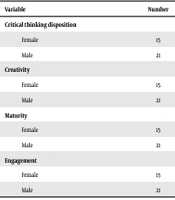
The comparison of the mean scores of CTD and its subscales based on gender indicated that although the mean scores of CTD and its subscales were higher in the women compared to the men, the differences in this regard were not significant (P > 0.05). Furthermore, no significant differences were observed in the mean scores of CTD and its subscales between the assistant professors and those with higher academic ranks (P > 0.05) (Table 2).
Table 2.
Comparison of Mean Scores of CTD and Subscales Based on Gender
| Variable | Number | Mean ± SD | t | P-Value |
|---|---|---|---|---|
| Critical thinking disposition | 1.060 | 0.29 | ||
| Female | 15 | 133.2 ± 9.67 | ||
| Male | 21 | 130.1 ± 8.18 | ||
| Creativity | 0.904 | 0.37 | ||
| Female | 15 | 48.2 ± 4.21 | ||
| Male | 21 | 47.1 ± 2.82 | ||
| Maturity | 0.456 | 0.65 | ||
| Female | 15 | 31.5 ± 1.88 | ||
| Male | 21 | 31.1 ± 2.90 | ||
| Engagement | 0.904 | 0.37 | ||
| Female | 15 | 53.5 ± 6.14 | ||
| Male | 21 | 51.8 ± 5.16 |
The obtained results indicated no significant correlations between the mean scores of CTD and its subscales with the variables of age and work experience (Table 3).
Table 3.
Correlations of Mean Scores of CTD and Subscales with Age and Work Experience
| Variable | CTD | Creativity | Maturity | Engagement |
|---|---|---|---|---|
| Age | ||||
| Pearson's correlation-coefficient (r) | -0.249 | -0.171 | 0.073 | -0.329 |
| Significance level (P-value) | 0.143 | 0.320 | 0.673 | 0.050 |
| Work experience | ||||
| Pearson's correlation-coefficient (r) | -0.229 | -0.167 | -0.034 | -0.251 |
| Significance level (P-value) | 0.180 | 0.330 | 0.845 | 0.140 |
5. Discussion
According to the results of the present study, the critical thinking disposition of the pharmacy faculty members was above average and relatively desirable. This is consistent with the results obtained by Rafiee et al. (22), while inconsistent with the studies reporting the low level of critical thinking disposition in university faculty members (23, 24). For instance, the CTD level of university faculty members was reported to be relatively low in a study conducted in Turkey (25). The differences in the CTD in various studies could be due to the variations in the study populations, cultural characteristics, sample size, and research instruments.
Although our findings indicated the desirable mean score of CTD in the pharmacy faculty members, the total score obtained by the majority of the faculty members was moderate, and strong critical thinking disposition was only observed in a few participants. This could be due to the weaknesses of the medical education system in Iran, in which the faculty members without strong critical thinking skills and disposition cannot facilitate and transfer critical thinking methods to learners. In this regard, researchers have argued that critical thinking skills and disposition play a pivotal role in teaching, while university faculty members are essentially involved in the development of critical thinking skills in students (26, 27).
Considering that medical practitioners should be able to resolve problems and make proper decisions while dealing with patients in the clinical setting, the graduates of medical sciences in various fields must acquire competency and other necessary qualifications, especially those associated with critical thinking, during their academic studies in the university; evidently, faculty members play a fundamental role in this regard. Medical sciences students must strengthen their critical thinking skills and disposition more than the students of other sciences (28). Unfortunately, studies have indicated that in most of the universities in Iran, the CTD level of students is rather low and undesirable (23, 29, 30). Therefore, special attention must be paid to the attitudes of professors toward critical thinking skills and their teaching methods of choice, as well as educational programs.
The results of the present study demonstrated no significant differences in the CTD level based on the gender and academic rank of the faculty members, which is in line with the findings of Rafiei et al. (22) and Baba Mohammadi et al. (24), while inconsistent with the study by Safari et al. (23), who reported significant differences between male and female teachers and their academic rank in the creativity and engagement subscales of CTD. This discrepancy could be due to the differences in the sample populations and research tools.
The current research showed no significant correlations between the mean scores of CTD, age, and work experience of the faculty members, which is consistent with the results obtained by Safari et al. (23) and Baba Mohammadi et al. (24) possibly due to the general atmosphere of universities and giving CTD a lower profile.
The limitations of the present study were the small sample size and evaluation of the faculty members of only one school; therefore, the generalization of the results should be achieved with caution. Among the other limitations were difficult access to the faculty members and their unwillingness and lack of time to complete the questionnaires.
5.1. Conclusion
According to the results, the scores of critical thinking disposition and its subscales were above average and relatively desirable in the pharmacy faculty members. However, no correlations were observed between the CTD, age, and work experience of the professors. Due to the key educational role of faculty members in the development of critical thinking in universities, continuous educational programs must be implemented for faculty members for familiarization with various aspects of critical thinking and the required teaching strategies, which in turn result in the promotion of this concept in students. Considering the significant impact of the CTD of teachers on the quality of education, it is suggested that emphasis be placed on the selection of faculty members with high critical thinking abilities and proper workshops be held to improve the critical thinking skills and disposition of these scholars.