
1. Background
Patient safety is a major concern for health care professionals (1, 2). Therefore, in today’s health care system, patient safety is a key concept and an important indicator of quality control of services (3). There are various definitions of patient safety. The best description for patient safety is to prevent the development of injury in patients due to errors in performing an action. This definition includes the consequences of diagnostic and therapeutic factors, as well as the usage rate of health care resources. Patient safety is person-centered, and caring for patients without harm is an ethical principle (4). Medical errors are among the major challenges and threats to the health system in all countries (5, 6). Some studies in Iran have shown that larger hospitals account for more than half of all medical errors (7). Notably, nurses (67.3%) and physicians (20.2%) commit the majority of errors in hospitals in Iran (8, 9). The high rate of medical errors in some hospitals in Iran confirms the mentioned challenge (8).
According to studies by Johns Hopkins University in 2018, the latest medical error statistics show 250000 cases per year in the United States (10). Medical errors after heart disease and cancer are the third leading cause of death in the United States (11). Medication error is a major determinant of health care quality among safety issues (namely, patient identification, error in blood transfusions, falls, and suicide) (5). Drug errors refer to any preventable event during the drug treatment process, which can lead to misuse of medication or harm to the patient (12). Drug errors may occur at any stage of the therapeutic process, such as writing and copying prescriptions, distributing and dispensing medication, and during the delivery of medication to the patient (13). Medication errors result in adverse outcomes, such as increased mortality, length of hospitalization, and treatment costs for patients (14). According to a 2005 study, thousands of people in the United States die every year from medication errors, and financial costs related to drug side effects in this country are close to 77 million $ per year (15). Bates et al. reported that patients experience at least 1 medication error during their hospitalization (16).
Practical application of error probability criteria focuses on all safety measures, including error probability identification and assessment, as well as error reduction and elimination (17). The first step in evaluating the probability of error is to define the objectives of the assessment (18), which is an important part of hospital management and patient safety (19). Reducing the probability of error in hospitals is vital to improve the quality of health care and achieve effective communication between hospital staff and patients (20, 21). In this regard, identifying the causes of errors and awareness of the challenges associated with reducing them are the first step in implementing strategies to decrease unwanted events (22).
Pharmaceutical knowledge is an important component of a nurse’s clinical practice (23). Nurses spend approximately 40% of their working time in hospitals to give medication to patients (24). Reasons for the increasing importance of pharmacology knowledge for nurses are as follows: Medications are generally administered by nurses, patients’ medication regimens are constantly changing and may include new medications, nurses need medical knowledge to educate patients about medications and their side effects with changing demographics conditions, and the population of patients taking more than 1 drug is increasing (25).
2. Objectives
In this study, the researcher attempted to evaluate the relationship between pharmacology knowledge and the probability of medical errors in nurses working in Urmia hospitals in 2020.
3. Methods
The methodology of the present study is based on the strengthening the reporting of observational studies in epidemiology (STROBE) checklist (26). The local human subject review board of Urmia University of Medical Sciences approved this study (code: IR.UMSU.REC.1397.203). Urmia is a city located in the northwest of Iran bordering Turkey, Iraq, and the Nakhchivan Autonomous Republic. In the present cross-sectional study, a random sample of 490 nurses from those working in different wards of private and public hospitals of Urmia City were investigated in 2020. Due to the wide range of pharmaceutical knowledge in nurses, an average of 50% was considered. The sample size was selected based on the study by Simonsen et al. (27) as follows:
The sample size was 475 people, and, considering the percentage of dropout, 490 nurses working in hospitals of Urmia City were selected and examined based on the total number of nurses in that center. Before distributing the questionnaires, we obtained the informed consent form from them.
The data collection tool in this study was a multiple-choice questionnaire based on the study by Simonsen et al. (27, 28) on pharmacology knowledge and skills, consisting of 3 sections. The inclusion criteria in the present study were being employed in one of the hospitals in Urmia and signing an informed consent form. The first section included demographic information of nurses (such as age, gender, marital status, number of children, education, clinical experience, place of work, history of drug training courses, ward type, shift work, and overtime work rate per month), the second section included nurses’ medical knowledge (ie, pharmacology information, drug side effects, prescription method, storage, preparation and drug management, patient prescription, and pharmaceutical computing), and the third section was the confidence level of nurses’ response. The reliability of the questionnaire was calculated to be 0.8 using the Cronbach α coefficient.
3.1. Data Analysis
Statistical analyses were conducted using SPSS version 21 (IBM Inc, Armonk, NY, USA). Quantitative measurement was expressed by mean ± SD. Qualitative variables were presented as absolute frequency and percentage. To analyze questions and hypotheses, the t-test and analysis of variance (ANOVA) were employed. P-values less than 0.05 were regarded as statistically significant.
4. Results
A total of 490 nurses were enrolled in this descriptive cross-sectional study working in 9 hospitals of Urmia City in 2020. The characteristics of the nurses are presented in Table 1.
Table 1.
Sample Characteristics of 490 Nurses
| Variables | No. (%) |
|---|---|
| Gender | |
| Female | 411 (83.9) |
| Male | 79 (16.1) |
| Education | |
| Technician | 1 (0.2) |
| Bachelor of sciences | 472 (96.3) |
| Master of science | 17 (3.5) |
| Marital status | |
| Single | 181 (36.9) |
| Married | 307 (62.7) |
| Divorced | 2 (0.4) |
| Drug training class | |
| In the last 6 months | 270 (55.1) |
| In the past 1 year | 133 (27.1) |
| More than a year | 87 (17.8) |
| Wards | |
| General | 274 (55.9) |
| Special | 216 (44.1) |
| Morning | 108 (22) |
| Shift work | |
| Evening | 13 (2.7) |
| Night | 3 (0.6) |
| Circulation | 366 (74.7) |
| < 50 | 147 (30) |
| 50 - 100 | 252 (51.4) |
| Overtime work (h) | |
| 100 - 150 | 69 (14.1) |
| > 150 | 22 (4.5) |
| Type of hospital | |
| Public | 424 (86.5) |
| Private | 66 (13.5) |
| Number of children | |
| 0 | 256 (52.2) |
| 1 | 109 (22.2) |
| 2 | 118 (24.1) |
| 3 | 7 (1.4) |
| 20 - 30 | 205 (41.83) |
| 31 - 40 | 190 (38.77) |
| Age (y) | |
| 41 - 50 | 89 (18.16) |
| > 50 | 6 (1.2) |
| < 10 | 282 (57.55) |
| Clinical experience (y) | |
| 11 - 20 | 182 (37.14) |
| > 20 | 26 (5.30) |
4.1. Pharmaceutical Knowledge Scores
Table 2 illustrates the pharmaceutical knowledge scores of nurses. The highest pharmaceutical knowledge scores of nurses were related to the method of administration (2.9 ± 1.01 [72.56%]), and the lowest score was related to drug management (1.05 ± 0.63 [52.84%]).
Table 2.
The Pharmaceutical Knowledge Scores of Nurses
| Dimension | Number of Questions | Mean Scores of Pharmaceutical Knowledge | Pharmaceutical Knowledge (%) |
|---|---|---|---|
| Pharmacology | 3 | 1.96 ± 0.81 | 65.4 ± 27.3 |
| Medicinal effects | 3 | 1.72 ± 0.86 | 57.5 ± 28.99 |
| Side effects | 4 | 2.8 ± 1.00 | 70 ± 25.18 |
| Method of administration | 4 | 2.9 ± 1.01 | 72.56 ± 25.31 |
| Drug management | 2 | 1.05 ± 0.63 | 52.84 ± 31.64 |
| Storage | 4 | 2.26 ± 0.84 | 56.60 ± 21.22 |
| Preparation | 4 | 2.42 ± 0.87 | 60.72 ± 21.99 |
| Prescription to the patient | 4 | 2.15 ± 0.84 | 53.93 ± 21.16 |
| Pharmaceutical calculations | 14 | 8.78 ± 3.06 | 62.76 ± 21.86 |
| Total | 42 | 24.58 ± 5.54 | 58.51 ± 13.19 |
4.2. Confidence in Response Scores
Table 3 shows the confidence in response scores among nurses. The highest score of confidence was related to storage response (11.33 ± 4.03 [70.82 ± 25.1%]), and the lowest score was related to medicinal effects (7.71 ± 2.84 [64.26 ± 23.67%]).
Table 3.
Confidence in Response Scores in Nurses
| Dimension | Number of Questions | Mean of Scores | Confidence in Response (%) |
|---|---|---|---|
| Pharmacology | 3 | 7.93 ± 2.73 | 66.12 ± 22.81 |
| Medicinal effects | 3 | 7.71 ± 2.84 | 64.26 ± 23.67 |
| Side effects | 4 | 11.12 ± 3.7 | 69.5 ± 23.16 |
| Methods of administration | 4 | 10.45 ± 3.75 | 65.34 ± 23.49 |
| Drug management | 2 | 5.61 ± 2.09 | 70.2 ± 26.13 |
| Storage | 4 | 11.33 ± 4.03 | 70.82 ± 25.1 |
| Preparation | 4 | 11.06 ± 3.89 | 69.17 ± 24.33 |
| Prescribing to the patient | 4 | 11.14 ± 4.18 | 69.65 ± 26.18 |
| Pharmaceutical calculations | 14 | 38.10 ± 1.41 | 68.06 ± 25.23 |
| Total | 42 | 114.49 ± 36.97 | 68.14 ± 22 |
4.3. The Relationship Between Pharmaceutical Knowledge and Confidence in the Response with Probability of Medication Errors Among the Nurses
According to Table 4, the mean of correct answers was 60.44%, and only 28.81% of nurses had confidence in their response. Therefore, the mean of error probability was very low in 28.81% of nurses, low in 37.66%, high in 11.34%, and very high in 22.85%. Considering the inverse relationship between the mean of medication errors and confidence in the response in each of the mentioned dimensions, the lowest and highest probability of medication error was in storage (34.8%) and adverse effects (20.4%), respectively. The relationship between pharmaceutical knowledge and confidence in the response for all the remaining dimensions was significant except for side effects and drug management (P < 0.05 for all).
Table 4.
The Relationship Between Pharmaceutical Knowledge and Confidence in the Response and the Probability of Medication Errors in Nurses a
| Dimension | Pharmaceutical Knowledge | Confidence in the Response | P-Value | ||||
|---|---|---|---|---|---|---|---|
| Correct | False | Very Much | Much | Low | Very Low | ||
| Pharmacology | 64 | 34.5 | 21.8 | 42.3 | 14.5 | 21.3 | < 0.001 |
| Medicinal effects | 56.4 | 41.9 | 20.45 | 40.6 | 14.5 | 24.4 | < 0.001 |
| Side effects | 69.2 | 29.9 | 29.5 | 39.3 | 18.1 | 20.4 | 0.398 |
| Methods of administration | 71.3 | 26.9 | 23.7 | 37.8 | 14.5 | 23.8 | < 0.001 |
| Drug management | 51.6 | 46.5 | 33.6 | 35.6 | 8.8 | 21.9 | 0.065 |
| Storage | 55.5 | 42.9 | 34.8 | 35.2 | 8.3 | 21.6 | < 0.001 |
| Preparation | 60.3 | 38.8 | 28.9 | 41.1 | 7.4 | 22.4 | < 0.001 |
| Prescribing to the patient | 53.3 | 45.5 | 33 | 35.5 | 8.2 | 23.1 | 0.009 |
| Pharmaceutical calculations | 62.0 | 35.5 | 33.6 | 31.6 | 7.8 | 26.8 | < 0.001 |
| Mean | 60.4 | 38.0 | 28.8 | 37.6 | 11.3 | 22.8 | < 0.001 |
a Values are expressed as percent.
4.4. The Relationship Between Pharmaceutical Knowledge and Confidence in the Response with Some of the Demographic Characteristics in Nurses
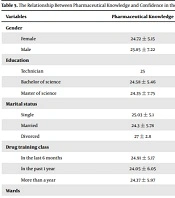
According to Table 5, pharmaceutical knowledge had no significant relationship with education, marital status, drug training courses, shift work, overtime work, age, and clinical experience (P > 0.05 for all); however, this relationship was statistically significant for the remaining factors (P < 0.05 for all).
Table 5.
The Relationship Between Pharmaceutical Knowledge and Confidence in the Response with Some of the Demographic Characteristics in Nurses
| Variables | Pharmaceutical Knowledge | P-Value | Confidence in the Response | P-Value |
|---|---|---|---|---|
| Gender | 0.002 | 0.018 | ||
| Female | 24.72 ± 5.15 | 115.76 ± 36 | ||
| Male | 23.85 ± 7.22 | 107.89 ± 41.05 | ||
| Education | 0.983 | 0.680 | ||
| Technician | 25 | 133 | ||
| Bachelor of science | 24.58 ± 5.46 | 114.22 ± 37.1 | ||
| Master of science | 24.35 ± 7.75 | 120.82 ± 34.42 | ||
| Marital status | 0.068 | < 0.001 | ||
| Single | 25.03 ± 5.1 | 110.49 ± 40.4 | ||
| Married | 24.3 ± 5.78 | 117.06 ± 34.11 | ||
| Divorced | 27 ± 2.8 | 81.5 ± 55.86 | ||
| Drug training class | 0.316 | 0.150 | ||
| In the last 6 months | 24.91 ± 5.17 | 116.98 ± 36.11 | ||
| In the past 1 year | 24.05 ± 6.05 | 113.5 ± 35.84 | ||
| More than a year | 24.37 ± 5.97 | 108.24 ± 40.73 | ||
| Wards | 0.001 | < 0.001 | ||
| General | 24.01 ± 6.18 | 110.44 ± 39.27 | ||
| Special | 25.3 ± 4.5 | 119.63 ± 33.2 | ||
| Shift work | 0.316 | 0.040 | ||
| Morning | 25.19 ± 4.92 | 122.98 ± 34.69 | ||
| Evening | 23.69 ± 7 | 104.15 ± 44 | ||
| Night | 20.33 ± 8.62 | 125 ± 15.52 | ||
| Circulation | 24.46 ± 5.63 | 112.26 ± 37.17 | ||
| Overtime work (h) | 0.585 | 0.410 | ||
| < 50 | 24.18 ± 6.27 | 116.93 ± 37.48 | ||
| 50 - 100 | 24.66 ± 5.31 | 112.26 ± 35.44 | ||
| 100 - 150 | 24.71 ± 4.92 | 118.91 ± 39.06 | ||
| > 150 | 25.82 ± 4.67 | 109.86 ± 43.75 | ||
| Type of hospital | < 0.001 | 0.035 | ||
| Public | 25.24 ± 4.91 | 118.44 ± 34.61 | ||
| Private | 20.3 ± 7.21 | 89.12 ± 41.58 | ||
| Number of children | 0.007 | 0.026 | ||
| 0 | 24.87 ± 5.47 | 110.37 ± 39.96 | ||
| 1 | 23.41 ± 6.1 | 114.88 ± 34.7 | ||
| 2 | 24.95 ± 5.16 | 122.48 ± 30.62 | ||
| 3 | 25.71 ± 2.28 | 124.29 ± 38.16 | ||
| Age (y) | 0.246 | < 0.001 | ||
| 20 - 30 | 24.36 ± 5.97 | 107.73 ± 39.07 | ||
| 31 - 40 | 24.4 ± 5.04 | 116.71 ± 35.07 | ||
| 41 - 50 | 25.3 ± 5.64 | 124.07 ± 34.01 | ||
| > 50 | 27 ± 2.6 | 133 ± 20.42 | ||
| < 10 | 24.45 ± 5.7 | 109.39 ± 39.18 | ||
| Clinical experience (y) | 0.250 | < 0.001 | ||
| 11 - 20 | 24.65 ± 5.13 | 120.55 ± 32.75 | ||
| > 20 | 25.42 ± 6.59 | 127.35 ± 31.26 |
The findings in Table 5 also show that confidence in the response had no significant relationship with education, drug training courses, and overtime work (P > 0.05 for all), but this relationship was significant for the other investigated factors (P < 0.05 for all).
5. Discussion
Medication errors constantly occur over time (29). The efforts to reduce and control these errors depend on taking a systematic approach to the underlying factors and eliminating these causes as much as possible (30). Based on the findings of the present study, the mean score of pharmaceutical knowledge in nurses working in hospitals in Urmia City was 24.58 ± 5.54 (58.51 ± 13.19%), whereas the average nurses’ knowledge of medication in the study by Simonsen et al. was 65% (27). The highest pharmaceutical knowledge scores of nurses were related to the method of administration, and the lowest score was related to drug management. In Norway, the highest pharmaceutical knowledge scores of nurses were related to pharmaceutical calculations, and the lowest scores were related to drug storage (27).
Our findings were in line with those of Barber et al. (31), Greengold et al. (32), and Elliott et al. (33), showing that mean medication error probability was very low in 28.81% of nurses, low in 37.66%, high in 11.34%, and very high in 22.85%. In agreement with this finding, the mean medication error probability in some previously published studies has been reported to be > 50% (14, 34, 35). This discrepancy may be due to differences in the sample size that causes a random error.
According to Table 4, the mean of correct answers was 60.44%, and only 28.81% of nurses had confidence in their response. Therefore, the mean of error probability was very low in 28.81% of nurses, low in 37.66%, high in 11.34%, and very high in 22.85%. Given the inverse relationship between the mean of medication errors and confidence in the response in each of the mentioned dimensions, the lowest probability of medication errors was in drug storage (34.8%), and the highest probability was observed in adverse effects (20.4%). The relationship between pharmaceutical knowledge and confidence in the response for all remaining dimensions was significant except for side effects and drug management.
Our findings indicated that pharmaceutical knowledge had no significant relationship with education, marital status, drug training courses, shift work, overtime work, age, and clinical experience, but this relationship was significant for the other investigated factors. Previous studies consistent with our results have demonstrated a significant difference between pharmaceutical knowledge and gender (35), hospital ward, and number of children (36). We also found no significant relationship between overtime work and the probability of medication errors.
Inconsistent with our results, Souzani et al. reported that overtime work was one of the most important reasons for medication errors in nurses (37). According to the results of their study, the pharmacological knowledge of nurses was 58.51%, but in the study by Ndosi and Newell, this rate was calculated at a higher level (88%) (25). This result indicates that the pharmacological knowledge of nurses in the present study is not sufficient and that nurses need further training in this regard. Many researchers have also stated that increasing pharmacological information and updating nurses’ information about medications can significantly reduce medication errors (38, 39). The present study did not face any particular limitations. The results of the present study are expected to be used in various fields, such as services, education, and nursing research.
5.1. Conclusions
The results of the present study are expected to be used in different areas, such as nursing services, education, and research. Since the nurses’ pharmaceutical knowledge level plays an essential role in the correct administration of medications, it is suggested that nurse managers and supervisors improve nursing knowledge by holding in-service training courses and providing booklets and posters.