
1. Introduction
Periodontal diseases are estimated to affect nearly 45% of the world’s population, representing more than 3.5 billion people globally. Among adults, dental caries and periodontal breakdown are the most common oral health concerns. Oral diseases are highly prevalent and largely preventable. However, owing to social and economic inequalities and limited resources, particularly in low- and middle-income countries, they remain widespread. These diseases have substantial personal and economic consequences, and access to treatment is limited. Their increasing prevalence in many countries is associated with social and commercial changes. Therefore, oral diseases should be addressed as a global health priority alongside other noncommunicable diseases (1).
Regional epidemiological studies have also confirmed the high prevalence of dental caries (50%) and chronic pulpitis (61%) among adults in northern China, particularly among individuals aged 60 years or older and women (2). Oral disease is widespread and can affect individuals across the life course, from childhood to adulthood; therefore, addressing it within health systems is essential (3). This initiative aims to reform oral healthcare systems by promoting preventive care, improving hygiene practices, and ensuring equitable access to dental services across populations. Existing evidence indicates that many individuals remain unaware of the importance of oral health, which represents a major barrier to effective oral disease prevention and management strategies (4).
Dental and periodontal disorders may lead to various physical and emotional consequences, including chronic pain, difficulty chewing and speaking, and reduced self-confidence, all of which negatively affect overall quality of life (5). These conditions may also impair nutritional intake and digestive efficiency. Psychological distress resulting from tooth loss, chewing impairment, xerostomia, and changes in facial appearance may further worsen general health status (6). A growing body of research has established associations between oral diseases and several systemic and chronic health conditions, including diabetes, cancer, cardiovascular disorders, depression, neurodegenerative diseases, rheumatoid arthritis, asthma, obesity, Helicobacter pylori infection, and inflammatory bowel disease (7).
Among chronic diseases, diabetes is specifically associated with a bidirectional, causal relationship with oral health problems (8). Diabetes increases the risk and severity of periodontitis, while periodontitis, in turn, complicates glycemic control and diabetes progression (9). Therefore, effective oral health management is of particular clinical importance in this population.
In this context, self-management education is a proven strategy for managing chronic conditions (10, 11). By empowering patients and enhancing self-efficacy, this approach has the potential to affect both diabetes management and related complications, including oral health problems (12, 13). Given the need for comprehensive attention to oral health and the importance of integrating oral health into primary healthcare to achieve affordable and accessible services, approaches such as interprofessional education, cross-disciplinary collaboration in the health sector, and public engagement can facilitate this integration and lead to successful health system outcomes (14). Ultimately, these interprofessional collaborations can help improve oral health, reduce oral health disparities, and support the prevention and treatment of systemic diseases (15).
Nevertheless, evidence regarding the effectiveness of self-management interventions specifically designed to improve oral health outcomes in patients with diabetes remains scattered and requires synthesis. To date, no comprehensive systematic review focusing solely on RCTs in this area has been conducted. Therefore, this study aimed to perform a systematic review of RCT evidence on the effects of self-management interventions on oral health outcomes in patients with diabetes. This PROSPERO-registered systematic review (ID: CRD420251141842) synthesized evidence from RCTs evaluating the effects of self-management interventions on oral health outcomes in patients with diabetes.
2. Method
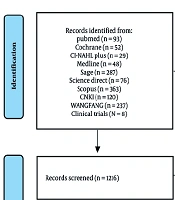
Given the interventional and educational nature of self-management interventions and the need to evaluate their effects on oral health outcomes in patients with diabetes, only RCTs were included to provide the highest level of evidence, minimize bias, and ensure greater consistency of results. Review designs, including narrative and systematic reviews, observational studies, and other non-RCT designs, were excluded. The review was conducted and reported in accordance with the PRISMA 2020 guidelines (Figure 1). Risk of bias in the included studies was assessed using the Jadad scale (Table 1).
Table 1.
Evaluation of the Quality of Randomized Clinical Trials Included in the Review
| Study | Journal | Randomization | Blinding | Withdrawals and Dropouts Reporting | Jadad Score |
|---|---|---|---|---|---|
| Mardom et al. (16) | Evidence-Based Care Journal | Adequate (++) | Not reported (0) | Described (+) | 3 |
| Zhang et al. (17) | Scientific Reports | Adequate (++) | Single-blind | Described (+) | 4 |
| Cinar and Schou (18) | Oral Health and Preventive Dentistry | Adequate (++) | Triple-blind | Described (+) | 4 |
| Cinar et al. (19) | Clinical Oral Investigations | Adequate (++) | Triple-blind | Described (+) | 4 |

Figure 1.
PRISMA flow diagram
2.1. Data Sources
On December 17, 2025, the final literature search was conducted in PubMed, Scopus, Web of Science, and ScienceDirect using the search strategies detailed below. The search strategies, databases, and numbers of retrieved records are summarized in Table 2.
Table 2.
Search Databases, Strategies, and Retrieved Records
| Database | Search Strategy (Keywords) | Records Retrieved (Results) |
|---|---|---|
| PubMed | ("Diabetes Mellitus"[Mesh] OR diabetic*[tiab] OR "Diabetes Mellitus"[tiab]) AND ("Self-Management"[Mesh] OR "Self Care"[Mesh] OR "Self-Management"[tiab] OR "self management"[tiab] OR "self-care"[tiab] OR "self care"[tiab] OR "patient education"[tiab] OR "self efficacy"[tiab] OR "self-management support"[tiab]) AND ("Mouth Diseases"[Mesh] OR "Oral Health"[tiab] OR "oral health"[Mesh] OR dental[tiab] OR denti*[tiab] OR periodont*[tiab] OR gingiv*[tiab] OR "dental caries"[tiab] OR "oral hygiene"[tiab] OR "tooth brushing"[tiab] OR "toothbrushing"[tiab]) AND (randomized controlled trial[pt] OR randomized[tiab] OR randomised[tiab] OR random*[tiab] OR "random allocation"[tiab] OR "double blind"[tiab] OR "single blind"[tiab]) | 22 |
| Scopus | TITLE-ABS-KEY ("Diabetes Mellitus" OR diabetic*) AND TITLE-ABS-KEY ("Self-Management" OR "Self Care" OR "self management" OR "self-care" OR "self care" OR "patient education" OR "self efficacy" OR "self-management support") AND TITLE-ABS-KEY ("Mouth Diseases" OR "Oral Health" OR dental OR denti* OR periodont* OR gingiv* OR "dental caries" OR "oral hygiene" OR "tooth brushing" OR toothbrushing) AND TITLE-ABS-KEY ("randomized controlled trial" OR randomized OR randomised OR random* OR "random allocation" OR "double blind" OR "single blind") | 45 |
| Web of Science | TS=("Diabetes Mellitus" OR diabetic*) AND TS=("Self-Management" OR "Self Care" OR "self management" OR "self-care" OR "self care" OR "patient education" OR "self efficacy" OR "self-management support") AND TS=("Mouth Diseases" OR "Oral Health" OR dental OR denti* OR periodont* OR gingiv* OR "dental caries" OR "oral hygiene" OR "tooth brushing" OR toothbrushing) AND TS=("randomized controlled trial" OR randomized OR randomised OR random* OR "random allocation" OR "double blind" OR "single blind") | 22 |
| ScienceDirect | ("Diabetes Mellitus" OR diabetes) AND ("Self-Management" OR "Self Care") AND ("Oral Health" OR periodontal disease) AND "Randomized Controlled Trial." | 330 |
2.2. Study Selection
A two-step screening process was conducted to ensure careful and unbiased study selection.
First, two independent reviewers screened the titles and abstracts of all retrieved records against the predefined eligibility criteria. Articles that clearly did not meet the criteria were excluded.
Second, the full texts of the remaining potentially eligible articles were obtained. The same two independent reviewers then performed a thorough full-text evaluation. No disagreements occurred between the reviewers at this stage; therefore, consultation with a third reviewer was not required. Articles that met all inclusion criteria proceeded to the data extraction phase.
The inclusion and exclusion criteria were aligned with the PICOTS framework and were defined as follows:
Population: Individuals diagnosed with diabetes, including type 1, type 2, or other forms, with no age restriction.
Intervention: Self-management interventions targeting oral health outcomes.
Comparison: Control groups receiving usual care, an alternative intervention, or no specific intervention.
Outcomes: Quantitative measures of oral health, including the plaque index, gingival bleeding index, periodontal status, caries indices, or oral health-related quality of life.
Time: Studies published up to December 17, 2025.
Study Design: RCTs.
Additional operational criteria were applied as follows:
Inclusion criteria: Original, peer-reviewed research articles published in English with full text available were included.
Exclusion criteria: Studies were excluded if they: 1) were not RCTs, such as observational studies, qualitative studies, case reports or series, or reviews; 2) did not focus on self-management in a diabetic population; 3) lacked sufficient methodological detail for quality appraisal; 4) constituted grey literature, such as books, dissertations, conference abstracts, or posters; or 5) were duplicate publications.
2.3. Data Extraction
Data were systematically extracted using a predesigned form, including the following elements:
Study characteristics, including researchers, year of publication, geographic location, cohort size, patient demographics, and intervention details (type and duration), are presented in Table 3. Key findings and statistical results are also presented in Table 3.
Table 3.
Core Features of the Studies Reviewed
| No. | Authors | Study Design | Control or Comparison Intervention | Sample Size | Mean Age (SD)/Age Range | No. of Sessions | Frequency | Duration | Outcomes (Tools) | Main Findings |
|---|---|---|---|---|---|---|---|---|---|---|
| 1 | Mardom et al. (16) | RCT | Standard care | 70 | Intervention: 54.20 ± 9.2; Control: 55.42 ± 9.1 | 16 (12 + 4 follow-up sessions) | Weekly | Not specified | The questionnaires used included the OHSQ and the Oral and Dental Health-Related Quality of Life Questionnaire. | A structured self-management education program significantly improved oral health self-efficacy scores (4.77 vs. 1.90; P < 0.05) and promoted positive oral hygiene behaviors among patients with type 2 diabetes. |
| 2 | Zhang et al. (17) | RCT | Routine management | 784 | 65.26 ± 7.72 years | 6 | Every 2 weeks | Each session lasted 1.0 - 1.5 hours | Information was obtained through questionnaires covering demographics, chronic disease self-management, and oral health status; physical measurements, such as height and weight; laboratory assessments, including FPG and HbA1c; and periodontal evaluations. | The comprehensive peer-led integrated intervention significantly improved glycemic control, self-efficacy, quality of life, and multiple oral health parameters (P < 0.05), establishing an effective community-based strategy for managing diabetes with periodontitis. |
| 3 | Cinar and Schou (18) | RCT | Health education | 186 | In both the health coaching and health education groups, the predominant age group was 50 - 59 years. | 8 | 10 initiation and maintenance sessions and 6-month follow-up | 20 - 60 minutes | Data collected at baseline comprised HbA1c, toothbrushing, physical activity, toothbrushing self-efficacy, and quality-of-life measures. | Health coaching significantly improved toothbrushing behaviors and self-efficacy more than standard education, and higher self-efficacy was linked to better glycemic control (HbA1c < 6.5%) and enhanced quality of life in patients with type 2 diabetes. |
| 4 | Cinar et al. (19) | RCT | Health education | 179 | In both the health coaching and health education groups, the predominant age range was 50 - 59 years. | 8 | 10 initiation and maintenance sessions and 6-month follow-up | 20 - 60 minutes | CPI and HbA1c, expressed as glycated hemoglobin percentage | Health coaching led to significant reductions in both periodontal index (CPI, 74%) and HbA1c (0.8%), with CPI improvement predicting better glycemic control, demonstrating a direct link between oral and metabolic health in patients with type 2 diabetes. |
Based on interpretation and synthesis of the findings using thematic analysis, three main themes were identified: 1) improvement in oral health-related quality of life, 2) enhancement of self-efficacy in oral health-related practices, and 3) promotion of oral health behaviors. The thematic analysis was conducted systematically. First, the researchers familiarized themselves with the extracted data from all included studies. Relevant findings were coded inductively, and similar codes were grouped into initial categories. Through an iterative process of comparison and refinement, these categories were organized into overarching themes that captured recurring patterns across the studies. The final themes were reviewed and validated by the research team to ensure coherence, credibility, and alignment with the study objectives.
2.4. Quality and Risk of Bias Evaluation
The methodological quality of the included RCTs was assessed using the Jadad scale. This instrument evaluates studies based on three criteria: appropriateness of randomization, blinding, and reporting of withdrawals and dropouts. Two independent reviewers assessed each study. No disagreements occurred during scoring; therefore, consensus discussions or third-reviewer consultation were not required.
3. Results
After screening and eligibility assessment, four RCTs were included in the final analysis. These studies included one from Iran, one from China, and two from Turkey. A detailed flowchart of the selection process is presented in Figure 1.
3.1. Study Characteristics
The reviewed studies comprised four RCTs published between 2014 and 2025, with a total sample size of 1219 participants diagnosed with type 2 diabetes. The mean age of participants ranged from approximately 54 to 65 years. Although the interventions were heterogeneous in design, they consistently focused on self-management strategies to improve oral health outcomes. The number of sessions ranged from 6 to 16 and they were delivered over periods ranging from several weeks to 6 months. Control groups received either standard care or basic health education. Outcomes were assessed using validated instruments, including oral health self-efficacy scales; glycemic markers, including fasting plasma glucose (FPG) and hemoglobin A1c (HbA1c); periodontal indices, such as the Community Periodontal Index (CPI); and quality-of-life questionnaires.
3.2. Main Findings
All four trials reported statistically significant improvements in oral health-related outcomes following self-management interventions. Mardom et al. (16) demonstrated that a structured 12-session education program, supplemented with four follow-up sessions, significantly increased oral health self-efficacy scores (intervention: 4.77 ± 0.5 vs. control: 1.90 ± 1.2; P < 0.05) and promoted adherence to oral hygiene practices. Zhang et al. (17) found that a comprehensive, peer-led integrated intervention produced the greatest improvements in glycemic control (FPG: B = 0.559; P = 0.027; HbA1c: B = 0.615; P = 0.007), self-efficacy, quality of life, and multiple periodontal parameters compared with routine management or single-component interventions. The two studies by Cinar and colleagues (18, 19) highlighted the effectiveness of health coaching over standard health education. Health coaching not only enhanced toothbrushing self-efficacy and frequency but also led to better glycemic control, including an HbA1c reduction of 0.8%, and significant improvements in periodontal health, including a 74% reduction in CPI. Importantly, path and regression analyses in these studies indicated that gains in oral health self-efficacy and periodontal status significantly predicted improved metabolic control and quality of life.
In summary, evidence synthesized from the included RCTs consistently supports the beneficial effects of self-management interventions, particularly those incorporating education, coaching, and peer support, on both oral health and diabetes-related outcomes in patients with type 2 diabetes. The methodological quality of the included trials is presented in Table 1, and the characteristics of the included studies are summarized in Table 3.
3.3. Synthesis of Findings
The findings of this systematic review indicate that self-management interventions are significantly associated with improvements in oral health outcomes, self-efficacy, health-related behaviors, and quality of life among patients with type 2 diabetes. These results suggest that self-management, as a patient-centered approach, may play a key role in reducing the burden of diabetes-related oral complications and promoting overall health.
The included studies highlight increased oral health self-efficacy as a central mechanism through which self-management interventions exert their effects. This finding is consistent with theoretical frameworks of self-management and patient empowerment, which emphasize individuals’ beliefs in their capability to perform health-promoting behaviors (6, 7). In the studies conducted by Cinar et al., improvements in toothbrushing self-efficacy and oral hygiene behaviors not only led to better periodontal outcomes but were also associated with improved glycemic control (18, 19). This relationship reinforces the bidirectional interaction between oral health and metabolic control in diabetes, which has been reported in broader reviews (4).
The study by Wang et al. demonstrated that integrated, peer-led interventions were more effective than usual care (10). This finding underscores the importance of social and supportive components in self-management programs and suggests that collaborative learning and social support can enhance patients’ adherence to health-promoting behaviors. This observation is consistent with previous evidence in chronic disease management, which emphasizes that self-management is most effective when implemented within appropriate social and cultural contexts (5, 8).
From a broader healthcare-system perspective, the results of this review indicate that structured educational interventions, particularly those combined with follow-up and health coaching, are more effective than traditional educational approaches. The findings reported by Mardom et al. (16) further support that regular educational programs can improve awareness, self-efficacy, and oral health-related behaviors. Overall, the consistency of findings across studies, despite differences in intervention design and cultural settings, suggests a robust and sustained effect of self-management on oral health outcomes in patients with diabetes.
4. Discussion
Evidence from this systematic review suggests that self-management interventions, particularly educational programs based on empowerment, health coaching, and peer support, play an important role in improving oral health, self-efficacy, quality of life, and even metabolic control in patients with type 2 diabetes. These findings highlight the importance of integrating oral health self-management into comprehensive diabetes care programs and support patient-centered approaches as effective strategies for reducing chronic diabetes-related complications.
The findings of this study have important practical implications for healthcare providers involved in diabetes care. The design and implementation of oral health self-management programs can be integrated into routine diabetes management in both clinical and community-based settings. Healthcare providers can support these interventions through patient education, health coaching, regular follow-up, and strategies aimed at enhancing self-efficacy to promote positive oral health behaviors. In addition, the incorporation of peer-led models within healthcare and community settings may further strengthen the effectiveness and sustainability of these programs.
Emerging digital approaches, such as conversational agents, also show considerable potential to transform the management of chronic diseases, including diabetes. By enhancing provider-patient communication, increasing patient engagement, and facilitating personalized care, these tools can effectively complement traditional self-management interventions (20). Ultimately, integrating oral health education into diabetes self-management initiatives may improve quality of life and reduce the clinical and economic burden associated with diabetes-related complications.
Based on this study, future research is recommended in clinical trials with larger sample sizes, longer follow-up periods, and a focus on other types of diabetes, such as type 1 diabetes. In addition, it is essential to examine the active components and cost-effectiveness of interventions, use more objective oral health assessment tools, and conduct qualitative studies to better understand barriers and facilitators from the perspectives of patients and healthcare providers.
4.1. Limitations
Despite these findings, this systematic review has several limitations. First, the number of included studies was limited, with only four RCTs meeting the inclusion criteria, which may restrict the generalizability of the results. Second, heterogeneity in the type, intensity, and duration of self-management interventions, as well as in outcome measurement tools, precluded a quantitative meta-analysis. Third, all included studies focused exclusively on patients with type 2 diabetes; therefore, the findings may not be generalizable to other types of diabetes. Finally, most outcomes were assessed using self-reported measures, which may increase the risk of response bias.