
1. Background
Nowadays, many researchers are interested in understanding, assessing, and educating children with specific learning disorders (SLD) in different societies (1). Learning is one of the most important skills acquired in early childhood, equipping children with essential tools for lifelong learning. According to a meta-analysis, approximately 70% of students with SLD experience higher levels of anxiety than their peers without SLD (2). Research reveals that children with SLD may experience increased social anxiety due to underperformance in the classroom, typically seen in reading aloud or answering questions that lead to teasing from peers or criticism from the teacher. This is thought to reflect a clinical fear of negative evaluation, recognized as a hallmark of social anxiety (3). Additionally, research evidence shows the role of social anxiety as one of the influential factors in predicting the academic failure of students with SLD (4).
Based on the results of research studies, negative thought patterns, which are one of the main characteristics of social anxiety disorder, stimulate excessive emotional reactions. At the neurobiological level, a neural circuit of emotion regulation is disrupted in social anxiety disorder (5). Therefore, the psychological variable that can be considered in relation to the social anxiety of children with SLD is emotion regulation. Emotion regulation includes a wide range of responses, including attempts to initiate, delay, terminate, change, and moderate the magnitude and intensity of thought, emotion, behavior, or physiological response that can result from a stressor (6). Interpersonal emotion regulation can have positive or harmful effects on social relationships depending on the success rate of emotional exchange between people (7).
On the other hand, evidence has shown that emotional intelligence is a group of abilities that enable people to identify emotions and integrate them into the cognitive process to understand the complexity of situations and emotional experiences and regulate their own and others' emotions (8). It includes the basic processes of adaptation to different social situations (9) and can be considered in relation to the social anxiety of children with SLD. Empirical evidence depicts that people with SLD experience the emotional and social world, in terms of identifying, managing, and regulating emotions, as more challenging than those who do not have this disability (10). The research results of D’Amico and Guastaferro (11) showed that emotional beliefs, self-concept, and emotional intelligence play a role in the psychological adjustment of adolescents with SLD, especially in the problems and symptoms of internalization related to adjustment. The results of Udayar et al.'s research (12) demonstrated that among young people aged 19 - 31, performance under stressful conditions and self-efficacy beliefs about the ability to deal with the emotional and stressful components of the situation are positively and significantly related to TEI.
Therefore, another psychological variable that can play a role in the social anxiety of children with SLD is perceived self-efficacy. Self-efficacy beliefs are considered an important factor in an adolescent's competence system. Those who experience anxiety believe they cannot control stressful situations. On the other hand, high anxiety in different social situations can damage the academic and social abilities of adolescents (13). Matteucci and Soncini's research (14) made clear that students with SLD had lower self-efficacy compared to the control group. Moreover, the study by Udayar et al. (12) showed that self-efficacy completely mediates the relationship between trait emotional intelligence and subjective and objective performance. Therefore, emotional intelligence, due to a person's self-efficacy, enables people to better understand and perform stressful tasks.
According to the research background, it was observed that one of the basic challenges of children with SLD is social-emotional problems. Scattered research has been conducted on the relationship between social anxiety in children with SLD with predictor variables (emotion regulation and emotional intelligence) and mediator variables (perceived self-efficacy) separately, but these studies are not complete and comprehensive.
2. Objectives
Therefore, due to the lack of comprehensive research that examines these variables together, as well as the importance of social anxiety in interacting with others and its negative consequences in the family, society, and academic life of students with SLD, the present research aims to develop a causal model of social anxiety in students with SLD based on emotion regulation and emotional intelligence, considering the mediating role of perceived self-efficacy.
3. Methods
In terms of the data collection method (research design), this research is considered descriptive. The statistical population comprised all students with SLD who were referred to the student counseling centers and LD centers affiliated with the education organization of Sanandaj city in the academic year 2022 - 2023. The sample size was considered to be 400, taking into account the possibility of dropout of the subjects and to increase external validity, determined by the method of targeted sampling. Entry criteria for the present study were: (a) diagnosis of learning disorder based on DSM-5 criteria, and (b) absence of other diagnoses alongside the learning disorder. Exclusion criteria were: (a) incompleteness of questionnaires, and (b) unwillingness to cooperate with the researcher.
The following tools were used to collect data:
3.1. Leibovitz Social Anxiety Scale for Children and Adolescents (LSAS-CA-SR)
This scale was developed by Masia-Warner et al. (15) and is a 24-item self-report scale that measures social anxiety symptoms in youth aged 7 - 18 years. It assesses levels of fear and avoidance in social situations and performance (15). In Iran, Cronbach's alpha coefficient and test-retest reliability coefficient of this scale have been reported as 0.87 and 0.93, respectively. In the present study, the reliability was obtained using Cronbach's alpha, which was equal to 0.88.
3.2. Emotion Regulation Inventory
This instrument consists of 24 items that measure emotional processes and regulation in children, including emotional instability, intensity, capacity, flexibility, and situational appropriateness (16). These items are divided into two subscales: Emotion regulation and instability/negativity. In a study that examined the psychometric properties of this tool, Cronbach's alpha coefficient for emotion regulation and instability/negativity was 0.79 and 0.90, respectively (16). Moreover, the validity and reliability of this tool have also been investigated in Iran. The reliability of this list was 0.46 and 0.49 for children with SLD, indicating its internal consistency and average reliability. In the present study, reliability, obtained using Cronbach's alpha, was 0.81.
3.3. Trait Emotional Intelligence Questionnaire for Children
The Trait Emotional Intelligence Questionnaire for children was created by Mavroveli et al. (17). This questionnaire consists of 75 questions, which include 9 subscales: Adaptability, emotional readiness, emotional perception, emotional expression, emotional regulation, low impulsivity, communication with peers, self-esteem, and spontaneity. The English version of the Trait Emotional Intelligence Questionnaire for children has been reported to have a satisfactory level of internal consistency (0.79) and reliability over 3 months (0.79) (17). This questionnaire was investigated in Iran, and the results of the exploratory factor analysis were confirmed using the principal components method. The Iranian version of this questionnaire consists of 69 questions. In the present research, reliability was obtained using Cronbach's alpha, with a value of 0.92.
3.4. Children's Self-Efficacy Questionnaire (SEQ-C)
The Self-Efficacy Questionnaire for children and adolescents was designed by Muris (18) to measure self-efficacy. The responses to the questions in this questionnaire are provided on a five-level Likert Scale. Muris (18) confirmed this questionnaire using the factor analysis method and found its correlation with mental health and behavioral disorders questionnaires to be above 0.65, indicating high validity. In Iran, the validity of the Muris Self-Efficacy Questionnaire was confirmed through factor analysis and the calculation of factor loadings above 0.4. The reliability of the questionnaire was estimated at 0.84 and 0.81 using Cronbach's alpha and test-retest methods, respectively. In the present study, reliability was obtained using Cronbach's alpha, with a value of 0.86.
The method of collecting information involved obtaining a permit from the Education Management of Sanandaj city and receiving an introduction letter from the Department of Education of District 2 of Sanandaj city. Learning disorder centers in Sanandaj city were then visited. At these centers, a list of students who had taken the necessary tests for the diagnosis of learning disorders based on the diagnostic criteria was obtained with the cooperation of the center's instructors. Finally, students with SLD were selected with the informed consent of their teachers and parents to participate in the research, using a purposive sampling method. After collecting the questionnaires, the scores obtained from 360 students were analyzed using Path Analysis (PA) with SPSS 24 and Lisrel 8.8 software.
The ethical considerations observed in this research included the right of participants to withdraw and the avoidance of completing the questionnaires if they chose not to. Permission to conduct the research was obtained from the Education Management of Sanandaj city. Additionally, each participant took part in the research with the informed consent of their teachers and parents. To protect privacy and confidentiality, participants did not need to provide their names or surnames. The confidentiality of the information was assured, and participants were mentally and psychologically prepared to participate in the research.
Furthermore, the common codes of ethics in medical research were observed, including codes 13, 14, and 2 (benefits from the findings for the advancement of human knowledge), code 20 (coordination of research with religious and cultural standards), and codes 1, 3, and 24 (satisfaction of subjects and their legal representatives).
4. Results
A total of 360 students with SLD, with an average age of 10.21 and a standard deviation of 1.30, in the age range of 8 to 12 years, participated in this study. Among the students attending the research, 51.7% (186 individuals) were boys, and 48.3% (174 individuals) were girls. The descriptive findings of the research variables are presented in Table 1.
Table 1.
Description of Research Variables
| Variables | Mean ± SD |
|---|---|
| Social anxiety | |
| Social interaction situations | 13.19 ± 3.74 |
| Functional positions | 13.76 ± 3.28 |
| Total score | 26.94 ± 6.01 |
| Perceived self-efficacy | |
| Social self-efficacy | 21.68 ± 6.48 |
| Academic self-efficacy | 22.45 ± 4.99 |
| Emotional self-efficacy | 22.59 ± 5.30 |
| Total score | 64.02 ± 12.13 |
| Emotional intelligence | |
| Adaptability | 28.92 ± 4.98 |
| Emotional readiness | 25.38 ± 4.40 |
| Emotional tool | 15.66 ± 3.30 |
| Emotional perception | 21.72 ± 3.86 |
| Emotion regulation | 25.08 ± 4.03 |
| Low impulse | 25.07 ± 4.22 |
| Communication with peers | 31.39 ± 5.54 |
| Self-esteem | 21.92 ± 3.89 |
| Spontaneity | 22.18 ± 3.73 |
| Total score | 217.31 ± 32.24 |
Table 2 presents the correlation matrix for the research variables.
Table 2.
Correlation Matrix of Research Variables
| Variables | 1 | 2 | 3 | 4 | 5 |
|---|---|---|---|---|---|
| (1) Social anxiety | 1 | ||||
| (2) Emotion regulation | - 0.53 b | 1 | |||
| (3) Instability/negativity | 0.49 b | -0.33 b | 1 | ||
| (4) Perceived self-efficacy | - 0.44 b | 0.32 b | - 0.15 a | 1 | |
| (5) Emotional intelligence | - 0.52 b | 0.31 b | - 0.34 b | 0.42 b | 1 |
a P < 0.05.
b P < 0.001.
The results in Table 2 show that there is a negative and significant relationship between social anxiety and emotion regulation, perceived self-efficacy, and emotional intelligence at the 99% level. Additionally, there is a positive and significant relationship between social anxiety and instability/negativity (P < 0.01).
In the present study, the structural equation PA method was used to investigate the direct and indirect effects of emotion regulation and emotional intelligence, with the mediation of perceived self-efficacy, on social anxiety. The research model in t-Value mode is presented in Figure 1.
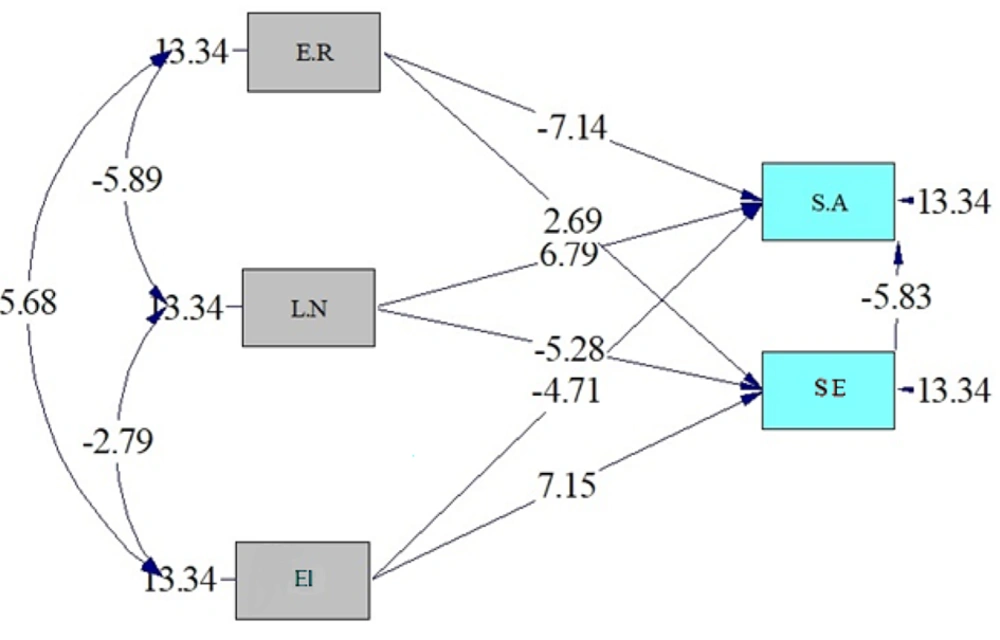
Figure 1.
Research model test (in t-Value mode)
According to the fit indices of the research model, the Comparative Fit Index (CFI) is 0.91, the Normalized Fit Index (NFI) is 0.92, the Goodness of Fit Index (GFI) is 0.84, the chi-square ratio to the degree of freedom is 2.71, and the root mean square error of approximation (RMSEA) is 0.079. Based on these results, it can be said that the research model is approved in terms of significance and fit indicators.
Table 3.
Structural Equations of of the Research Model
| Variables | Path Coefficients | t-Value | Standard Error | Significance |
|---|---|---|---|---|
| Emotional intelligence | ||||
| Social anxiety | - 0.20 | - 4.71 | 0.021 | P < 0.001 |
| Perceived self-efficacy | 0.34 | 7.15 | 0.027 | P < 0.001 |
| Emotion regulation | ||||
| Social anxiety | - 0.30 | - 7.14 | 0.035 | P < 0.001 |
| Perceived self-efficacy | 0.14 | 2.69 | 0.072 | P < 0.001 |
| Instability/negativity | ||||
| Social anxiety | 0.28 | 6.79 | 0.042 | P < 0.001 |
| Perceived self-efficacy | - 0.25 | - 5.28 | 0.061 | P < 0.001 |
| Perceived self-efficacy | ||||
| Social anxiety | - 0.25 | - 5.83 | 0.048 | P < 0.001 |
According to Table 3, the t-Value between the emotional intelligence variables and emotion regulation subscales with social anxiety and perceived self-efficacy is outside the range of -1.96 to 1.96. Therefore, the direct effect of emotional intelligence variables and emotion regulation subscales on social anxiety and perceived self-efficacy is significant. To investigate the indirect effect of emotional intelligence variables and emotion regulation subscales on social anxiety with the mediation of perceived self-efficacy, the Sobel test was used. To determine the intensity of the indirect effect through mediation, a statistic called VAF was utilized. The results are presented in Table 4.
Table 4.
Results of Indirect Effects Analysis
| Research Hypothesis | T-Sobel | Standard Path Coefficient | VAF Statistics | Test Result | ||||
|---|---|---|---|---|---|---|---|---|
| Emotional intelligence | → | Perceived anxiety | → | Social anxiety | 5.605 | 0.085 | 0.298 | Significant |
| Emotion regulation | → | Perceived anxiety | → | Social anxiety | 2.181 | 0.033 | 0.104 | Significant |
| Instability/negativity | → | Perceived anxiety | → | Social anxiety | 2.967 | 0.063 | 0.182 | Significant |
According to the number of indirect t-statistics (T-Sobel) between the above variables, which is outside the range of -1.96 to 1.96, the indirect effect of emotional intelligence and emotion regulation subscales on social anxiety is accepted. Therefore, emotional intelligence variables and emotion regulation subscales, in addition to their direct effects, also affect social anxiety indirectly through perceived self-efficacy. According to the VAF statistic, it can be seen that 29.8% of the effect of emotional intelligence, 10.4% of the effect of emotion regulation, and 18.2% of the effect of instability/negativity on social anxiety can be explained through perceived self-efficacy.
5. Discussion
The present study was conducted to develop a causal model of social anxiety in students with SLD based on emotion regulation and emotional intelligence, taking into account the mediating role of perceived self-efficacy. The results revealed that emotion regulation has a direct effect on the social anxiety disorder of students with SLD. The obtained results are in line with the research findings of (9-11, 19). The results of Eres et al.'s research (19) indicated that people with social anxiety disorder had more difficulties in regulating emotions and felt lonelier compared to the group without the disorder.
In explaining this finding, it can be said that anxious people suffer from severe and negative emotional reactions due to disturbances in the analysis of threat-related information and express themselves through severe and unpleasant emotional actions against perceived threats (11). According to Gross's theory (20), emotion regulation helps individuals to have a better understanding of the level of threat by managing emotions when dealing with stressful situations. With the help of positive emotion regulation strategies, they have more control over their actions in response to social performance events. This helps maintain emotion in functional conditions, stay in the present, reduce negative emotional actions, replace them with positive emotions, and become more aware of their emotions, which helps a person with social anxiety to have more control (8).
The results also pointed out that emotional intelligence has a direct effect on the social anxiety disorder of students with SLD. The obtained results align with the research findings of (11, 13). The results of Kahraman's research (21) outlined that emotional intelligence has a positive effect on reducing students' social anxiety levels. To analyze the gained result, it can be said that emotional intelligence helps recognize the desired emotional responses and create a positive attitude toward events and emotions. An individual with a higher level of emotional intelligence tends to possess better social skills, conflict resolution abilities, increased responsibility, and self-confidence.
By enhancing one's understanding of themselves and others, emotional intelligence fosters effective communication and adaptation to the surrounding environment, which is essential for succeeding in meeting social demands. Emotional intelligence promotes self-control, determination, patience, and the ability to direct emotions, which reduces social anxiety (13). For students, emotional intelligence equips them to effectively understand and express themselves, cultivate positive relationships, employ effective coping strategies for challenges, recognize their strengths and weaknesses, and express their opinions constructively to establish satisfying connections.
The results revealed that perceived self-efficacy has a direct effect on the social anxiety disorder of students with SLD. These findings align with the research findings of (16, 17, 22). The research by Çakmak Tolan and Kara (22) indicated a negative and significant relationship between social anxiety and self-efficacy. In explaining this finding, it can be said that self-efficacy is one of the factors that can create courage and self-esteem in a person, which leads to increased social interactions and social skills. According to Bandura's social cognitive approach, self-efficacy plays a significant role in shaping our social relationships. Self-efficacy essentially fosters healthy and positive social connections, while its absence can lead individuals to avoid and reject others, resulting in a loss of positive social interactions and support (16). As a result, if a student has more positive beliefs and expectations about their capacity to face a social situation, they will experience less social anxiety regarding that situation.
The results delineated that emotion regulation, through perceived self-efficacy, has an indirect effect on the social anxiety disorder of students with SLD. Although a study directly aligned with these results was not found, there are studies from which such results can be deduced. In the research by Usán Supervía and Robres (23), it was found that self-efficacy can play a mediating role in the relationship between emotion regulation and the academic performance of students. In explaining this finding, it can be stated that perceived self-efficacy plays a pivotal role in shaping the choice of coping strategies during stressful situations. Individuals with low self-efficacy tend to resort to less effective emotion-focused coping strategies, while those with higher self-efficacy typically employ problem-focused and task-oriented strategies.
The results also showed that emotional intelligence has an indirect effect on the social anxiety disorder of students with SLD through perceived self-efficacy. Although research directly aligned with these results was not found, there are studies from which such results can be deduced. In explaining this finding, it can be said that emotional intelligence enhances students' understanding of emotions and their ability to regulate them, consequently boosting their self-efficacy. With an increase in self-efficacy, students become more adept at managing their circumstances and emotions, leading to a reduction in fear and worry. This, in turn, improves students' social adaptability, making them feel more confident and at ease in social situations, ultimately resulting in a decrease in social anxiety (8).
5.1. Conclusions
Based on the obtained results, the social anxiety of students with SLD is significantly related to the mediation of perceived self-efficacy with emotion regulation and emotional intelligence. Therefore, to reduce the social anxiety of students with SLD, it is recommended that educators and experts formulate educational programs to increase adaptive emotion regulation strategies, enhance the sense of perceived self-efficacy, and strengthen emotional intelligence.
5.2. Limitations and Implications
Regarding the current research, it can be said that due to the use of a self-report tool, the responses may be influenced to some extent by the social bias of the subjects. Additionally, the present study was cross-sectional, and in these kinds of studies, it is not possible to provide a precise opinion about the causal relationship of the research variables. Based on the research findings, it is recommended that educational, counseling, and therapy centers develop tailored and effective educational programs aimed at emotion regulation, enhancing self-acceptance, and fostering a more optimistic self-attitude, particularly in addressing social anxiety in students with SLD.