1. Background
Different hazardous materials are constantly entered into the environment due to industrial and population growth. Heavy metals are one of the dangerous categories among these materials (1, 2). Although some metals are necessary for the human diet in low concentrations, others are detrimental even in low levels (1). The latter due to accumulation in the food chain exert acute and chronic health effects. Heavy metals such as lead, cadmium, mercury, and arsenic pose a major threat to human health. Arsenic is the constituent of the earth’s crust that could be entered into the environment through two ways: 1) Anthropogenic: There are different uses of arsenic compounds in industries such as pesticides and rodenticides; consequently, the dumping and discharge of untreated wastes and wastewater from industries leads to an increase in the arsenic level in the surface and groundwater (3) and 2) Natural sources: Arsenic could be released into groundwater by weathering and leaching from rocks and mineral layers of the earth and sedimentation (4-6).
The consumption of water and food containing arsenic has an impact on human health (7-9). A 10 µg/L limit for arsenic was considered as drinking water guideline by the world health organization (WHO), whereas the standard in Iran is 50 µg/L (7, 8, 10). The inorganic compounds of arsenic have been classified as Category 1A by the international agency for research on cancer (IARC) (11-13). Different studies have proven an association between the arsenic content of water and diabetes and liver cancer as well as with bladder, intestine, skin, and kidney diseases (6, 9-11, 14-16).
Arsenic contamination of water has been detected in some countries around the world such as Argentina, Bangladesh, Chile, China, India, Mexico, Romania, Taiwan, Vietnam, and parts of the USA. Therefore, drinking water supplies must be examined in terms of arsenic (3, 6, 17, 18). To that end, research has been conducted on food, water, and other environmental samples in recent years. Arsenate (pentavalent arsenic), arsenite, monomethylarsonic acid, monomethylarsenic acid, and dimethylarsinic acid are the dominant forms discovered among 25 various arsenic species in different water samples (19-22).
In Iran, the most common groundwater arsenic contamination source is natural. West Azerbaijan (Takab), East Azerbaijan (Hashtrood), Kurdistan (Gorveh and Bijar), Khorasan Razavi (Kashmar), Sistan and Baluchistan (Khash), and Fars (groundwater near Lake Maharloo) Provinces have been identified as the areas suffering from arsenic-contaminated groundwater (13, 23-25). Be that as it may, there are no statistical data on the population exposure to arsenic in Iran due to a lack of extensive monitoring.
Given that drinking water with high arsenic levels is too dangerous and that it is essential that water resources be monitored to ensure community health, especially in areas where the water has high arsenic levels (12, 23), we sought to determine the arsenic contamination level of groundwater in the rural water resources of Rivash in Koohsorkh county, Kashmar city.
2. Objectives
The present study was carried out to examine the arsenic content in the rural water resources of Rivash in Kashmar, Iran, and compare it with the national and international standards.
3. Materials and Methods
3.1. The Study Area
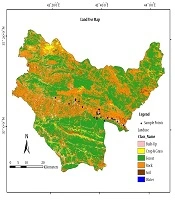
Rivash is situated between 35° 15/ N latitude and 58030/ E longitude covering a mountainous area of 2193 km2. Rivash is the most affected district in terms of contamination in Koohsorkh (Figure 1). Figure 1 shows the location map of the study area and the position of the gold mines in the area. The climate is cold, and 20501 people comprise the rural population in the area. The water use per capita is 130 - 150 liters per capita per day.
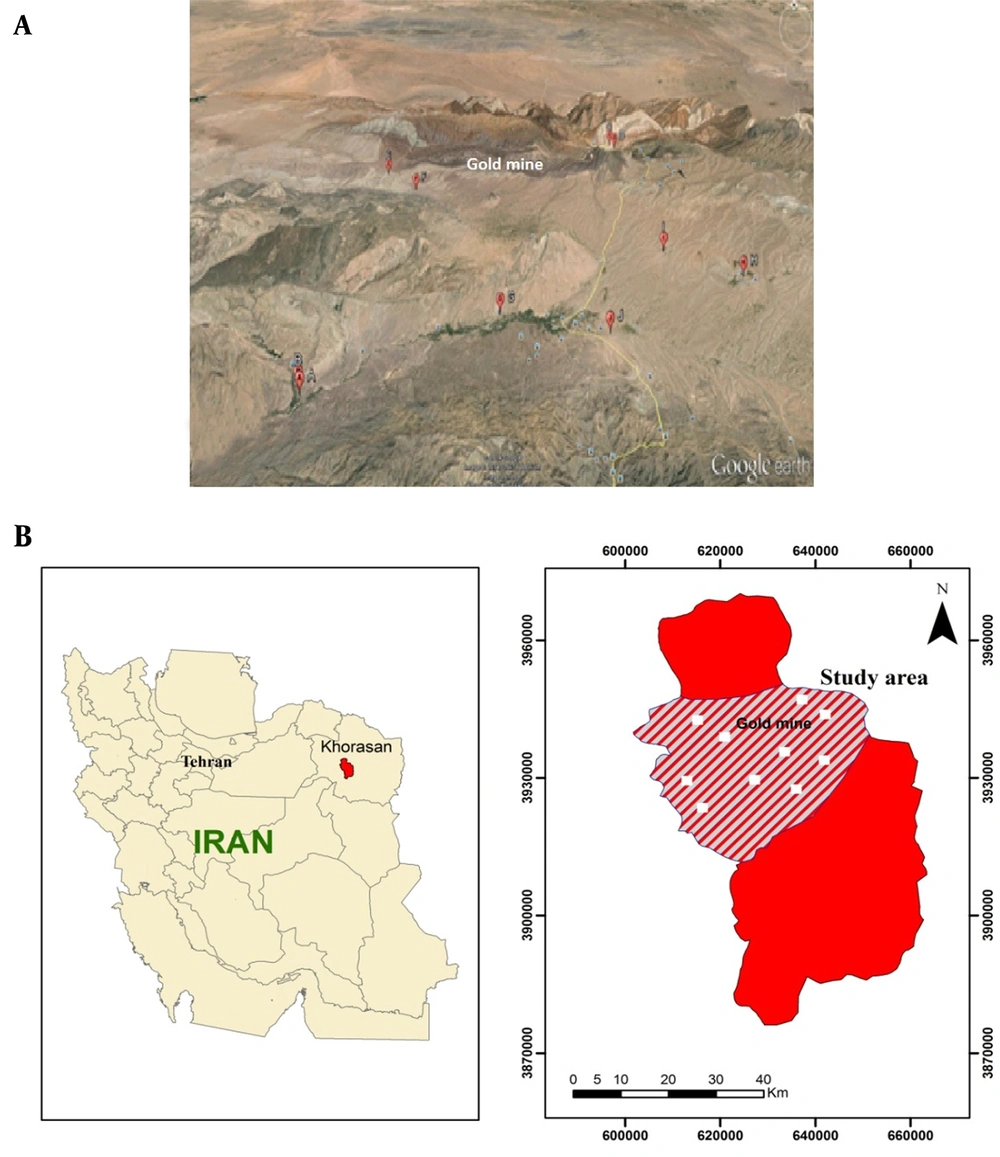
Figure 1.
A and B, Maps Showing the Location of the Study Area, Rivash, and the Position of the Sampling Stations
3.2. Water Resources
The present study focused on all the water drinking supplies in the study area. All the water supplies were groundwater (i.e. 7 wells and 3 springs).
3.3. Sampling and Analysis
Arsenic is a constituent of over 300 minerals and is widely detected in non-ferrous ores such as gold, copper, zinc, and uranium. Therefore, sampling stations were selected based on different distances in the four main geographical directions. Accordingly, the district was divided into ten sampling stations, five of which were close to gold mines (Figure 1). The stations were labeled A to J. Samples were gathered every two weeks in each month. Sixty samples were collected from the stations from April to June 2013. The sampling and preservation of the samples were performed in accordance with the standard methods. The water samples were collected in 100 mL polyethylene bottles and were immediately acidified with 100 µL of concentrated HCl, which provided a pH < 2 to avoid the adsorption of arsenic onto the polyethylene bottle walls. Analysis was carried out for a maximum of two weeks, and the arsenic (III) and total inorganic arsenic levels were determined (6, 26). The arsenic concentration of water was measured using the hydride generation atomic absorption spectrometry (AAS) via a Varian HVG-1 hydride system coupled to a Varian-AA240FS. All the chemicals and reagents used in the experimental study were of analytical grade, Merck (Darmstadt, Germany). The threshold of arsenic in drinking water is 10 ppb (µg/L) according to the WHO; thus, the method for the determination of arsenic is required to be sensitive at ppb level. The Atomic Absorption Spectrophotometry with Vapor Generation Assembly (AAS-VGA) is a well-known technique for the trace analysis of arsenic.
Calibration solutions of the parameters were prepared by diluting a certified stock solution of 1000 mg/L. Some qualitative parameters such as pH, total dissolved solids (TDS), and electrical conductivity (EC) were tested to survey their relationship and arsenic concentration. The data were subsequently analyzed using statistical package for the social sciences (SPSS) (version 11.5) and statistical tests such as the one-sample T-test and Mann-Whitney at a significance level of 0.05. The arsenic levels were compared with the national and international standards. Descriptive statistics were used to present the arsenic concentration and the other factors in the samples.
4. Results
The average arsenic level in stations A, B, C, D, E, F, G, H, I, and J was 1.53 ± 1.03, 1.30 ± 1.07, 10.55 ± 3.83, 11.21 ± 5.01, 10.57 ± 3.68, 2.34 ± 0.73, 3.22 ± 0.58, 9.89 ± 3.57, 10.48 ± 5.07, and 2.23 ± 0.53 µgL-1, respectively. The results of comparisons between the standards and the maximum arsenic concentration are presented in Table 1. The difference between the arsenic levels and the national standard was statistically significant (P < 0.001). The difference between the arsenic levels in 50% (i.e. A, B, F, G, and J) of the stations and the WHO standard was significant (P < 0.001).
Table 1.
Maximum Arsenic Concentration (Mean ± Standard Deviation) in Comparison with Standards
| Stations | Arsenic, μg/L | Comparison with the National Standard, 50 μg/L | Comparison with the World Health Organization Standard, 10 μg/L |
|---|---|---|---|
| A | 1.03 ± 1.53 | P < 0.001 | P < 0.001 |
| B | 1.30 ± 1.07 | P < 0.001 | P < 0.001 |
| C | 10.55 ± 3.83 | P < 0.001 | P = 0.73 |
| D | 11.21 ± 5.01 | P < 0.001 | P = 0.58 |
| E | 10.57 ± 3.68 | P < 0.001 | P =0.71 |
| F | 2.34 ± 0.73 | P < 0.001 | P < 0.001 |
| G | 3.22 ± 0.58 | P < 0.001 | P < 0.001 |
| H | 9.89 ± 3.57 | P < 0.001 | P = 0.94 |
| I | 10.48 ± 5.07 | P < 0.001 | P = 0.82 |
| J | 0.53 ± 2.23 | P < 0.001 | P < 0.001 |
Table 2 presents the arsenic concentrations in 6 steps of sampling. As is demonstrated in the table, the highest concentration in stations A and J was in the second step; in stations B and F in the first step; and in stations D, E, G, H, and I in the third step. The highest levels of arsenic were detected in stations E and D in different steps.
Table 2.
Arsenic Concentrations (μg/L) according to the Sampling Stages
| Stations | Step 1 | Step 2 | Step 3 | Step 4 | Step 5 | Step 6 |
|---|---|---|---|---|---|---|
| A | 2.37 | 3.13 | 0.83 | 1.63 | 0.63 | 0.63 |
| B | 3.05 | 2.1 | 1.24 | 0.44 | 0.36 | 0.64 |
| C | 6.83 | 6.99 | 17.4 | 10.64 | 10.82 | 10.63 |
| D | 7.05 | 6.76 | 20.6 | 10.5 | 11.08 | 11.28 |
| E | 9.33 | 8.64 | 17.6 | 11.52 | 7.54 | 8.84 |
| F | 3.68 | 2.47 | 2.12 | 1.44 | 2.11 | 2.27 |
| G | 3.4 | 3.44 | 3.95 | 3.4 | 2.90 | 2.24 |
| H | 8.02 | 5.77 | 16.45 | 9.88 | 10.09 | 9.18 |
| I | 6.73 | 6.75 | 20.4 | 9.5 | 10.32 | 9.23 |
| J | 2.56 | 2.9 | 2.44 | 2.25 | 1.44 | 1.8 |
| Minimum | 2.37 | 2.10 | 0.83 | 0.44 | 0.36 | 0.63 |
| Maximum | 9.33 | 8.64 | 20.6 | 11.52 | 11.08 | 11.28 |
| Mean ± Standard Deviation | 5.3 ± 2.54 | 4.89 ± 2.33 | 10.3 ± 8.75 | 6.12 ± 4.6 | 5.72 ± 4.62 | 5.67 ± 4.47 |
According to Table 3, there was no significant correlation between the arsenic levels in all the stations and the qualitative parameters, with the exception of pH inasmuch as an increase in pH was correlated with a rise in the arsenic level (Figure 2).
Table 3.
Correlation between the Arsenic Concentrations and the Qualitative Parameters
| Qualitative Parameters | r | P Value |
|---|---|---|
| Electrical Conductivity, µSiemens/cm | -0.044 | 0.73 |
| Total Dissolved Solids , mg/L | -0.044 | 0.74 |
| T, °C | -0.082 | 0.53 |
| pH | 0.33 | 0.009 |
| Salinity, ppt | -0.041 | 0.75 |
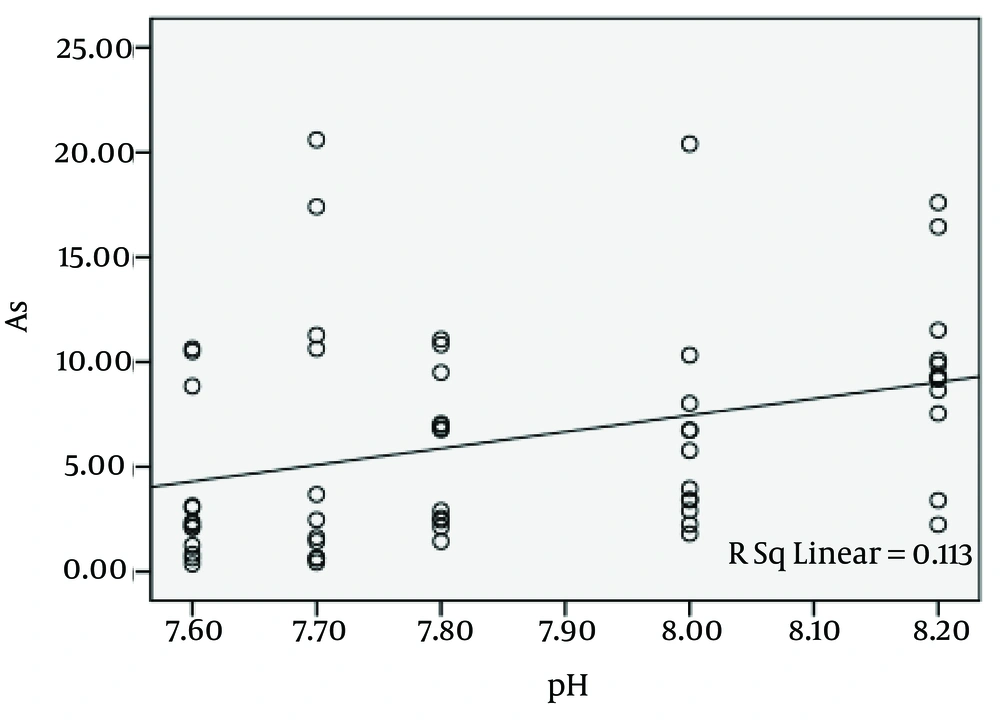
Figure 2.
Correlation Between the Arsenic Concentration and pH
The arsenic concentrations of the stations close to the gold mines in comparison with those of the other stations are presented in Table 4. The T-test showed a significant difference between these two series sources insofar as the stations near the mines had a higher concentration than the others.
Table 4.
Comparison between the Arsenic Levels of the Stations
| Minimum, μg/L | Maximum, μg/L | Mean ± Standard Deviation (μg/L) | T-Test | |
|---|---|---|---|---|
| Stations | T = 11.14 , P < 0.001 | |||
| Stations (near gold mines) | 5.77 | 20.6 | 4 ± 10.54 | |
| Stations (far from gold mines) | 0.36 | 3.95 | 1 ± 2.12 | |
| Total | 0.36 | 20.6 | 5.13 ± 6.33 |
Figure 3 shows the arsenic concentrations in the sampling stations. The study area is colored dark brown to light yellow (low levels of arsenic: light yellow (southwest of the area) and high levels: dark brown (northeast of the area)). As is illustrated in the table, the stations close to the gold mines are dark brown, denoting high concentrations.
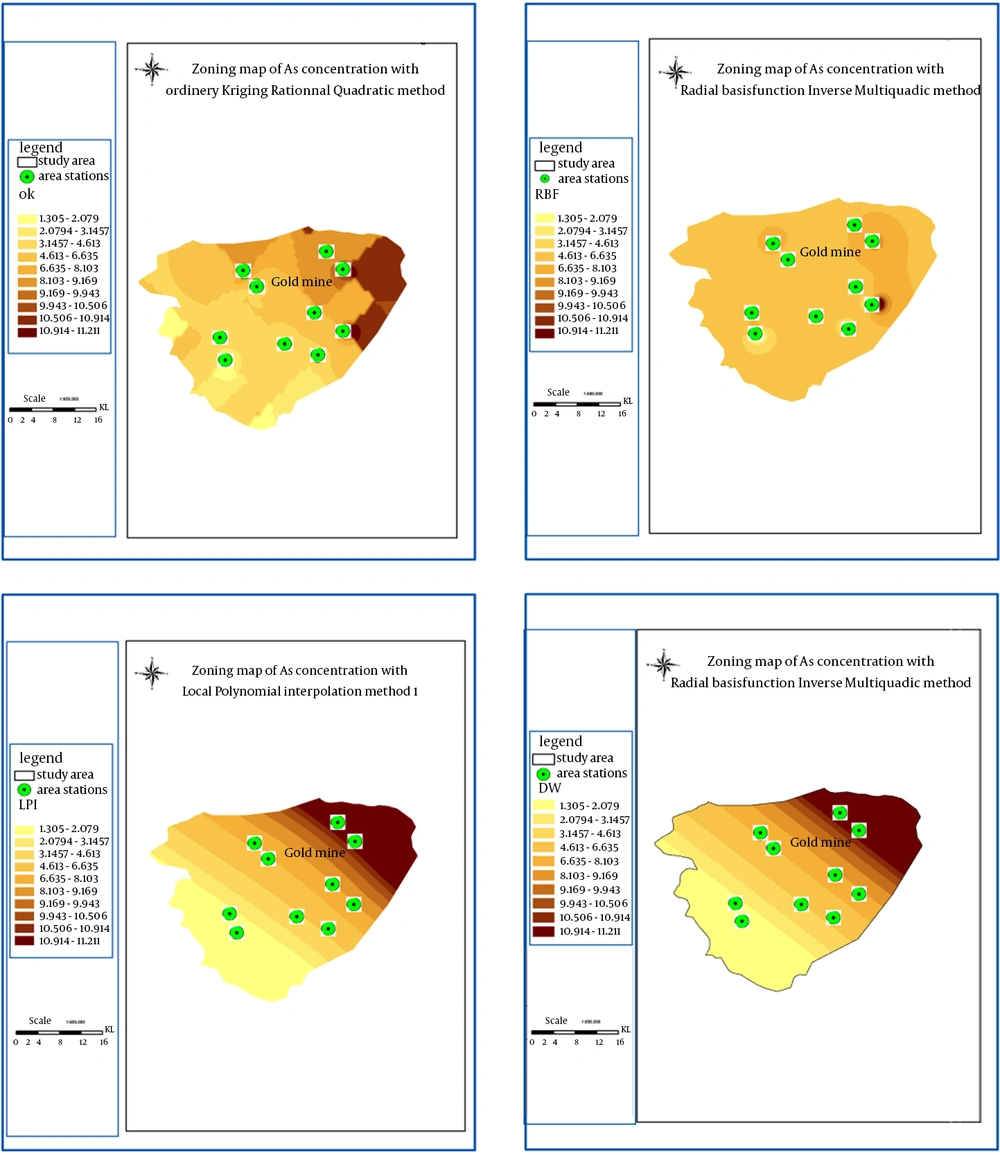
Figure 3.
Distribution of the Arsenic Contamination of the Groundwater in Rivash
5. Discussion
The first step to evaluate the extent and severity of arsenic contamination is to determine the arsenic concentration in the water resources. In this study, ten (50%) stations had a higher concentration than the WHO guideline. The highest level was detected in station D (twice as much as the WHO guideline). Other studies have presented similar results. Jing et al. (22) determined arsenic levels in the water resources of Aksaray province in 62 stations of drinking water and reported that the arsenic concentration ranged from 10 to 50 mg/L and more than 50 mg/L in 22 and 5 stations, respectively. Shukla et al. (4) examined the sources of arsenic contamination in the groundwater of Rajnandgaon and Kanker district and reported that the majority of the wells in the district had a higher concentration of arsenic than the WHO guideline. The highest level of arsenic was 250 mg/L. Agusa et al. (9) surveyed contamination by arsenic and other trace elements in tube-well water in Hanoi and found arsenic concentrations between 0.1 and 330 µg/L; as a result, 40% of the samples exceeded the WHO guideline. Babaei et al. (14) studied the surface water arsenic contamination of Kohsorkh in Kashmar by collecting samples from fall 2005 to summer 2006. The authors measured the same qualitative parameters as those in the present study and showed no significant difference between the parameters and the arsenic level, whereas there was a significant statistical difference between pH and arsenic level in our study. In their study, the maximum concentration of arsenic was 150 µg/L.
Shams et al. (25) surveyed the arsenic contamination of drinking water in 20 villages of Khorramabad in 2012 and reported that the average amount of arsenic during the sampling (December to February) was lower than the WHO and Iran standards. The number of samples in both studies is the same, but Shams analyzed water using a voltammeter (25). According to the results obtained through other surveys and the present study, Rivash water resources are safer in terms of arsenic contamination. In the study area, 5142 people are potentially affected by arsenic concentrations higher than the WHO guideline, whereas 5213 people consume lower concentrations. Totally, 57.73% of the rural population is exposed to different arsenic concentrations by drinking water in Rivash. According to Table 2, in some stations, the arsenic concentrations during the closing sampling steps decreased. The probable reason for the reduced concentrations is the decreasing amount of precipitation, leading to the entrance of arsenic in the water resources at lower levels. The current study was performed in spring and summer; however, the arsenic concentration is influenced by annual rainfall in different areas. Wasserman et al. found that the arsenic concentrations strongly varied from place to place by studying 6000 wells in Bangladesh. In addition, their results demonstrated that the arsenic level could be different among the wells even in a village. Another study presented that in arsenic contaminated areas, the bottom water layers of deep wells might be contaminated by upper water layers over time (13, 27) .
In the present study, water was contaminated while flowing from arsenic content layers in the proximity of gold mines (13), while at the stations situated farther from gold mines, water was contaminated by arsenic precipitation. Therefore, the stations farther from gold mines had lower concentrations of arsenic. According to the results, it is essential that plans be devised to replace the current supplies with safe drinking water in Rivash, which has high levels of arsenic. Furthermore, these water resources should be monitored regularly as regards the risk of contamination with arsenic.