1. Background
The prevalence of obesity and other nutrition-related risk factors are increasing among children and adults (1-3). Nutrition during childhood has a long-term impact on heart diseases during adulthood (4). Research results show that atherosclerosis begins in childhood (5) and fatty streaks and plaques in coronary arteries appear at the age of 5 to 10 years (6).
Eating habits and taste preferences are developed during childhood (7). Recommended diets for children aged two years and above emphasize consuming fruits and vegetables, cereals, fat-free and low-fat dairy products, meat, beans, and fish, and reducing energy uptake and consumption of saturated-fats, salt, and sugar (5). Studies show that the consumption trend of high-fat, high-calorie, and non-nutritious foods are increasing among children (7). The increasing prevalence of unhealthy eating and its role in the incidence of obesity in children grow concerns in this regard (8). Thus, understanding the factors influencing eating habits among a population with unhealthy diet is the most important step toward improvement and implementation of necessary interventions and policies (9).
Physical inactivity and unhealthy diet cause non-communicable diseases, morbidity, and mortality in the developed countries especially among poor people (10, 11). Socioeconomic inequality leads to pro-poor prevalence of unhealthy diet and its related diseases such as diabetes, obesity, cardiovascular disease, some cancers, and osteoporosis in most of the developed and developing countries (12-14). Unhealthy diet is independently or synergically associated with socioeconomic status (SES) (15). Generally, people with low SES have unhealthier diet such as low fruits and vegetables consumption, high intake of saturated-fats, fast foods, and sweet drinks. Such a diet increases the energy uptake and prevalence of obesity and consequently increases the risk of chronic diseases in older ages (16).
2. Objectives
Unhealthy diet in children received lots of attention lately, but to the best of the authors’ knowledge, no studies determined socioeconomic inequality in unhealthy diet among children in Iran. The current study aimed at defining inequalities in unhealthy diet of a population of Iranian children. The Blinder-Oaxaca decomposition technique was used to calculate the share of each determinant of inequality.
3. Methods
The current cross-sectional study was conducted in 2015 in Sanandaj city, the capital of Kurdistan province in the west of Iran, on 2506 male and female students aged 10 - 12 years, using multistage sampling. More details about the sampling method are presented elsewhere (17). The diet was evaluated using food frequency questionnaire (FFQ), which its validity is reported in previous studies in Iran (18). FFQ evaluates the frequency of food consumption on a daily, monthly, and yearly basis, according to their consumption unit. It also classifies different foods according to their similarities (19). Children whose food complied with the guideline received score 1 and the others zero. Participants were divided into two groups with healthy and unhealthy diet according to the obtained scores. Children in the highest quartile of eating habits were considered children with healthy diet (20). For SES variable, a questionnaire including the number of household assets was used. The principal composition analysis (PCA) technique was employed to calculate asset index that was divided into five quintiles including very poor, poor, moderate, rich, and very rich (21, 22).
To measure the inequalities, concentration curve (CC) and concentration index were used. Concentration index varies from -1 to +1; negative concentration index above the equality line indicates pro-poor outcome variable and positive values indicate pro-rich inequality. If the concentration index is zero, the CC is tangent to the equality line and no inequalities exist. The Kakwani method was used to calculate the concentration index. Due to binary variables, the Wagstaff correction was used (23, 24). The formula for the Kakwani method is as follows:
Where C is the concentration index, Cov the covariance, yi the health variable, Ri the ith socioeconomic rank of individual, and μ the health variable mean.
The Blinder-Oaxaca decomposition was used to analyze the gap between the rich and poor groups. The Blinder-Oaxaca decomposition determines how much a given variation in inequality X changes the mean Y. This analysis breaks down the observed differences into two components as the following formula. The inequality associated with the differences in the mean of the determinants is referred to as X or the explained component, and the inequality related to the differences in the responses given by the different SESs or the difference of the coefficients is referred to as β or the unexplained component. CE is the interaction between the explained component and the coefficients (25).
The Blinder-Oaxaca decomposition was used to calculate the contribution of each of these components to the total difference:
Where y is the mean of the outcome variable, i.e. unhealthy diet, G0 the intercept difference, G1 the difference of x1 and β1, and G2 the difference of x2 and β2.
To carry out the decomposition, the relationship between unhealthy diet and the different determinants, including age, gender, parents’ level of education, parents’ age, and the SES were first evaluated using the logistic regression. The variables that were significantly related to unhealthy diet were then transferred to the Blinder-Oaxaca model. P value < 0.05 was considered as the level of significance for all the models (23). The data obtained were analyzed using Stata version 13 and SPSS version 20.
4. Results
Out of 2506 samples, 1284 students were in the 5th and 1224 in the 6th grades of elementary school (Table 1). The percentage of children with unhealthy and healthy diets was 50.75% (95% confidence interval (CI): 48.79 - 52.71) and 49.24% (95% CI: 47.28 - 51.20), respectively. The number of samples in the 1st, 2nd, 3rd, 4th, and 5th quintiles was 1120 (44.00%), 465 (18.55%), 356 (14.20%), 315 (12.56%), and 250 (10.00%), respectively; while the prevalence of unhealthy diet in these quintiles was 57.32%, 50.32%, 51.12%, 44.44%, and 29.60%, respectively.
Table 1.
Samples Characteristics
| Characteristic | No. (%) |
|---|---|
| Grade | |
| 5th | 1282 (51.16) |
| 6th | 1224 (48.84) |
| Mother’s level of education | |
| Uneducated | 473 (18.89) |
| Elementary school | 640 (25.56) |
| Guidance school | 405 (16.17) |
| High school | 548 (21.88) |
| Academic | 438 (17.49) |
| Father’s level of education | |
| Uneducated | 218 (8.72) |
| Elementary school | 501 (20.05) |
| Guidance school | 420 (16.61) |
| High school | 565 (22.61) |
| Academic | 795 (31.81) |
| Quintile | |
| Poorest SES | 1120 (44.00) |
| 2nd SES | 465 (18.55) |
| Middle SES | 356 (14.20) |
| 4th SES | 315 (12.56) |
| Richest SES | 250 (10.00) |
| Year | |
| 10 | 374 (14.92) |
| 11 | 1044 (41.66) |
| 12 | 1088 (43.42) |
| Gender | |
| Male | 929 (37.07) |
| Female | 1577 (62.93) |
| Residential areaa | |
| 1st | 355 (14.17) |
| 2nd | 604 (24.10) |
| 3rd | 883 (35.24) |
| 4th | 373 (14.88) |
| 5th (high SES) | 291 (11.61) |
| Mother’s age, y | |
| < 34 | 175 (6.99) |
| 35 - 44 | 1574 (62.86) |
| > 45 | 755 (30.15) |
| Father’s age, y | |
| < 34 | 970 (38.86) |
| 35 - 44 | 1282 (51.36) |
| > 45 | 244 (9.78) |
Abbreviation: SES, socioeconomic status.
aResidential area categorized by SES.
Table 2 shows the relationship between various socioeconomic factors and unhealthy diet based on logistic regression in raw and adjusted models. The findings showed that the prevalence of unhealthy diet was lower in children with high SES than their counterparts with low SES (odds ratio (OR) = 0.41, 95% CI: 0.30 - 0.57). The prevalence of unhealthy diet was lower in children living in high-SES neighborhoods (OR = 0.76, 95% CI: 0.53 - 1.08). Higher maternal education level was a protective factor against unhealthy diet (OR = 0.55, 95% CI = 0.39 - 0.77). No significant correlation was observed between diet and age of parents or father’s level of education.
Table 2.
Unhealthy Diet According to Different Independent Variable
| No. (%) | OR (Crude) | OR (Adjusted) | P Value | |
|---|---|---|---|---|
| Gender | ||||
| Male | 438 (47.14) | 1 | 1 | |
| Female | 834 (52.88) | 1.25 (1.06 - 1.48) | 1.36 (1.15 - 1.61) | 0.000 |
| Mother’s level of education | ||||
| Uneducated | 279 (58.98) | 1 | 1 | |
| Elementary | 353 (55.15) | 0.85 (0.67 - 1.08) | 0.87 (0.67 - 1.12) | 0.28 |
| Guidance | 222 (54.81) | 0.84 (0.64 - 1.10) | 0.98 (0.73 - 1.31) | 0.90 |
| High school | 260 (47.44) | 0.62 (0.48 - 0.80) | 0.77 (0.57 - 1.03) | 0.08 |
| Academic | 157 (35.84) | 0.38 (0.29 - 0.50) | 0.55 (0.39 - 0.77) | 0.001 |
| Father’s level of education | ||||
| Uneducated | 129 (59.17) | 1 | 1 | |
| Elementary | 297 (59.28) | 1.00 (0.72 - 1.38) | 1.04 (0.74 - 1.47) | 0.77 |
| Guidance | 225 (53.57) | 0.79 (0.57 - 1.10) | 0.86 (0.60 - 1.24) | 0.44 |
| High school | 267 (47.25) | 0.61 (0.45 - 0.84) | 0.79 (0.55 - 1.14) | 0.21 |
| Academic | 350 (44.02) | 0.54 (0.40 - 0.73) | 0.99 (0.67 - 1.44) | 0.96 |
| Quintile | ||||
| Poorest SES | 642 (57.32) | 1 | 1 | |
| 2th SES | 234 (50.32) | 0.75 (0.60 - 0.93) | 0.86 (0.69 - 1.09) | 0.22 |
| Middle SES | 182 (51.12) | 0.77 (0.61 - 0.98) | 0.96 (0.75 - 1.25) | 0.82 |
| 4th SES | 140 (44.44) | 0.59 (0.46 - 0.76) | 0.75 (0.57 - 1.00) | 0.05 |
| Richest SES | 74 (29.60) | 0.31 (0.23 - 0.42) | 0.41 (0.30 - 0.57) | 0.000 |
| Mother’s agea, y | ||||
| < 29 | 93 (53.14) | 1 | - | |
| 29 - 39 | 793 (50.38) | 0.89 (0.65 - 1.22) | ||
| > 40 | 385 (50.99) | 0.91 (0.65 - 1.27) | ||
| Father’s agea, y | ||||
| < 29 | 489 (50.41) | 1 | - | |
| 29 - 39 | 645 (50.31) | 0.99 (0.84 - 1.17) | ||
| > 40 | 132 (54.09) | 1.15 (0.87 - 1.53) | ||
| Residential area | ||||
| 1 | 213 (60.00) | 1 | 1 | |
| 2 | 329 (54.47) | 0.79 (0.61 - 1.04) | 0.88 (0.67 - 1.16) | 0.39 |
| 3 | 468 (53.00) | 0.75 (0.58 - 0.96) | 0.94 (0.72 - 1.23) | 0.69 |
| 4 | 140 (37.53) | 0.40 (0.29 - 0.53) | 0.58 (0.42 - 0.81) | 0.002 |
| 5 | 122 (41.92) | 0.48 (0.35 - 0.65) | 0.76 (0.53 - 1.08) | 0.13 |
| Agea, y | ||||
| 10 | 182 (48.66) | 1 | - | |
| 11 | 536 (51.34) | 1.11 (0.87 - 1.40) | ||
| 12 | 554 (50.91) | 0.79 (0.86 - 1.38) |
Abbreviation: SES, socioeconomic status.
aOR (crude) > 0.2 did not enter into the adjusted model.
The results of the current study showed that concentration index for unhealthy diet was -0.14 (95% CI: -0.18, -0.09), indicative of pro-poor unhealthy diet (P < 0.001). The curve related to unhealthy diet was above the line of equality and it showed the high concentration of unhealthy diet among children with low SES (Figure 1).
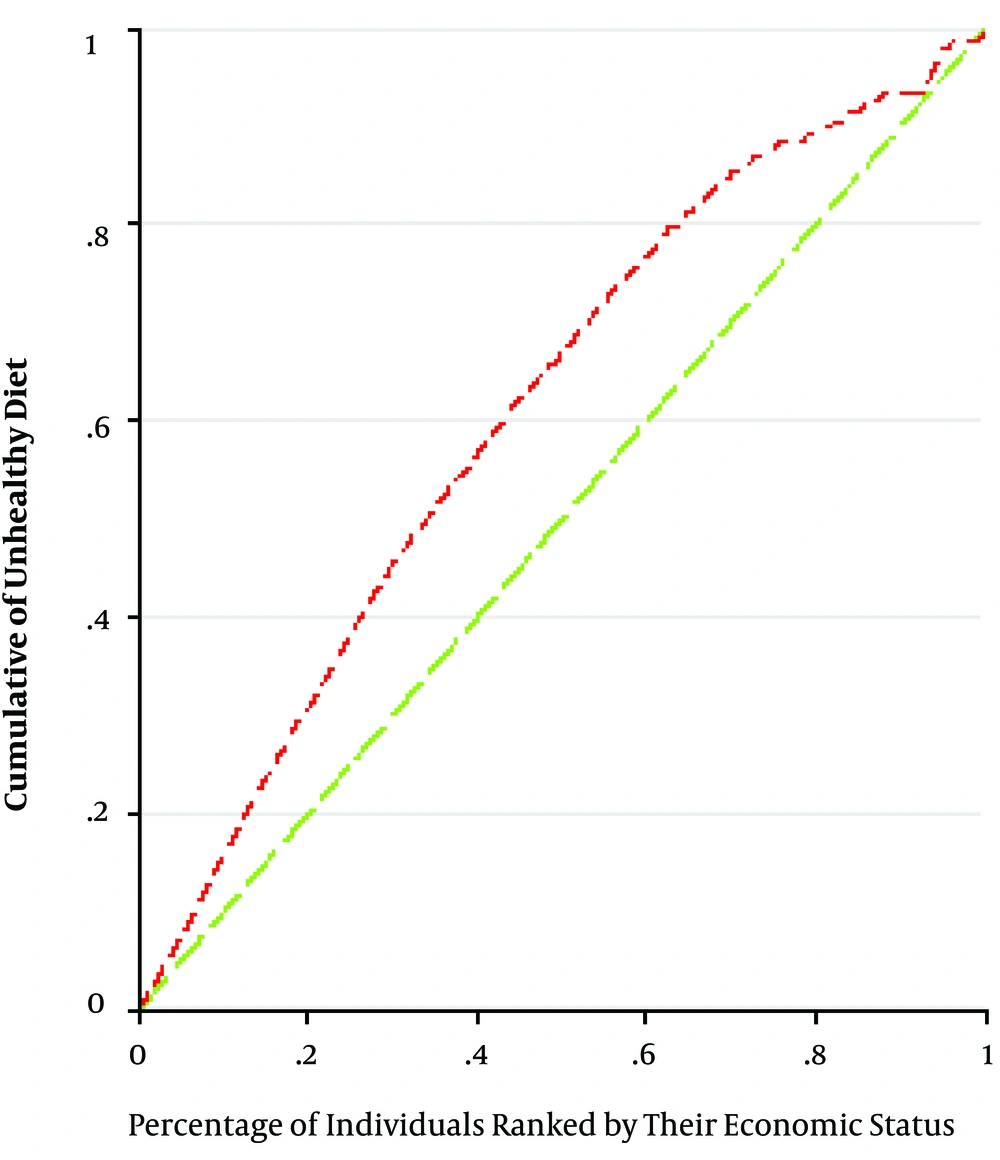
Figure 1.
Concentration curve of unhealthy diet, Kurdistan, Iran, 2015
The decomposition results showed that the contribution of unhealthy diet for poor and rich groups was 57.37 (95% CI: 54.47 - 60.27) and 29.60 (95% CI: 24.00 - 35.19), respectively. The gap between the two groups was 27.77%, while 59.41% of the total differences were attributed to gender, mother’s level of education, place of residence, or the explained components. The largest share in the inequality was attributed to mother’s level of education with 83.63% followed by place of residence with 17.81%. The rest of the gap between the two socioeconomic groups was attributed to unexplained components and associated with differences in coefficients or factors that were not studied in the current study (Table 3).
Table 3.
Decomposition of the Difference in Proportion of Unhealthy Diet Between the Richest and Poorest Groups
| Prediction, % | P Value | (95% CI) | ||
|---|---|---|---|---|
| Unhealthy diet proportion in the poorest group | 57.37 | < 0.001 | 54.47 | 60.27 |
| Unhealthy diet proportion in the richest group | 29.60 | < 0.001 | 24.00 | 35.19 |
| Difference (total gap) | 27.77 | < 0.001 | 21.46 | 34.07 |
| Due to endowment (explained) | ||||
| Residential area | 2.94 | 0.43 | -4.39 | 10.28 |
| Gender | -0.24 | 0.46 | -0.89 | 0.41 |
| Mother’s level of education | 13.80 | < 0.001 | 7.48 | 20.11 |
| Subtotal gap (explained part) | 16.50 | < 0.001 | 8.73 | 24.26 |
| Due to coefficients (unexplained) | ||||
| Residential area | 0.80 | 0.94 | -22.85 | 24.46 |
| Gender | -2.05 | 0.67 | -11.73 | 7.62 |
| Mother’s level of education | 31.91 | < 0.001 | 13.36 | 50.46 |
| Constant | -8.44 | 0.48 | -32.12 | 15.24 |
| Subtotal gap (unexplained part) | 22.22 | < 0.001 | 14.76 | 29.75 |
| Due to interaction | ||||
| Residential area | -0.25 | 0.94 | -7.68 | 7.85 |
| Gender | 0.10 | 0.69 | -0.42 | 0.63 |
| Mother’s level of education | -10.80 | 0.002 | -17.68 | -3.93 |
| Total (interaction part) | -10.95 | 0.014 | -19.66 | -2.24 |
5. Discussion
The current study aimed at measuring inequality of unhealthy diet and defining the share of each of the determinants that caused inequality through the Blinder-Oaxaca decomposition method. The result showed that 50.75% had unhealthy diet (95% CI: 48.79 - 52.71), while the concentration index for unhealthy diet was -0.14 (95% CI = -0.18, - 0.09) indicative of pro-poor inequality in unhealthy diet in children. The Blinder-Oaxaca results showed that the gap between poor and rich groups was 27.77%, while 59.41% of the observed gap was attributed to explained components with highest contribution of mother’s level of education and place of residence.
The results of the current study showed that the unhealthy diet was higher in children with low SES. It was aligned with the results of the study by Lioret et al. (26), which reported a direct and significant relationship between consumption of milk and dairy products and SES (P < 0.0001). The current study was also aligned with the study by Attorp et al. (1) that reported 1.74 unit increase in SES caused 0.17 unit increase in fruit and vegetable consumption (P = 0.04). Moreover, it is aligned with the study by Giskes et al. (27), reporting the existence of a reverse relationship between lack of fruit and vegetable consumption with income. The results were though not aligned with the results of the study by Vereecken et al. (9), reporting higher consumption of soft drinks in East and Central European among people with high SES as they were capable of buying such luxurious foods.
The results of the present study showed that unhealthy diet was more common in neighborhoods with low SES. This finding was aligned with that of the study by Carroll-Scott et al. (28), which showed people living in neighborhoods with low SES consumed more unhealthy foods such as fast, high-sodium, and fat-rich foods as well as soft drinks (P < 0.05). Also, the study by Vereecken et al. (9), showed that students entering high-SES schools had higher consumption of fruits (OR = 1.01, 95% CI = 0.97 - 1.04) and lower consumption of soft drinks (OR = 0.93, 95% CI = 0.90 - 0.96).
The current study results showed that mother’s level of education was the most important factor in creating inequalities, which was aligned with those of the study by Giskes et al. (29) that reported the association of low consumption of fruits and vegetables with lower maternal level of education (OR = 0.78, 95% CI = 0.39 - 1.58). The current study was also aligned with the study by Zarnowiecki et al. (15) reporting a reverse relationship between maternal education level and consumption of soft drinks and unhealthy nutritional behaviors (P < 0.05). The present study results was inconsistent with those of the study by Hulshof et al. (16), in which lower consumption of fruits and vegetables was reported among children of mothers with higher level of education (P < 0.05).
The current study had several limitations; it was conducted in Sanandaj, thus, the results could not be generalized to the country; the data were collected using a self-report questionnaire and questions were referred to nutrition habits in the previous year; as a result, the collected data might have some bias.
5.1. Conclusions
The current study findings were indicative of high prevalence of unhealthy diet, especially among children with low SES. Special attention should be paid to mothers’ level of education; performing interventions based on different neighborhoods can be effective in decreasing socioeconomic inequalities in unhealthy diet and preventing chronic diseases in children.