1. Background
The prevalence of obesity in children and adolescents is increasing worldwide (1-3). Obesity in children and adolescents is gradually becoming a major public health problem in many developing countries, including Iran (4, 5). Approximately a half (42 to 63%) of obese school children become obese adults (6, 7). However, whether overweight persists until adulthood is a matter of concern; overweightness appears to increase the risk of subsequent morbidity (8-10). Overweight and obesity are major risk factors of a number of chronic diseases, such as diabetes, cardiovascular diseases and cancer (11-13). Comparison of cross-sectional data from the United States and 13 European countries has shown that the prevalence of overweight, based on BMI above the 85th percentile and below 95th percentile varied between 5.2% and 28.9% for boys and 8.1% and 31.0% for girls; and the prevalence of obesity, based on BMI above 95th percentile varied between 1.9% and 13.9% for boys and 1.1% and 15.1% for girls among adolescents (14). The prevalence of overweight and obesity (excess of the 85th and 95th percentiles) has been 21.1% and 7.8% among Iranian adolescents (15). Zahedan is the center of Sistan and Baluchestan province in south-east of Iran.
2. Objectives
Based on Iranian deputy for health studies, this province has the highest prevalence of underweight students (15%) among other provinces of Iran and also the lowest prevalence of overweight students (6%) (16, 17).
These statistics led us to examine this issue in Zahedan city, the capital of Sistan and Baluchestan to assess the prevalence of overweight and obesity based on BMI in 6 to 13-year-old children in Zahedan in 2012.
3. Patients and Methods
The study was performed at the primary and guidance schools of Zahedan in 2012. We assessed a sample of 3582 school children (1786 girls and 1796 boys) aged 6 - 13 years in a cross-sectional study.
Subjects were selected through stratified sampling from two geographic regions of Zahedan (Zone 1 and 2). According to grade, sex and educational class, 16 strata were obtained. In Iran, for usual students, grades 1 to 5 of primary schools are normally equivalent to ages 6 to 10 years and grades 1 to 3 of guidance school are equivalent to ages 11 to 13. Each stratum contained 220 students. In each stratum, schools were selected with cluster random method separately from public and private schools. Students with known cardiac, renal and thyroidal diseases were excluded from the study because of their known relationship with weight.
3.1. Instruments
Weight and height were measured to calculate body mass index (BMI). Measurements were performed by trained health teachers of schools. Body weight and height were measured and rounded to the nearest 0.1 kg and 0.5 cm using digital scales (Seca, Germany) and a non-stretch tape fixed to a flat vertical wall, respectively. BMI values were calculated based on the following Equation.
kg stands for kilogram and m stands for meter.
Overweight was defined using age and sex specific charts for BMI released by the center for disease control (CDC) (18, 19). BMI between the 85 - 95th percentile was considered as overweight and a BMI greater than the 95th percentile as obesity (20, 21). Measurements were performed in the morning (10 - 12 AM) in all schools. Digital scales were checked before the measurements with the standard device.
3.2. Data analysis
The data was analyzed using SPSS software version 16 for windows (Inc. Chicago, IL). For reporting and analysis purposes, we used real ages of students instead of their grades. After determining the prevalence of obesity and overweight in each age-sex stratum, the prevalence of obesity and overweigh was estimated by weighting each stratum based on the size of the same stratum in student population of Zahedan.
We also performed a logistic regression analysis to assess the effect of gender, age and type of school on obesity and overweight as a dependent variable.
4. Results
Weight and height of children were recorded. From all 3582 children, 78.9% were under 85th percentile, 11.8% were overweight (85th - 95th percentile of BMI) and 9.3% (95th percentile of BMI) were obese.
In our sample, 7.7% of girls and 10.9% of boys were obese, while 12.8% of girls and 10.8% of boys were overweight. Table 1 shows the weighted prevalence of obesity/overweight in each sex-age stratum. Weighted estimate for prevalence of obesity/overweight in girls, boys and all 6 - 13 years old students were 16.2%, 18.4% and 17.4%, respectively.
Table 1 shows the prevalence of obesity and overweight in different age-sex-school type strata and also weighted prevalence of overweight/obesity in age-sex strata. The prevalence of overweight/obesity was obviously higher in guidance schools (11 - 13 years) compared with 6 - 10 years old children of elementary schools (Table 1).
Table 1.
Prevalence of Obesity and Overweight in 6 - 13 Years Old Students of Zahedan (2012)
| Age, y | Number (City) | Number of Sample | Obesity Prevalence | Overweight Prevalence | Prevalence of Obesity/Overweight | ||
|---|---|---|---|---|---|---|---|
| Public | Private | Public | Private | (Weighted for School Type) | |||
| Girls | |||||||
| 6 | 6166 | 220 | 5.3 | 11.4 | 3.0 | 13.6 | 10.8 |
| 7 | 5603 | 216 | 3.0 | 11.1 | 9.6 | 4.9 | 13.0 |
| 8 | 5321 | 232 | 5.6 | 6.5 | 6.4 | 7.5 | 12.2 |
| 9 | 5290 | 214 | 1.8 | 7.7 | 10.0 | 17.3 | 13.4 |
| 10 | 5004 | 216 | 2.0 | 12.2 | 5.9 | 17.4 | 10.7 |
| 11 | 4600 | 217 | 7.6 | 13.9 | 19.3 | 15.3 | 27.1 |
| 12 | 4078 | 223 | 7.6 | 8.1 | 14.7 | 19.4 | 22.8 |
| 13 | 3497 | 239 | 13.3 | 8.5 | 12.8 | 28.8 | 27.2 |
| Boys | |||||||
| 6 | 6773 | 212 | 3.3 | 10.9 | 3.3 | 14.1 | 9.5 |
| 7 | 6054 | 226 | 4.0 | 12.0 | 5.3 | 9.3 | 11.2 |
| 8 | 6025 | 224 | 6.9 | 13.9 | 7.6 | 10.1 | 16.0 |
| 9 | 5767 | 223 | 9.3 | 19.3 | 7.9 | 13.3 | 19.3 |
| 10 | 5510 | 210 | 8.3 | 14.0 | 10.0 | 9.0 | 19.0 |
| 11 | 5948 | 217 | 14.8 | 11.1 | 12.9 | 19.0 | 28.1 |
| 12 | 5151 | 223 | 6.3 | 23.8 | 9.8 | 25.0 | 21.0 |
| 13 | 4571 | 214 | 14.3 | 21.6 | 7.9 | 28.4 | 26.7 |
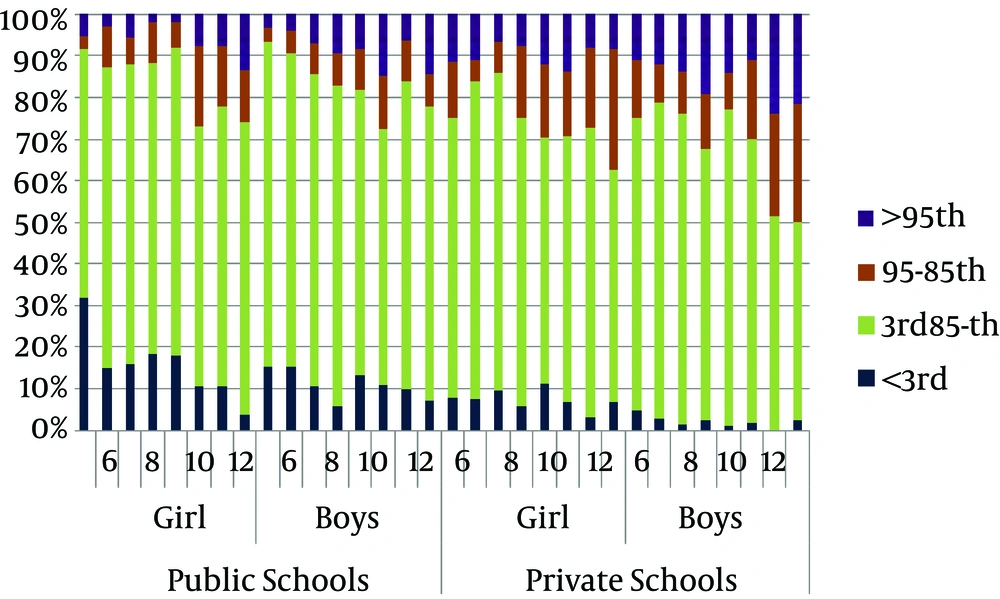
Figure 1.
A concurrent decrease is also observed in the prevalence of underweight (BMI < 3rd percentile).
Logistic regression analysis was performed on obesity/overweight as the dependent variable and covariates of age, gender and type and level of school with different models. Age and school type were significantly related to overweight/obesity in Model 1. In Model 2, school level had a significant association with overweight/obesity independent to age (Table 2). We performed subgroup analysis for private and public schools; while age was similarly related to obesity/overweight in both public and private schools, sex was related just in private schools.
Table 2.
Factors Related to Overweight/Obesity in Primary and Guidance Schools of Zahedan, Iran (2012)
| Model 1 (All Schools) | B | S.E. | Wald | P Value | Odds Ratio | 95.0% C.I | |
|---|---|---|---|---|---|---|---|
| Lower | Upper | ||||||
| School type (Private to Public) | 0.733 | 0.085 | 74.7 | 0.000 | 2.081 | 1.763 | 2.457 |
| Sex (M to F) | 0.139 | 0.084 | 2.7 | 0.099 | 1.149 | 0.974 | 1.355 |
| Age, y | 0.176 | 0.019 | 87.0 | 0.000 | 1.192 | 1.149 | 1.237 |
| Constant | -3.422 | 0.206 | 276.6 | 0.000 | 0.033 | ||
| Model 2 (All schools) | |||||||
| School type (Private to Public) | 0.756 | 0.086 | 77.9 | 0.000 | 2.129 | 1.800 | 2.518 |
| Level (Guidance to Elementary) | 0.340 | 0.165 | 4.2 | 0.040 | 1.404 | 1.016 | 1.941 |
| Sex (M to F) | 0.139 | 0.084 | 2.7 | 0.100 | 1.149 | 0.974 | 1.355 |
| Age, y | 0.112 | 0.036 | 9.6 | 0.002 | 1.119 | 1.042 | 1.201 |
| Constant | -2.952 | 0.304 | 94.1 | 0.000 | 0.052 | ||
| Model 3 (Public schools) | |||||||
| Sex (M to F) | 0.006 | 0.115 | 0.003 | 0.958 | 1.006 | 0.803 | 1.261 |
| Age, y | 0.184 | 0.025 | 52.9 | 0.000 | 1.202 | 1.144 | 1.262 |
| Constant | -3.431 | 0.275 | 155.2 | 0.000 | 0.032 | ||
| Model 4 (Private schools) | |||||||
| Sex (M to F) | 0.306 | 0.125 | 6.0 | 0.014 | 1.358 | 1.064 | 1.734 |
| Age, y | 0.159 | 0.029 | 30.5 | 0.000 | 1.172 | 1.108 | 1.240 |
| Constant | -2.606 | 0.289 | 81.3 | 0.000 | 0.074 | ||
5. Discussion
In the current study, the prevalence of obesity was higher in private schools than public schools and in older students than younger ones. Regarding the fact that Zahedan has had the lowest human development index (HDI) in Iran in the recent studies (22) and is known for its highest rates of stunting and underweight among Iran provinces (16, 23), obesity seems a common problem in students, especially around the puberty age in Zahedan. The prevalence of obesity and overweight in Zahedan children is similar to many other places of Iran as shown in Table 3.
Table 3.
The Prevalence of Obesity and Overweight in Zahedan Children Compared to Other Places of Iran
| Authors | City | Year | Sex | Sample Size | Age | Prevalence of Obesity, a | Prevalence of Overweight, a |
|---|---|---|---|---|---|---|---|
| Sohailifar and Sadri (24) | Hamedan | 1998 | Girls/Boys | 2000 | 7 - 11 | 2.5 | - |
| Asar and Asghari (25) | Ahwaz | 2001 | Girls/Boys | 4793 | 7 - 14 | 2.2 | 6.0 |
| Karajibani et al. (26) | Zahedan | 2002 | Girls/Boys | 2067 | 7 - 11 | 1.4 | 1.5 |
| Gheibi et al. (27) | Orumiyeh | 2002 | Girls | 458 | 11 - 14 | 4.0 | 10.4 |
| Mozafari and Nabaei (28) | Tehran | 2002 | Girls | 1800 | 6 - 10 | 7.7 | 13.3 |
| Beigi et al. (29) | Neyshabour | 2005 | Girls/Boys | 1471 | 6 - 12 | 4.6 | - |
| Taheri et al. (30) | Birjand | 2005-6 | Girls/Boys | 6093 | 7 - 18 | 1.8 | 4.8 |
| Haeri Behbahani et al. (31) | Sabzevar | 2008 | Girls/Boys | 1800 | 6 - 11 | 4.8 | 7.9 |
| Nabavi et al. (32) | Semnan | 2010 | Girls/Boys | 400 | 7 - 12 | 14.3 | 18.8 |
a Data are presented as %.
Maddah et al. studied a random sample of 1079 students in Zahedan and reported overweight and obesity in 8.9% of boys and 10.3% of girls in 2010 (33). Another study by Mortazavi et al reported 12.9% overweight, similar to our study and 1.3% obesity (39.5% of female and 3.1% of male students with central obesity) in 720 students in Zahedan in 2004 (23). In our sample, 9.3% of the students were obese, which can be due to increased obesity rate in the recent decades (20). As far as we are concerned, there has been no recent study in Zahedan with similar sample size. Therefore, the results of these studies might not be statistically comparable.
Relationship of socio-economic level of school and overweight/obesity, independent of age, found in our study, needs more exploration, which can be due to unfair dropout of children at the end of primary school and entrance to a more special group of students to guidance school.
Higher prevalence of obesity in students of private schools might be correlated with better socio-economic levels of their families. In developing countries, lifestyle risk factors such as overweight and obesity are usually higher in people with higher socioeconomic status, while in more developed countries, such risk factors are mainly the problem of poor people (34).
In this cross-sectional study, we were not able to discriminate the effect of age with respect to cohort and time period (35).
Considering the association between childhood and adult overweight and deleterious consequences of overweight on health, special attentions should be made regarding prevention and management of childhood obesity.