
1. Background
Autoimmune hepatitis (AIH) is a chronic hepatitis condition characterized by inflammation of unknown etiology that does not fully regress. The first cases were reported in the 1950s, describing patients who developed jaundice, had elevated serum gamma-globulin levels, positive lupus erythematosus preparations, and liver histology showing severe inflammation with plasma cells. It is a necroinflammatory chronic liver parenchymal disease that can progress rapidly if left untreated (1). The disease has a genetic basis, which may explain the epidemiological variation observed in serological tests and clinical presentations in different populations. This disease group accounts for 10 - 20% of chronic hepatitis cases in Northern European, American, and Caucasian populations. In contrast, it is a relatively less frequent reason for chronic liver disease in Eastern European and Middle Eastern countries (2). If the diagnosis is missed and treatment is delayed, it may develop into end-stage liver failure and liver cirrhosis. Acute hepatitis is typically the clinical manifestation. Sometimes it can be very severe and progress to decompensated cirrhosis; less often, it may be subtle or entirely asymptomatic. This disease, which can affect people of all ages and is more common in women, appears to be increasing in incidence and prevalence worldwide (3). The absence of accurate and specific illness indicators makes it difficult to diagnose AIH. To arrive at a trustworthy diagnosis, several clinical, biochemical, immunological, histological, and genetic aspects need to be taken into account. Most patients have positive test results for antinuclear antibody (ANA), anti-smooth muscle antibody (ASMA), anti-soluble liver antigen (anti-SLA), and/or anti–liver-kidney microsomal antibody (anti-LKM). However, these serological markers are negative in approximately 20% of AIH cases (4).
The disease's pathogenic mechanism is an abnormal immune response that targets liver autoantigens and causes chronic, self-replicating liver inflammation. The diagnostic characteristics of AIH include elevated IgG concentrations (hypergammaglobulinemia), a particular collection of autoantibodies (ANA, ASMA, anti-SLA, etc.), histological evidence of interface hepatitis, and periportal necrosis (5). Due to the vast age range in which the disease manifests, the variety of clinical presentations ranging from asymptomatic illness to fulminant liver failure, and the varied serologic markers, diagnosing AIH is still difficult. Immunological markers and histopathological findings are similar to other chronic liver diseases (4, 5). This disease has three main types according to immunoserological markers (type I: ANA, ASMA; type II: Anti-LKM; type III: Anti-SLA), with 80% of cases being type I (6). Nearly all patients respond quickly to corticosteroid and other immunomodulatory medication treatment, which confirms the diagnosis of AIH. The goal of treatment is to achieve and maintain remission, defined as normalization of aminotransferases and IgG levels within six months. Liver fibrosis can frequently be reversed with treatment, halting the development of decompensated cirrhosis and its consequences (7). The majority of cases necessitate lifelong maintenance therapy, and frequent follow-up by skilled professionals enhances the standard of care and the lives of those impacted. Early randomized trials have demonstrated that adding azathioprine to steroid therapy increases the rate of maintaining remission and improves survival (7, 8). Roughly 10% to 20% of AIH patients experience severe adverse effects that necessitate stopping treatment, or they may not experience remission with conventional approaches. For individuals who become unresponsive and develop liver failure, liver transplantation is a viable alternative (6-8).
For the diagnosis of AIH, percutaneous liver biopsy (PLB) is now the gold standard. The Ishak and Knodell classifications are among the most commonly used grading systems for biopsy specimens (9). During the Knodell classification, a fibrosis (F) score is determined and staging is performed. The Ishak scoring system is an update of the Knodell. Although PLB remains the gold standard, the procedure's painful nature and the potential for complications pose significant challenges. It is difficult to repeat in long-term follow-up cases and poses a risk for the patient and the physician because it is an invasive method (10). In recent years, ultrasound (US) elastography has been used to evaluate and diagnose patients with AIH. Shear-wave elastography (SWE) is a more recent technique for evaluating liver elasticity, while transient elastography (TE) is the most researched approach. Additionally, SWE can be used to track changes in blood flow, assess liver morphological changes, and detect isolated hepatic abnormalities (11). In contrast to single-point measurement in PLB, the SWE technique places multiple regions of interest (ROIs) in the liver parenchyma and allows quantitative measurements. This allows for a larger area of the liver to be evaluated simultaneously under B-mode US guidance (12). Shear-wave elastography is the best non-invasive technique for determining the severity of liver fibrosis because of its excellent overall accuracy, particularly when it comes to staging the disease (11, 12).
2. Objectives
Whether interface hepatitis and resulting periportal necrosis affect the liver lobes (right and left) at the same rate in AIH cases has not been investigated to date. In this study, the right and left liver lobe stiffness values of the patients were compared according to Knodell-Ishak histopathological classifications. In other words, it was investigated whether the presence of AIH affected the Ishak-Knodell fibrosis stages and SWE measurements in the right and left lobes at a similar rate. Thus, the effectiveness of SWE was compared with fibrosis stages and its usefulness in the diagnosis of AIH was evaluated.
3. Methods
3.1. Research Subjects
The cases referred to the radiology unit with the diagnosis of AIH between January 2023 and February 2025 and subsequently undergoing PLB and SWE, respectively, within 6 months were evaluated retrospectively. The clinical medical research ethics committee of a tertiary health center approved ethical permission for this study (IRB: 2025-4174-735). All SWE procedures and PLB procedures for all patients were performed in the same clinic. Informed consents were available for all participants who underwent biopsy and SWE during archival search. The Declaration of Helsinki was fully complied with at all stages, including measurement and writing. The cases aged ≥ 18 years who were diagnosed with AIH and had complete Knodell-Ishak classifications and SWE results were included. The patients with a body mass index (BMI) > 35, younger than 18 years old, a history of hepatobiliary surgery, liver transplantation, a concurrent mass lesion in the liver, a history of liver trauma (+), and those who could not hold their breath were excluded. The characteristics of the included cases (age, gender, etc.), SWE data, and PLB results were recorded. According to archival records, in the AIH cases included in the study, other causes of hepatitis, primarily viral hepatitis, were ruled out immunohistochemically and pathologically (Figure 1). SWE values were expressed in kilopascals (kPa) for both liver lobes (right and left). In each case, the average SWE values of the left and right lobes at the same stage of fibrosis according to the Knodell and Ishak classifications were compared.
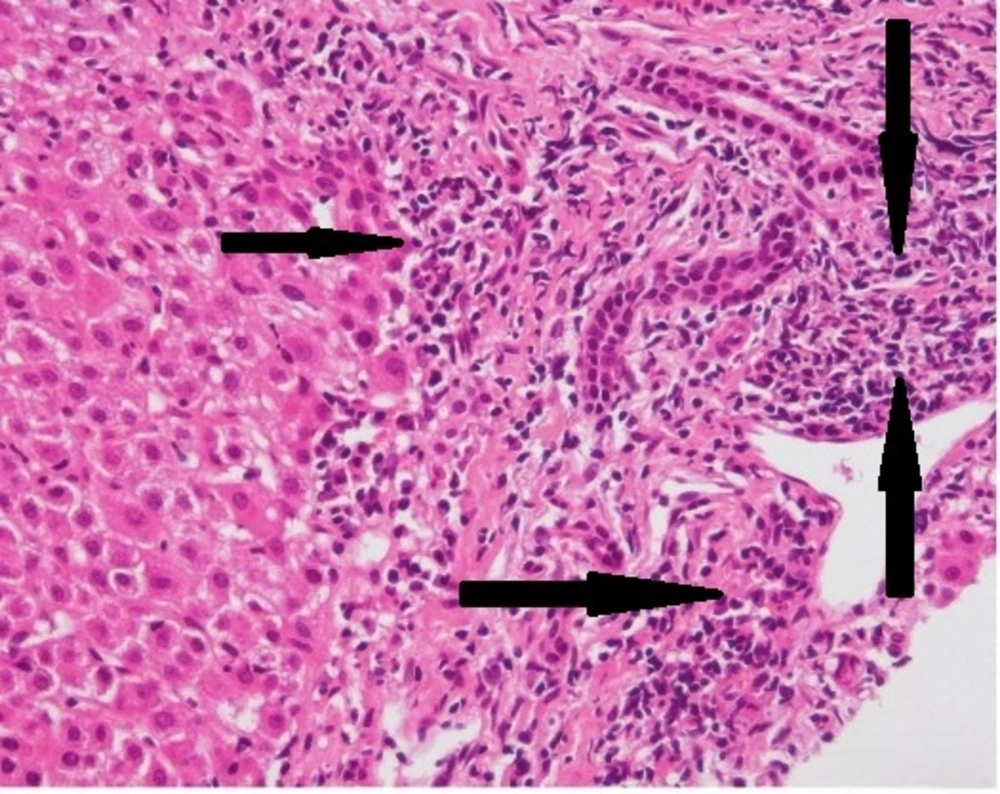
Figure 1.
The histology of autoimmune hepatitis (AIH) is shown in detail (hematoxylin and eosin staining). The portal and periportal inflammatory infiltrate specific to AIH consists of lymphocytes, monocytes/macrophages, and plasma cells. Interface hepatitis is indicated by black arrows.
3.2. Radiological Evaluation
All SWE measurements were performed by a practitioner experienced in US elastography and abdominal radiology. A device with a 1-5 MHz convex US probe (Philips IU22 Bothell WA, US) was used during the procedures. Since hepatobiliary USG was performed in the same session and B-mode imaging was used as a guide during the measurements, the patient was asked to have an optimal fast before the procedure (Figure 2). SWE measurements were made in the supine position with the right arm in full abduction and in the left decubitus position, with the probe held at the intercostal and subcostal spaces. In each case, measurements were made from 8 points in the liver during the same session according to the Couinaud classification, two of which were in the left lobe (segments 2 and 3). The measurement values obtained by placing a default ROI (15 × 10 mm) on each segment of the liver were recorded (Figure 3). Vascular structures were avoided when placing ROI measurement points, thus preventing erroneous kPa values. For optimal measurement, SWE values were obtained at a depth of up to 8 cm within the liver parenchyma.
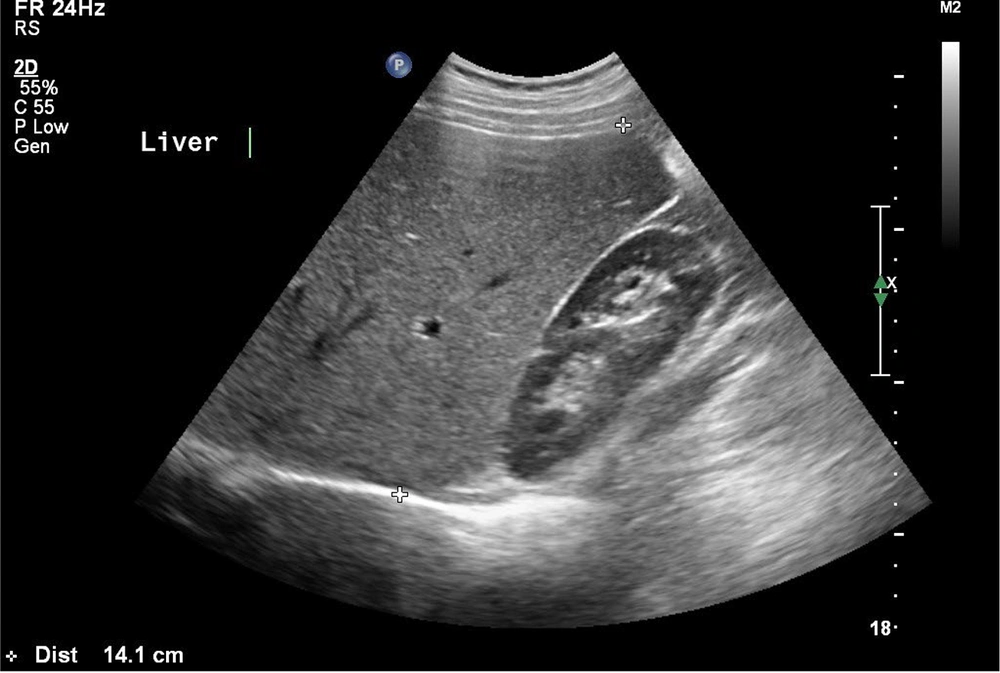
Figure 2.
Before shear-wave elastography measurements, a 38-year-old female patient underwent hepatobiliary USG with B-mode imaging and the craniocaudal liver size was also calculated (in cm at the lower left corner).
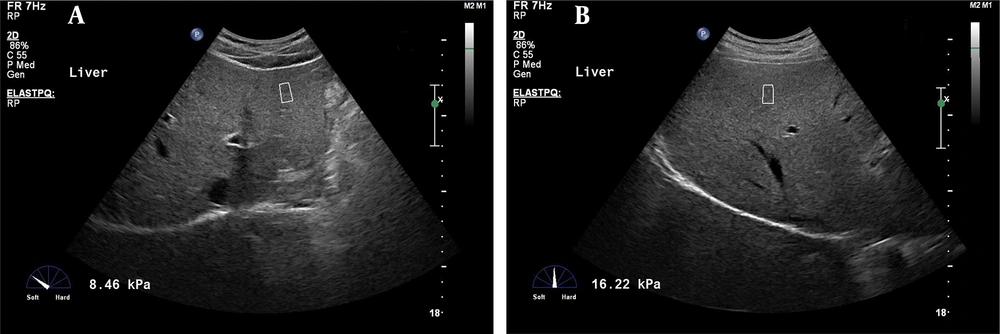
Figure 3.
In a 52-year-old male case who underwent SWE, liver stiffness values in kPa were obtained with SWE at the left lobe segment 2 (A) and right lobe segment 8 (B) levels.
3.3. Pathologic Evaluation
Knodell and Ishak classifications were used to determine the biopsy materials' fibrosis scores. Firstly, Knodell histological activity index (HAI) was used and biopsy samples were divided into four categories (F0-F1-F3-F4). Accordingly, it was stated as: "F0: no fibrosis", "F1: fibrous portal expansion", "F3: bridging fibrosis (portal-to-portal or portal-to-central connection)" and "F4: cirrhosis". In contrast to Ishak, the Knodell HAI does not include the F2 score. Hepatocellular necroinflammation activity was defined using Knodell. The Ishak scoring is a modified version of the Knodell HAI and consists of 6 categories (F0-F1-F2-F3-F4-F5-F6). It is graded as: F0: no fibrosis, F1: fibrous expansion of some portal areas, with or without short fibrous septa, F2: fibrous expansion of most portal areas, with or without short fibrous septa, F3: portal fibrous with occasional (portal-portal bridging), F4: portal fibrosis with marked (portal-portal bridging or portal-central bridging), F5: marked bridging with occasional nodules (incomplete cirrhosis) and F6: probable or definite cirrhosis. F5 and F6 in this system stand for both definite and incomplete cirrhosis. By grading, Ishak's grade also assists in determining the amounts of necro-inflammatory activity (13).
3.4. Statistical Analysis
Data were statistically analyzed using IBM SPSS ver. 22 (Armonk, NY, USA). The distribution of the data was assessed using the Shapiro-Wilk and Kolmogorov-Smirnov tests. The median values of continuous variables were compared using the Mann-Whitney U test, while categorical variables were compared using the chi-square test or Fisher's exact test. Central tendency was expressed using descriptive statistical techniques (median, frequency, percentage, interquartile range (IQR), minimum, and maximum). Since normal distribution was not observed, Spearman correlation (𝝆) was used to assess the relationship between elasticity values and histological fibrosis stages. The Wilcoxon Paired Signed-Rank Test was used to assess the difference between the elasticity values of the liver lobes (left and right). A 95% confidence interval was adopted for all parameters, and P < 0.05 was considered statistically significant.
4. Results
There were 92 patients in all, including 74 females (80.4%) and 18 males (19.6%). The youngest patient was 18 years old and the oldest was 71 years old; both were male. The oldest instance among females was 68 years old, and the youngest was 22 years old. The median age of all cases was calculated as 41.23 (11.36), 39.79 (12.83) for females and 42.75 (10.42) for males. When examining the relationship between AIH and gender, no significance was found (P > 0.05). Similarly, the association between gender and age was not statistically significant (P > 0.05).
The cases were also evaluated according to the Ishak and Knodell fibrosis grading systems. According to the Knodell classification for all cases, 16 cases (17.4%) were defined as F0, 40 cases (43.5%) as F1, 28 cases (30.4%) as F3, and 8 cases (8.7%) as F4. In Ishak's system, 13 patients (14.1%) were evaluated as F0, 21 patients (22.9%) as F1, 18 patients (19.5%) as F2, 21 patients (22.9%) as F3, 10 patients (10.9%) as F4, 5 patients (5.4%) as F5, and 4 patients (4.3%) as F6 (Table 1). According to the Ishak system, significant fibrosis was defined as F ≥ 2, and 58 (63.1%) patients met this criterion. There was no significant relationship between F values and gender in both grading systems (Knodell and Ishak) (P > 0.05).
Table 1.
Fibrosis classifications and AIH cases distribution (n = 92)
| Fibrosis (F) | No. (%) |
|---|---|
| Knodell (n = 92) | |
| F0 | 16 (17.4) |
| F1 | 40 (43.5) |
| F3 | 28 (30.4) |
| F4 | 8 (8.7) |
| Ishak (n = 92) | |
| F0 | 13 (14.1) |
| F1 | 21 (22.9) |
| F2 | 18 (19.5) |
| F3 | 21 (22.9) |
| F4 | 10 (10.9) |
| F5 | 5 (5.4) |
| F6 | 4 (4.3) |
The liver lobes' (left and right) stiffness values were also compared in the same Knodell and Ishak F stages. For Ishak's system, the two F stages were accepted as a single group because the number of subgroup samples in F5 and F6 was small. Stiffness values (kPa) for the right and left lobes were compared for both fibrosis systems, respectively (Table 2 and Table 3). Accordingly, there was no statistical significance seen between lobes (P > 0.05). In addition, Spearman correlation was also used. Consequently, SWE (liver stiffness) values and Knodell F grades showed a significant, moderate positive correlation (𝝆 = 0.427, P < 0.001). Therefore, as the degree of fibrosis increased, liver stiffness also increased. Similarly, a significant, moderate positive association was found between Ishak F grades and SWE (liver stiffness) levels (𝝆 = 0.418, P < 0.001).
Table 2.
Comparison of the Liver Lobes According to Knodell Scoring
| Knodell Fibrosis Scoring | Liver Stiffness kPa Value; Median (IQR) | P-Value |
|---|---|---|
| F0 (n = 16) | 0.386 | |
| Right lobe stiffness | 10.6 (5.5) (3.7 - 31.6) | |
| Left lobe stiffness | 8.8 (6.7) (2.1 - 27.3) | |
| F1 (n = 40) | 0.522 | |
| Right lobe stiffness | 11.9 (5.3) (4.5 - 20.3) | |
| Left lobe stiffness | 9.8 (8.4) (2.9 - 45.6) | |
| F3 (n = 28) | 0.585 | |
| Right lobe stiffness | 12.7 (7.9) (4.7 - 38.5) | |
| Left lobe stiffness | 10.8 (12.5) (3.89 - 49.1) | |
| F4 (n = 8) | 0.579 | |
| Right lobe stiffness | 31.2 (22.3) (16.0 - 51.3) | |
| Left lobe stiffness | 29.6 (27.3) (6.3 - 88.7) |
Table 3.
Comparison of the Liver Lobes According to Ishak’s System
| Knodell Fibrosis Scoring | Liver Stiffness kPa Value; Median (IQR) | P-Value |
|---|---|---|
| F0 (n = 13) | 0.391 | |
| Right lobe stiffness | 10.3 (5.1) (3.8 - 31.8) | |
| Left lobe stiffness | 8.7 (6.8) (2.1 - 27.6) | |
| F1 (n = 21) | 0.787 | |
| Right lobe stiffness | 11.8 (5.8) (4.5 - 20.3) | |
| Left lobe stiffness | 11.0 (8.2) (2.8 - 45.7) | |
| F2 (n = 18) | 0.238 | |
| Right lobe stiffness | 11.8 (5.3) (5.9 - 20.1) | |
| Left lobe stiffness | 9.7 (6.1) (5.2 - 24.4) | |
| F3 (n = 21) | 0.648 | |
| Right lobe stiffness | 12.8 (7.3) (4.6 - 25.9) | |
| Left lobe stiffness | 10.3 (13.0) (3.9 - 48.7) | |
| F4 (n = 10) | 0.937 | |
| Right lobe stiffness | 14.3 (8.3) (10.2 - 38.4) | |
| Left lobe stiffness | 13.1 (12.4) (7.1 - 49.1) | |
| F5-6 (n = 9) | 0.582 | |
| Right lobe stiffness | 31.2 (21.9) (16.0 - 51.4) | |
| Left lobe stiffness | 29.5 (27.3) (6.2 - 89.5) |
5. Discussion
The observation that fibrosis regression or improvement occurs when the factor causing liver fibrosis damage is removed has led to many advances in diagnosis and treatment (14, 15). Regardless of the cause and mechanism, liver fibrosis should be considered a dynamic process and should be monitored (16). To correct inflammation and fibrosis in chronic liver diseases, cause-specific or outcome-oriented action should be taken (14-16). Current management for AIH should include noninvasive methods to assess changes in hepatic fibrosis and aim to control, interrupt, and reverse disease progression (17). Research on non-invasive radiologic evaluation of liver fibrosis has been ongoing because of the invasiveness of liver biopsies, sample errors, possible consequences, and interobserver variability restrictions. Among the radiological non-invasive assessment tools for hepatic fibrosis, transient elastography (TE) and SWE are increasingly used (14, 18, 19).
Firstly, the role of liver stiffness (LS) measurement using TE in the progression and decompensation of cirrhosis in patients with AIH was researched. Four hundred thirty-nine participants with histologically verified AIH and at least one LS measurement at follow-up were included in this multicenter cohort research. The association between the onset of cirrhosis and adverse outcomes (decompensation, liver transplantation, and/or related death) and the initial LS measurement conducted at least six months following the initiation of treatment was assessed. The initial LS value was higher in patients with poor outcomes (13.5 kPa vs. 6 kPa; P < 0.001) and was independently associated with the development of cirrhosis, regardless of whether a biochemical response was achieved (hazard ratio 1.300; P < 0.001). A poor result and the onset of cirrhosis were accurately predicted by a cut-off value of 8.5 kPa (20). Paranaguá-Vezozzo et al. examined the agreement between LS measurement and TE and PLB in patients with AIH who were in biochemical remission. Thirty-three AIH subjects underwent PLB to evaluate histological remission following at least 18 months of normal aminotransferase levels. The efficacy of LS measurement and fibrosis stages (with METAVIR) was tested. According to the METAVIR system, 1 case was determined as F0, 6 cases as F1, 8 cases (24.2%) as F2, 10 cases as F3, and 8 cases (24.2%) as F4. Histological remission was not achieved in 13 cases. The optimum LS cut-off values for TE were 12.3 kPa (sensitivity 87.5%, specificity 88%). When AIH patients were in biochemical remission, TE could reliably identify liver fibrosis based on the METAVIR score (21).
Hazzan et al. (22) assessed the connection between fibrosis and inflammation in AIH patients and LS as determined by SWE. The 25 AIH cases who had pre-biopsy SWE measurements were included in this prospective investigation. The Scheuer grading system was used to assess liver biopsy samples for fibrosis, and the modified Hepatic Activity Index (mHAI) was used to assess inflammation. LS showed a significant correlation with fibrosis stages (𝝆: 0.58, P = 0.002), while SWE showed a relatively weaker correlation (𝝆: 0.50, P = 0.01). Accordingly, it has been shown that SWE is weaker in the diagnosis of hepatic fibrosis in AIH, especially in the pre-treatment period when inflammation levels are high, and is more successful in the early stages (22). Rasool et al. (12) investigated the validity of SWE for diagnosis and discrimination of liver fibrosis stage in AIH patients. Results from liver biopsies and SWE were available for the evaluation of 162 patients with AIH diagnosed between March 2022 and December 2023 in this retrospective study analysis. The METAVIR scoring system was used to assess the phases of fibrosis in biopsy samples. Shear-wave elastography had a 92.11% overall diagnostic accuracy, 82.86% sensitivity, and 98.7% specificity in predicting the stages of fibrosis. While SWE was effective in distinguishing early fibrosis (F1-F2), its sensitivity was shown to decrease in distinguishing advanced fibrosis (F3-F4) process (12).
Soh et al. tried to ascertain whether SWE was helpful in measuring liver stiffness in order to measure hepatic fibrosis and therapy response in individuals with AIH (23). This retrospective analysis comprised 69 patients who had SWE between June 2014 and 2021 and had been diagnosed with AIH. Using METAVIR scoring, patients were categorized into four groups based on their histological fibrosis stage (F1-F4). The diagnostic efficacy of LS measures in hepatic fibrosis staging was examined, and variables were contrasted prior to and following AIH steroid treatment. LS values obtained by SWE differed according to the stage of liver fibrosis (P < 0.001). With the exception of F4 (P < 0.05), the diagnostic performance of LS measures was substantially better than that of blood biomarkers. Patients undergoing steroid treatment showed significant variations in LS value follow-up assessments (P = 0.012). In patients with AIH, SWE is a helpful technique for assessing hepatic fibrosis, and LS is a trustworthy metric for assessing therapy response during follow-up exams (23). Janik et al. compared liver and spleen SWE measurements with PLB in prospectively selected patients with AIH (24). In 63 patients with AIH, liver and spleen SWE values were assessed over an 18-month follow-up period and compared with PLB. Liver SWE values were associated with surrogate markers of active hepatitis (ALT and IgG, both P < 0.001), but there was no association between spleen SWE and ALT (P > 0.05). Additionally, there was a correlation (P < 0.01) between liver SWE and the histological inflammatory score. For identifying cirrhosis by liver and spleen 2D-SWE, the best cut-offs (areas under the receiver operating characteristic curve: AUROC) were 16.1 kPa (AUROC 0.93) and 29.8 kPa (AUROC 0.95), respectively, in comparison to liver biopsy. When it came to identifying cirrhosis in individuals with active AIH, the combination diagnostic method that included liver and spleen SWE had a considerably greater AUROC (P < 0.05) than liver SWE alone (24).
Xing et al. studied the diagnostic performance of SWE in the evaluation of liver fibrosis in AIH patients. Besides SWE, the diagnostic performance of serological tests including aspartate aminotransferase-to-platelet ratio index (APRI) and fibrosis-4 index (FIB-4) was evaluated (25). A total of 103 patients were identified retrospectively and liver fibrosis was staged according to the Scheuer scoring system. Histological fibrosis stage and LS as determined by SWE were highly correlated (r = 0.71, P < 0.0001). Significantly better than serological tests, the AUROCs of SWE in identifying cirrhosis, severe fibrosis, and substantial fibrosis of LS were 0.84, 0.84, and 0.94, respectively. The AUROCs of LS for the detection of significant fibrosis and severe fibrosis were (0.57, 0.56) in APRI and (0.63, 0.66) in FIB-4. Consequently, SWE demonstrated encouraging diagnostic results in the stage of liver fibrosis in AIH (25). In order to evaluate hepatic fibrosis in patients with autoimmune liver disease (AILD), including AIH and primary biliary cholangitis (PBC), Park et al. looked into SWE's diagnostic performance. The reference standard was histological examination, and the diagnostic efficacy of SWE was contrasted with serum fibrosis indicators such as FIB-4 and APRI. The AUROC (0.77–0.81, 95% CI) of SWE for severe fibrosis (≥ F2) and cirrhosis (F4) in AILD patients (49 AIH and 41 PBC cases) was greater than APRI and FIB-4. SWE exhibited better diagnostic performance in assessing liver fibrosis in AILD patients compared to serum fibrosis markers (26).
There are only a few studies evaluating fibrosis in AIH patients using the SWE technique. In these studies, only one scoring system was used for histopathological score system to compare SWE (12, 22-26). Differently, in our study, two histopathological scoring systems (Knodell and Ishak) were used for the first time in AIH cases, and the diagnostic efficiency of SWE was tried to be evaluated with as much data as possible. Previous studies using TE and SWE mainly focused on finding cut-off values to distinguish fibrosis in AIH cases. However, none of them have evaluated whether AIH affects both lobes (left and right) of the liver equally (12, 20-26). In our study, for the first time in the literature, SWE values of both lobes of the liver were determined and compared. In addition, among the studies using SWE, our study had the third highest number of patients with 92 cases, thus obtaining as much data as possible (12, 25).
This study had several limitations. The first limitation was that there were no previous studies comparing both lobes of the liver. Previous elastography studies in AIH cases were aimed at finding cut-off values and evaluating remission after treatment (12, 20-26). The second limitation is that all operations were performed by only one operator, so no interobserver variability could be assessed. The third limitation was the retrospective approach of our study. Nevertheless, previous studies using SWE were only prospective (22). The fourth limitation is that the dimensions of the used ROI point cannot be changed during the measurements.
In conclusion, measurements can be taken from multiple locations across the liver lobes thanks to the SWE method's benefit of positioning as many ROI points as feasible throughout the liver parenchyma. SWE provides quantitative measurement values for the diagnosis of liver stiffness and fibrosis in AIH cases. In contrast to PLB, this approach is affordable, non-invasive, and simple to use. In this study, both liver lobes (left and right) were compared for the first time in the literature; unlike other studies, kPa values of the liver lobes were compared using two histopathological scoring (Knodell and Ishak) systems. According to SWE values, it was seen that AIH affected both lobes of the liver similarly.