
1. Background
Chronic hepatitis B (CHB) infection is often asymptomatic, yet it poses a significant risk for HBV reactivation in patients undergoing IST. This risk is primarily driven by the persistence of covalently closed circular DNA (cccDNA) in hepatocytes, which can lead to viral replication upon immune suppression (1). HBVr has been well-documented in various clinical settings, including patients receiving chemotherapy, organ transplantation, or biological therapies such as tumor necrosis factor-alpha (TNF-α) inhibitors, corticosteroids, anti-CD20 monoclonal antibodies, and other immunomodulators (2, 3).
Patients at risk for HBVr are broadly categorized into two groups: those who are HBsAg-positive and those who are HBsAg-negative but anti-HBc positive. A significant risk also exists for HBsAg-negative/anti-HBc positive individuals, in whom anti-HBc serves as a lifelong marker of prior HBV exposure (4). However, rare cases of HBV DNA detection in the absence of anti-HBc antibodies have been reported, particularly in immunocompromised individuals, raising concerns about diagnostic limitations (5, 6). Furthermore, the risk in individuals with isolated anti-HBs positivity—typically indicative of resolved infection or vaccination—remains an area of uncertainty (7). Importantly, the loss of protective anti-HBs titers (seroconversion from positive to negative) has been observed in patients under potent IST, such as anti-TNF agents. Literature suggests that the waning of humoral immunity and a decrease in anti-HBs titers over time significantly increase the susceptibility to HBV reactivation or new infection in these patients (8). Reactivation is clinically characterized by an increase in HBV DNA levels and/or reappearance of HBsAg, which may be accompanied by biochemical hepatitis (3, 7).
Clinical guidelines recommend HBV screening and appropriate antiviral prophylaxis before initiating IST, with risk stratification based on serological status and the type and duration of immunosuppression (9-11). Management of HBV in the context of IST is guided by evolving international standards. The European Association for the Study of the Liver (EASL) 2025 Clinical Practice Guidelines and the American Association for the Study of Liver Diseases (AASLD) 2018 guidance provide a robust framework for screening and risk stratification, emphasizing that all patients initiating IST must be evaluated for HBsAg and anti-HBc status to prevent potentially fatal reactivation events (3, 11). These guidelines refine the indications for proactive antiviral prophylaxis based on the specific potency of the immunosuppressive agent and the patient’s serological profile.
The most recent American Gastroenterological Association (AGA) 2025 Clinical Practice Guidelines refine this approach by categorizing patients into high (> 10%), moderate (1 - 10%), and low (< 1%) risk groups based on serostatus and the nature/duration of immunosuppression, thereby guiding decisions for prophylactic antiviral therapy versus monitoring (4). Despite these updated recommendations, real-world adherence to screening and prophylaxis protocols remains variable.
Despite these updated recommendations, real-world adherence to screening and prophylaxis protocols is inconsistent. Moreover, longitudinal data on serological dynamics, such as anti-HBc seroconversion and anti-HBs loss, in diverse populations under IST remain scarce. Therefore, anchored in the current scientific framework of the AGA 2025 guidelines, this study aimed to address specific gaps in clinical practice.
2. Objectives
Our objectives were to: (1) Determine the prevalence of HBV serological markers (HBsAg, anti-HBc, anti-HBs) among patients initiating IST; (2) evaluate the real-world alignment of applied prophylactic strategies with the latest risk-based guideline recommendations; and (3) investigate the occurrence of critical serological changes, specifically anti-HBc seroconversion and the loss of protective anti-HBs antibodies, during the course of immunosuppression.
3. Methods
3.1. Study Design and Population
The study included patients who were referred to the Infectious Diseases Clinic for HBV screening and pre-treatment evaluation prior to the initiation of IST by the departments of Physical Medicine and Rehabilitation, Gastroenterology, and Ophthalmology in Canakkale 18 Mart University Hospital between January 2019 and November 2024. The IST regimens included tumor necrosis factor-α (TNF-α), Janus kinase (JAK), interleukin, cytokine and tyrosine kinase inhibitors, systemic steroids, methotrexate (MTX), or anti-CD20 monoclonal antibodies. The study period was selected based on the availability and completeness of electronic medical records during this timeframe.
3.2. Risk Stratification and Definitions
The risk of HBVr in patients receiving IST is strongly influenced by both the baseline HBV serological profile and the potency and duration of immunosuppression. In accordance with the American Gastroenterological Association (AGA) 2025 Clinical Practice Guidelines, the risk of HBVr was categorized as low (< 1%), moderate (1 - 10%), and high (> 10%) based on the type of IST and the patient's baseline serological status (4).
According to the updated AGA 2025 criteria, HBVr is defined as: In HBsAg-positive patients: (1) Reappearance of HBV DNA in those with previously undetectable levels, (2) a ≥ 1 log10 increase in HBV DNA levels compared to baseline in those with detectable HBV DNA, or (3) HBsAg seroconversion (reappearance of HBsAg) in patients who were previously HBsAg-negative. In HBsAg-negative/anti-HBc-positive patients: (1) Reappearance of HBsAg (reverse seroconversion), or (2) reappearance of HBV DNA in those with previously undetectable levels.
HBV-related flare (biochemical hepatitis) was defined as an ALT increase to ≥ 3 times the baseline level or ALT ≥ 100 IU/mL in the presence of HBVr. ALT levels were monitored during the entire follow-up period. HBV DNA testing was performed at baseline for all patients and conducted during follow-up if HBVr was clinically or biochemically suspected (4, 10, 11).
3.3. Inclusion and Exclusion Criteria
All patients over 18 years of age receiving IST who presented to the specified outpatient clinics during the study period and whose complete serological records (HBsAg, anti-HBs, and anti-HBc) were accessible were included. Patients with incomplete baseline HBV serology (HBsAg, anti-HBs, and anti-HBc) or those with less than 6 months of follow-up were excluded. Data were systematically recorded in a standardized, anonymized Excel database.
3.4. Statistical Analysis
All statistical analyses were conducted using SPSS software (version 26, IBM Corp., Armonk, NY, USA). Descriptive characteristics were presented as frequency and percentage (%) for categorical variables. Continuous variables were expressed as mean ± standard deviation (SD). For the comparison of continuous variables between two groups, the Independent Student’s t-test was utilized. For comparisons involving more than two groups, One-Way Analysis of Variance (ANOVA) was utilized. Categorical data and proportions were analyzed using the Pearson Chi-square test or Fisher’s Exact test, as appropriate. A P-value of <0.05 was considered statistically significant.
3.5. Ethics Committee Approval
Ethics committee approval was obtained from Canakkale Onsekiz Mart University Non-Interventional Research Ethics Committee (Application number: 2025-71) in accordance with the Declaration of Helsinki. Due to the retrospective design, the requirement for informed consent was waived.
4. Results
4.1. Analysis of All Patients Receiving Immunosuppressive Therapy
We retrospectively analyzed 650 records referred to the Infectious Diseases Clinic for HBV evaluation prior to IST. After excluding 26 patients due to missing baseline serology (HBsAg, anti-HBc, or anti-HBs) or less than 6 months of clinical follow-up, a total of 624 patients were included in the final cohort. All patients underwent regular monitoring of liver function and HBV serology during IST.
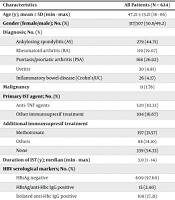
The demographic and clinical characteristics of the entire cohort are summarized in Table 1. Briefly, the mean age was 47.2 ± 13.2 years with an equal gender distribution (50.8% female). The most common underlying disease was ankylosing spondylitis (44.7%), and anti-TNF agents constituted the majority of primary IST (83.3%). Regarding HBV serology, the vast majority of patients were HBsAg-negative (97.6%). Isolated anti-HBc IgG positivity (indicative of resolved infection) was present in 108 patients (17.3%), and 52.7% had detectable anti-HBs, of which 90.3% (n = 297/329) were attributable to prior vaccination.
Table 1.
Demographic Characteristics of All Patients a
| Characteristics | All Patients (N = 624) |
|---|---|
| Age (y); mean ± SD (min - max) | 47.21 ± 13.21 (18 - 86) |
| Gender (female/male); No. (%) | 317/307 (50.8/49.2) |
| Diagnosis; No. (%) | |
| Ankylosing spondylitis (AS) | 279 (44.71) |
| Rheumatoid arthritis (RA) | 119 (19.07) |
| Psoriasis/psoriatic arthritis (PSA) | 168 (26.92) |
| Uveitis | 30 (4.81) |
| Inflammatory bowel disease (Crohn’s/UC) | 26 (4.17) |
| Malignancy | 11 (1.76) |
| Primary IST agent; No. (%) | |
| Anti- TNF agents | 520 (83.33) |
| Other immunsupresif treatment | 104 (16.67) |
| Additional immunsupresif treatment | |
| Methotrexate | 197 (31.57) |
| Others | 88 (14.10) |
| None | 339 (54.33) |
| Duration of IST (y); median (min - max) | 3.0 (1 - 14) |
| HBV serological markers; No. (%) | |
| HBsAg negative | 609 (97.60) |
| HBsAg/anti-Hbc IgG positive | 15 (2.40) |
| İsolated anti-Hbc IgG positive | 108 (17.31) |
| Anti-Hbc IgG positive | 123 (19.7) |
| Anti-Hbs positive | 329 (52.7) |
| Anti-Hbs positive with vaccine | 297 (47.6) |
| Anti-Hbs+anti-Hbc IgG positive | 82 (13.1) |
| Hepatitis B unvaccinated patients | 325 (52.1) |
| anti-HCV positive | 0 (0) |
| Oral antiviral treatment | 118 (18.9) |
a Continuous variables are presented as mean ± SD (min-max) or median (min-max) based on normality testing (Kolmogorov-Smirnov test).
When the patients were then stratified into three management groups: vaccinated (n = 297, 47.6%), unvaccinated (n = 209, 33.5%), and patients receiving antiviral medication (n = 118, 18.9%), a highly significant age difference was observed across the three groups (P < 0.001); the antiviral group was the oldest (58.16 ± 12.10 years), while the vaccinated group was the youngest (45.86 ± 13.28 years). Gender distribution also showed significance (P = 0.030), with female predominance most notable in the antiviral (57.6%) and vaccinated (53.2%) groups (Table 2).
Table 2.
Demographic Data of Patients Receiving Antiviral Agent , Hepatitis B Vaccinated and Unvaccinated Patients
| Variables | Unvaccinated (n = 209, 33.5%) | Vaccinated (n = 297, 47.6%) | Patients Receiving Antiviral Agent (n = 118, 18.9%) | P-Value |
|---|---|---|---|---|
| Age (y); mean ± SD | 48.36 ± 13.05 | 45.86 ± 13.28 | 58.16 ± 12.10 | 0.0001 a |
| IST duration (y); mean ± SD | 3.56 ± 3.33 | 3.73 ± 3.22 | 4.10 ± 3.37 | 0.362 a |
| Gender; No. (%) | 0.030 b | |||
| Female | 92 (44) | 158 (53.2) | 68 (57.6) | |
| Male | 117 (56) | 139 (46.8) | 50 (42.4) |
a ANOVA
b Chi-square test.
3.2. Antiviral Management and Guideline-Based Risk Stratification
A total of 118 (18.9%) patients received antiviral medication. Among them, 15 (12.7%) were on therapeutic treatment for CHB, and 103 (87.3%) received prophylaxis due to the risk of HBVr (Table 1).
We stratified all anti-HBc positive patients (n = 123) according to the AGA 2025 guidelines (4), with results detailed in Table 3. The cornerstone finding was that no HBV reactivation occurred in any risk group during the study follow-up period.
Table 3.
Laboratory Data and Clinical Management According to HBV Reactivation Risk Groups (Based on AGA 2025 Guidelines)
| Risk Groups a | Age (y); Mean ± SD | Sex | HBsAg | Anti-HBs | HBVr | TDF | ETV | 3TC | |||
|---|---|---|---|---|---|---|---|---|---|---|---|
| Male | Female | Positive | Negative | Positive | Negative | ||||||
| Low (< 1%) (n = 56) | 56.6 ± 11.9 | 24 | 32 | 0 | 56 | 45 | 11 | 0 | 43 | 8 | 0 |
| Moderate (1 - 10%) (n = 51) | 60.4±11.4 | 23 | 28 | 0 | 51 | 33 | 18 | 0 | 48 | 3 | 0 |
| High (> 10%) (n = 16) | 56.3 ± 14.6 | 3 | 13 | 15 | 1 | 4 | 12 | 0 | 10 | 4 | 2 |
| P-value | 0.219 b | 0.156 c | < 0.001 c | < 0.001 c | - | - | - | - | |||
Abbreviations: TDF, Tenofovir Disoproxil Fumarate; ETV, Entecavir; 3TC, Lamivudine.
a Risk stratification was performed according to the American Gastroenterological Association (AGA) 2025 Clinical Practice Guidelines.
b Anova test
c Chi-square test.
High Risk (> 10% risk) Patients: Sixteen (2.6%) patients were classified as high-risk. This group included 15 HBsAg-positive patients and one HBsAg-negative/anti-HBc-positive patient receiving the B-cell depleting agent, rituximab. The mean age of this group was 56.3 ± 14.6 years. Among HBsAg-positive patients, three (20%) were simultaneously positive for anti-HBs. Eleven patients achieved undetectable HBV DNA levels under therapy, while four showed significant viral suppression (Table 3). Antiviral agents used were tenofovir disoproxil fumarate (TDF) (n = 10, 62.5%), entecavir (ETV) (n = 4, 25%), and lamivudine (3TC) (n = 2, 12.5%). No reactivation occurred.
Moderate Risk (1% - 10% risk): Fifty-one (8.2%) patients were classified as moderate-risk according to AGA 2025. The mean age of this group was 60.4 ± 11.4 years. These were HBsAg-negative/anti-HBc-positive patients receiving corticosteroids (> 4 weeks) or cytokine inhibitors. All 51 patients (100%) received prophylaxis, primarily with TDF (n = 48, 94%) and ETV (n = 3, 6%).
Low Risk (< 1% risk): Fifty-six (8.9%) patients were classified as low-risk per AGA 2025. Despite their low-risk status according to AGA, 51 of these patients received prophylaxis in accordance with the Turkish Clinical Practice Guidelines (2023 Update) (10), which categorizes anti-HBc positive patients receiving potent anti-TNF agents into the moderate-risk category. The remaining 5 patients did not receive prophylaxis. In a retrospective detailed assessment of these 5 patients, the Turkish Guidelines would have categorized three as moderate-risk (receiving adalimumab or infliximab) and two as low-risk (methotrexate monotherapy). The lack of prophylaxis in the three moderate-risk patients was due to clinician oversight. Critically, no clinical or laboratory evidence of HBVr was detected in any patient within this "guideline discordance" zone.
3.3. Comparison of Patients Based on Antiviral Status
A comparison between patients who received antiviral agents (n = 118) and those who did not (n = 506) is presented in Table 4. As expected, antiviral use was significantly associated with older age, HBsAg positivity, and anti-HBc positivity (all P < 0.001). Underlying diagnosis and the choice of primary IST agent did not significantly influence antiviral prescription decisions.
Table 4.
Comparison of Patients with and Without Antiviral Prophylaxis
| Variables | Patients Receiving Agent (N = 118, 18.9%) | Patients Not Receiving Antiviral Agent (N = 506, 81.1%) | P-Value |
|---|---|---|---|
| Age (y); mean ± SD | 58.1 ± 12.1 | 46.8 ± 13.2 | 0.0001 a |
| Gender (female); No. (%) | 68 (57.6) | 249(49.2) | 0.104 b |
| Duration of IST (y); mean ± SD | 4.1 ± 3.3 | 3.6 ± 3.2 | 0.190 a |
| HBsAg positive | 15 (12.7) | 0 (0.00) | 0.0001 b |
| anti-HBc positive/HBsAg negative | 103 (87.3) | 5 (1.0) | 0.0001 b |
| Common diagnoses; No. (%) | |||
| Ankylosing spondylitis | 47 (17.0.) | 229 (83) | 0.285 b |
| Rheumatoid arthritis | 28 (23.1) | 93(76.9) | 0.185 b |
| Psoriatic arthritis | 26 (24.8.) | 79 (75.2) | 0.093 b |
| Primary immunosuppressive agents; No. (%) | |||
| Adalimumab | 32 (14.7) | 185 (85.3) | |
| Secukinumab | 15 (22.7 | 51 (77.3) | |
| Certolizumab | 11(19.0) | 47 (81.0) |
a Independent Student’s t-test.
b Chi-square test
3.4. Serological Changes During Follow-up
During serial monitoring, important serological changes were observed. Three patients exhibited anti-HBc seroreversion (transition from positive to negative) during follow-up (Table 5). All three were using anti-TNF agents (adalimumab or secukinumab). Additionally, 33 patients (5.3% of the total cohort and 10.0% of those initially anti-HBs positive) lost protective anti-HBs titers (< 10 mIU/mL), underscoring the necessity of long-term serological monitoring in patients receiving potent IST.
Table 5.
Data of Patients Who Developed Anti-HBc Seroconversion
| Variables | Gender | Age | Diagnosis | IST | IST Initiation (y) | Antiviral | Antiviral Initiation (y) | First Anti Hbc Total Value | Last Anti Hbc Total Value |
|---|---|---|---|---|---|---|---|---|---|
| Patient 1 | Female | 56 | PSA | Adalimumab | 2016 | TDF | 2016 | 3.19 | 0.6 |
| Patient 2 | Female | 54 | AS | Adalimumab | 2017 | TDF | 2017 | 1.32 | 0.7 |
| Patient 3 | Female | 67 | Psoriasis | Secukinumab | 2023 | TDF | 2023 | 1.18 | 0.7 |
5. Discussion
Patients undergoing IST face a significant risk of HBV reactivation due to the persistence of cccDNA in hepatocytes (9). This real-world study of 624 patients receiving IST demonstrates that a rigorous, guideline-adherent approach to hepatitis B virus (HBV) screening and prophylaxis is highly effective in preventing HBV reactivation (HBVr), achieving a 0% reactivation rate. Our findings highlight the successful application of both international (AGA 2025) and more conservative national (Turkish 2023) guidelines in a clinical setting, while also revealing important serological dynamics under long-term IST.
Turkey is a region of moderate HBV endemicity. General population studies report anti-HBc IgG and HBsAg positivity rates of 30.6% and 4.0%, respectively (12). Among immunosuppressed cohorts, these rates are typically lower. Previous studies in Turkish rheumatology patients on biologics reported HBsAg positivity between 0.4% - 2.9%, anti-HBs between 34.4% - 45.6%, and anti-HBc between 25.1% - 31.2% (13, 14). Our cohort showed a similar profile with HBsAg at 2.4% and anti-HBc at 19.7%. The relatively lower anti-HBc prevalence in our study is likely attributable to a younger patient demographic and a notably high vaccination rate of 47.6% (with 90.3% of anti-HBs positivity being vaccine-induced). The analysis of age distribution further supports this, as patients receiving antiviral therapy were the oldest cohort (58.16 ± 12.10 years), whereas the vaccinated group was the youngest (45.86 ± 13.28 years). Similar findings were reported in the TURHEP field study by Tozun et al., which highlighted improved HBV vaccination coverage in younger populations (12). This aligns with national trends showing improved vaccination coverage in younger generations (12), underscoring the impact of public health initiatives.
Our management was meticulously aligned with guideline recommendations. All HBsAg-positive patients (n = 15) received immediate antiviral therapy per AASLD/EASL guidelines (3, 11), and the vast majority of HBsAg-negative/anti-HBc-positive patients at moderate or high risk received prophylaxis. A central and instructive finding of our study revolves around the 56 patients classified as 'low-risk' (< 1%) by the AGA 2025 criteria but considered 'moderate-risk' per the more conservative Turkish National Guidelines (4, 10). Given the regional endemicity and the potential severity of reactivation, we prioritized national safety protocols, initiating prophylaxis in these patients. This approach ensured maximal safety, even though international frameworks might suggest monitoring alone. In line with our local protocol, 51 of these patients received prophylaxis. Conversely, three patients missed due to clinician oversight remained reactivation-free despite receiving potent anti-TNF agents (adalimumab/infliximab). This "guideline discordance" zone represents a critical junction in clinical decision-making for endemic regions. The fact that no reactivation occurred in any of the 56 patients—including the 3 who did not receive prophylaxis due to oversight—provides real-world evidence that the absolute risk for this subgroup on anti-TNF therapy may indeed be very low. However, the three missed cases, though event-free, underscore the peril of deviating from standardized protocols and support the Turkish guideline's safety-first approach in an endemic setting.
Additionally, the inverse association between anti-HBs positivity and prophylaxis administration (P < 0.001) is expected, as individuals with isolated anti-HBs (vaccinated) are generally considered protected. A meta-analysis by Paul et al. demonstrated that patients with high anti-HBs titers have a significantly reduced risk of HBV reactivation, which supports the rationale for selective prophylaxis (7).
The complete prevention of HBVr in our cohort, including all 16 high-risk patients (15 HBsAg+, 1 on rituximab), strongly affirms the efficacy of antiviral prophylaxis. This is particularly notable given the reported reactivation rates of up to 85% in HBsAg-positive patients and 25% in anti-HBc-positive patients receiving B-cell depleting agents like rituximab without prophylaxis (15-19). Our success is attributable to the consistent use of high-genetic-barrier antivirals (tenofovir or entecavir). Similar to findings by Kefeli et al. and Su et al. (20, 21), the specific choice among these high-barrier agents did not affect outcomes, as no reactivation occurred with any. Furthermore, our data support the relative safety of anti-TNF agents and methotrexate when managed under appropriate screening and prophylaxis protocols, mitigating concerns raised by some studies (19, 22).
Beyond virological control, we observed significant serological shifts that warrant attention. The loss of protective anti-HBs titers (< 10 mIU/mL) in 33 patients (10.0% of initially seropositive individuals) demonstrates that vaccine-induced immunity can wane under IST. More intriguingly, three patients exhibited anti-HBc seroreversion, a phenomenon suggesting the potential fading of the immunological footprint of past infection under potent immunosuppression (23). These findings move beyond the binary outcome of reactivation and emphasize the necessity for long-term, periodic serological monitoring to identify patients who may benefit from booster vaccinations or require re-evaluation of their risk profile.
5.1. Conclusion
In conclusion, our study reinforces the critical importance of comprehensive HBV screening, individualized risk assessment, and strict adherence to antiviral prophylaxis protocols in patients receiving IST. The absence of HBV reactivation in our cohort suggests that current prophylactic strategies, particularly with high-barrier antivirals like tenofovir and entecavir, are highly effective in clinical practice.
A key finding of our study was the discrepancy between international and national guidelines; while 56 patients were categorized as low-risk according to AGA 2025 criteria, 54 of them were identified as moderate-risk under the Turkish National Guidelines (2023 Update). Consequently, except for three patients who were missed due to the clinician's workload, the rest of the patients received antiviral prophylaxis, reflecting a more conservative and safety-oriented approach in an HBV-endemic region.
However, the findings also highlight the necessity for prospective studies incorporating routine and systematic HBV DNA monitoring to detect occult reactivation events that may be missed by biochemical markers alone. Given the potential for atypical serological patterns and the observed loss of anti-HBs protection over time and the observed loss of anti-HBc seropositivity in select patients warrants further investigation to understand its clinical implications, long-term vigilance and multicenter data are essential to refine global management strategies.
These findings underscore that current clinical practice should not replace established standards; instead, it highlights the imperative need for strict adherence to standardized prophylaxis protocols and the generation of large-scale, multicenter data to eliminate clinician-dependent variables. Future research should prioritize establishing unified international criteria that bridge the gaps between divergent regional guidelines, thereby ensuring maximal patient safety and refining global management strategies across diverse epidemiological settings.