1. Background
Hepatocellular carcinoma (HCC) is the predominant type of primary liver cancer, accounting for approximately 80% of cases (1). Several factors contribute to HCC, including hepatitis B virus (HBV) infection, aflatoxin exposure, and ethanol consumption. HBV infection is the major causative factor in China (2). HCC is characterized by an insidious onset and a high propensity for metastasis. Its distant metastasis rate ranks second among all cancers, and more than 30% of patients initially present with metastatic HCC (3, 4). HCC has a substantial impact on survival and can lead to death within a short period (5). Early death, defined as death within 3 months of the initial HCC diagnosis, is common among patients with metastatic HCC (5). Therefore, developing a predictive model for early death in metastatic HCC is important for guiding clinical decisions and improving clinical outcomes. However, research in this area is limited, and relevant existing models still use the 7th edition of the American Joint Committee on Cancer (AJCC) criteria. This study used the 8th edition of the AJCC criteria to develop a predictive model for early death in metastatic HCC.
2. Objectives
This study aimed to develop a predictive model for early death in metastatic HCC (mHCC; AJCC 8th edition, tumor-node-metastasis [TNM] M1 stage IVB) using the Surveillance, Epidemiology, and End Results (SEER) database. Univariable and multivariable logistic regression analyses were used to construct a nomogram, which was evaluated using receiver operating characteristic (ROC) curves, calibration curves, and decision curve analysis (DCA).
3. Methods
3.1. Data Source and Study Population
Data were obtained from the Surveillance, Epidemiology, and End Results (SEER) Program [Surveillance, Epidemiology, and End Results (SEER) Program (www.SEER.cancer.gov) SEER*Stat Database: Incidence - SEER Research Data, 17 Registries, Nov 2025 Sub (2000 - 2023) - Linked To County Attributes - Time Dependent (1990 - 2024) Income/Rurality, 1969 - 2024 Counties, National Cancer Institute, DCCPS, Surveillance Research Program, released April 2026, based on the November 2025 submission]. Patients diagnosed between 2018 and 2023 with primary hepatocellular carcinoma (site code C22.0; ICD-O-3 histology codes 8170/3 - 8175/3) and distant metastasis at diagnosis (AJCC 8th edition M1 stage) were identified. The data used in this study were obtained from the publicly available SEER database, access to which was approved by the National Cancer Institute, and are cited in accordance with SEER guidelines. This SEER-based study was granted an exemption from ethical review by the Ethics Committee of Hefei Cancer Hospital, Chinese Academy of Sciences.
For covariates with documented "Unknown" coding (bone metastasis, brain metastasis, lung metastasis, alpha-fetoprotein (AFP), race, and marital status), unknown values were retained as valid categories rather than treated as missing. For radiotherapy, no/unknown values were pooled into a single category. A total of 5,877 patients remained for analysis. The cohort was randomly split in a 7:3 ratio into a training cohort (n = 4,114) for model development and a validation cohort (n = 1,763) for independent performance assessment. Because SEER is a publicly available, de-identified database, the study was granted an exemption by the institutional ethics review board, and individual informed consent was not required.
The following baseline variables were collected: age (< 65, 65 - 74, ≥ 75 years), sex, race (Black, White, Other, Unknown), T stage (T0/Tx, T1/T2, T3/T4), N stage (N0, Nx, N1), tumor size (≤ 2 cm, 2 - 5 cm, > 5 cm), AFP (Negative, Positive, Unknown), bone metastasis (Absent, Present, Unknown), brain metastasis (Absent, Present, Unknown), lung metastasis (Absent, Present, Unknown), marital status (Single, Married, Other, Unknown), radiotherapy (no/unknown, yes), and chemotherapy (no/unknown, yes). The outcome was early death, defined as death from any cause within 3 months of the initial pathological diagnosis and determined using the SEER survival status and survival months variables.
3.2. Statistical Analysis
All analyses were performed using R software (version 4.6.0). Continuous variables were categorized using clinically established thresholds; no data-driven optimal binning was performed during modeling. Differences in variable distributions between the training and validation cohorts were assessed using the chi-square test or Fisher exact test, as appropriate.
In the training cohort, univariable logistic regression was first performed for all candidate predictors, followed by multivariable logistic regression that included all variables. Predictors for the final model were selected using a backward stepwise procedure based on the Akaike information criterion (AIC). Regression coefficients and 95% confidence intervals (CIs) were estimated using Wald tests and profile likelihood methods.
Model discrimination was evaluated using the area under the receiver operating characteristic curve (AUC/C-index). Calibration was assessed using calibration curves generated by bootstrap resampling (200 iterations) and quantified using the calibration intercept, calibration slope, and Brier score. To correct for optimism, 1,000 bootstrap resamples were applied to the final model, yielding optimism-corrected estimates of the C-index, calibration intercept, calibration slope, and Brier score. Clinical net benefit was assessed using decision curve analysis (DCA) by comparing the nomogram with a tumor-node-metastasis (TNM) staging model incorporating T and N stage only, a "treat all" strategy, and a "treat none" strategy across a range of threshold probabilities. Because treatment variables (radiotherapy and chemotherapy) may not be available at initial diagnosis, a reduced model excluding these variables was also constructed as a sensitivity analysis. All tests were two-sided, and P < 0.05 was considered statistically significant.
4. Results
4.1. Baseline Characteristics
A total of 5,877 patients with metastatic HCC were included: 4,114 in the training cohort and 1,763 in the validation cohort. Early death occurred in 2,571 patients (62.5%) in the training cohort and 1,118 patients (63.4%) in the validation cohort. No statistically significant differences were observed between the cohorts for most variables (all P > 0.05). Overall, the cohorts were well balanced. Detailed baseline characteristics are presented in Table 1.
Table 1.
Baseline Clinicopathological Characteristics of Patients with Metastatic Hepatocellular Carcinoma in the Training and Validation Cohorts a
| Variables | Training Cohort (n = 4,114) | Validation Cohort (n = 1,763) | Chi-square Statistic | P Value |
|---|---|---|---|---|
| Age | 2.962 | 0.2274 | ||
| < 65 | 1666 (40.5) | 690 (39.1) | ||
| 65 - 74 | 1543 (37.5) | 703 (39.9) | ||
| ≥ 75 | 905 (22) | 370 (21) | ||
| Sex | 2.2 | 0.138 | ||
| Female | 831 (20.2) | 387 (22) | ||
| Male | 3283 (79.8) | 1376 (78) | ||
| Race | 1.351 | 0.717 | ||
| Black | 589 (14.3) | 239 (13.6) | ||
| White | 2855 (69.4) | 1249 (70.8) | ||
| Other | 637 (15.5) | 260 (14.7) | ||
| Unknown | 33 (0.8) | 15 (0.9) | ||
| T stage | 1.274 | 0.529 | ||
| T0/Tx | 765 (18.6) | 324 (18.4) | ||
| T1/T2 | 1424 (34.6) | 587 (33.3) | ||
| T3/T4 | 1925 (46.8) | 852 (48.3) | ||
| N stage | 0.234 | 0.8894 | ||
| N0/Nx | 2294 (55.8) | 995 (56.4) | ||
| N1 | 1062 (25.8) | 447 (25.4) | ||
| Unknown | 758 (18.4) | 321 (18.2) | ||
| Tumor size (cm) | 3.437 | 0.1793 | ||
| ≤ 2 | 1147 (27.9) | 451 (25.6) | ||
| 2 - 5 | 1228 (29.8) | 0.3) | ||
| > 5 | 1739 (42.3) | 777 (44.1) | ||
| AFP | 0.023 | 0.9884 | ||
| Negative | 537 (13.1) | 229 (13) | ||
| Positive | 2640 (64.2) | 1135 (64.4) | ||
| Unknown | 937 (22.8) | 399 (22.6) | ||
| Bone metastasis | 2.044 | 0.3598 | ||
| No | 2718 (66.1) | 1133 (64.3) | ||
| Yes | 1301 (31.6) | 591 (33.5) | ||
| Unknown | 95 (2.3) | 39 (2.2) | ||
| Brain metastasis | 1.258 | 0.5331 | ||
| No | 3905 (94.9) | 1670 (94.7) | ||
| Yes | 97 (2.4) | 37 (2.1) | ||
| Unknown | 112 (2.7) | 56 (3.2) | ||
| Lung metastasis | 4.035 | 0.133 | ||
| No | 2293 (55.7) | 999 (56.7) | ||
| Yes | 1725 (41.9) | 709 (40.2) | ||
| Unknown | 96 (2.3) | 55 (3.1) | ||
| Marital status | 4.024 | 0.2589 | ||
| Unmarried | 1063 (25.8) | 466 (26.4) | ||
| Married | 1935 (47) | 789 (44.8) | ||
| Other | 960 (23.3) | 447 (25.4) | ||
| Unknown | 156 (3.8) | 61 (3.5) | ||
| Radiotherapy | 0.914 | 0.3392 | ||
| No/unknown | 3441 (83.6) | 1456 (82.6) | ||
| Yes | 673 (16.4) | 307 (17.4) | ||
| Chemotherapy | 0.002 | 0.9684 | ||
| No | 3205 (77.9) | 1375 (78) | ||
| Yes | 909 (22.1) | 388 (22) |
a Values are expressed as No. (%). Bone, brain, and lung metastasis correspond to M bone, M brain, and M lung in the source data. Abbreviations: AJCC, American Joint Committee on Cancer; AFP, alpha-fetoprotein. T stage and N stage refer to the AJCC 8th edition.
4.2. Risk Factors for Early Death
The results of the univariable and multivariable logistic regression analyses in the training cohort are presented in Table 2. After backward stepwise selection, the final model retained age, tumor size, AFP, bone metastasis, brain metastasis, lung metastasis, marital status, radiotherapy, and chemotherapy. Larger tumor size (> 5 cm: odds ratio [OR] = 1.44; 95% CI, 1.21 - 1.70), positive AFP (OR = 1.40; 95% CI, 1.14 - 1.73), bone metastasis (OR = 1.30; 95% CI, 1.10 - 1.54), and lung metastasis (OR = 2.02; 95% CI, 1.74 - 2.35) were significantly associated with a higher risk of early death. Age, brain metastasis, and most marital-status categories did not reach statistical significance. The unexpected inverse association for the unknown brain metastasis category (OR = 0.39) may reflect data bias. Radiotherapy (OR = 0.26; 95% CI, 0.21 - 0.31) and chemotherapy (OR = 0.27; 95% CI, 0.23 - 0.31) were strongly inversely associated with early death, although selection bias should be considered. Sex, race, T stage, and N stage were excluded from the nomogram (all P > 0.05).
Table 2.
Univariable and Multivariable Logistic Regression Analyses of Risk Factors for Early Death in the Training Cohort a
| Variables | Univariable OR (95% CI) | Univariable P Value | Multivariable OR (95% CI) | Multivariable P Value |
|---|---|---|---|---|
| Age | ||||
| < 65 | 1 (Reference) | |||
| 65 - 74 | 1.031 (0.894 - 1.188) | 0.6762 | 1.001 (0.854 - 1.173) | 0.9911 |
| ≥ 75 | 1.274 (1.076 - 1.511) | 0.0051 | 1.199 (0.988 - 1.457) | 0.0664 |
| Sex | ||||
| Female | 1 (Reference) | |||
| Male | 0.888 (0.757 - 1.040) | 0.1428 | ||
| Race | ||||
| Black | 1 (Reference) | |||
| White | 1.051 (0.875 - 1.260) | 0.5945 | ||
| Other | 1.080 (0.857 - 1.361) | 0.5145 | ||
| Unknown | 0.965 (0.475 - 2.024) | 0.9219 | ||
| T stage | ||||
| T0/Tx | 1 (Reference) | |||
| T1/T2 | 0.687 (0.571 - 0.824) | 0.0001 | ||
| T3/T4 | 0.926 (0.776 - 1.105) | 0.3956 | ||
| N stage | ||||
| N0/Nx | 1 (Reference) | |||
| N1 | 1.025 (0.882 - 1.190) | 0.7506 | ||
| Unknown | 1.299 (1.093 - 1.546) | 0.0031 | ||
| Tumor size (cm) | ||||
| ≤ 2 | 1 (Reference) | |||
| 2 - 5 | 1.251 (1.062 - 1.474) | 0.0074 | 1.210 (1.010 - 1.449) | 0.0386 |
| > 5 | 1.619 (1.388 - 1.888) | 0 | 1.435 (1.209 - 1.703) | 0 |
| AFP | ||||
| Negative | 1 (Reference) | |||
| Positive | 1.528 (1.268 - 1.842) | 0 | ||
| Unknown | 1.944 (1.563 - 2.419) | 0 | ||
| Bone metastasis | ||||
| No | 1 (Reference) | |||
| Yes | 0.691 (0.604 - 0.791) | 0 | ||
| Unknown | 1.277 (0.825 - 2.029) | 0.2841 | ||
| Brain metastasis | ||||
| No | 1 (Reference) | |||
| Yes | 0.931 (0.619 - 1.417) | 0.735 | ||
| Unknown | 1.123 (0.762 - 1.679) | 0.5651 | ||
| Lung metastasis | ||||
| No | 1 (Reference) | |||
| Yes | 2.256 (1.973 - 2.581) | 0 | ||
| Unknown | 1.935 (1.255 - 3.056) | 0.0035 | ||
| Marital status | ||||
| Unmarried | 1 (Reference) | |||
| Married | 0.906 (0.776 - 1.056) | 0.2081 | ||
| Other | 1.077 (0.899 - 1.292) | 0.4219 | ||
| Unknown | 2.139 (1.450 - 3.234) | 0.0002 | ||
| Radiotherapy | ||||
| No/unknown | 1 (Reference) | |||
| Yes | 0.217 (0.182 - 0.259) | 0 | ||
| Chemotherapy | ||||
| No | 1 (Reference) | |||
| Yes | 0.237 (0.203 - 0.277) | 0 |
a T stage and N stage refer to the AJCC 8th edition. Bone, brain, and lung metastasis correspond to M bone, M brain, and M lung in the source data. Abbreviations: AJCC, American Joint Committee on Cancer; AFP, alpha-fetoprotein; CI, confidence interval; OR, odds ratio.
4.3. Model Development and Validation
A nomogram incorporating the nine predictors retained in the final model was constructed (Figure 1). Each variable level corresponds to a point score. Summing the individual scores yields a total score, which can be projected downward to obtain the predicted probability of early death. Age and lung metastasis contributed most substantially to the total score.
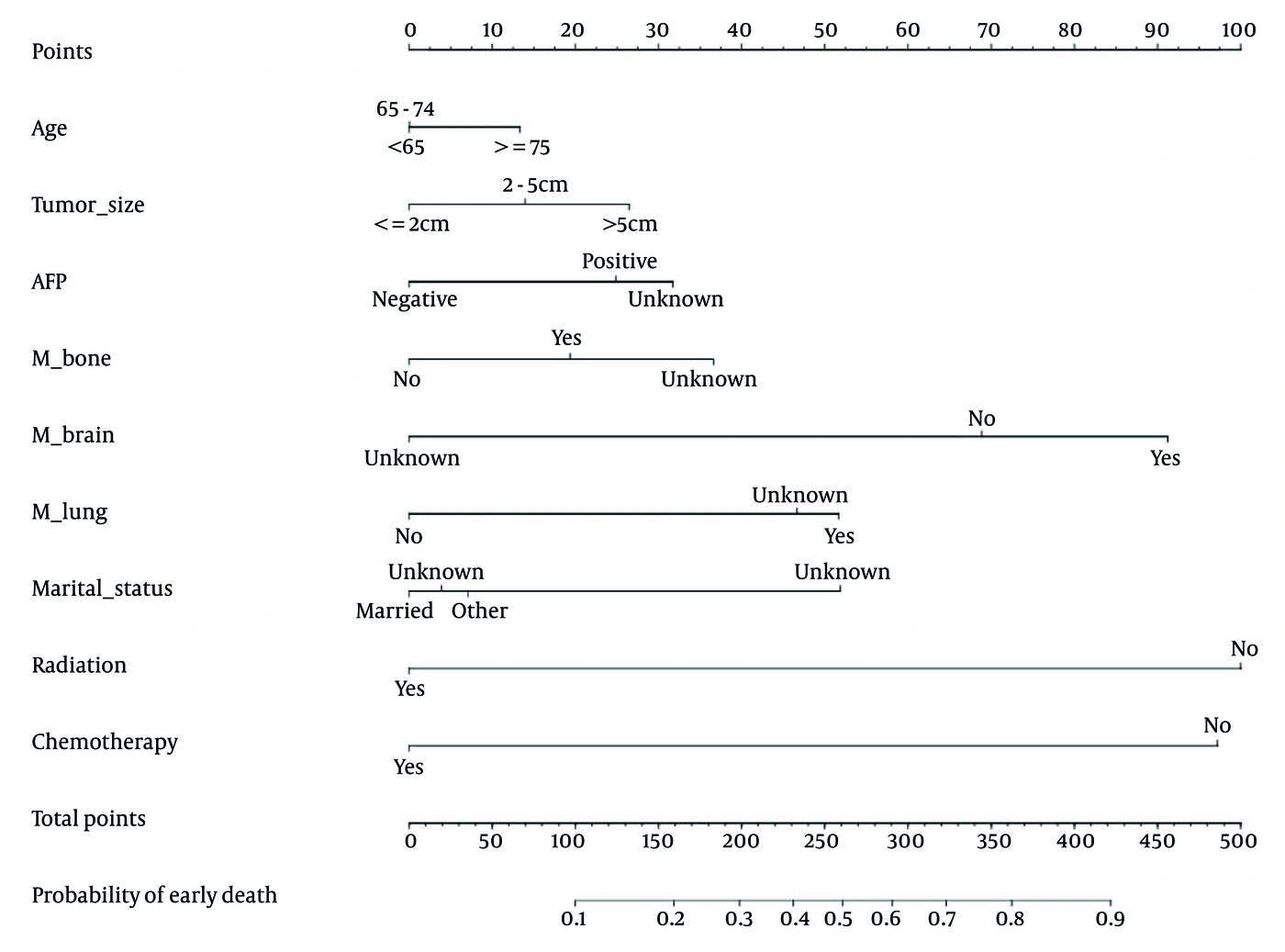
Figure 1.
Nomogram for predicting the probability of early death in patients with metastatic hepatocellular carcinoma.
M bone, bone metastasis; M brain, brain metastasis; M lung, lung metastasis. To use the nomogram, locate each variable value on its corresponding axis and draw a vertical line to the “Points” scale to obtain its score. Sum the scores and locate the total on the “Total Points” axis. A vertical line drawn downward from this point gives the predicted probability of early death.
The predicted probability of early death for an individual patient can be calculated using the following logistic regression equation:
P(early death) = 1 / [1 + exp(−LP)]
where the linear predictor (LP) is defined as:
LP = 0.1253 + 0.0009 × (Age 65 - 74) + 0.1818 × (Age ≥ 75) + 0.1903 × (Tumor size 2 - 5 cm) + 0.3609 × (Tumor size > 5 cm) + 0.3391 × (AFP Positive) + 0.4328 × (AFP Unknown) + 0.2641 × (Bone metastasis = Yes) + 0.4999 × (Bone metastasis = Unknown) + 0.3052 × (Brain metastasis = Yes) − 0.9397 × (Brain metastasis = Unknown) + 0.7050 × (Lung metastasis = Yes) + 0.6364 × (Lung metastasis = Unknown) − 0.0533 × (Marital status = Married) + 0.0436 × (Marital status = Other) + 0.6543 × (Marital status = Unknown) − 1.3644 × (Radiotherapy = Yes) − 1.3265 × (Chemotherapy = Yes)
The AUC was 0.740 (95% CI, 0.724 - 0.755) in the training cohort and 0.746 (95% CI, 0.721 - 0.771) in the validation cohort. After 1,000 cycles of bootstrap internal validation, the optimism-corrected C-index was 0.736. In contrast, the TNM staging model (T and N stage only) achieved a C-index of 0.531 in the validation cohort, significantly lower than that of the nomogram (Figure 2).
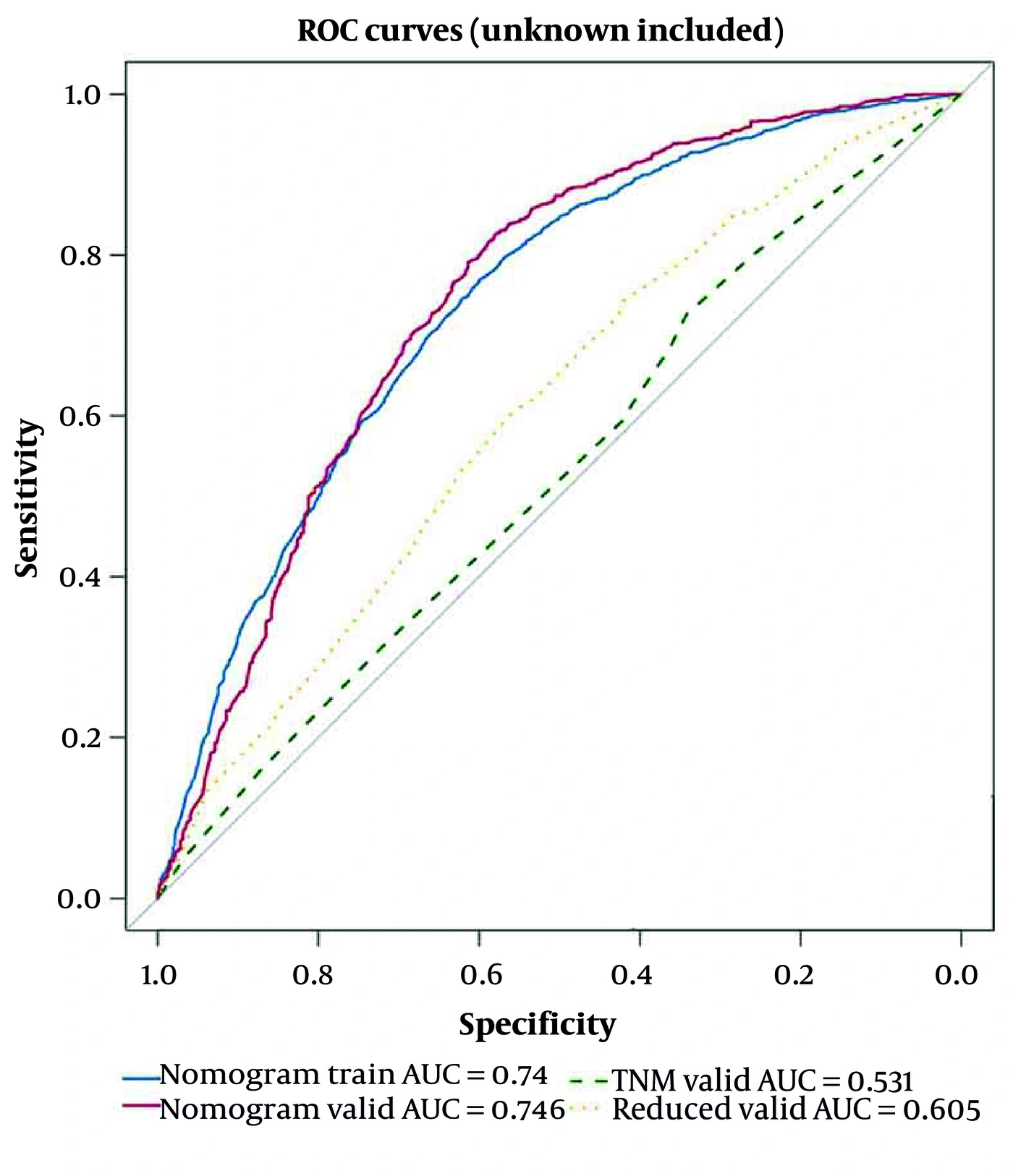
Figure 2.
Receiver operating characteristic (ROC) curves for predicting early death in patients with metastatic hepatocellular carcinoma. The curves illustrate the performance of the nomogram in the training and validation cohorts, the tumor-node-metastasis (TNM) staging model (T and N stage only), and the reduced model (excluding radiotherapy and chemotherapy) in the validation cohort.
The calibration curves (Figure 3) showed that the bootstrap-corrected curve in the training cohort closely approximated the ideal diagonal line. The Loess-smoothed calibration curve in the validation cohort also lay near the diagonal, indicating close agreement between predicted probabilities and observed frequencies. The bootstrap-corrected calibration intercept was 0, the calibration slope was 1, and the corrected Brier score was 0.193, meeting rigorous calibration standards (mean absolute error = 0.004).
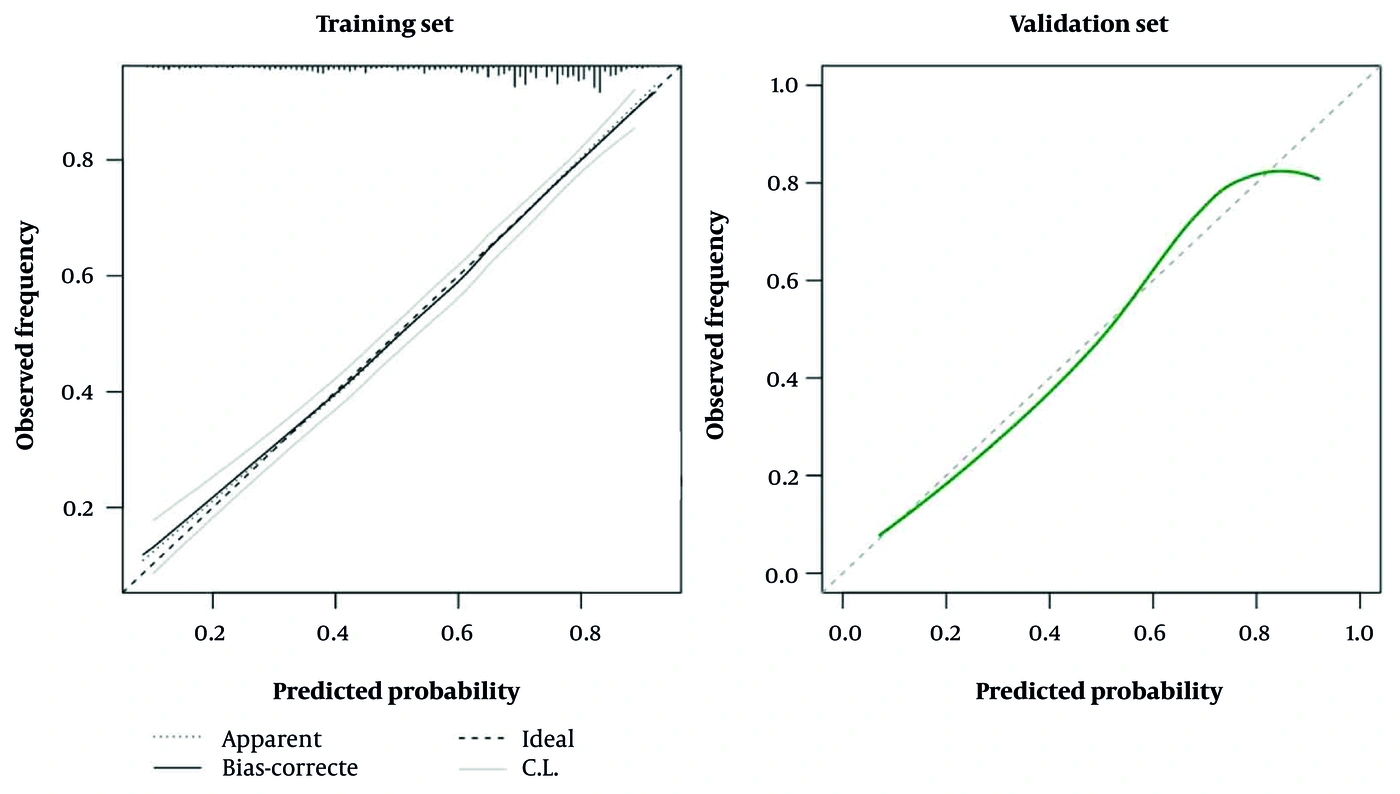
Figure 3.
Calibration curves of the nomogram for predicting early death in the training cohort (left) and validation cohort (right). The dashed diagonal line represents perfect prediction; the solid line represents the observed calibration.
Decision curve analysis (Figure 4) demonstrated that, across a threshold probability range of approximately 0.20 - 0.80, the nomogram consistently yielded greater net benefit than the “treat all” and “treat none” strategies and substantially outperformed the TNM staging model, supporting its clinical utility. This finding indicates that individualized risk stratification using the nomogram provides positive net clinical benefit across a wide range of clinically relevant decision thresholds. The threshold and corresponding clinical action, such as intensified monitoring or aggressive systemic therapy, are determined by the treating physician according to the clinical context. The nomogram remains beneficial across a range of reasonable thresholds.
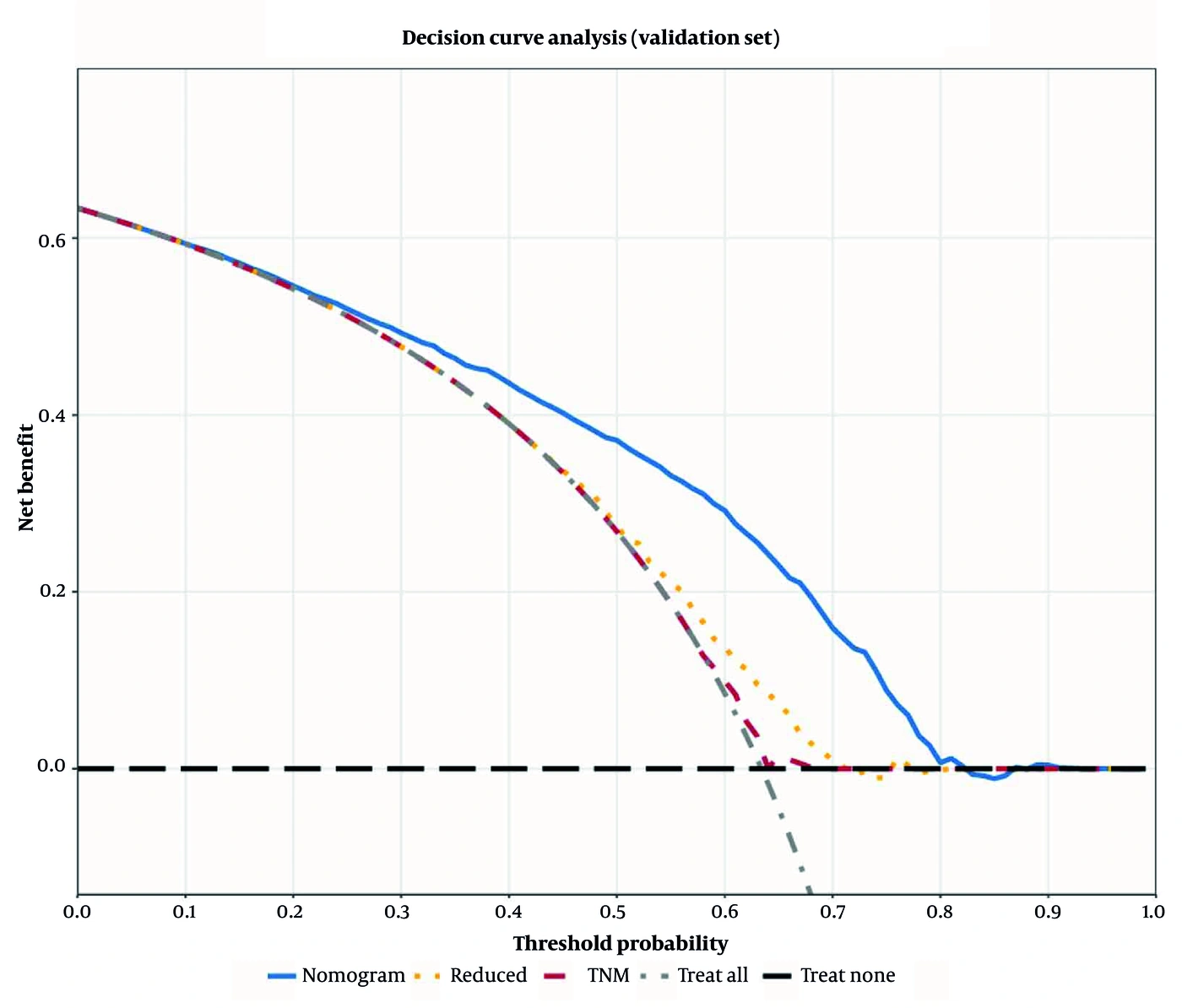
Figure 4.
Decision curve analysis of the nomogram, the tumor-node-metastasis (TNM) staging model, the "treat all" and "treat none" strategies, and the reduced model (excluding radiotherapy and chemotherapy) in the validation cohort. The y-axis represents net benefit, plotted against threshold probability on the x-axis.
When radiotherapy and chemotherapy were excluded, the reduced model, comprising age, tumor size, AFP, bone metastasis, brain metastasis, lung metastasis, and marital status, achieved a validation-cohort C-index of 0.605 (95% CI, 0.578 - 0.632). Although lower than that of the full model, its performance remained superior to that of the TNM model, which had a C-index of 0.531. This suggests that the reduced model can still provide meaningful risk stratification when treatment information is unavailable at initial diagnosis (Figure 2).
5. Discussion
This study aimed to develop a predictive model for early death in metastatic HCC using the SEER database. Against the background of increasing HCC mortality, multiple clinical factors were integrated to construct a model intended to support clinical interventions for patients with advanced HCC. The final model retained age, tumor size, AFP, bone metastasis, brain metastasis, lung metastasis, marital status, radiotherapy, and chemotherapy. Age, brain metastasis, and most marital-status categories did not reach statistical significance. Radiotherapy and chemotherapy were inversely associated with early death after diagnosis. Compared with previous models, the present model had an adequate sample size and demonstrated satisfactory performance, supporting its clinical applicability (Table 3) (5, 6).
Table 3.
Comparison of Predictive Models a
| Model | Our Model | Wang et al. (5) | Zhang et al. (4) |
|---|---|---|---|
| Sample size | 5,877 | 2,587 | 5,211 |
| Number of predictors | 9 | 7 | 10 |
| AUC (95% CI) | 0.746 (0.721 - 0.771) | 0.726 (0.702 - 0.749) | 0.789 (0.768 - 0.810) |
| Limitations | No external validation; selection bias | Based on AJCC 7th edition staging; no external validation; selection bias | Based on AJCC 7th edition staging; no external validation; selection bias |
a The AUC and 95% CI for our model refer to the validation cohort. Abbreviations: AJCC, American Joint Committee on Cancer; AUC, area under the receiver operating characteristic curve; CI, confidence interval.
In recent decades, HCC mortality has risen sharply, and overall survival remains poor, with a 5-year survival rate of approximately 21% across all races and even worse outcomes for mHCC (7). Metastatic HCC is highly heterogeneous. Patients diagnosed initially with metastasis often have advanced terminal disease and face a very high risk of death within a short period. In China, HCC is the fourth most common cancer and the second leading cause of cancer death (8). Elevated AFP and advanced TNM stage, reflecting larger tumors, lymph node metastasis, or distant metastasis, are associated with a poorer prognosis (9). In our cohort of 5,877 patients with mHCC, the overall early death rate was approximately 63%, underscoring the need for accurate short-term prognostic tools and motivating this study.
The development of HCC is associated with multiple factors. In China, HBV infection is a major predisposing factor; therefore, preventing HBV infection is crucial to controlling HCC occurrence (10). HCC commonly spreads through the hepatic vein, portal vein, and lymphatic system, and vascular invasion often indicates a poor prognosis (11, 12). Alpha-fetoprotein and protein induced by vitamin K absence or antagonist-II (PIVKA-II) are important HCC biomarkers. Their combined use with ultrasound or imaging is widespread in HCC screening (6, 13, 14).
The AJCC TNM staging system is an established standard for tumor staging. In HCC, TNM staging reflects the anatomical characteristics of the tumor but has limitations in guiding treatment and assessing prognosis (15). The Barcelona Clinic Liver Cancer (BCLC) staging system is commonly used internationally, whereas the China Liver Cancer Staging (CNLC) system is based on clinical practice in China. Although they differ in some details, both systems incorporate patient performance status and liver function, along with extrahepatic metastasis, vascular tumor thrombus, tumor number, and tumor size, to stage HCC, guide treatment strategies, and predict survival (1, 16). For metastatic HCC, these systems classify patients as BCLC stage C and CNLC stage IIIb, respectively. Both recommend systemic therapy based on immunotherapy and/or antiangiogenic targeted therapy as the principal treatment, with transarterial chemoembolization (TACE) or local radiotherapy as optional treatments depending on the patient's condition (17, 18). Common systemic treatment options for metastatic HCC include lenvatinib, sorafenib, atezolizumab plus bevacizumab, sintilimab plus bevacizumab, and camrelizumab plus apatinib (19, 20). Substantial advances have been made in integrating artificial intelligence (AI) with imaging for HCC diagnosis. Continued developments in multidisciplinary diagnosis and treatment and AI-driven diagnostics may benefit clinical diagnostic and prognostic models for HCC (21).
Larger tumor size (> 2 cm) was significantly associated with a higher risk of early death, possibly because larger tumors have greater proliferative activity and invasiveness. Age was retained in the model but did not reach statistical significance. Both bone and lung metastases indicate widespread systemic disease. Brain metastasis was also retained in the model, but its presence did not reach statistical significance. Previous reports indicate that the most common metastatic sites for HCC are the lung, abdominal lymph nodes, and bone, consistent with clinical practice.
In this study, radiotherapy and chemotherapy were administered after diagnosis and within the 3-month survival period. These variables reflect subsequent treatment and should be considered markers of clinical operability and selection bias rather than baseline predictors. Both treatments showed strong inverse associations with early death in multivariable analysis, which appears inconsistent with clinical reality. A plausible explanation is that treated patients tend to have better baseline general health, liver function, and performance status, indicating substantial treatment selection bias and confounding by indication. Thus, these findings should not be interpreted as evidence that radiotherapy or chemotherapy itself reduces the risk of early death. Rather, they may reflect clinical operability: patients unable to receive antitumor therapy are often already critically ill and have a very high probability of short-term death. From another perspective, these findings highlight the importance of active supportive care and early systemic therapy in reducing the risk of early death.
Determining the threshold probability and how it should guide clinical management is essential. However, because the model has not been widely implemented in routine clinical practice, further analyses using adequate real-world data are needed to establish a more robust and clinically appropriate threshold.
5.1. Model Strengths
1) Compared with previous models, this model includes > 5,800 patients diagnosed during 2018 - 2023 and uses AJCC 8th edition criteria, providing an up-to-date reassessment of prognostic factors in metastatic HCC (5, 6). Retaining "Unknown" as a distinct category minimizes selection bias and enhances real-world generalizability.
2) ROC analysis showed good discrimination (AUC > 0.7), whereas the conventional TNM system performed poorly. DCA also indicated that the nomogram offers greater net clinical benefit than the "treat all," "treat none," and TNM-based strategies.
3) Most predictors, including age, tumor size, bone metastasis, and lung metastasis, can be assessed at the initial visit. Radiotherapy and chemotherapy are subsequent treatments, and information about these treatments is readily accessible.
5.2. Study Limitations
1) Further collection of clinicopathological characteristics is needed, including liver function assessed using the Child-Pugh score (hepatic encephalopathy, ascites, total bilirubin, albumin, and prothrombin time), HBV infection status, and major venous tumor thrombi, such as those in the hepatic or portal veins.
2) The model was developed using SEER data and has not been externally validated. Validation in independent clinical datasets is required to assess its clinical value.
3) HCC treatment modalities are increasingly diverse, and the predictors included in our model remain limited. Future updates should incorporate additional clinicopathological features, such as the Ki-67 index and PD-1/PD-L1 expression, as well as treatment factors, including immunotherapy and targeted therapy. Data from public databases alone are insufficient; real-world data collection will be essential.
5.3. Conclusions
Using SEER data, we developed a nomogram incorporating nine variables (age, tumor size, AFP, bone metastasis, brain metastasis, lung metastasis, marital status, radiotherapy, and chemotherapy) to predict early death in metastatic HCC. The model demonstrated strong discrimination, calibration, and net clinical benefit, significantly outperforming the conventional TNM system. The nomogram provides an intuitive quantitative tool for identifying high-risk patients and guiding individualized treatment and follow-up.