1. Background
Hepatocellular carcinoma (HCC) accounts for approximately 80% of all primary liver malignancies. Globally, it ranks sixth in incidence and third in cancer-related mortality, with 2022 data reporting approximately 866,000 newly diagnosed cases and 758,000 deaths (1, 2). Surgical resection is widely regarded as one of the most effective curative options; however, posthepatectomy liver failure (PHLF) continues to compromise both immediate recovery and long-term prognosis. Reliable preoperative assessment of hepatic function is therefore essential for identifying high-risk candidates and tailoring management strategies. Although the Child-Pugh, model for end-stage liver disease (MELD), and albumin-bilirubin (ALBI) scores are routinely used, each has intrinsic limitations when applied specifically to PHLF prediction in HCC (3, 4). Platelet-albumin-bilirubin (PALBI) and aspartate aminotransferase to platelet ratio index (APRI) have demonstrated some prognostic utility; however, no composite indicator currently integrates coagulation status, markers of hepatocyte injury, and functional reserve for forecasting PHLF (5, 6).
2. Objectives
This retrospective investigation aimed to identify independent preoperative predictors of PHLF in patients undergoing resection for HCC, develop an integrated predictive tool, and compare its performance with that of existing scoring systems to improve preoperative decision support.
3. Methods
3.1. Study Population
Records of individuals who underwent partial hepatectomy for focal liver lesions at our institution between June 2022 and June 2025 were retrospectively reviewed. Of 379 initially screened cases, 228 met the inclusion criteria of histologically confirmed HCC and complete perioperative documentation. Cases were excluded for the following reasons: non-HCC histology (n = 27), previous antineoplastic treatment (n = 52), tumor thrombus in the hepatic or portal veins (n = 23), biliary tract obstruction (n = 9), severe comorbid conditions affecting vital organs (n = 7), and incomplete perioperative data (n = 33) (Figure 1).
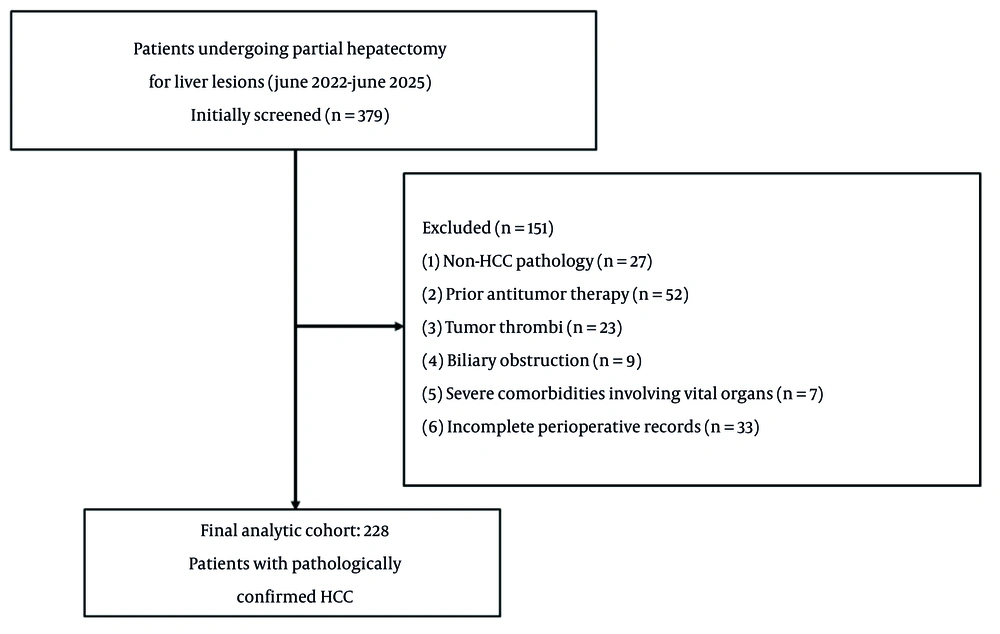
Figure 1.
Patient selection flowchart
3.2. Definitions of PHLF and Prolonged Postoperative Length of Stay
PHLF was diagnosed and graded according to the 2011 International Study Group of Liver Surgery framework, requiring an international normalized ratio (INR) greater than 1.20 on or after the fifth postoperative day in conjunction with hyperbilirubinemia, after excluding contributing factors such as medication effects or biliary obstruction (7). Patients were categorized according to the occurrence of PHLF. Prolonged postoperative length of stay (PPOLOS) was operationally defined, based on prior reports and institutional practice, as hospitalization extending beyond 14 days after surgery (8).
3.3. Calculation Methods for Liver Function Scoring Systems
Classical hepatic scoring indices were calculated as follows:
1. Child-Pugh score: The score is based on 5 indicators: albumin (ALB), total bilirubin (TBIL), prothrombin time (PT), ascites, and hepatic encephalopathy. The total score ranges from 5 to 15 and is classified as grade A (5 - 6 points), grade B (7 - 9 points), or grade C (10 - 15 points) (9).
2. FIB-4 (Fibrosis-4 index) = [Age (years) × aspartate aminotransferase(AST) (U/L)] / [platelet (PLT) (10⁹/L) × alanine aminotransferase (ALT)1/2 (U/L)] (10).
3. ALBI = log TBIL (μmol/L) × 0.66 - 0.085 × ALB (g/L) (11).
4. MELD = 3.78 × ln[TBIL(mg/dL)] + 11.2 × ln(INR) + 9.57 × ln[creatinine (Cr) (mg/dL)] + 6.4 (12).
5. ALBI-FIB4 (Albumin-Bilirubin-Fibrosis-4 Index) = 0.899 × ALBI + 0.195 × FIB-4 (13).
6. PALBI = 2.02 × log (TBIL) - 0.37 × [log (TBIL)]² - 0.04 × ALB - 3.48 × log (PLT) + 1.01 × [log (PLT)]2 (14).
7. APRI = [AST(U/L) / 40(U/L)] / PLT(10⁹/L) × 100 (15).
8. DRR (De Ritis ratio) = AST(U/L) / ALT(U/L) (16).
3.4. Statistical Analysis
All analyses were performed using SPSS version 26.0 and R version 4.4.3. The normality of continuous data was assessed using the Shapiro-Wilk test. Results are presented as mean ± SD or median (IQR) and were compared using the independent-samples t-test or Mann-Whitney U test, as appropriate. Categorical data are presented as counts and proportions and were compared using the chi-square test or Fisher exact test. Patients were randomly divided into a training cohort (n = 159, 70%) and a test cohort (n = 69, 30%). LASSO regression with 10-fold cross-validation was used for variable selection, after which multivariable logistic regression was used to obtain the weighted regression coefficients. The discrimination, calibration, and clinical usefulness of the resulting model were evaluated using area under the receiver operating characteristic curve (AUC-ROC), calibration curves based on 1,000 bootstrap iterations together with the Hosmer-Lemeshow test, and decision curve analysis (DCA), with validation repeated in the test cohort. Statistical significance was defined as a two-sided P < 0.05.
4. Results
4.1. Baseline Data
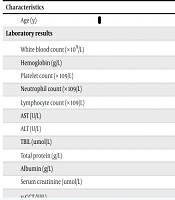
Among the overall series of 228 patients with resected HCC, 58 (25.4%) developed PHLF. Baseline characteristics did not differ significantly between the training and test cohorts (all P > 0.05; Table 1).
Table 1.
Comparison of Patient Characteristics Between the Training Cohort and the Test Cohort a
| Variables | Test Cohort (n = 69) | Training Cohort (n = 159) | P-Value |
|---|---|---|---|
| Age (y) | 56.0 (46.0, 65.0) | 57.0 (49.0, 64.0) | 0.8 |
| BMI (kg/m2) | 22.9 ± 3.4 | 23.2 ± 3.3 | 0.6 |
| Maximum tumor diameter (cm) | 5.3 (2.8, 7.3) | 4.4 (2.9, 6.5) | 0.3 |
| Cr (μmol/L) | 71.0 (64.0, 80.0) | 73.0 (61.5, 82.0) | 0.7 |
| PT (s) | 11.9 (11.2, 12.8) | 12.0 (11.5, 12.6) | 0.9 |
| PLT (× 109/L) | 171.0 (132.0, 244.0) | 186.0 (134.0, 241.0) | 0.5 |
| DRR | 1.2 (0.9, 1.4) | 1.2 (0.9, 1.4) | 0.5 |
| FIB4 | 2.2 (1.3, 2.9) | 1.9 (1.3, 3.0) | 0.5 |
| ALBI | -2.7 (-3.0, -2.4) | -2.7 (-3.0, -2.5) | 0.4 |
| ALBI-FIB4 | -2.0 (-2.3, -1.6) | -2.0 (-2.4, -1.7) | 0.3 |
| MELD | 58.2 (56.5, 60.1) | 58.3 (56.3, 60.3) | 0.9 |
| PALBI | -2.5 (-2.7, -2.3) | -2.5 (-2.7, -2.3) | 0.9 |
| APRI | 0.5 (0.3, 0.9) | 0.5 (0.3, 0.9) | 0.5 |
| Gender | 0.3 | ||
| Male | 56 (81.2) | 118 (74.2) | |
| Female | 13 (18.8) | 41 (25.8) | |
| Liver cirrhosis | 0.1 | ||
| Absent | 39 (56.5) | 107 (67.3) | |
| Present | 30 (43.5) | 52 (32.7) | |
| Tumor number | 0.1 | ||
| Single | 49 (71.0) | 131 (82.4) | |
| Multiple | 20 (29.0) | 28 (17.6) | |
| Ascites | 0.8 | ||
| Absent | 37 (53.6) | 88 (55.3) | |
| Present | 32 (46.4) | 71 (44.7) | |
| AFP (ng/mL) | 0.3 | ||
| < 400 | 61 (88.4) | 131 (82.4) | |
| ≥ 400 | 8 (11.6) | 28 (17.6) | |
| Child-Pugh grade | 0.6 | ||
| A | 59 (85.5) | 140 (88.1) | |
| B | 10 (14.5) | 19 (11.9) | |
| PHLF | 0.3 | ||
| Absent | 48 (69.6) | 122 (76.7) | |
| Present | 21 (30.4) | 37 (23.3) |
a Values are expressed as No. (%) or range.
4.2. Development of the PT-ALBI-DRR Score
In the training cohort, LASSO regression with 10-fold cross-validation was used to screen preoperative candidate predictors of PHLF among 13 variables, including demographics (age, gender, and body mass index [BMI]), imaging-derived characteristics (maximum tumor diameter, tumor number, ascites, and liver cirrhosis), and preoperative laboratory tests or derived parameters (Cr, PT, PLT, alpha-fetoprotein [AFP], DRR, and ALBI). All variables had non-zero variance and no meaningful multicollinearity. Under the lambda.1se rule, 3 predictors retained non-zero coefficients: PT, DRR, and ALBI. Each remained independently significant when entered into a multivariable logistic regression model (all P < 0.05), with coefficients of 0.736, 1.441, and 1.535, respectively (Figures 2A and B). The PT-ALBI-DRR (PAD) score was therefore formulated as follows: PAD = 0.736 × PT + 1.441 × DRR + 1.535 × ALBI.
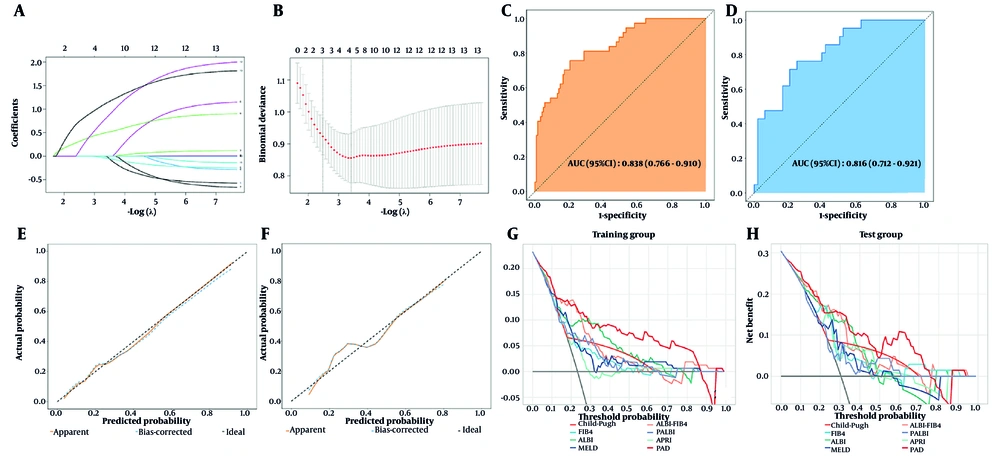
Figure 2.
LASSO regression for feature selection and development of the PAD score. (A) LASSO coefficient profiles of all candidate variables plotted against the log-transformed penalty parameter. (B) 10-fold cross-validation curve for optimal λ selection (λmin and λ1se) based on minimal binomial deviance. (C, D) ROC curves of the PAD score in the training (C) and test (D) cohorts; the AUC was 0.838 (95% CI: 0.766 - 0.910) and 0.816 (95% CI: 0.712 - 0.921), respectively. (E, F) Calibration curves in the training (E) and test (F) cohorts; the Hosmer-Lemeshow test confirmed adequate calibration in both cohorts (training: χ2 = 5.666, P = 0.685; test: χ2 = 4.727, P = 0.786). (G, H) DCA in the training (G) and test (H) cohorts, demonstrating net clinical benefit of the PAD score over treat-all and treat-none strategies across a range of threshold probabilities.
4.3. Internal Validation and Evaluation of the PAD Score
The internal validity and predictive performance of the PAD score were examined in detail. Discrimination was favorable, with AUC values of 0.838 (95% CI, 0.766 - 0.910) in the training cohort and 0.816 (95% CI, 0.712 - 0.921) in the test cohort. In both cohorts, calibration curves closely tracked the ideal diagonal, indicating good agreement between predicted probabilities and observed outcomes. This was corroborated by non-significant Hosmer-Lemeshow tests in both cohorts. DCA further showed that, across a broad range of threshold probabilities, the PAD score provided greater net clinical benefit than either the treat-all or treat-none reference strategy, supporting its practical utility (Figure 2C-H).
4.4. Predictive Performance of the PAD Score and Conventional Scoring Systems for PHLF and PPOLOS
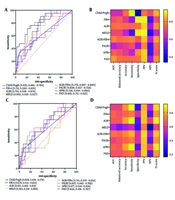
Comparative ROC analyses were conducted for PHLF and PPOLOS. For PHLF, the PAD score achieved the highest AUC of 0.816 (95% CI: 0.712 - 0.921), outperforming Child-Pugh (0.635), FIB-4 (0.712), ALBI (0.755), MELD (0.692), ALBI-FIB4 (0.779), PALBI (0.608), and APRI (0.726), confirming its superior discriminative capacity for identifying at-risk patients (Figure 3A and B).
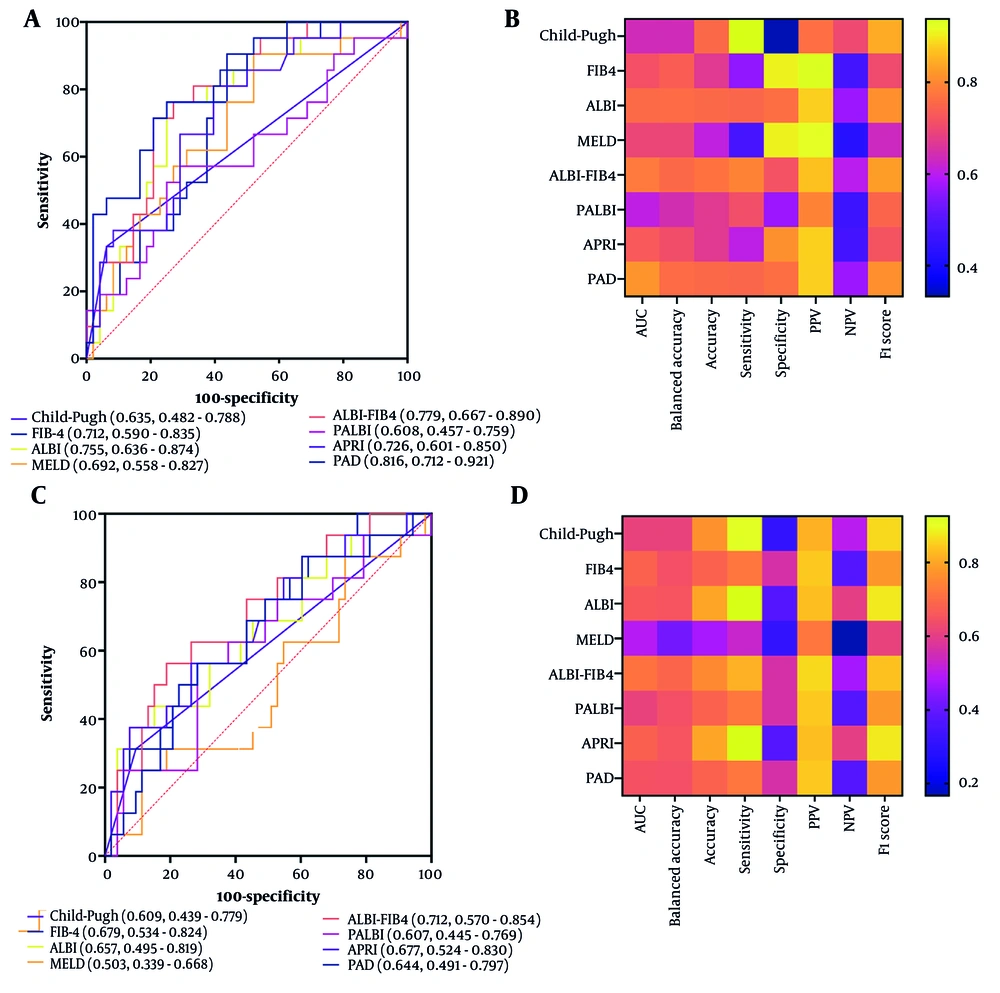
Figure 3.
Comparative predictive performance for PHLF and PPOLOS. (A, B) For PHLF, the PAD score achieved the highest AUC (0.816, 95% CI: 0.712 - 0.921), outperforming Child-Pugh (0.635), FIB-4 (0.712), ALBI (0.755), MELD (0.692), ALBI-FIB4 (0.779), PALBI (0.608), and APRI (0.726). (C, D) For PPOLOS, PAD showed moderate accuracy (AUC: 0.644, 95% CI: 0.491 - 0.797).
In contrast, the PAD score showed only moderate accuracy for PPOLOS, with an AUC of 0.644 (95% CI: 0.491 - 0.797). The corresponding AUCs for Child-Pugh, FIB-4, ALBI, MELD, ALBI-FIB4, PALBI, and APRI were 0.609, 0.679, 0.657, 0.503, 0.712, 0.607, and 0.677, respectively. Collectively, these findings suggest that the PAD score is better suited for forecasting PHLF than for predicting PPOLOS (Figure 3C and D).
5. Discussion
PHLF is a severe complication after hepatectomy in patients with HCC. Previous studies have reported incidence rates ranging from 0.7% to 39.6%, with an associated mortality rate of approximately 50% (17-19). In the present cohort of 228 patients, the PHLF incidence was 25.4%, consistent with previous reports. Therefore, identifying at-risk candidates before surgery is important to refine operative planning, tailor perioperative protocols, and ultimately improve clinical outcomes.
Current assessment systems, such as Child-Pugh, MELD, and ALBI, are widely used but have limited discriminatory ability for predicting PHLF in clinical practice. The Child-Pugh score, which incorporates subjective indicators, has a ceiling effect in well-compensated patients and fails to stratify risk within the same grade. In the test cohort of the present study, it yielded an AUC of only 0.635, consistent with Mai et al. (AUC = 0.619), suggesting inadequate capture of surgical stress and postoperative metabolic demands (20). MELD, originally designed to predict mortality among candidates with end-stage liver disease awaiting transplantation, similarly performed suboptimally (21). Its heavy reliance on Cr may not adequately reflect hepatic reserve in a surgical cohort in which renal function is often preserved, potentially misrepresenting the primary driver of PHLF risk. These findings highlight the importance of evaluating the generalizability of scoring models when they are applied across different clinical contexts.
Although novel scoring systems have improved PHLF prediction in patients with HCC, limitations in predictive capability and clinical applicability persist. ALBI integrates ALB and TBIL as objective surrogates of hepatic synthetic and excretory function and outperforms both Child-Pugh and MELD, consistent with Shi et al. (22). However, these markers alone do not fully capture hepatic reserve under surgical stress, because coagulation function and hepatocyte injury reflect critical dimensions of acute functional reserve and regenerative potential that ALBI does not address (23). The PALBI score incorporates PLT as a proxy for portal hypertension severity but yielded an AUC inferior to that of ALBI, consistent with Wong et al. (0.625 vs. 0.671) (24). These findings indicate that PLT has limited direct relevance to acute postoperative hepatic decompensation, may be confounded by hypersplenism, bone marrow suppression, and immune mechanisms, and lacks sensitivity to remnant functional reserve and regenerative capacity. Moreover, the complexity of the PALBI formula, involving multiple logarithmic transformations and potentially suboptimal weighting, may further limit its clinical utility.
Fibrosis-based indices, including FIB-4 and APRI, assess chronic liver disease progression through noninvasive surrogates and yielded AUCs of 0.712 and 0.726 in this study, consistent with prior reports (6, 25). Their suboptimal predictive performance likely reflects their focus on chronic structural changes rather than acute hepatic functional reserve, because fibrosis correlates less strongly with postoperative decompensation than indicators of hepatic synthetic capacity (26). The ALBI-FIB4 score, which integrates functional reserve with fibrosis assessment, achieved an AUC of 0.779 and demonstrated superior predictive efficacy for PHLF compared with other scoring systems, consistent with Tian et al. and supporting the value of multidimensional composite scoring for assessing acute hepatic functional status under surgical stress (13). Nevertheless, the present study identified PT as an independent risk factor for PHLF, indicating that coagulation function carries significant predictive value but remains absent from the ALBI-FIB4 framework, leaving acute hepatic synthetic reserve incompletely captured. Moreover, FIB-4 has limited sensitivity to acute functional alterations because it predominantly reflects chronic fibrosis, whereas elevated DRR more directly reflects acute hepatocellular injury under surgical stress via mitochondrial impairment (27). Collectively, optimal PHLF prediction models should prioritize intrinsic hepatic functional reserve and regenerative capacity.
To address the limitations of existing models in simultaneously capturing hepatic reserve, acute injury, and synthetic function, this study proposes the PAD score, a multidimensional index that integrates 3 complementary biological domains. PT prolongation, reflecting impaired synthesis of vitamin K-dependent coagulation factors (FII, FVII, FIX, and FX), serves as a sensitive indicator of acute hepatic synthetic capacity because of the characteristically short half-lives of these factors (28, 29). ALBI provides an objective measure of baseline hepatic reserve derived exclusively from serum albumin and total bilirubin, eliminating interobserver variability inherent in subjective grading systems. Its continuous mathematical structure enables granular risk stratification and overcomes the ceiling effect of categorical systems such as the Child-Pugh classification. The DRR reflects acute hepatocellular injury and mitochondrial dysfunction through a well-established biochemical mechanism. Because AST is present in both mitochondrial and cytoplasmic compartments whereas ALT is predominantly cytoplasmic, severe hepatocellular insults precipitate disproportionate mitochondrial AST release, producing selective DRR elevation that captures parenchymal injury depth beyond what either transaminase alone can convey (30). In patients with HCC undergoing hepatectomy, DRR has been validated as an independent predictor of PHLF, supporting individualized risk stratification and clinical decision-making (31). Collectively, these 3 parameters assess hepatic status across complementary dimensions, establishing a comprehensive functional assessment framework.
The PAD score is calculated from 3 simple, routinely available preoperative laboratory tests, making it cost-effective and readily implementable at the bedside without specialized imaging or invasive procedures. A high PAD score could prompt clinicians to consider preoperative optimization strategies, such as nutritional support or portal vein embolization, or to select less extensive resection. It could also guide postoperative management by identifying patients who warrant more intensive monitoring in a high-dependency or intensive care setting. As shown by DCA, use of the PAD score may lead to better clinical decisions by reducing unnecessary interventions for low-risk patients while ensuring that high-risk patients receive appropriate attention. These findings underscore the importance of refining preoperative assessments to improve outcomes, whether through laboratory-based predictors or advanced imaging features, and highlight the ongoing need for better risk stratification tools.
Beyond its primary endpoint, the PAD score showed moderate discriminatory ability for predicting PPOLOS, a surrogate for overall recovery burden, and outperformed several traditional scoring systems. These findings suggest ancillary value in forecasting postoperative resource utilization and recovery trajectories, indicating that the model captures a broader spectrum of postoperative morbidity related to hepatic vulnerability.
5.1. Limitations
Several limitations should be acknowledged. First, the retrospective single-center design and modest cohort size entail inherent biases, necessitating subsequent external validation across diverse liver disease etiologies, operative approaches, and geographic populations. Second, although the PAD score was pragmatically derived from 3 routine biochemical parameters, future studies should evaluate whether incorporating radiologic features would augment its stratifying capacity. Third, the absence of extended follow-up precludes conclusions regarding the score's implications for long-term survival or quality of life. Finally, because this analysis was restricted to partial hepatectomy recipients, extrapolation of the PAD score to patients managed with liver transplantation, transarterial chemoembolization (TACE), or other locoregional modalities awaits further confirmation.
5.2. Conclusions
This study developed and internally validated the PAD score, a novel preoperative index combining PT, DRR, and ALBI. The model was simple and objective while delivering superior discrimination, reliable calibration, and clinical usefulness for PHLF prediction in patients with HCC undergoing hepatectomy, outperforming seven established scoring systems. The PAD score therefore represents a promising instrument for strengthening preoperative risk stratification, facilitating shared decision-making, and informing perioperative management.