1. Background
Hepatitis A virus (HAV) is a major cause of acute viral hepatitis throughout the world (1). It accounts for 1.5 million cases of hepatitis each year (2). The main route of HAV transmission is the fecal - oral, by ingestion of contaminated food or water (3) or through contact with an infected person (4).
The epidemiologic pattern of HAV is dependent on age and hygiene level (5). The severity of HAV clinical symptoms in infected cases is strongly related to age. Young children are mostly asymptomatic, however, the infection is important in older children and adults due to severe clinical manifestations (5). In young children, HAV infection symptoms are similar to gastroenteritis or a viral respiratory infection, followed by hepatomegaly and jaundice. Then, a convalescent period begins that lasts for several weeks (6). HAV infection can rarely cause acute liver failure and death; this risk increases with age (7).
In the past, due to large population, low socioeconomic status, and inadequate clean water, high endemicity of HAV was seen in developing countries and more than 90% of the population acquired natural immunity before 10 years of age (8, 9). However, now, in these countries, improvement in socioeconomic status, standards of hygiene, and sanitation lead to a rise in the mean age of HAV exposure (5, 10, 11). Due to the fact that the risk of developing symptomatic HAV infection increases with age, when a country experiences an epidemiological transition to a lower HAV endemicity, HAV affects the population at a later age with an increased risk of symptomatic HAV infection, including acute liver failure and death (5).
So far, global reports had considered Iran as an intermediate endemic area for HAV (1, 12). However, recent investigations showed that the prevalence of the HAV infection in different parts of the country is declining (13-15) and now Iran can be considered as a low endemic area for HAV infection (16).
Age - specific seroprevalence studies are a reliable method to estimate the susceptibility rate to HAV infection in different populations and can help establish the vaccination implementation policies (16). The World Health Organization also emphasizes that each country should collect the information regarding the seroprevalence of HAV in different age groups to provide evidence for health policy makers to implement appropriate and cost - effective preventive strategies for HAV infection (12).
2. Objectives
In this study we aimed to determine the age - specific HAV seroprevalence among 1 to 23 year subjects residing in Tehran, capital city of Iran to assist to make an appropriate decision about HAV vaccination in the Iranian population.
3. Methods
In this cross - sectional study, blood samples of 1120 cases (516 male and 604 female) between the ages of 1 - 23 years, who were referred to the hospitals’ biochemical laboratories in Tehran for diagnostic purposes, were collected and tested for total hepatitis A antibody (anti - HAV) between January to July 2017. This project was approved by Pasteur Institute of Iran Ethical Committee and informed consent was obtained from subjects or their parents prior to the enrollment. Subjects who either suffered from chronic diseases, immunodeficiency disorders or had received intravenous immunoglobulin (IVIG) were excluded from the study.
The cases were categorized into five age groups: Group 1 (1 - 5 years; N = 228), Group 2 (6 - 10 years; N = 231), Group 3 (11 - 15 years; N = 283), Group 4 (16 - 19 years; N = 201), and Group 5 (20 - 23 years; N = 177).
Blood samples were collected in serum separating tubes, left to clot at room temperature for 30 minutes, then centrifuged and stored at -80°C until analysis.
Serum samples were tested for anti - HAV using enzyme - linked immunosorbent assay (ELISA). The commercial enzyme immunoassay kit was Dia.Pro Diagnostic BioProbes Srl, Milan, Italy.
The procedure was followed as indicated by the manufacturer. According to the manufacturer’s manual, the anti - HAV detection sensitivity is 100% and specificity is more than 98%.
3.1. Statistical Analysis
The Chi - square and t2 - tests were used with the SPSS 16 package program for statistical analysis (Chicago, IL, USA). Data are presented as mean ± SD or, when indicated, as an absolute number and percentage. The 95% confidence interval (95% CI) was calculated. P values < 0.05 were considered statistically significant.
4. Results
A total of 1120 cases (516 male and 604 female) between the ages of 1 - 23 years were enrolled in the study. The overall prevalence of total anti - HAV was 6% (95% CI: 4.74% - 7.52%). HAV prevalence rates, according to age groups were as follows: Group 1; 5.7% (95% CI: 3.36% - 9.51%), Group 2; 1.7% (95% CI: 0.67% - 4.36%), Group 3; 4.2% (95% CI: 2.44% - 7.26%), Group 4; 5.5% (95% CI: 3.08% - 9.53%), and Group 5; 15.3% (95% CI: 10.7% - 21.28%) (Figure 1).
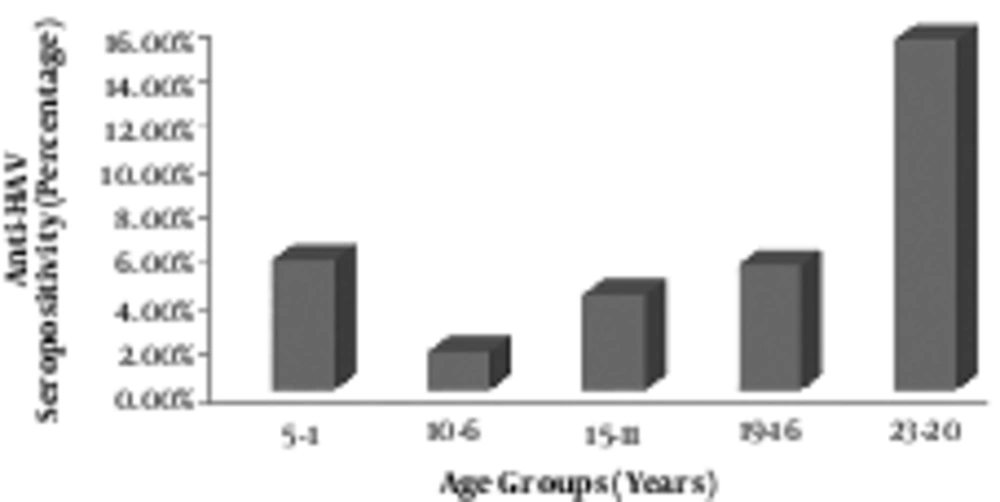
Figure 1.
Anti - HAV Seroprevalence in Different Age Groups
Except for the 6 - 10 year age group, an increase in HAV seropositivity was observed with the age. The seroprevalence progressively increased from 4.2% in 11 - 15 years to 15.3% in young adults (20 - 23 years). Anti - HAV seropositivity in terms of age groups was significantly different from each other (P = 0.000).
The HAV seroprevalence rate was 32.8% in males and 67.2% in females with a significant difference between genders (P = 0.025).
5. Discussion
In this study age - specific HAV seroprevalence among 1 to 23 years subjects referred to hospitals’ biochemical laboratories in Tehran, capital city of Iran, were investigated. The total anti - HAV seropositivity was 6%. Except for the 6 - 10 year age group, HAV seroprevalence progressively increased with age.
HAV seroprevalence showed significant variations in different parts of the world. In most developed countries such as Western Europe, North America, Australia, and Japan, good condition of sanitation and hygiene results in low rates of HAV infection (1). Nordic European countries show lower levels of HAV endemicity compared to Central, Southern, and Eastern Europe (17). Studies showed that most of Africa remains a high endemicity region for HAV infection, with the exception of subpopulations in some regions like white people in South Africa (1). In Asia, HAV seroprevalence rates differ considerably among countries, some continuing to have high rates of HAV infection and others show a transition to moderate or low incidence of HAV (1).
HAV seroprevalence showed significant difference in various parts of Iran (18-23). This divergence in HAV seroprevalence could be due to different studied populations with different socio - economic and hygienic status as well as different selection methods.
In the past, HAV was endemic in Iran. In 1980, Farzadegan et al., reported an almost complete immunity against HAV among adults after the age of 30 years (24). Afterward, Saffar et al., conducted an age - specific seroprevalence study in Mazandaran (North of Iran) in 1997 and showed a high prevalence rate (87%) of HAV infection in 1 - 15 year old subjects (25). Few age - specific HAV seroprevalence studies from 1997 to 2000 also reported high prevalence rates of HAV infection (26, 27). Later to 2000, other seroepidemiological surveys demonstrated lower rates of infection, especially among children in some parts of the country (28, 29). Other investigations also showed less HAV seroprevalence rates in almost two decades in the Iranian general population (16, 30). Our study also showed low anti - HAV seropositivity in Tehran, capital city of Iran, in comparison to previous studies in this region (20, 21, 29). Therefore, due to improved socioeconomic and sanitation conditions, the epidemiological pattern of HAV had improved in Iran and HAV seroepidemiology was shifting to lower rates of endemicity.
The recent changes in socioeconomic status, standards of hygiene and sanitation in Iran had caused that the most susceptible population change from children to adolesents, young adults, and adults (31, 32). While infected children often have asymptomatic infection, the HAV infection is important in older age groups due to clinical manifestation of infection (33). Our study also showed that HAV seroprevalence progressively increased with age.
In our survey, the HAV seroprevalence rate was higher in females than males. Our finding is consistent with other studies (3, 16, 34), however, in contrast to other investigations (35-38).
HAV vaccines had been available since the early 1990s, however, it has not yet entered into the Expanded Program of Immunization (EPI) in Iran. Regarding the shifting of epidemiological pattern of HAV infection from high to lower endemicity in Iran and the trend towards a lower HAV seroprevalence in younger children in recent years, vaccination of this subgroup seems logic and beneficial. Other recent studies also showed higher rate of HAV seroconversion in Iranian adolescents and suggested that mass vaccination of children may be beneficial and can be considered by national health authorities (16, 30, 39).
5.1. Conclusion
Our study demonstrates that most young children are susceptible to HAV infection, whereas adolescents and young adults are at a higher risk for HAV acquisition. Further, HAV seroprevalence studies in different parts of the country together with nationwide seroprevalence surveys and active surveillance of clinical hepatitis A burden assist the health managers to provide correct policies for HAV prevention and possible consideration of adding HAV vaccination to national vaccination program.