
1. Background
Leukemia accounts for 8% of all human cancers and about 7% of all deaths from malignancies; it ranks 14th in cancer types around the world and 7th in Iran (1-4).
The prevalence of AML is approximately 3.2 per 1000 000 people, which increases with age; so, it is estimated to increase to 1.7 by age 65 and, then, to 16.2. The mortality rate from AML under the age of 10 is 0.5 and 20 per 100 000 people in the 9th decade of life (5).
AML is more common in the United States, Australia, and Western Europe, and it is more common in females. American men have the highest numbers compared to other countries. AML is the most common type of leukemia in adults, and it is more commonly seen in older people than in youth and even adolescents. The average age of AML is about 65 years. Mortality rates in AML depend on factors such as age, sex, and race, and these factors may be affected separately. For example, death rates in the United States are more related to age. Mortality in whites is also much higher than in blacks. Of course, the reasons for these gender and racial differences have not been identified (6).
Acute myeloid leukemia (AML) is the second common leukemia (%18.5) and the third deadliest leukemia in Iran. It is the most common acute leukemia in adults and people over 60 years of age and is more prevalent in men than women (2, 7). In our country, the estimated number of new cases of Leukemia were 5437 and 3711 death numbers and the age-standardized (World) incidence rate is 14.5 per 100 000 in 2018 (4).
AML is a clonal disorder of hematopoietic stem cells (8) and its risk factors vary from congenital and hematological disorders to environmental exposures and chemotherapeutic agents (9). Although some studies on the geographic patterns of the disease indicated more AML prevalence in North America, Western Europe, and Australia, it is one of the main health problems all over the world (10).
Even though recent advancements in therapeutic approaches increased the cure rate up to 15% in patients older than 60 years and about 40% in patients below 60 years of age, AML is a poor prognosis disease especially in the elderlies, and about 70% of deaths occur in patients aged 65 years or older within 1 year following diagnosis (3, 10).
Treatment strategies in AML patients, based on their risk-stratification, involve standard or increased therapeutic regimen intensity, consolidation therapy, or hematopoietic stem cell transplantation (3).
Therefore, induction therapy (combination of cytarabine [100 - 200 mg/m2/day for 7 days] and daunorubicin [45 - 90 mg/m2/day for 3 days, named as the “7 + 3 regimen”]) starts as the first step of the treatment procedure to achieve complete remission, and in the case of favorable response the procedure, it should be followed by consolidation therapy. However, there is a risk of resistance or relapse in patients undergoing stem cell transplantation (2, 8). Therefore, a precise evaluation of prognosis factors is essential for risk-stratification and therapy management and avoiding wrong treatment decisions.
Moreover, the new drugs and their increasing expenses, the advancement in technology, and limitations in health-care services, such as financial and human resources necessitate cost estimation studies to provide clear insights into the current situation and choose appropriate therapeutic agents.
Cost-of-illness studies are intended to identify the economic effects of a disease on society (economic stress). These descriptive studies seek to determine the type and amount of costs and problems that arise in a health care system and show their economic burden. Cost forecasting is essential for planning to provide services within the budget and to prioritize various interventions in health care systems (11). Given the limited financial and human resources to provide health care in different sectors (12), cost evaluation studies can be a valuable tool to consider the economic burden imposed by disease (11) and facilitate planning and prioritization for the management of this disease in the future. The present study is a cost evaluation study.
Among the costs that are considered in disease, cost studies are direct costs. Direct costs are divided into two types of direct medical costs and direct non-medical costs (13). Direct treatment costs refer to costs that are incurred directly in connection with the provision of medical services to patients. The second group is direct non-medical costs. These costs are auxiliary resources that patients pay in exchange for medical services, such as the cost of out-of-town transportation or intra-city transportation to reach specialized treatment centers, the cost of home care, all of which are paid from the patient's pocket (14).
2. Objectives
Although the assessment of cost analysis of AML treatment is complicated, it offers valuable information for healthcare providers, health professionals, and policymakers about the effective use of resources in AML management and improvement of community health standards. As stated earlier, AML is among the most common cancers in Iran; therefore, this study was conducted to calculate its cost analysis (direct medical and non-medical costs) in 2019.
3. Methods
This retrospective-descriptive study was conducted between January 2016 and December 2018. The population consisted of 290 patients aged 19 to 70 years with AML in Shariati Hospital in Tehran (the most prestigious medical, research, and educational centers in the country and one of the 4 most important stem cell transplant centers in the world, which admits patients from the entire country). Moreover, the obtained results can be generalized to the whole country, since the tariff for medical services is the same throughout Iran. The data were collected from hospital records and interviews with experts, based on which 192 patients were included in the study because they met the inclusion criteria. The inclusion criteria include patients, whose information during all stages of treatment was completely recorded. The exclusion criteria included patients under 19 years of age and those aged 70 years or older, who were unable or unwilling to answer questions. Also, some patients were excluded from the study, such as the children, due to their different treatment protocol, as well as patients, whose information was not recorded in the information system or their treatment period was not completed either due to death or referral.
The bottom-up approach was used for the cost analysis. In the bottom-up approach, the average cost per patient is first calculated and, then, multiplied by the total number of patients. To calculate the cost per patient, the various components of the cost are identified and the cost generated is measured for each component. For example, to calculate the total cost of patients' travel, the average number of trips per patient is multiplied by the average cost of each trip and, then, multiplied by the total number of patients (15).
All hospital-related costs linked to AML treatment were included in the cost analysis. Since those patients are insured, costs are mainly paid by health insurance.
Direct medical cost data were abstracted from inpatient and outpatient medical records; thus, it included the costs of diagnosis, hospitalization, nursing, operating room, visits, chemotherapy, medication, and medical supplies. Diagnostic costs consist of the cost of pathology, laboratory tests, consulting, radiology, and ultrasound. The questionnaire was used as a data collection tool for calculating direct non-medical costs in this study. Content validity was used to determine the scientific validity of the questionnaire so that the questionnaire was prepared and confirmed by scientific texts and opinions of some professors of medical universities. Before collecting data, the questionnaire was piloted on some patients and the ambiguities of the questionnaire were identified and resolved. The face-to-face interviews or telephone interviews with patients or their companions were performed to ask about the imposed costs, such as travel and patient care costs at home. In this study, costs were calculated and evaluated based on the payer's perspective. Accordingly, all costs incurred in managing the disease, regardless of who is paying (patient, insurance, or health system), were considered and calculated. However, in this study, only the direct treatment and non-treatment costs of AML were evaluated.
The demographic characteristics and types of costs were described by the mean, standard deviation (SD), and reported by percentage also analyzed by SPSS 11 software. Because the sample size was 192, the Shapiro-Wilk criterion was used. Total costs were taken as the dependent variable and demographic information, length of stay (LOS), costs of hospitalization, medication, diagnostic, and other costs were the independent variables. Differences between gender and costs were evaluated by the Mann-Whitney test, and to assess the costs differences between age groups and LOS, Kruskal–Wallis test was used. For the sake of international comparison (16), all costs converted into United States dollars (USD$) based on the average exchange rate in 2019.
4. Results
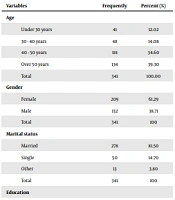
According to the findings, 55.7% of patients were male and 44.3% were female. Also, the mean age of the patients was 43.91 (± 13.02) with the age range of 19 to 70 years; 68.3% of the patients had an academic degree, 96.8% were insured, and the share of insurance was 54%. The average monthly income was $80.17 (± 11) (Table 1).
Table 1.
Socio-economic and Demographic Characterizations of Patients with AML
| Variables | Mean ± SD | Relative Frequency (%) | P-Value |
|---|---|---|---|
| Gender | 30.7 | ||
| Male | 55.3 | ||
| Female | 44.7 | ||
| Age group | 43.91 ± 13.02 | 0.428 | |
| 19 - 28 | 16.1 | ||
| 29 - 38 | 19.8 | ||
| 39 - 48 | 21.4 | ||
| 49 - 58 | 2 6.6 | ||
| 59 - 68 | 16.8 | ||
| 69 - 78 | 1.6 | ||
| Education | |||
| Academic | 31.7 | ||
| Non-academic | 68.3 | ||
| Medical insurance | 96.8 | ||
| Average monthly income | 80.17 ± 11 | ||
| LOS | 76.98 ± 36.385 | < 0.001 | |
| 1 - 29 | 11.5 | ||
| 30 - 60 | 22.4 | ||
| 61 - 90 | 35.9 | ||
| 91 - 120 | 11.5 | ||
| > 120 | 18.8 |
Abbreviation: SD, Standard deviation.
The results of the Mann-Whitney test showed no significant differences between men and women in total costs, costs of hospitalization, medication, diagnostic and other costs (P > 0.05).
Patients were classified into 6 age groups; 26.6% of patients were in the age group of 49 to 58 years, 21.4% were in the age group of 39 to 48 years, and the 69 to 78 age group had the lowest frequency (1.6%) compared to other groups. Also, 19.8% of patients in the 29 to 38 age group, 16.1% in the 19 to 28 age group, and 16.8% of patients were classified in the age group of 59 to 68 years.
Based on the results of the Kruskal-Wallis test, there is not a significant difference between the age of groups and in total costs, hospitalization, medication, diagnostic, and others cost (P > 0.05).
The mean length of hospitalization was 76.98 ± 36.38 days. The lowest and longest hospitalizations were 15 and 172 days, respectively; 11.5% of patients with hospital stay duration of 1 to 29 and 91 to 120 days, and 35.9% of patients had 61 to 90 hospitalization days. Also, 22.4% and 18.8% of patients had 30 to 60 and more than 120 hospitalization days, respectively (Table 1).
According to the Kruskal-Wallis test results, costs of hospitalization, medication, diagnostic costs, and other costs as well as total cost based on the length of hospitalization days have been significantly different (P < 0.05), and this difference is greater with increasing of hospital stay duration. The difference in the cost of medication based on length of stay in hospital was more than other fees. Then, the cost of the diagnostic ranked second.
The components of the direct medical costs of AML are presented in Table 2. Diagnostic costs include the cost of radiography, consulting, radiology, sonography, laboratory testing, and pathology. The highest diagnostic costs were related to laboratory tests $1656459.48 followed by radiology costs $110144.40 and counseling costs $107194.37. Moreover, laboratory and radiological services were performed for all patients. The cost of pathology services was $86082.94. The lowest diagnostic costs were related to radiography at $61949.41 and ultrasound at $4229.46.
Table 2.
The Direct Medical Cost of AML ($)
| Type of cost | Sum Cost | Cost (Mean) | SD | Total cost (%) |
|---|---|---|---|---|
| Hospitalization | 3219105.21 | 14753.51 | 4967 | 0.31 |
| Medication | 3971178.98 | 18216.42 | 9872 | 0.38 |
| Visit & consultation | 434945.82 | 1995.16 | 256 | 0.04 |
| Operation room | 132894.29 | 334.42 | 98 | 0.01 |
| Medical supplies | 453217.65 | 2078.98 | 318 | 0.04 |
| Nursing | 209071.04 | 959.04 | 211 | 0.02 |
| Diagnostic services | 2065075.49 | 9367.15 | 916 | 0.20 |
| Total | 10485488.48 | 48098.57 | 13067 | 100 |
| Share of patients | 1056624.78 | 4846.90 | 675 |
Abbreviation: SD, Standard deviation.
The total cost per patient was $1056624.78 with an average of $4846.90. The cost of medication includes 36% of the total direct medical costs followed by hospitalization (31%) and diagnostic (20%) costs.
The direct non-medical costs of AML in Iran in 2019 were demonstrated in Table 3. Telephone interviews revealed that most of the patients needed care during or after hospitalization. The average home care days were 64 days. Patients' care often was performed by their couples or a family member, while in a few cases, those were conducted by a hired nurse. In addition, the average number of transportations were approximately 20 trips. The average cost of transportation and home caring were $486.69 and $2052.50, respectively.
Table 3.
The Direct Non-Medical Costs Due to Acute Myeloid Leukemia in 2019 ($)
| Cost Type | Travelling Costs | Home Care Costs | Total |
|---|---|---|---|
| Direct non-medical costs | |||
| Per patient | 486.69 | 2052.50 | 2539.18 |
| Total | 93443.59 | 394079.28 | 487522.87 |
5. Discussion
The aim of this study was to determine the cost-analysis of treating AML. The results of our study show that the largest share of the costs of AML treatment, like other types of leukemia, has been due to the hospital and medication costs. The highest rate of total in-hospital costs was related to medication (38%) followed by the cost of hospitalization (31%). According to the results, the average cost of medication and hospitalization was $18216.42 and $14753.51 in 2019. These findings are consistent with those of the study by Hayati et al., who found hospitalization (40.3%) and medication costs (26.1%) as the highest direct medical expenses (17). Similarly, in the study of Daroudi et al., the total direct medical costs of chronic myeloid leukemia in Iran was $23089323, 97.3% of which was spent on medicine (18). The results of Menzin et al.’s study indicated that 84% of direct costs were related to hospitalization costs (19).
Based on the findings, the diagnostic costs accounted for 20% of total in-hospital costs, 80% of which was related to laboratory tests during treatment. These are in line with the findings of the study by Davari et al., who studied the direct therapeutic costs of acute lymphocytic leukemia in children aged 1 to 15 years in Isfahan Province and found that the highest diagnostic cost was associated with laboratory testing costs with an average of $103.22 (20).
Moreover, the findings demonstrated that the average cost of AML for each patient was estimated to be $48098.57 in 2019 and the share of the patient was $4846.90, while in Hagiwara et al.’s study, the average total cost per patient was $386077 (21). Moreover, the results of the study of Menzin et al. (19) indicated that costs for adults of AML were $62070.83 (in 2019 US dollars). Finally, it can be concluded that most of the treatment costs for AML patients in Iran have been provided by insurance organizations and the government; so, the payment from the patient's pocket is very small. The high share of drug costs shows that chemotherapy drugs are one of the main reasons for the increase in out-of-pocket payments.
Most studies have only calculated direct medical costs and have not considered direct non-medical costs but in the study of Hayati et al., the non-medical direct cost was $1688.9 that the largest share belonged to transportation at $675.5 (17).
The diagnosis of AML in patients is associated with frequent hospitalizations, frequent outpatient visits, and significant use of expensive drugs that lead to higher costs for these patients (22, 23). Also, the disease progression and the increase in patient care resulted in cost increases. On the other hand, the need for intensive care also increases the cost of hospitalization. Up to 26% of patients need to be admitted to the intensive care unit (23, 24) and for those aged 60 and over, admissions to the intensive care unit will increase by 30.1%. In addition, frequent hospitalization and outpatient visits in the first year after diagnosis is an important factor in the cost of AML (23-25). According to the results of our study, hospitalization and drug costs had the largest share of direct medical costs and 35.9% of patients had a length of hospital stay of 90 to 61 days and the average length of hospital stay in patients was 76.98 days.
In our study, the transportation cost was $93443.59 and due to the greater need of patients for home care, the highest direct non-medical costs belonged to home care costs at $394079.28.
Information on health care costs can help health system managers and officials to distribute financial resources efficiently and effectively and make appropriate decisions about prevention or treatment programs and budgeting. In addition, the cost of this disease can be used as an introduction to other economic studies in this field.
The present research was the first study to examine the costs of AML patients in Iran; however, it should be noted that the calculated costs may be less than the actual amount of costs of the disease, which could be attributed to the defects in patient information registration and incomplete registration of processes and care costs by employees.
Another limitation of this study was the lack of cooperation between some patients and their companions. In this case, an attempt was made to obtain their consent for the interview by talking to patients and their companions, explaining the importance of this issue and the results of the study, which help improve patients' well-being. Another limitation of the study was the error of reminding patients and their families in expressing the type and amount of costs, which was tried to reduce this error as much as possible by preparing a comprehensive questionnaire to remind costs from the time of the interview.
5.1. Conclusions
The costs of AML treatment in patients aged 19 to 70 years amounted to $10485488.48, which due to hidden subsidies in governmental sectors, are much less than the actual costs spent for these patients. Inpatient and medication costs of AML account for the highest percentage of expenses and are important factors in the cost of treatment of these patients. Finally, it can be concluded that the direct medical cost of AML in Iran is much cheaper than that compared to other countries and also the payment from the patient's pocket is very small.