
1. Background
Cancer is a large group of non-communicable diseases that result from the uncontrolled growth of abnormal cells and can affect various organs. It is a leading cause of death worldwide, responsible for nearly 10 million deaths in 2020- approximately one in six deaths (1). In the United States, cancer is reported the second-leading cause of death in the general population and the leading cause among people younger than 85 years (2). The estimates suggest that approximately one in five individuals, regardless of sex, develop cancer in their lifetime, while around one in nine men and one in 12 women die from disease. Demographics‐based predictions indicate that the number of new cases of cancer will reach 35 million by 2050 (3). The burden of cancer is particularly relevant in the Middle East, where more than 430,000 new cancer cases were reported in 2020 (4). Cancer is also a public health problem in Iran and is increasing significantly in both sexes (5). According to research, this disease is the third cause of death in Iran after cardiovascular diseases and accidents, which leads to the death of 50,000 people annually (6-8). Due to many reasons, such as the increase in the aging population, changes in lifestyle, increase in cancer-causing behaviors such as tobacco use, unhealthy diet, lack of physical activity, and high-risk jobs, the overall burden of cancer is increasing (9). The incidence of cancer has been dramatically affected by aging, which is considered one of the main causes of cancer development (3). Mortality from cancer is also directly related to increasing age, so that more than 80% of invasive and fatal cancers occur at the age of 55 and older (9). According to the last census conducted in 2015 in Iran, the proportion of elderly people aged 60 and above was 9.3% which has been increasing since 1995 (5.3%), and Guilan province in southern boundary of Caspian sea, with the most elderly population in Iran, has a significant prevalence of cancers (10, 11). Previous studies confirmed that advanced age is associated with insufficient diagnosis, treatment and shorter survival rate (12).
2. Objectives
Studying the trend of cancer in this age group can help determine the priorities of prevention and treatment programs in developing health policies. The aging of the population, along with some unhealthy dietary behaviors such as consuming salted or smoked seafood, as well as prolonged exposure to sunlight due to jobs such as fishing in Guilan, were the main reasons for conducting this study.
3. Methods
In this cross-sectional study, data were gathered from the National Cancer Registry, Guilan province branch. This registry receives notifications from physicians, hospitals, pathology, and hematology laboratories. Incomplete information about cases was defined as unknown data. Primary tumors were coded based on the International Classification of Diseases 10 (ICD-10). Metastases or recurrences of previously recorded primary cancers are not included as new cases. This study was approved by the ethics committee of Guilan University of Medical Sciences (GUMS), Rasht, Iran (ethics code: IR.GUMS.REC.1400.166). Necessary information such as sex, age, type of cancer, site of cancer, source of confirmation, and vital status were extracted from the cancer registry and the death registry of GUMS, the inclusion criteria were age of older 60 years, and residence in Guilan at the time of diagnosis. Exclusion criteria were duplicated records or residents of another provinces. The data were analyzed with SPSS software (version 21) and Excel software. Descriptive statistics were used for the analysis of quantitative data. For calculating the age-standardized rate, the direct method of standardization was implemented (12), and the World Health Organization (WHO) standard population 2000 was applied for standardization purposes (13).
4. Results
During the study period, 10624 new cases of cancer were recorded among elderly patients, showing an increasing trend of cancers from 2014 to 2017, as shown in Table 1.
Table 1.
Age-standardized Incidence Rate of Cancer by Year in the Elderly in Guilan Province During 2014 - 2017
| Years | Count | Total Population of Old Ages (≥ 60 y) | Incidence Rate per 100,000 | ASIR per 100,000 |
|---|---|---|---|---|
| 2014 | 2003 | 313170 | 639.59 | 636.42(633.08 - 639.75) |
| 2015 | 2687 | 323754 | 829.95 | 821.18 (817.48 - 824.89) |
| 2016 | 2652 | 335313 | 790.90 | 787.69 (784.10 - 791.28) |
| 2017 | 3282 | 345000 | 951.30 | 963.14 (959.20 - 967.09) |
Abbreviation: ASIR, age-standardized incidence rate.
The standard population for estimation was the WHO standard population 2000. Most (63.1%) of the patients were male and 63.9% of participants were in the 60 - 74 years age group, 26.9% were in the 75 - 84 years age group, and others (9.2%) were aged 85 years and older (Table 2). The common source of cancer diagnosis was cytological pathology (70.8%). The death certification accounted for 15.5% of the cases and clinical investigations were the last source of diagnosis in 13.7% of cases. The primary site of cancer was unknown in 256 (2.4%) cases, such as metastatic misclassified.
Table 2.
Cancers Incidence in Old Ages According to Period, Age Groups, and Sex in Guilan a
| Periods | Women’s Age Groups (y) | Men’s Age Groups (y) | ||||||
|---|---|---|---|---|---|---|---|---|
| Total (≥ 60 y) | 60 - 74 | 75 - 84 | ≥ 85 | Total (≥ 60 y) | 60 - 74 | 75 - 84 | ≥ 85 | |
| 2014 | 715 (100) | 480 (67.6) | 183 (25.2) | 52 (7.2) | 1288 (100) | 839 (65.1) | 337 (26.2) | 112 (8.7) |
| 2015 | 957 (100) | 643 (67.2) | 240 (25.1) | 74 (7.7) | 1730 (100) | 1010 (58.4) | 549 (31.7) | 171 (9.9) |
| 2016 | 975 (100) | 656 (67.3) | 238 (24.4) | 81 (8.3) | 1677 (100) | 1033 (61.6) | 471 (28.1) | 173 (10.3) |
| 2017 | 1271 (100) | 867 (68.2) | 290 (22.8) | 114 (10) | 2011 (100) | 1261 (62.7) | 552 (27.4) | 198 (9.9) |
a Values are expressed as No. (%).
Unfortunately, in the majority of cases [6729 cases (63.3%)], the grades of cancer were not recorded. Among the recorded cases, 1758 (16.5%) were in grade 2, and 1259 (11.9%) were in grade 3.
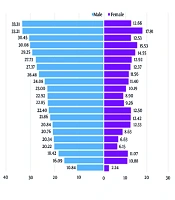
The most common cancers were stomach (14.2%), colorectal (11.9%), non-melanoma skin cancer (10.5%), prostate (9.1%), and bladder (8.1%). Among men, the most frequent cancers were stomach, prostate, colorectal, bladder, and non-melanoma skin cancers, respectively, while in women, the most prevalent were breast, colorectal, stomach, non-melanoma skin cancers, and cervical cancers (Figures 1 - 3).
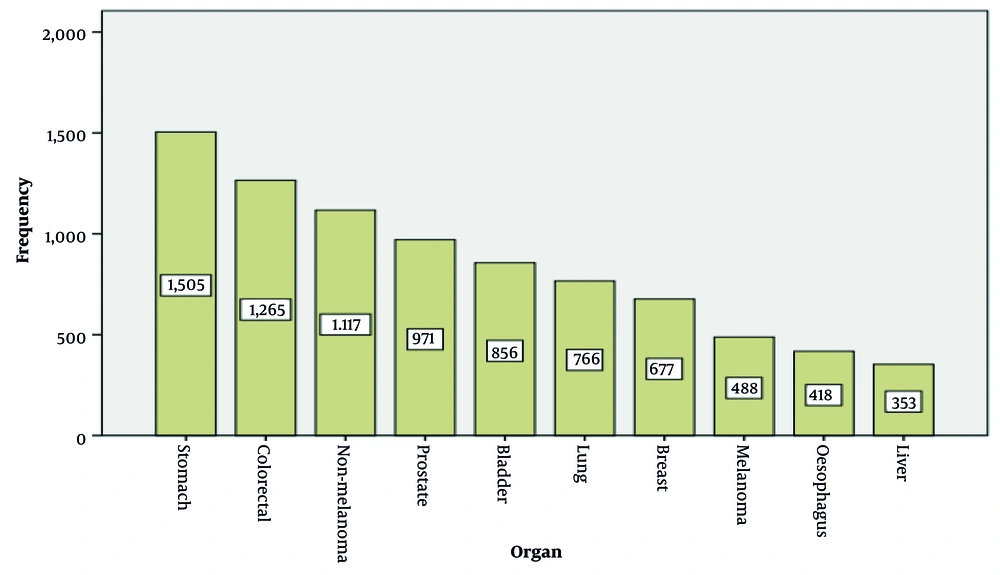
Figure 1.
Ten most common cancers of both sexes in Guilan, Iran (2014 - 2017)
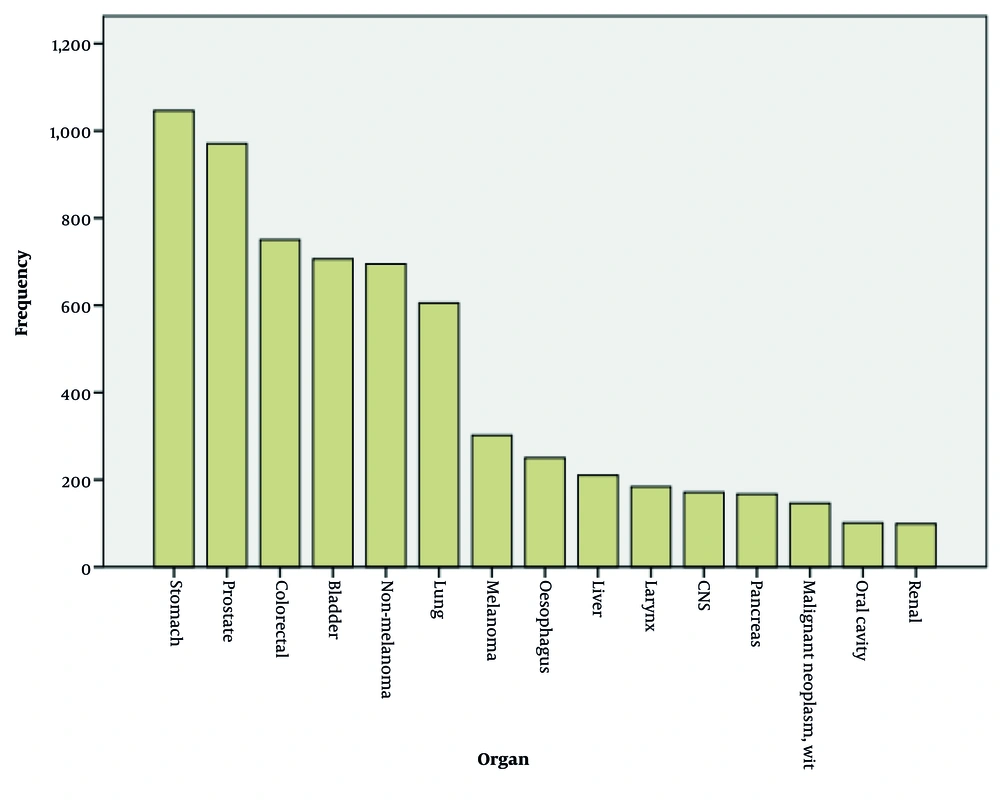
Figure 2.
The most common cancers among men in Guilan, Iran (2014 - 2017)
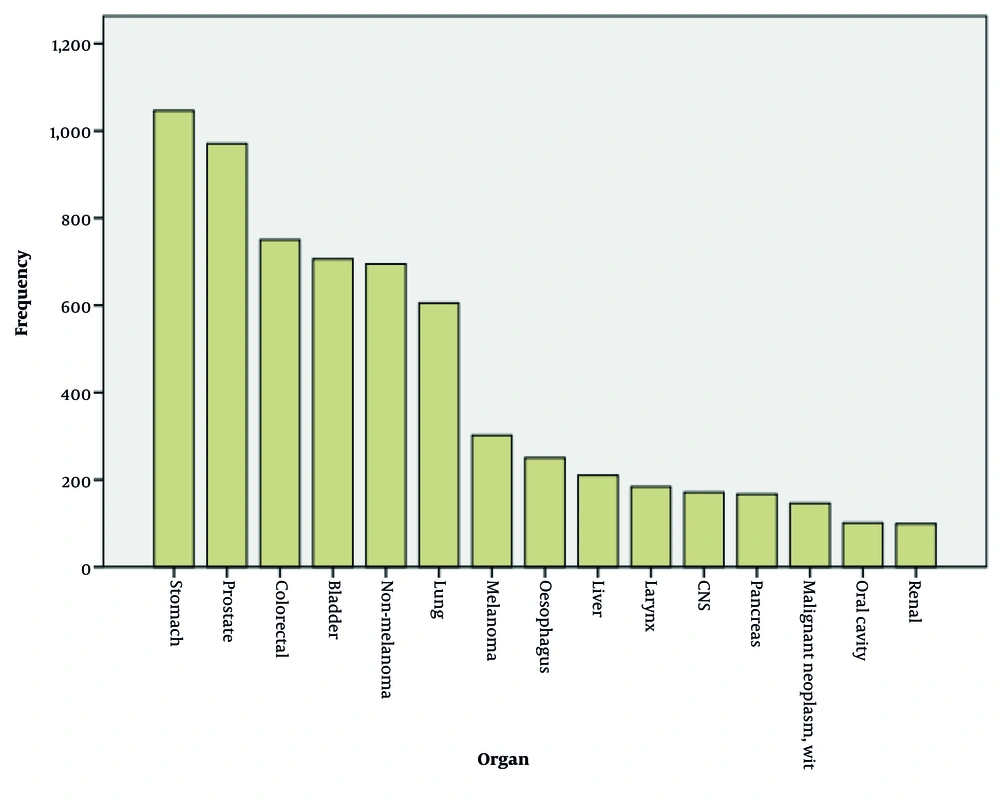
Figure 3.
The most common cancers among women in Guilan, Iran (2014 - 2017)
In 2014, the five most common cancers were stomach, non-melanoma skin cancer, colorectal, bladder, and prostate. By 2017, colorectal and prostate cancer had risen to the second and third most common cancers. In women, the most common cancers in 2014 were breast, stomach, colorectal, non-melanoma, and esophagus, which shifted in 2017 to breast, colorectal, stomach, non-melanoma, and cervix. In men, the most common cancers in 2014 were stomach, prostate, non-melanoma, bladder, and colorectal. By 2017, the ranking had changed, with prostate cancer first, followed by stomach, colorectal, bladder, and non-melanoma skin (Figure 4).
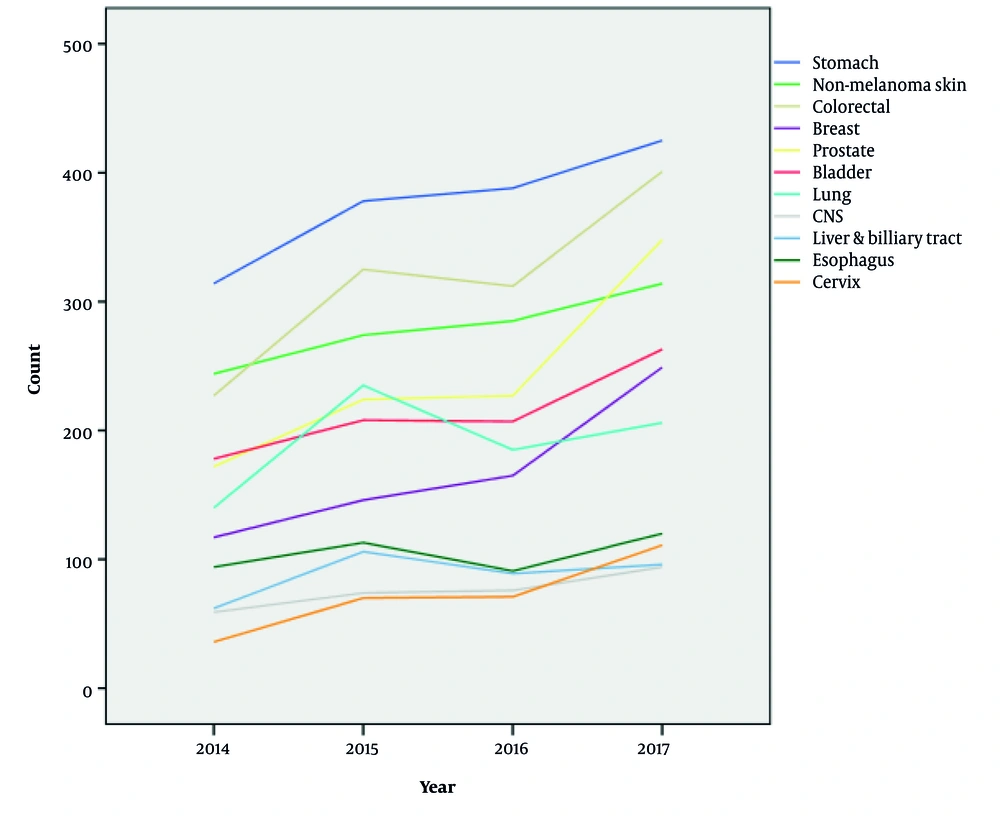
Figure 4.
Trend of common cancers in old ages, 2014 - 2017
5. Discussion
In the 2016 census, Guilan province had the highest proportion of elderly people in Iran, with more than 8.8% populationulation aged over 65 years (14). This study also demonstrated a rising trend in cancer incidence over time. Based on the age-standardized incidence rate (ASIR) for both sexes, the incidence increased from 636.4 per 100,000 populations in 2014 to 963.1 per 100,000 populations in 2017. This increasing rate can be attributed to several factors such as an increase in predisposing risk factors rates or an increase in the number of elderly populations (11), and improvements in the reporting and registration of cancer cases. This can lead to more accurate and comprehensive data collection, resulting in a higher recorded incidence and an increase in people's awareness and referrals. These results are in line with other studies conducted in other geographic areas, which indicate the increasing trend of cancers in the elderly group (15-17). Based on the global cancer incidence prediction from 2012 to 2035 in older adults, the largest relative increase in incidence is predicted in the Middle East and Northern Africa (17).
A study conducted by Roshandel et al. in 2014 in Iran reported a total of 3,524 cancer cases across all population groups and both sexes in Guilan. Notably, it appears that more than half of these cases were found in older age (18). Other studies have shown that over 60% of all new cancer cases and more than 70% of deaths from malignant tumors occur in older individuals (19, 20), although this percentage is reported to be much lower in some countries (21). Considering the increase in the elderly population in the whole country and especially in Guilan in the near future, this amount is very alarming. The highest incidence of cancer was observed in the age group of 75 to 84 years old. The crude incidence rate in this study increased from 824.8 per 100,000 people in 2014 to 1351.5 in 2017. The results of this study are consistent with the Italian (22) and Finnish (14) studies but are lower than the incidence reported in Tehran province (23).
The cancer diagnosis was based on the death certificate or clinical in about 30% of the cases, which was consistent with the previous study in Iran (24) but data quality was expected to improve over time. About two-thirds of cancer cases were in men, which was also seen in previous studies (15-18, 25).
The most common types of cancer identified in this study were stomach, followed by colorectal, non-melanoma skin, prostate, and bladder. These findings differ from a global study conducted by Bray et al. and Pilleron et al. (17, 26), which lung cancer was reported as the most common cancer in both sexes. Also, our results are different from the findings of Vercelli et al. in Italy in the period of 1976 - 1992 (22), which can be due to the research time and lifestyle differences, geographical, and environmental factors. The study conducted by Rouhani-Rasaf et al. in Tehran province in 2007 found that prostate and breast cancers were the most common types of cancer in both men and women (23). Other studies in Iran showed nearly the same pattern of common cancers in older ages. Roshandel et al. in 2015 reported breast cancer, prostate cancer, skin cancer (non-melanoma), stomach cancer, and colon cancer as the most common cancers in Iran (18). Another study by Akbari et al. found that skin cancer had the highest incidence among elderly people (11). Similar to this study, the previous studies conducted in the province assigned the highest prevalence rate to stomach cancer. In the study by Hoda et al. (27), stomach cancer was identified as the most common cancer in both sexes, with a prevalence rate of 8.17%. Similarly, in the study by Rafiemanesh et al. in the Caspian Sea region, including Guilan, Mazandaran, and Golestan provinces, stomach cancer was reported as one of the most common cancers, along with breast, skin, colon, and bladder cancer (28). Based on research performed by Tayibi et al. in Mazandaran (29), breast, esophageal, brain, stomach, and uterine cancer were the most incident diagnosed cancers in women. Another study in the northwest of Iran showed that the five most common cancers (excluding skin cancer) were stomach, bladder, esophagus, prostate and lung in males and esophagus, stomach, breast, colorectal cancer, and bladder in females (30). According to the statistics mentioned, it does appear that cancers of the digestive system, such as stomach and colorectal cancer, are prevalent in different provinces of Iran. High prevalence of gastrointestinal cancers in the north of Iran may be due to environmental conditions and nutritional habits, such as consumption of dried, smoked, or salted seafood, pickles, or high prevalence of Helicobacter pylori infection (31) in this area. Decreasing the incidence of gastric cancer in the US and developed countries suggests the role of environmental exposures in the pathogenesis of the cancer. Some authors have suggested that genetic susceptibility plays an important role in the different proportions of colorectal cancer (30). In addition, age plays an important role in the survival of GI cancer (32). To further understand and address this rise in digestive system cancers, it is crucial to conduct national and periodic studies that evaluate the risk factors associated with these types of cancers in different provinces.
Non-melanoma skin cancers were the third most common cancer of the elderly in this geographical area, after gastric and colorectal. Guilan is located on the southern boundary of the Caspian Sea, and for this reason, the occupation of a number of people is fishing and exposure to UV. On the other hand, using the sea for recreation is also very popular. These factors cause the people of the region to be more exposed to sunlight; on the other hand, most of the people of the region have pale skin, fair hair, and blue eyes, which increases the chance of skin cancer.
Almost all prostate cancers occur in older adults. Therefore, as the population of elderly men continues to grow, we can expect an increase in the incidence of this cancer. However, the rising trend of the prostate cancer cases observed from 2014 to 2017 is concerning. The reasons for this rise could be due to awareness about this cancer also increasing of screening by physicians. Breast cancer is the most frequently seen malignancy among women aged 65 and older in different parts of the world (16, 17, 21, 25, 30). Breast cancer screening has been included in Iran's health system since previous decades. It seems that the majority of breast cancers are diagnosed before old age; however, this cancer still has the highest incidence in elderly women.
Every year, nearly 500.000 women are diagnosed with cervical cancer, and approximately 80% of them are seen in developing countries (21). There is a simple, easy, and cheap method with a highly sensitive and specific Pap smear test for screening of this cancer.
In terms of the grading of cancer in the study, it is concerning that in over 63% of cases, the tumor grading was not clear, and in many of these cases, the primary location of the tumor was also unknown. This lack of clarity highlights the need for improved diagnostic procedures and accurate reporting of tumor grading and primary tumor location. This information is essential for determining appropriate treatment plans and predicting the prognosis for patients.
Among the cases with available grading, most were classified as grade 2 or grade 3. This indicates that a substantial proportion of patients were diagnosed with moderately to poorly differentiated tumors, suggesting a tendency toward more aggressive disease. This finding emphasizes the importance of public education and awareness campaigns to encourage early detection and screening programs for common cancers. Early diagnosis is particularly crucial for certain types of cancer, such as skin, breast, and gastrointestinal cancers. Prompt detection of these cancers can significantly impact the final outcome and improve the patient's survival rate.
5.1. Conclusions
This study shows the high rate of cancer in the elderly group, presenting a clear picture of the trend of cancer development in Guilan, the province with the highest elderly population. It is important to note that cancer incidence tends to increase with age. On the other hand, most of the common cancers can be detected early and treated successfully. Therefore, implementation of screening programs, especially for common cancers such as GI system cancers (with more focus on stomach and colorectal), and an educational program for people at risk, such as fishermen, is highly recommended.
5.2. Limitations
This study, like other cancer registry studies, had many limitations, such as a lack of access to all information, such as cancer grading, primary site of cancers, underlying diseases, occupation, and family history.