This analysis provided an up-to-date picture of the ALK-positive mNSCLC population in Italian clinical practice, focusing on the epidemiology, baseline characteristics, treatment patterns, TTNT, OS, and economic burden of patients on ALKi therapy available during the study period. Considering a sample corresponding to 11% of the Italian national population, an incidence rate of mNSCLC of 35.6 per 100,000 people per year was estimated, in line with existing literature on lung cancer epidemiology in Italy. The Italian AIOM reported approximately 41,500 new lung cancer diagnoses in 2019, with NSCLC accounting for the majority of these cases (
25).
Among the patients included in the analysis, the observed proportion of ALK-positive cases was 5.6%, slightly higher but still close to the range of 4% - 5% described in the international literature (
26,
27). Such consistency suggests that the prescriptions of ALK inhibitors, as a proxy for ALK-positive NSCLC diagnosis, were a reliable approach for the effective identification of this patient subset (
28).
The selection of first-line therapy for patients with ALK-positive NSCLC often considers factors such as age and comorbidity profiles. Thus, next-generation ALKi, like alectinib, ceritinib, and brigatinib, are becoming the preferred choice by clinicians compared to the first-generation ALKi crizotinib (
29). The real-world data emerging here largely corroborate this view, as ceritinib, alectinib, and brigatinib were more commonly used as first-line therapy in patients with younger age and less severe comorbidity profiles over the crizotinib-treated cohort. During the study period, lorlatinib was not available as a first-line treatment.
The analysis of the treatment patterns and sequences showed that among ALK-positive mNSCLC patients, alectinib was the most commonly used first-line therapy in around two-thirds of the cases, followed by crizotinib, brigatinib, lorlatinib, and CT combined with an ALKi. Upon progression, various second-line treatments were observed. For alectinib-treated patients, common options included CT + alectinib and lorlatinib, while crizotinib-treated patients frequently switched to CT + crizotinib. Among brigatinib users, nearly 16% progressed to CT + brigatinib, while CT alone was the second-line option in half of those who initially received CT + ALKi.
These patterns, although variable, align with findings from available real-world analyses. Recent data of 463 ALK-positive NSCLC patients followed from July 2019 to March 2024 across 37 Italian centers showed that 82.5% of patients received alectinib as their first-line ALK inhibitor, underscoring its widespread adoption in clinical practice (
30). Regarding second-line therapies post-alectinib, lorlatinib was the most commonly administered ALK inhibitor, accounting for 17% of cases, followed by brigatinib at 6% (
29).
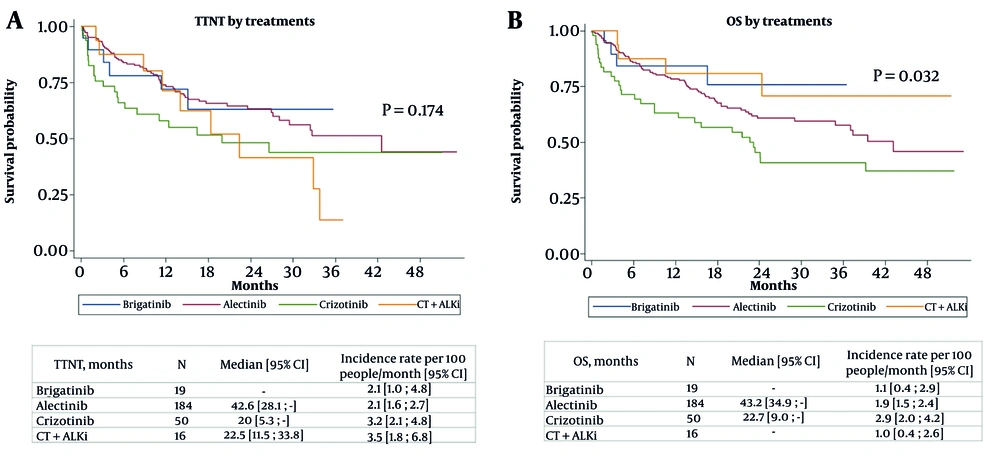
Kaplan-Meier survival analysis did not highlight significant differences in TTNT among treatment groups. Moreover, treatment type, sex, age, comorbidities, or brain metastases did not affect the likelihood of switching. When analyzing OS, significant differences emerged between treatment groups, with alectinib and crizotinib showing the longest median OS, while median OS for brigatinib and CT + ALKi was not reached.
In general, the observed OS outcomes are in line with findings from clinical trials comparing alectinib and crizotinib in ALK-positive NSCLC patients. In the phase III J-ALEX study, the final OS analysis did not show a significant difference between alectinib and crizotinib, likely due to treatment crossover. The 5-year OS rates were 60.9% for alectinib and 64.1% for crizotinib (
31). Regarding brigatinib, the ALTA-1L trial demonstrated improved progression-free survival (PFS) compared to crizotinib in ALKi-naïve advanced ALK-positive NSCLC patients. Similar to our data, the median OS was not reached in either group, and no significant differences were detected in the HR for OS (
32). To date, alectinib and brigatinib appear to provide significant clinical benefits in terms of PFS, although further research is needed to draw firm conclusions regarding OS.
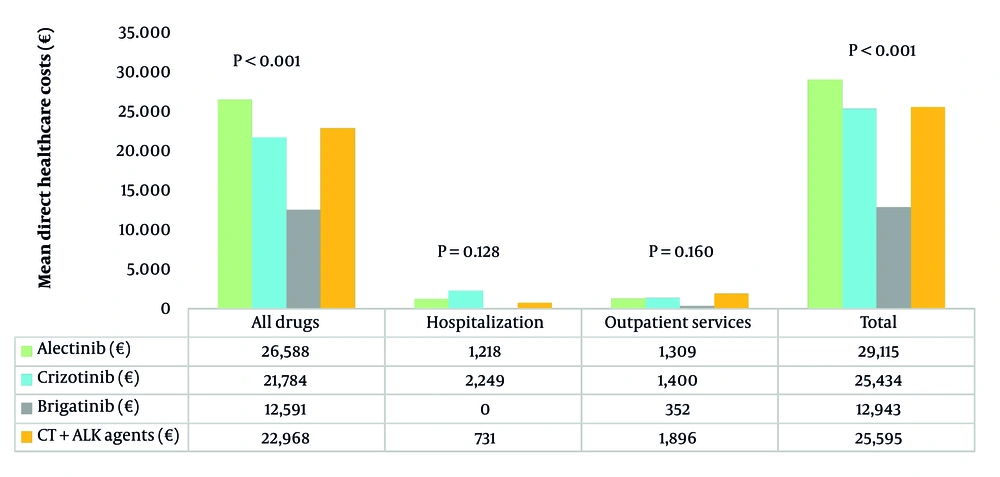
The analysis of HCRU during the first 6 months of follow-up revealed comparable numbers of drug prescriptions across the treatment cohort. On the other hand, patients receiving the next-generation ALKi required fewer hospitalizations than those on first-line crizotinib therapy. Of note, the brigatinib-treated group showed by far the lowest consumption and costs for outpatient specialist services and no hospitalization expenses. Consistently, cost analysis showed that over the 6-month follow-up, total healthcare costs per alive patient were the lowest for those on brigatinib and the highest for alectinib-treated patients. A parallel trend was observed for all drug costs, which represented the most burdensome cost driver, with the highest values observed in the groups treated with alectinib and crizotinib.
A similar pattern was reported in previous studies that investigated the economic burden of treatments for ALK-positive NSCLC. A cost-effectiveness comparison in French ALK-positive NSCLC patients treated with ALKi in the first line found that alectinib had significantly higher drug-related costs compared to other ALKi inhibitors (
33). In Italy, Ravasio et al. conducted a cost-utility analysis of brigatinib compared to alectinib in the treatment of ALK-positive NSCLC patients naïve to ALKi. The cost evaluation considered frontline therapies, subsequent therapies, best supportive care administration, comedications, adverse events, and health status. The results showed a quality-adjusted life-years (QALYs) increase of 0.216 and a cost reduction of €85,635 associated with brigatinib, indicating it as the most valid cost-utility option from the perspective of INHS (
34).
The results of this analysis should be interpreted in view of some limitations. Given that the administrative databases are primarily conceived to track economic flows of reimbursable healthcare services and drugs, diagnoses could be identified only using proxies like hospitalization codes, exemption codes, and drug prescriptions. Likewise, the CCI was also determined by searching diagnoses with codes of drug prescriptions and hospitalizations; hence untreated/non-hospitalized comorbidities were not captured. In addition, the results were generated from a sample corresponding to 11% of the Italian population, which may limit their transferability on a larger national and international scale. Lastly, for some small subgroups of fewer than 3 patients, results could not be disclosed for privacy reasons, and this might limit the robustness of subgroup analysis. Furthermore, another limitation of this study was the small number of included ALK-positive NSCLC patients, and further studies on a larger sample should be conducted to corroborate the present findings.
5.1. Conclusions
In conclusion, this analysis provides valuable insights into the treatment of ALK-positive NSCLC in Italy before lorlatinib approval as first-line therapy, highlighting trends in epidemiology, treatment patterns, survival outcomes, and the associated economic burden. The findings support the reliability of ALKi prescriptions to identify ALK-positive cases within the administrative database and confirm a shift towards next-generation ALKi, such as alectinib, ceritinib, and brigatinib, as first-line treatments.
The analysis of HCRU revealed that next-generation ALKi were associated with fewer hospitalizations than crizotinib. Alectinib was found to have the highest treatment costs (€29,114.8), primarily due to drug expenses, while brigatinib was confirmed to be the most cost-effective option (€12,942.6), in line with existing evidence. Further research and real-world data are necessary to optimize treatment strategies and clinical outcomes in the population of ALK-positive NSCLC patients.