
1. Background
Breast cancer is the most common cancer in women globally, representing 23% of female cancer cases (1), with approximately 1.6 million new diagnoses annually and a markedly higher incidence in developed countries (86.4 per 100,000) compared to less developed regions (27.3 per 100,000) (2, 3). In Iran, it ranks as the second most frequent cancer and the fifth leading cause of cancer-related mortality, with a current incidence of 22.33 per 100,000 women, projected to rise by 34% by 2025 (4, 5).
Treatment for breast cancer typically involves surgery, especially mastectomy, often combined with chemotherapy, radiotherapy, hormone therapy, or immunotherapy (6). In certain clinical scenarios, a radical mastectomy is necessary to prevent disease progression, involving the complete removal of the breast tissue. While effective in controlling tumor spread, this procedure can lead to profound psychological consequences, including anxiety, depression, body image disturbances, loss of self-esteem, fear of recurrence, and diminished quality of life (7). One of the profound psychosocial consequences of mastectomy is its detrimental impact on marital quality of life, as breast cancer and its treatment can significantly disrupt key aspects of intimate relationships (8). Marital quality of life encompasses emotional companionship, effective communication, cooperation, shared activities, affectionate expression, and agreement on major life issues, including sexual satisfaction, all of which contribute to relational adjustment and harmonious couple functioning (9).
In the aftermath of mastectomy, body image disturbance stands out as a pivotal psychological challenge, profoundly influencing postoperative adjustment and quality of life among women with breast cancer (10). Defined as distressing preoccupations with perceived alterations in physical appearance, even in the absence of objective disfigurement, body image concerns can trigger significant emotional distress, heightening susceptibility to anxiety and depression (11-13). In post-mastectomy patients, the loss of a breast often symbolizes a rupture in bodily integrity and femininity, intensifying feelings of shame, self-consciousness, and sexual inadequacy. Critically, these negative self-perceptions may be amplified by alexithymia, a multidimensional trait characterized by deficits in identifying, describing, and regulating emotions (14, 15). Women with elevated alexithymia struggle to recognize their emotional responses to body changes, limiting their capacity to process grief, seek support, or communicate needs effectively (16). This emotional dysregulation not only exacerbates internal distress but also impairs relational functioning, as alexithymia individuals often exhibit reduced emotional expressivity and empathy — key components of marital intimacy (17). Consequently, the interplay between body image dissatisfaction and alexithymia may create a compounding effect: Poor body image fuels emotional turmoil, while alexithymia obstructs adaptive coping and interpersonal connection. Empirical studies confirm that alexithymia is independently linked to poorer interpersonal relationships and diminished quality of life (18), with specific deficits in emotion regulation strongly associated with adverse marital outcomes (19). Thus, in post-mastectomy patients, alexithymia may serve as a critical psychological mechanism through which body image concerns translate into reduced marital quality of life, highlighting the need for targeted interventions that address both perceptual and emotional processing dimensions of post-surgical adjustment (20).
Body image dissatisfaction following mastectomy is known to impair psychosocial and marital well-being, yet the psychological mechanisms remain unclear. Given that alexithymia disrupts emotional awareness and interpersonal functioning, it may mediate the link between body image concerns and marital quality of life. Clarifying this pathway is essential for developing targeted psychological interventions to support relational resilience in post-mastectomy patients.
2. Objectives
This study, therefore, examines: Does alexithymia mediate the relationship between body image concerns and marital-specific quality of life in women after mastectomy?
3. Methods
3.1. Sampling
This cross-sectional study was conducted in 2024 at Shohada Tajrish Hospital (Martyrs Hospital) in Tehran, Iran, among married women diagnosed with breast cancer who had undergone mastectomy. The sample size was determined a priori using the formula proposed by Tabachnick and Fidell for multiple regression analyses (N ≥ 50 + 8m, where m is the number of predictor variables), with an additional 10% buffer to account for potential incomplete or unusable responses, yielding a target sample of 120 participants.
Data were collected using validated self-report questionnaires assessing emotional alexithymia, body image concerns, and marital quality of life, along with a demographic form capturing age, education level, duration of illness, number of children, occupation, and duration of marriage. Trained researchers administered all instruments in a private clinical setting to ensure confidentiality, minimize response bias, and enhance participant comfort. All participants provided written informed consent before enrollment. The study protocol was approved by the Institutional Ethics Review Board of the affiliated university and conducted in accordance with the principles of the Declaration of Helsinki.
3.2. Eligibility Criteria
Inclusion criteria were: (1) married status; (2) age from 20 to 50 years; (3) histologically confirmed stage I or II breast cancer; (4) history of mastectomy; (5) literacy sufficient to complete self-report measures; (6) absence of chronic psychiatric disorders (e.g., schizophrenia, bipolar disorder, or major depressive disorder requiring long-term pharmacotherapy); (7) no current use of strong psychotropic or sedative medications; and (8) voluntary, informed consent. Exclusion criteria included: (1) stage IV disease; (2) severe physical or cognitive impairment limiting questionnaire comprehension; (3) incomplete or inconsistent questionnaire responses; and (4) participant withdrawal.
3.3. Information Gathering Tool
Data were collected using standardized self-report questionnaires. To assess emotional alexithymia, the 20-item Toronto Alexithymia Scale (TAS-20), developed by Taylor et al. (21), was employed. The scale comprises 3 subscales: Difficulty identifying feelings, difficulty describing feelings, and externally oriented thinking. Items are rated on a 5-point Likert scale (1 = strongly disagree to 5 = strongly agree), with total scores ranging from 20 to 100; higher scores indicate greater alexithymia severity. A total score ≥61 is commonly used as a clinical cutoff to indicate high alexithymia, while scores from 52 to 60 suggest possible alexithymia (Bagby et al., as cited by Taylor et al.) (21). The Persian version of the TAS-20 has demonstrated acceptable psychometric properties, with Cronbach’s alpha reported at 0.85 in the present sample, indicating good internal consistency.
Body image concerns were evaluated using the Body Image Concern Inventory (BICI), originally developed by Liteton et al. (22). This 19-item instrument measures cognitive and emotional preoccupation with physical appearance using a 5-point Likert scale (1 = never to 5 = always). Total scores range from 19 to 95, with higher scores reflecting greater body image dissatisfaction and distress. Although no universal clinical cutoff exists, prior studies have used a score ≥45 to indicate clinically significant body image concerns (23). The Persian version of the BICI was validated by Basak Nejad and Ghaffari (2011) (24) in Iranian clinical and non-clinical samples, demonstrating excellent internal consistency (Cronbach’s α = 0.95) and test-retest reliability (r = 0.89 over two weeks). Confirmatory factor analysis supported its unidimensional structure (CFI = 0.94, RMSEA = 0.06), confirming strong construct validity in the Iranian context. In this study, the BICI yielded a Cronbach’s alpha of 0.90.
Marital quality of life was assessed with the Revised Dyadic Adjustment Scale (RDAS), developed by Busby, Christensen, Crane, and Larson (25). The RDAS consists of 14 items across three subscales: Consensus (agreement), satisfaction, and cohesion within the marital relationship. Responses are recorded on a 6-point Likert-type scale (0 = always disagree to 5 = always agree), with total scores ranging from 0 to 69. Higher scores indicate better marital adjustment; a total score < 47 has been proposed as a threshold for identifying distressed couples (25). The Persian adaptation of the RDAS was validated by Yousefi (26) among Iranian married individuals, reporting Cronbach’s alpha coefficients of 0.79 (consensus), 0.80 (satisfaction), 0.90 (cohesion), and 0.86 for the total scale. Split-half reliability exceeded 0.70 across subscales, and both exploratory and confirmatory factor analyses confirmed the original three-factor structure, supporting its construct validity in Persian-speaking populations. In this study, Cronbach’s alpha was 0.80, confirming acceptable internal reliability.
3.4. Data Analysis
In this study, both descriptive and inferential statistical methods were employed for data analysis. Descriptive statistics were used to organize, summarize, and present the raw data, including the construction of frequency distribution tables, calculation of measures of central tendency (mean) and dispersion (standard deviation), reporting of categorical variables as percentages, and graphical visualization of data distributions.
Before path analysis, the assumption of multivariate normality was evaluated using Mardia’s coefficient, while univariate normality for each observed variable was assessed via skewness and kurtosis (|skewness| < 2 and |kurtosis| < 7 considered acceptable) and Shapiro–Wilk tests. Although one subscale (externally oriented thinking, TAS-20) showed slight deviation from univariate normality (P = 0.032), Mardia’s coefficient indicated acceptable multivariate normality (1.84 < 3). Given our sample size (N = 120), which exceeds the recommended threshold for robustness of maximum likelihood estimation (N > 100), and the use of Bollen–Stine bootstrap (1,000 samples) to adjust model fit indices and standard errors, the impact of minor non-normality on parameter estimates is considered negligible (21, 27).
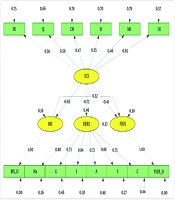
In the inferential phase, and in alignment with the study’s objectives — namely, examining relationships among variables and testing the mediating role of alexithymia — a two-step analytical approach was adopted. First, Pearson’s correlation coefficient was used to assess initial bivariate linear associations among the study variables. However, given that Pearson correlations do not account for potential confounding effects, we subsequently controlled for key demographic covariates (including age, education level, disease duration, and number of children) in the path analysis to address possible confounding. Second, a hypothesized structural model was tested using path analysis in AMOS (Version 24). The proposed model posited that body image concerns directly influence marital quality of life and that this relationship is partially mediated by emotional alexithymia. A schematic representation of the theoretical model is presented in Figure 1 (to be included in the manuscript).
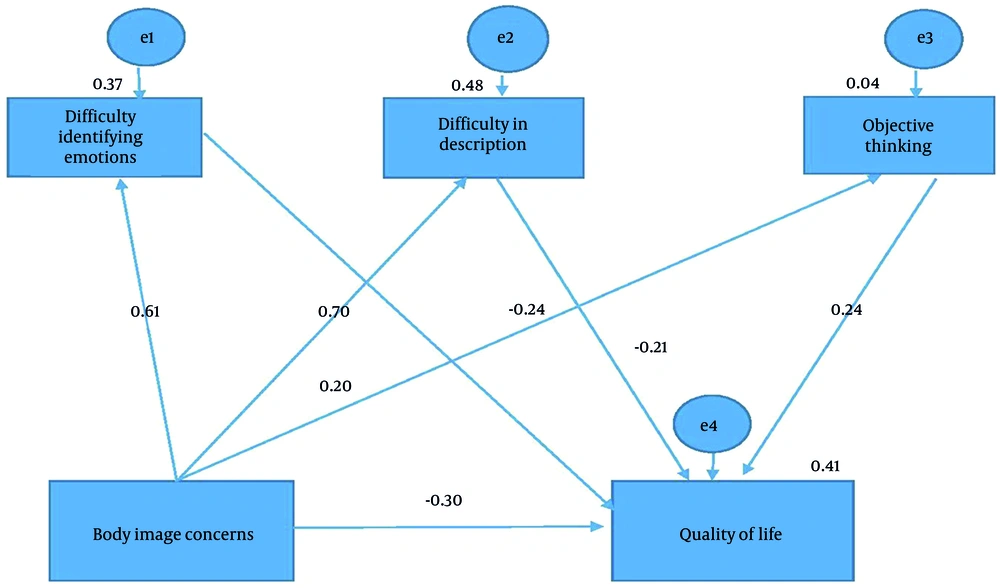
Figure 1.
The structural model was implemented in the AMOS 24 software
Model fit was evaluated using multiple fit indices, including the Comparative Fit Index (CFI), Tucker–Lewis Index (TLI), Root Mean Square Error of Approximation (RMSEA), and chi-square (χ²) statistic. Following conventional criteria, acceptable model fit was defined as CFI ≥ 0.90, TLI ≥ 0.90, RMSEA ≤ 0.08, and a non-significant χ² test (P > 0.05) or a χ²/df ratio < 3 (Hu & Bentler, 1999). Bootstrap confidence intervals (95%, 1,000 samples) were used to test the significance of indirect effects. All analyses were performed using IBM SPSS Statistics (Version 26) for descriptive and correlation analyses, and AMOS (Version 24) for path modeling and model fit assessment.
3.5. Ethical Statement
All procedures performed in this study involving human participants were conducted in accordance with the ethical standards of the institutional research committee and the 1964 Declaration of Helsinki and its subsequent amendments. The study was approved by the Ethics Committee (code No: IR.IAU.SRB.REC.1403.327). Written informed consent was obtained from all participants before data collection, and confidentiality of personal and medical information was strictly maintained throughout the study.
4. Results
4.1. Descriptive Findings
According to the descriptive statistics, the participants' ages ranged from 30 to 50 years, with 60% aged between 30 and 40 years. In terms of educational attainment, the largest proportion of participants (40.3%) had completed high school (diploma level). Regarding disease duration, 47.5% of the women were within 1 to 2 years post-diagnosis. The majority of participants (41.7%) had 2 children, and 83.3% were homemakers (Table 1).
Table 1.
Description of Participants' Ages
| Demographic Variables and Groups | Frequency | Frequency Percentage |
|---|---|---|
| Education | ||
| Guidance | 34 | 28.6 |
| Diploma | 48 | 40.3 |
| Associate diploma | 4 | 3.4 |
| Bachelor's degree | 25 | 21.0 |
| Master's degree | 8 | 6.7 |
| Duration of illness (y) | ||
| 1 to 2 | 24 | 20.0 |
| 2 to 4 | 57 | 47.5 |
| 4 to 6 | 25 | 20.8 |
| More than 6 | 9 | 7.5 |
| 1 to 12 months | 5 | 4.2 |
| Number of children | ||
| No children | 8 | 6.7 |
| One child | 47 | 39.2 |
| Two children | 50 | 41.7 |
| Three children | 10 | 8.3 |
| Four children | 3 | 2.5 |
| More than four children | 2 | 1.7 |
| Occupation | ||
| Housewife | 100 | 83.3 |
| Student | 6 | 5.0 |
| Teacher | 4 | 3.3 |
| Employee | 8 | 6.7 |
| Artist | 2 | 1.7 |
| Duration of marriage (y) | ||
| 1 to 10 | 7 | 5.8 |
| 11 to 15 | 15 | 12.5 |
| 16 to 20 | 26 | 21.7 |
| Demographic variables | ||
| More than 20 years | 72 | 60.0 |
4.2. Inferential Findings: Assessment of Data Normality
To evaluate the assumption of normality in the distribution of research variables, the Kolmogorov-Smirnov and Shapiro-Wilk tests were conducted. The results, presented in Table 2, indicate whether the data met the normality assumption required for parametric analyses. Given the sample size (n = 120), the Shapiro-Wilk test was considered more appropriate due to its greater sensitivity in detecting deviations from normality in moderate sample sizes.
Table 2.
Checking the Normality of Data Distribution
| Variables | Shapiro-Wilk Kolmogorov-Smirnov Variables | Shapiro-Wilk | ||
|---|---|---|---|---|
| Values | Values | Values | Values | |
| Body image concerns | 0.075 | 0.096 | 0.991 | 0.629 |
| Quality of life | 0.049 | 0.002 | 0.993 | 0.777 |
| Difficulty recognizing emotions | 0.07 | 0.09 | 0.981 | 0.096 |
| Difficulty in description | 0.031 | 0.012 | 0.968 | 0.001 |
| Objective thinking | 0.087 | 0.058 | 0.986 | 0.261 |
Table 2 shows that the assumption of normality has been met for all research variables, because both Kolmogorov-Smirnov and Shapiro-Wilk tests are not significant for the research variables, and the significance level for the research variables is greater than the research error value, which is equal to 0.05. Therefore, the assumption of normality of data distribution is confirmed.
According to the correlation analysis (Table 2), body image concerns, difficulty in identifying emotions, and difficulty in describing emotions were negatively and significantly associated with marital quality of life (P < 0.05), indicating that higher levels of these factors are linked to lower relationship satisfaction. In contrast, no statistically significant relationship was found between the externally oriented thinking (objective thinking) subscale and quality of life (P > 0.05).
4.3. Structural Model Evaluation
The structural model was implemented in AMOS 24 software, followed by path analysis (Figure 1). The significance of path coefficients in the structural model was assessed using the Critical Ratio (CR) statistic, where values exceeding ±1.96 were considered statistically significant at the 95% confidence level (P < 0.05). The magnitude of standardized path coefficients (analogous to standardized beta weights in regression) was interpreted as follows: Coefficients below 0.30 were considered weak, those between 0.30 and 0.60 as moderate, and values above 0.60 as strong effects (Table 3).
Table 3.
Model Path Coefficients and Model Significance
| Path | Total Effects | Direct Effect | Indirect Effect | Results | |||
|---|---|---|---|---|---|---|---|
| Path Coefficient | P | Path Coefficient | P | Path Coefficient | P | ||
| Body image concerns → quality of life | -0.543 | 0.002 | -0.300 | 0.003 | - | - | Confirm |
| Body image concerns → difficulty in recognizing emotions | 0.609 | 0.001 | 0.609 | 0.001 | - | - | Confirm |
| Body image concerns → difficulty in describing | 0.695 | 0.002 | 0.695 | 0.002 | - | - | Confirm |
| Body image concerns → objective thinking | 0.204 | 0.028 | 0.204 | 0.028 | - | - | Confirm |
| Difficulty in recognizing emotions → quality of life | -0.240 | 0.024 | -0.240 | 0.024 | - | - | Confirm |
| Difficulty in describing → quality of life | -0.209 | 0.085 | -0.209 | 0.085 | - | - | Reject |
| Objective thinking → quality of life | 0.239 | 0.001 | 0.239 | 0.001 | - | - | Confirm |
| Body image concerns → difficulty in recognizing emotions → quality of life | - | - | - | - | -0.148 | 0.017 | Confirm |
| Body image concerns → objective thinking → quality of life | - | - | - | - | 0.049 | 0.082 | Reject |
| Body image concerns → difficulty in describing → quality of life | - | - | - | - | -0.147 | 0.100 | Reject |
The structural equation model was evaluated using multiple goodness-of-fit indices. As shown in Table 4, the model demonstrated acceptable but not ideal fit: χ²/df = 2.313 ( < 3); RMSEA = 0.046 ( < 0.05, indicating close fit); AGFI = 0.965 ( > 0.90); GFI = 0.865, NFI = 0.829, IFI = 0.840, and CFI = 0.835 — all above the 0.80 threshold for minimal acceptability but falling short of the ≥ 0.90 benchmark for good fit. TLI (0.910) and RFI (0.890) approached or met the more stringent criterion.
Table 4.
Model Fit Indices
| Indicators | Desired Limit | Obtained Value |
|---|---|---|
| Chi-square on degrees of freedom | Less than 3 | 2.313 |
| RMSEA | Less than 0.05 | 0.046 |
| PNFI | More than 0.05 | 0.688 |
| GFI | More than 0.9 means excellent; more than 0.8 means acceptable | 0.865 |
| AGFI | More than 0.9 means excellent; more than 0.8 means acceptable | 0.965 |
| NFI | More than 0.9 means excellent; more than 0.8 means acceptable | 0.829 |
| TLI | More than 0.9 means excellent; more than 0.8 means acceptable | 0.910 |
| CFI | More than 0.9 means excellent; more than 0.8 means acceptable | 0.835 |
| RFI | More than 0.9 means excellent; more than 0.8 means acceptable | 0.890 |
| IFI | More than 0.9 means excellent; more than 0.8 means acceptable | 0.840 |
| Indicators | Desired limit | Obtained value |
| Chi-square on degrees of freedom | Less than 3 | 2.313 |
| RMSEA | Less than 0.05 | 0.046 |
| PNFI | More than 0.05 | 0.688 |
| GFI | More than 0.9 means excellent; more than 0.8 means acceptable | 0.865 |
| AGFI | More than 0.9 means excellent; more than 0.8 means acceptable | 0.965 |
| NFI | More than 0.9 means excellent; more than 0.8 means acceptable | 0.829 |
Abbreviations: RMSEA, Root Mean Square Error of Approximation; TLI, Tucker–Lewis Index; CFI, Comparative Fit Index.
Given that the path from “difficulty describing feelings” to “marital quality of life” was non-significant (β = −0.209, P = 0.085), we tested a theory-justified trimmed model by removing this path. The revised model showed slightly improved fit: CFI increased to 0.852, TLI to 0.921, and RMSEA decreased to 0.041, while χ²/df remained stable (2.28). However, the improvement in fit was modest, and the original model was retained to preserve theoretical comprehensiveness and align with prior literature linking all alexithymia dimensions to relational outcomes.
As shown in Table 5, body image concerns exerted a significant direct negative effect on marital quality of life (β = −0.300, P = 0.003), indicating that greater body image dissatisfaction is associated with lower marital quality of life. Furthermore, body image concerns had significant positive direct effects on all three alexithymia dimensions: Difficulty identifying feelings (β = 0.609, P = 0.001), difficulty describing feelings (β = 0.695, P = 0.002), and externally oriented thinking (β = 0.204, P = 0.028).
Table 5.
Correlation Matrix of Research Variables
| Variables | 1 | 2 | 3 | 4 | 5 |
| 1. Body image concerns | - | ||||
| 2. Difficulty recognizing emotions | 0.609 a | - | |||
| 3. Difficulty describing | 0.695 a | - 0.656 a | - | ||
| 4. Objective thinking | 0.204 b | 0.287 c | 0.411 a | — | |
| 5. Quality of life | -0.549 a | -0.496 a | -0.482 a | 0.023 | — |
a P < 0.001.
b P < 0.05.
c P < 0.01.
In turn, difficulty identifying feelings significantly and negatively predicted marital quality of life (β = −0.240, P = 0.024). Externally oriented thinking showed a significant positive effect on marital quality of life (β = 0.239, P = 0.001), whereas difficulty describing feelings did not reach statistical significance (β = −0.209, P = 0.085).
To evaluate indirect (mediated) effects, bias-corrected bootstrapping (1,000 samples) was conducted. Body image concerns significantly predicted lower marital quality of life indirectly through difficulty identifying feelings (β = −0.148, 95% CI [−0.267, −0.041], P = 0.017). However, the indirect paths via difficulty describing feelings (β = −0.147, P = 0.100) and externally oriented thinking (β = 0.049, P = 0.082) were not statistically significant.
The explanatory power of the model was assessed using the coefficient of determination (R²) for each endogenous latent variable (Table 6). Marital quality of life was explained to a relatively high extent (R² = 0.408), indicating that approximately 40.8% of its variance is accounted for by the predictors in the model. The alexithymia subscales also demonstrated notable explanatory power: Difficulty identifying feelings (R² = 0.371), difficulty describing feelings (R² = 0.483), and externally oriented thinking (R² = 0.043). These R² values suggest that the model captures a substantial proportion of variance in marital quality of life and 2 core alexithymia dimensions, though externally oriented thinking is only weakly explained.
In summary, the model demonstrates acceptable fit across a comprehensive set of indices, statistically significant direct and indirect pathways where hypothesized, and quantifiable explanatory power, thereby supporting both the structural validity and theoretical relevance of the proposed mediation framework.
Table 6.
Coefficient of Determination of Endogenous Research Variables
| Endogenous Variables | Coefficient of Determination |
|---|---|
| Quality of life | 0.408 |
| Difficulty recognizing emotions | 0.371 |
| Difficulty in description | 0.483 |
| Objective thinking | 0.043 |
5. Discussion
This study aimed at examining the mediating role of emotional alexithymia in the relationship between body image concerns and marital quality of life among women with breast cancer following mastectomy.
Breast cancer, the most common malignancy among women, significantly impacts multiple aspects of patients' physical and psychosocial functioning (28). Mastectomy remains a key treatment modality for this disease (29), but surgical removal of the breast, often perceived as a central symbol of femininity, attractiveness, and maternal identity, can profoundly disrupt body image (10, 11). As the breast is a primary female sexual organ, its loss may threaten a woman’s sense of self, leading to feelings of diminished femininity, bodily incompleteness, and reduced sexual self-esteem (11). Post-mastectomy body image concerns commonly include dissatisfaction with appearance, self-consciousness about scars, avoidance of nudity, and perceived loss of attractiveness (30).
These disturbances contribute to negative emotional outcomes, often rooted in self-disapproval, which hinder the development of a positive self-concept (30). Importantly, such psychological distress extends into intimate relationships. Evidence indicates that mastectomy can impair marital quality of life, as many women experience shame, worthlessness, and fears of rejection following surgery (31, 32). They may struggle with feelings of inadequacy and fear of being perceived as less desirable by their partners (32). Given that marital quality is a critical component of overall quality of life, these concerns can lead to communication difficulties, reduced intimacy, and relational strain (33). Studies report that women after mastectomy frequently experience preoccupation with their ability to maintain fulfilling marital relationships, which negatively affects marital satisfaction and dyadic adjustment (33).
The findings of this study indicate that body image concerns have a significant direct negative effect on quality of life, consistent with previous research. Studies by Naghipoor et al. (34), Konaramudiyanselage et al. (35), and Moreira et al. (36) similarly reported a strong association between impaired body image and reduced quality of life among breast cancer survivors.
Naghipour et al. (34) compared body image, sexual satisfaction, and quality of life across 3 groups: Women who underwent mastectomy, those who received breast-conserving surgery, and healthy controls, and found no significant differences in body image or sexual satisfaction. However, a significant difference was observed in quality of life, with lower scores among patients who had undergone surgery. In another study, Phoosuwan and Lonberg (11) examined quality of life and body image after mastectomy using multiple linear regression and reported a significant negative correlation between body image concerns and overall quality of life. Furthermore, Correro (37) demonstrated that heightened body image distress is associated with diminished self-worth and impaired interpersonal relationships.
Collectively, these findings underscore the critical role of body image in psychosocial well-being following mastectomy.
Alexithymia has been conceptualized both as a stable personality trait (primary alexithymia) and as a transient, adaptive response to psychological distress associated with illness (secondary alexithymia) (38). Some authors suggest it functions as a coping mechanism, in which individuals limit their emotional expression to avoid painful affective experiences, particularly following a cancer diagnosis, potentially diminishing over time as patients adapt (38). In contrast, primary alexithymia is viewed as a more enduring characteristic involving deficits in emotional awareness and symbolic thinking. For instance, an Italian study found that women with breast cancer often exhibit traits typical of psychosomatic patients, such as restricted imagination, reduced fantasy life, and difficulty verbalizing emotions (27).
The present study revealed a significant relationship between emotional alexithymia and marital quality of life in post-mastectomy breast cancer patients. Specifically, difficulty in identifying emotions had a significant negative direct effect on quality of life, indicating that impaired emotional awareness contributes to poorer marital adjustment. In contrast, difficulty in describing emotions did not significantly predict quality of life. Notably, externally oriented thinking (often referred to as "objective thinking") showed a significant positive effect on quality of life, suggesting that a more cognitive, less emotionally engaged processing style may, in some contexts, serve a protective or adaptive role. These findings align with previous research by Mu et al. (19) and and Cengiz et al. (39), who also reported differential impacts of alexithymia subscales on psychosocial outcomes in cancer populations.
A study by Mu et al. (19) titled "The Role of Emotional Alexithymia in the Quality of Life of Students", conducted on 183 healthy university students without physical or psychiatric conditions, found that individuals with alexithymic traits experience greater difficulties in interpersonal relationships and report lower overall quality of life, supporting the relevance of emotional regulation in psychosocial functioning.
Lee et al. (40) examined cognitive emotion regulation strategies and their impact on quality of life in women with cancer using the Functional Assessment of Cancer Therapy–Breast (FACT-B) scale. Their findings indicated that maladaptive strategies, such as catastrophizing, rumination, and self-blame, were negatively associated with quality of life, whereas adaptive strategies, such as acceptance and positive reappraisal, were positively associated. Notably, all 9 assessed coping mechanisms were significantly correlated with quality of life, and these effects remained significant after controlling for demographic and clinical variables.
Similarly, Qin et al. (41), in a study titled "The Mediating Role of Cognitive Emotion Regulation in the Relationship Between Self-Concealment and Quality of Life in Breast Cancer Patients Undergoing Chemotherapy," reported that quality of life varied significantly by age, household income, and place of residence. They also found that adaptive emotion regulation strategies were positively associated with well-being, whereas maladaptive strategies were linked to poorer outcomes.
Further reinforcing these findings, Durosini et al. (42), in "The Role of Emotion-Related Abilities in the Quality of Life of Breast Cancer Survivors," demonstrated that emotional competencies, such as identifying, understanding, and managing emotions, play a crucial role in psychosocial adjustment and overall quality of life among survivors.
Women with breast cancer often experience intrusive thoughts about distressing situations related to their diagnosis and treatment, which can intensify negative emotional states (10). Body image concerns may become persistent mental preoccupations, particularly when individuals lack the capacity to process and express their emotions effectively. Research suggests that the ability to articulate and regulate emotional experiences is closely linked to psychological adjustment, such that impaired emotional expression increases vulnerability to anxiety and tension (35). When body image distress remains unprocessed and emotionally suppressed, it can exacerbate psychological burden and heighten the risk of conditions such as anxiety and depression (13).
The current findings reveal that body image concerns exert an indirect negative effect on marital quality of life through difficulty in identifying emotions — a core component of alexithymia — indicating that emotional unawareness mediates the impact of body image on relational well-being. However, no significant indirect effects were found through difficulty in describing emotions or externally oriented thinking (objective thinking), suggesting that these alexithymia subscales do not play a mediating role in this pathway.
The findings of the present study are consistent with previous research by Gutiérrez-Hermoso et al. (20), Kazemi-Zahrani et al. (43), Hajiyousefi et al. (44), and Abdi and Sadeghi (45), which collectively underscore the role of emotional processing difficulties in psychosocial adjustment among women with breast cancer.
Gutiérrez-Hermoso et al. (20) investigated differences in body image and psychological adjustment among women undergoing mastectomy, comparing those with high versus low alexithymia. Their results showed that patients with high alexithymia, particularly those who underwent radical mastectomy, experienced greater hopelessness, higher levels of body image distortion, and more frequent use of maladaptive coping strategies. These findings suggest that alexithymia significantly influences emotional adaptation, especially in the context of extensive surgical intervention.
Kazemi-Zahrani et al. (43), in a study titled "The Mediating Role of Alexithymia in Predicting Body Image Concerns Based on Emotional Expression Ambivalence," found that alexithymia significantly mediated the relationship between emotional expression ambivalence and body image concerns, indicating that difficulty in identifying and expressing emotions amplifies distress related to physical appearance.
Furthermore, in their study "The Relationship Between Cognitive Emotion Regulation and Marital Intimacy with Quality of Life in Women with Breast Cancer," Abdi and Sadeghi (45) reported a significant positive association between adaptive emotion regulation strategies (e.g., acceptance, positive refocusing) and quality of life, while maladaptive strategies (e.g., self-blame, rumination) were negatively associated with well-being (46). These results align with the current findings, reinforcing the importance of emotional regulation capacities in maintaining marital and overall quality of life during cancer survivorship.
The positive association between externally oriented thinking and marital quality of life may reflect a culturally shaped coping mechanism among Iranian women, wherein a focus on external realities and practical problem-solving — rather than emotional introspection — may reduce interpersonal tension in the post-mastectomy period. In collectivist contexts, emotional restraint and pragmatic adjustment are sometimes valued as signs of resilience (e.g., reference). Furthermore, in early-stage breast cancer (Stage I – II), cognitive detachment may serve as a short-term adaptive strategy, minimizing emotional overwhelm and preserving relational stability.
5.1.. Limitations of the Study
This study’s cross-sectional design and relatively small sample of 120 married women with early-stage breast cancer, recruited via convenience sampling from a single center in Tehran, limit the generalizability of findings and increase the risk of selection bias. The reliance on self-report questionnaires may introduce recall or social desirability bias, despite the use of validated Persian instruments. Additionally, unmeasured confounders, such as partner support, type of treatment, time since mastectomy, and sociocultural factors influencing emotional expression and marital expectations, were not controlled, which may affect the validity and applicability of the observed relationships.
5.2. Conclusions
This study demonstrates that emotional alexithymia, particularly difficulty in identifying emotions, plays a significant mediating role in the relationship between body image concerns and marital quality of life among women with breast cancer after mastectomy. While body image concerns directly and negatively affect marital well-being, their indirect impact through emotional unawareness further exacerbates relational difficulties. The findings highlight that impaired emotional processing acts as a key psychological mechanism linking physical self-perception to intimate relationship quality. In contrast, other alexithymia components, such as difficulty in describing feelings or externally oriented thinking, did not significantly mediate this relationship. These results underscore the importance of addressing emotional regulation in psychosocial interventions to improve marital adjustment and overall quality of life in post-mastectomy patients.