
1. Background
Primary bone cancers are considered malignant tumors originating from mesenchymal tissue, accounting for approximately 0.2% of all malignancies worldwide. In most cases, the underlying cause remains unknown. The most common types of primary bone malignancies are osteosarcoma, chondrosarcoma, and Ewing sarcoma (1). Osteosarcoma is the most prevalent among primary malignant bone tumors and is more commonly observed in adolescents and young adults. Although it can occur in any bone, it most frequently affects the long bones of the extremities (2). Some studies have indicated that young adults possess a lower survival rate compared to young or pubertal children. Additionally, osteosarcoma is more common in males than in females (3). According to data from The European and American Osteosarcoma Study (EURAMOS-1), the 3- and 5-year event-free survival rates for osteosarcoma were reported at 59% and 54%, respectively (4). A study conducted in Malaysia over a 15-year period (1997 - 2011) found that the independent prognostic survival factors were the presence of metastasis and completion of treatment (5). Analysis of Surveillance, Epidemiology, and End Results (SEER) data from 1984 to 2013 revealed that the overall incidence of osteosarcoma remained relatively stable, while the 10-year relative survival rate increased modestly from 57.7% to 61% (6).
The introduction of chemotherapy has significantly improved survival outcomes in patients with bone cancer. However, advancements in surgical techniques and latest therapy modalities have had limited additional impact on survival. Several prognostic factors including tumor size, histological grade at diagnosis, patient age, and gender are known to influence survival (7). Improved diagnostic techniques and increased life expectancy have led to a growing economic burden on both governments and individuals. Healthcare costs associated with the diagnosis and treatment of bone malignancies have risen considerably in recent decades, necessitating further investigation into effective resource management (8).
2. Objectives
Estimating survival rates after diagnosis is a key component for revising educational protocols, enhancing prevention strategies across all three levels (primary, secondary, and tertiary), and evaluating the effectiveness of current and emerging therapies (9, 10). Due to the limited number of studies on this topic in Iran, we aimed to investigate the survival rates of patients diagnosed with bone cancer in Guilan Province.
3. Methods
This retrospective cohort study examined the survival status of all patients diagnosed with primary bone cancer in Guilan province, between 2014 and 2018. Data was obtained from the cancer registry of the Health Deputy of Guilan University of Medical Sciences.
A census-based approach was employed. Patient demographic and clinical characteristics, including gender, age at diagnosis, tumor histology, and place of residence, were systematically extracted from the cancer registration database. For deceased patients, the exact date of death was recorded in the study questionnaire. Given that the definitive cancer diagnosis date was documented based on pathology laboratory certificates within the cancer registry software, survival time was calculated from the date of pathological confirmation.
The survival duration was calculated from the date of definitive cancer diagnosis, as documented by pathological confirmation certificates available in the cancer registry software, ensuring accuracy and reliability of the temporal data.
All patients' information was analyzed anonymously using coded identifiers to ensure complete confidentiality and privacy protection.
Data was entered and analyzed using Statistical Package for the Social Sciences (SPSS). Descriptive statistics were employed to analyze quantitative variables and patient characteristics. Survival analysis was conducted using the life table, Kaplan-Meier estimation, and Cox regression analysis.
4. Results
A total of 166 patients with bone tumors were identified in Guilan Province during the study period.
Among the patients, 63.3% were male, and 36.7% were female, and the male-to-female ratio was 1.7:1.
The mean age at diagnosis was 44.75 ± 25.55 years, with the youngest patient being under one year of age and the oldest being 92 years old (Table 1).
Table 1.
Demographic Characteristics of the Patients
| Variables | Values |
|---|---|
| Gender; No. (%) | |
| Men | 105 (63.3) |
| Women | 61 (36.7) |
| Mean age of patients ± SD | 44.75 ± 25.55 |
The distribution of bone tumor types was as follows: Osteosarcoma accounted for 14.5% of cases, chondrosarcoma for 7.2%, and Ewing sarcoma for 3.0%. Giant cell tumors and odontogenic tumors each comprised 0.6% of cases. The remaining 74.1% were classified as other bone tumors, including malignant neoplasms, plasmacytoma, multiple myeloma, chordoma, diffuse large B-cell lymphoma, synovial sarcoma, and peripheral neuroectodermal tumors (Table 2). The highest frequency of bone tumor patients was observed in the 65-69 years age group, representing 12% of all patients. Log-rank (Mantel-Cox) test demonstrated statistically significant differences in median survival time among different age groups (P < 0.001).
Table 2.
Frequency Distribution of Different Types of Bone Tumor
| Bone Tumor Type | Frequency (%) |
|---|---|
| Osteosarcoma | 24 (14.5) |
| Chondrosarcoma | 12 (7.2) |
| Ewing sarcoma | 5 (3.0) |
| Giant cell tumor | 1 (0.6) |
| Odontogenic tumor | 1 (0.6) |
| Other | 123 (74.1) |
| Total | 166 (100) |
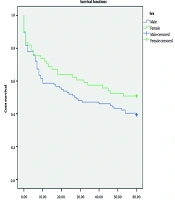
Mean survival times was 31.79 ± 2.58 months for male and 37.47 ± 3.26 months for female, but Log-rank (Mantel-Cox) test analysis confirmed no statistically significant difference in median survival time between male and female patients (P = 0.166) (Figure 1).

Figure 1.
Comparison of bone tumor survival time by gender
Log-rank (Mantel-Cox) test comparing median survival times among different tumor types showed no statistically significant difference (P = 0.757) (Figure 2).

Figure 2.
Comparison of bone tumor survival by tumor types
Based on life table analysis, the one-year, two-year, three-year, four-year, and five-year survival rates for patients with bone tumors were calculated to be 57%, 51%, 47%, 44%, and 43%, respectively.
Cox regression analysis was performed to evaluate the combined effects of age, gender, and tumor type on survival, and age at diagnosis had a statistically significant impact on survival.
4.1. Tumor-Specific Analysis
Patients with osteosarcoma had a mean age of 25.71 ± 17.17 years at diagnosis time, with the youngest patient being 4 years old and the oldest 74 years old. The highest frequency was seen in the 10–14-year-old group. Kaplan–Meier survival analysis was performed, and differences in median survival time across age groups were compared using the log-rank test, revealing a statistically significant association between patient age and survival (P ≤ 0.0001).
Males comprised 54.2% of osteosarcoma patients, while females represented 45.8% and male-to-female ratio was 1.18:1. Kaplan–Meier survival analysis with the log-rank test showed no statistically significant difference in median survival time according to patient gender.
Based on life table analysis, the one-year, two-year, three-year, four-year, and five-year survival rates for patients with osteosarcoma were calculated to be 63%, 50%, 46%, 38%, and 38 %, respectively.
The mean age of chondrosarcoma patients was 43.58 ± 17.54 years, with ages ranging from 22 to 76 years. The highest frequency was seen in the 30-34 years old group. Kaplan–Meier survival analysis with the log-rank test showed no statistically significant difference in median survival time according to patient age (p = 0.05). Males constituted 83.3% of these patients, resulting in a male-to-female ratio of 5:1.
Kaplan–Meier survival analysis with the log-rank test showed no statistically significant difference in median survival time according to patient gender (P = 0.913).
Based on life table analysis, the one-year, two-year, three-year, four-year, and five-year survival rates for patients with chondrosarcoma were calculated to be 92%,75%, 58%,50%, and 36 %, respectively.
Patients with Ewing sarcoma had a mean age of 20.0 ± 13.34 years, with the youngest patient being 8 years old and the oldest 42 years old. Kaplan–Meier survival analysis with the log-rank test showed no statistically significant difference in median survival time according to patient age.
Males accounted for 60% of cases, yielding a male-to-female ratio of 1.5:1. Kaplan–Meier survival analysis with the log-rank test showed no statistically significant difference in median survival time according to patient gender (p = 0.610).
Based on life table analysis, the one-year, two-year, three-year, four-year and five-year survival rates for patients with Ewing sarcoma were calculated to be 20%.
Based on the results, the sample size was adequate for the overall analysis of bone tumors; however, limitations were encountered when analyzing specific bone tumor subtypes.
5. Discussion
In this study, the overall 5-year survival rate for malignant bone tumors was 43%. Recent comprehensive analyses from developed countries reported overall 5-year survival rates for osteosarcoma ranging from 51 - 60.5% (11).
Early diagnosis of bone cancer faces several challenges. Owing to the rarity of these tumors, their symptoms are often attributed to more common musculoskeletal conditions. In addition, limited access to advanced imaging modalities in remote or low-income regions may delay diagnosis, resulting in presentation at more advanced stages and poorer survival outcomes. These barriers can cause differences in the survival rate of bone tumors (2).
Contemporary treatment of bone sarcomas requires multimodal approaches, including neoadjuvant chemotherapy, surgical resection with wide margins, and adjuvant therapy. The establishment of specialized sarcoma centers with multidisciplinary teams has been shown to significantly improve outcomes (12, 13).
Similar to our study, a comprehensive 20-year analysis of malignant bone tumors from the SEER database (2000 - 2019) demonstrated that osteosarcoma was the most common tumor type, followed by chondrosarcoma and Ewing sarcoma (14). The relatively high proportion of "other bone tumors" (74.1%) in our study suggests possible inclusion of metastatic lesions, which warrants careful consideration when interpreting these epidemiological findings.
Our findings revealed a male predominance with a male-to-female ratio of 1.7:1, which aligns with recent international data. A 2022 SEER-based analysis of osteosarcoma covering 1975 - 2017 confirmed a higher overall incidence in males. However, among patients aged 0 - 9 years, the incidence of primary osteosarcoma was similar between sexes (15). Similarly, recent studies reported male predominance with ratios ranging from 1.2:1 to 1.6:1 (16, 17).
The mean age at diagnosis of 44.75 ± 25.55 years in this study reflects the characteristic age distribution of bone sarcomas. Contemporary data from 2020 - 2024 studies confirm the bimodal distribution, with pediatric/young adult peaks and in older patients for osteosarcoma (18, 19). The peak frequency observed in the 65 - 69 years age group in our study (12% of all patients) corresponds to the secondary peak that is typically seen in elderly patients, also often associated with secondary sarcomas.
Our analysis revealed no statistically significant difference in median survival time between male and female patients, which contrasts with several recent studies that have demonstrated significant gender-related survival differences in bone sarcomas (20).
A 2024 National Cancer Database analysis of the USA, specifically examining sex differences in osteosarcoma survival, found that females had higher 5-and 10-year survival in all age groups (17). The study reported that this gender disparity persists even after adjusting for treatment modalities, suggesting biological or behavioral factors may contribute to these differences. Similarly, a 2022 SEER-based study noted worse survival in males compared to females for osteosarcoma patients (15).
The absence of significant gender-related survival differences in our study may be attributed to the relatively small sample size, shorter follow-up period, or treatment variations that mask potential biological differences between sexes. This finding warrants further investigation with larger cohorts and longer follow-up periods.
Our osteosarcoma patients demonstrated a mean age at diagnosis of 25.71 ± 17.17 years, and the highest frequency was seen in the 10 - 14-year-old group, which is consistent with recent epidemiological data. A 2018 observational study of patients younger than 25 years old identified similar age distributions for pediatric and young adult osteosarcoma (21). The observed slight male predominance (M:F ratio 1.18:1) is consistent with contemporary data showing a male preponderance in osteosarcoma incidence (15, 22).
However, our reported 5-year survival rate of 38% for osteosarcoma patients is significantly lower than recent international benchmarks. A 2020 survival analysis reported 5-year survival rates ranging from 60-68% in the western region, while acknowledging that centers in the Asia-Pacific region report rates of 27 - 67% (5). Recent SEER data shown overall 5-year relative survival rates of bone and joint cancer 68.5% (23). This disparity highlights the global inequality in osteosarcoma outcomes and the need for standardized treatment protocols.
The demographic profile of chondrosarcoma patients in our study, with a mean age of 43.58 ± 17.54 years and pronounced male predominance (M:F ratio 5:1), partially aligns with established patterns. Recent studies confirm that chondrosarcoma typically affects middle-aged and older adults, with a slight male predominance (24, 25). Our cohort shows an extreme male predominance that surpasses most contemporary studies.
In our study, the 5-year survival rate for chondrosarcoma was 36%. In comparison, a 2020 SEER database analysis of chondrosarcoma subtypes reported 5-year survival rates ranging from 11.3% to 68.1%, depending on histological subtype (25). This significant discrepancy may be attributed to differences in histological grading, staging at presentation, or treatment approaches, emphasizing the need for standardized diagnostic and treatment protocols.
The age distribution of Ewing sarcoma patients in our study (mean age 20.0 ± 13.34 years) corresponds well with established epidemiological patterns. Recent European data confirm that Ewing sarcoma predominantly affects children, adolescents, and young adults (16). The male-to-female ratio of 1.5:1 is consistent with recent literature reporting male predominance in Ewing sarcoma (26).
Our reported 5-year survival rate of 20% for Ewing sarcoma represents a concern, as it falls below current international standards. Recent studies report 5-year survival rates for Ewing sarcoma ranging from 70% for localized disease and 30 - 40% for metastatic disease (16, 27). A 2020 prognostic analysis using SEER data demonstrated significantly improved outcomes with contemporary treatment protocols (28) his substantial improvement underscores the need for the implementation of standardized multimodal treatment strategies. This study demonstrates that primary bone cancers in Guilan Province, Iran, are associated with lower survival rates compared to those reported in developed countries. The findings emphasize the need to enhance early detection strategies, improve diagnostic facilities, and expand access to comprehensive multimodal treatments in this region.
It is important for healthcare providers to be aware of the symptoms of bone tumors for early detection and increased survival. Also, developing targeted screening protocols for high-risk individuals can be effective in this regard (2).
Future efforts should focus on cancers features and detailed treatment data to better understand the disease and optimize patient management, which finally resulted in improving survival and quality of life for bone cancer patients in this population.