
1. Introduction
Cancer is one of the most dangerous noncommunicable diseases and is often perceived by the public as a death sentence. It is a leading cause of mortality in more than 110 countries worldwide (1). In Iran, cancer constitutes the second-largest group of noncommunicable diseases and is the third leading cause of death after cardiovascular diseases and accidents. The number of new cancer cases in Iran is projected to increase from 112,000 in 2016 to 160,000 in 2025 (2). This upward trend has transformed the growing cancer burden into a major public health challenge (3). However, an encouraging aspect is that 30% - 50% of cancers can be prevented by avoiding risk factors and implementing evidence-based prevention strategies (4). Achieving this goal requires increasing public awareness and willingness to engage in preventive behaviors, which is linked to improved access to relevant health information (5).
Despite scientific advances in prevention and treatment, individuals’ responses to cancer-related information are not uniform. Although much of the literature on health information behavior assumes that people seek health information, greater access to information does not always lead to positive outcomes. Health information may evoke unpleasant emotions, anxiety, conflict with personal beliefs, or even compel unwanted decisions. Consequently, some individuals consciously prefer ignorance to knowledge. Empirical evidence indicates that people may intentionally avoid receiving health information, particularly information about cancer (6). Given the widespread fear of cancer, information avoidance is more common for this disease than for other diseases (7).
Information avoidance encompasses a set of selective behaviors aimed at stopping, limiting, or delaying the search for, exposure to, processing, or use of information (8). In the context of cancer, this behavior is defined as a communication strategy in which an individual consciously refrains from acquiring cancer-related information from various sources to prevent the emotional stress associated with exposure to such information (9). This type of avoidance can have numerous adverse consequences and impose high costs at both individual and societal levels (10). When vital cancer information is available, avoiding it can lead to increased complications, mortality, and costs for healthcare systems (11).
Despite numerous studies on cancer information avoidance (12-15), Kahlor et al. (18) and Emanuel et al. (17) noted that research investigating the determinants of cancer information avoidance remains in its early stages (12 - 21). These points underscore the importance of identifying and understanding the models, theories, and determinants of cancer information avoidance.
The main reasons for conducting this study were to provide a comprehensive and evidence-based overview of the models, theories, and determinants of cancer information avoidance using a mixed-methods approach combining a scoping review and bibliometric analysis. A scoping review, as a qualitative and exploratory method, enables the identification of key concepts, theoretical frameworks, and dimensions that determine cancer information avoidance behavior. It also helps systematically identify and map the breadth of existing evidence on a specific topic, area, concept, or issue (22, 23). In contrast, bibliometric analysis, as a quantitative and data-driven method, reveals the structure of science by examining indicators such as coauthorship, cocitation, and co-word analysis and maps research trends over time (24). Combining these two methods integrates the conceptual richness of the scoping review with the quantitative precision of bibliometric analysis, enabling researchers to identify theoretical frameworks and determinants of cancer information avoidance while also pinpointing knowledge gaps and future research directions.
2. Methods
This study was conducted using the scoping review method proposed by Arksey and O'Malley (22) and the subsequent modifications by Levac et al. (23). The Joanna Briggs Institute (JBI) guidelines (23) and the Preferred Reporting Items for Systematic Reviews and Meta-Analyses Extension for Scoping Reviews (PRISMA-ScR) checklist (24) were followed for conducting the study and reporting the results. Accordingly, the study involved the following iterative stages.
2.1. Identifying the Research Questions
Based on a preliminary search, the research questions were as follows:
1) What are the research and thematic trends in the field of cancer information avoidance?
2) What research models and theories have been used in studies that examine the factors affecting cancer information avoidance?
3) What are the determinants of cancer information avoidance?
2.2. Identifying Relevant Studies
In accordance with the JBI recommendations, the search process was conducted in 3 stages.
First, a preliminary search was conducted in Scopus to identify keywords and key phrases relevant to the topic. Subsequently, the final keywords were derived using Medical Subject Headings (MeSH) and input from subject specialists.
Second, the search strategy was executed across Scopus, PubMed, and Web of Science. Table 1 shows the PubMed search formula. The same keywords were used in Web of Science and Scopus by combining Boolean and truncation operators, with restrictions applied to the title, abstract, and keywords fields. No time limit was applied to maximize access to relevant literature. The reference lists of the identified papers were also searched to identify additional papers. Grey literature was also searched via Google Scholar.
Table 1.
Search Strategy
| Database | Search Strategy | Search Time |
|---|---|---|
| PubMed | (((((((((((("information avoid*"[Title/Abstract]) OR ("information ignore*"[Title/Abstract])) OR ("information deny"[Title/Abstract])) OR ("information deni*"[Title/Abstract])) OR ("information reject*"[Title/Abstract])) OR ("nonuse of information"[Title/Abstract])) OR ("avoiding information"[Title/Abstract])) OR ("avoiding of information"[Title/Abstract])) OR ("information escape"[Title/Abstract])) OR ("information evad*"[Title/Abstract])) OR ("avoidance behavio?r*"[Title/Abstract]))) AND ((((cancer [Title/Abstract]) OR (neoplasm* [Title/Abstract])) OR (tumor*[Title/Abstract])) OR (Onco* [Title/Abstract]) AND (english[Filter])) | The search was conducted on August 18, 2025. |
2.3. Study Selection
All 2135 retrieved records were imported into EndNote software. After the inclusion and exclusion criteria were established based on JBI guidance, 2 researchers independently screened the titles and abstracts of the records.
After screening and reaching final consensus, full-text sources published in English and relevant to information avoidance in the context of cancer were included in the study (354 records). Studies published in other languages and those addressing unrelated topics were excluded (1457 records).
The 2 researchers independently assessed the titles and abstracts. In cases of disagreement, a final decision was reached through discussion. When judgment was difficult based on the abstract alone, the full text of the article was reviewed. Ultimately, 28 studies met the eligibility criteria and were selected for the scoping review. A flow diagram of the study selection process (PRISMA-ScR flowchart) is presented in Figure 1.
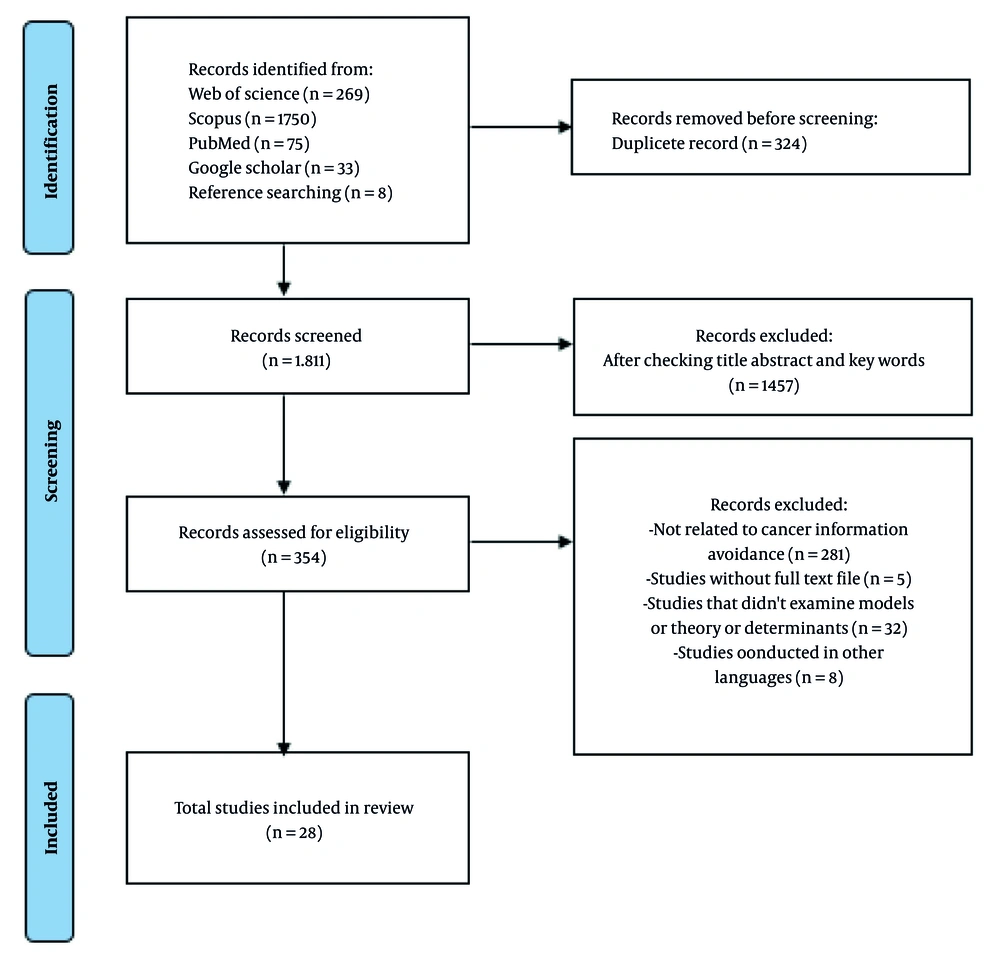
Figure 1.
PRISMA flow diagram
2.4. Charting the Data
First, a data extraction form was developed in accordance with JBI guidelines. The data were imported into Biblioshiny software in BibTeX format. To answer the first research question, knowledge maps were generated and analyzed using bibliometric techniques and Biblioshiny software.
2.5. Collating, Summarizing, and Reporting the Results
To answer the second and third research questions and identify models and theories of cancer information avoidance and its determinants, a scoping review approach was used.
2.6. Consultation With Experts
To validate the final findings, the research team, which included a medical librarian, a behavioral researcher, and a cancer specialist, independently examined the final determinants of cancer information avoidance. Their feedback was incorporated into the data interpretation and analysis process. Ethical approval for this study was obtained from the Research Ethics Committee of Kerman University of Medical Sciences.
3. Results
The bibliometric analysis showed that 28 studies on cancer information avoidance were published between 1995 and 2025, indicating an annual growth rate of 3.73%. Only 3 articles were single-authored, and 75 authors contributed to these articles. The results showed an average of 3.7 authors per study. However, only 33.3% of the articles involved international collaboration, with most research concentrated at the domestic and national levels.
The mean age of the cited references was 6.63 years, suggesting that this is a developing field that relies on relatively recent publications. In contrast, the average of 47.78 citations per document indicates high impact and relevance to core discussions within the scientific community.
The presence of 309 unique keywords indicates the conceptual diversity and multidisciplinary nature of this field. For the keyword analysis, the data were preprocessed: irrelevant terms were removed, and terms referring to the same concept were standardized. A visualization of the generated word cloud is presented in Figure 2. As shown, the core of the studies revolves around information avoidance, cancer, and information-seeking behavior.
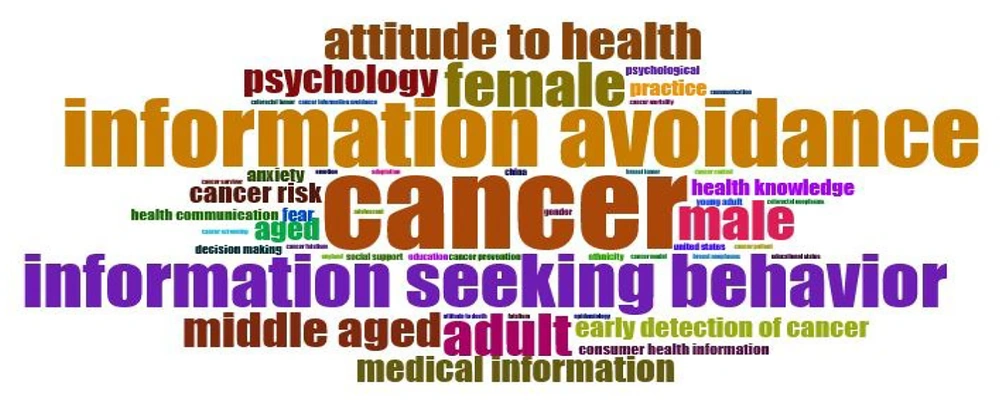
Figure 2.
Word cloud visualization of cancer information avoidance
As illustrated in Figure 2, keywords such as female, male, adult, middle-aged, aged, gender, education, and ethnicity indicate a focus on sociodemographic variables. Furthermore, they indicate that research has predominantly focused on adults and middle-aged groups, with particular emphasis on women.
Terms such as risk, fear, anxiety, self-efficacy, self-concept, and psychology reflect an emphasis on psychological and behavioral variables in investigations of cancer information avoidance. Additionally, the keyword survivors indicates attention to cancer survivors and their information behaviors during the posttreatment phase.
As shown in Figure 3, the largest volume of studies was conducted in the United States (31.6%), China (19%), and the United Kingdom (5.9%). Collectively, these 3 countries account for 56.5% of the studies.
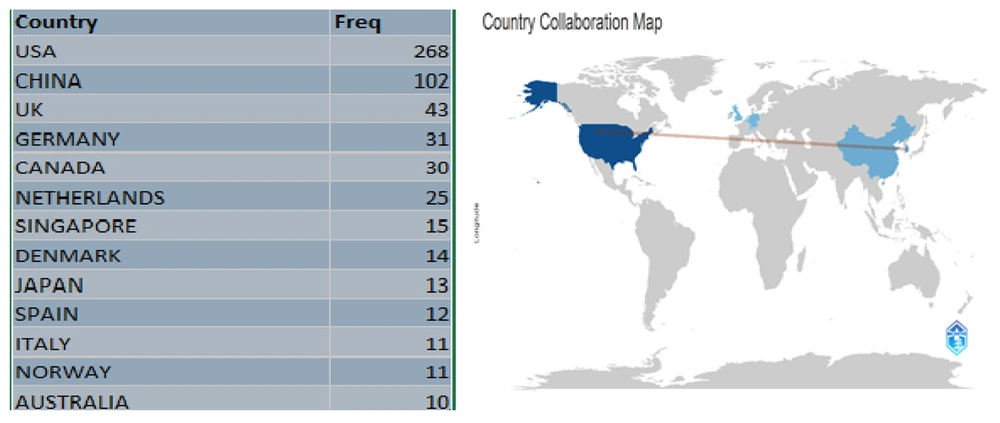
Figure 3.
Country collaboration map of cancer information avoidance articles
As Figure 4 illustrates, thematic mapping in the field of cancer information avoidance is divided into 4 themes—niche, motor, emerging or declining, and basic—based on 2 axes: degree of relevance (centrality) and degree of development (density). Motor themes (upper-right quadrant) are key to the research area; in this study, they include variables such as gender, breast cancer, and health literacy. Specialized themes (upper-left quadrant) have been sufficiently addressed in previous years and are not critical to the structure of the research area; race, cancer survivors, and education level fall into this group. Emerging or declining themes (lower-left quadrant) include 2 categories: 1) emerging themes, which are characterized by low centrality and high density; these themes are new and have limited occurrence, but their importance is increasing; self-efficacy, trust, and attitudes toward death are among the emerging concepts; and 2) declining topics, which are no longer central to the development of the research field and are less studied; cancer screening and cancer information fall into this category. Finally, core themes (lower-right quadrant) are considered important to the field and are frequently studied; fatalism in cancer and models of cancer information avoidance fall into this category.
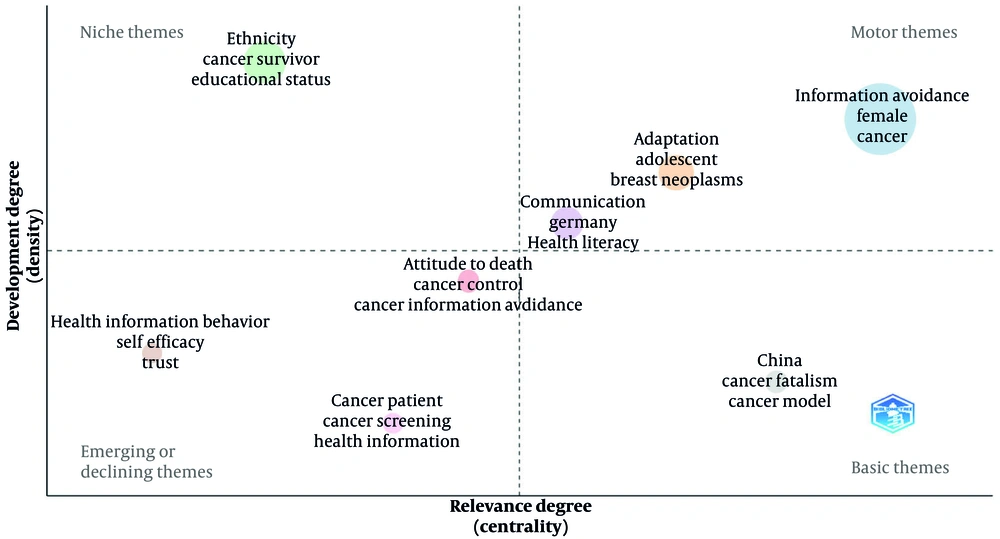
Figure 4.
Thematic map of cancer information avoidance articles
3.1. Theories and Models of Cancer Information Avoidance
Information avoidance research remains in its infancy compared with information-seeking research. As presented in Table 2, studies on cancer information avoidance have been based on 7 theories drawn from diverse fields, such as psychology, communication science, behavioral economics, and health sciences.
Table 2.
Theories Applied in Studies on Cancer Information Avoidance
| No. | Theory | Related Studies | Focus | Field |
|---|---|---|---|---|
| 1 | Cognitive Dissonance Theory | (25) | Avoidance of information that causes dissonance and unpleasant emotions | Psychology |
| 2 | Crisis Decision Theory | (7) | Coping with a negative life event | Psychology |
| 3 | Uncertainty Management Theory | (26, 27) | Maintaining hope and optimism derived from uncertainty | Behavioral economics |
| 4 | Stimulus-Organism-Response Theory (S-O-R Theory) | (28) | Cognitive responses based on an individual's internal mechanisms | Psychology |
| 5 | Prospect Theory | (29) | Avoidance of loss and fear of missing out | Behavioral economics |
| 6 | Monitoring Versus Blunting Styles | (30) | Psychological coping with threatening information | Psychology |
| 7 | Theory of Motivated Information Management | (31) | Uncertainty and anxiety | Communication science |
Furthermore, as presented in Table 3, studies on cancer information avoidance have been developed based on several models, each of which examines the cognitive, affective, social, and situational processes underlying an individual's decision to avoid cancer-related information from a distinct perspective.
Table 3.
Models Applied in Studies on Cancer Information Avoidance
| No. | Model | Reference | Number of Studies | Related Studies | Core Focus |
|---|---|---|---|---|---|
| 1 | Taxonomy of Psychological Conditions | Ortony et al., 1987 | 1 | (32) | Psychological variables for assessing mental state, including emotional, cognitive, and affective-cognitive conditions |
| 2 | Extended Parallel Process Model (EPPM) | Witte, 1992 | 5 | (13, 14, 17) | Fear appeal |
| 3 | Planned Risk Information-Seeking Model (PRISM) | Kahlor, 2010 | 1 | (33) | Response to perceived risk as a purposeful and conscious behavior |
| 4 | Risk Information Seeking and Processing Model (RISP) | Griffin et al., 1999 | 2 | (9, 34) | Risk communication |
| 5 | Pathway Mediation Model | Street et al., 2009 | 1 | (35) | Physician-patient communication on health |
Based on Table 3, the most widely used model is the Extended Parallel Process Model, which aims to explain the processing and effects of fear-appeal messages. The second most widely used model is the Risk Information Seeking and Processing Model, which aims to distinguish among social, psychological, and relational factors.
3.2. Determinants of Cancer Information Avoidance
A review of the literature reveals that numerous factors influence the avoidance of cancer information, necessitating a comprehensive classification of these determinants. In this study, as illustrated in Table 4, these factors are categorized into 4 main dimensions: sociodemographic characteristics, individual factors, social factors, and contextual-situational factors.
Table 4.
Determinants of Cancer Information Avoidance
| Dimensions and Subdimensions | Variables and Sources |
|---|---|
| Sociodemographic characteristics | Age (3, 9, 31, 36); gender (7, 15); deprivation (14); race (26); education (26); debt (26); income (26); occupation (14); marital status (7, 15, 28); years of smart-device use (28); weekly hours of reading health information (28); per capita monthly household income country (28) |
| Individual factors | |
| Cognitive factors | Cancer risk perception (3, 9, 32, 37); susceptibility (9, 10); severity (9, 10); perceived control (7, 11, 15); coping resources (9, 11); personal coping resources (31); coping efficacy (31); lack of personal resources (7); self-efficacy (15, 28, 29); perceived cancer information usefulness (9); cancer information insufficiency and health literacy (33); seeking efficacy (31); target efficacy (31); response efficacy (14); loss aversion (29) |
| Affective factors | Cancer worry (3, 10, 32, 37); hope (31); interest (31); worry about medical bills (38); privacy concerns (28); worry about uninsured status (38); cancer fear (9, 13, 29, 32, 39, 40); regret over seeking (11); regret over avoiding (11); perceived psychosocial stress (13); anxiety (7, 15, 27, 31, 36); affective risk response (9); negative emotion (28) |
| Social factors | Social support (7, 9, 28); interpersonal resources (7); negative interactions with healthcare (36); discrimination (treated with less courtesy or as if dishonest) and discrimination in daily life (38); patient-centered communication (3); patient trust (3); stigma (34) |
| Contextual and situational factors | |
| Cultural factors | Cancer fatalism (7, 9, 13, 15, 33, 40); cancer fatalistic belief (3); cultural difference (3); channel beliefs (34); avoidance efficacy (31) |
| Informational factors | Health information exposure on social media (33); health information exposure in mass media (33); cancer information overload (CIO) (7, 15, 27); trust in health information (7); trust in health information sources (6, 15); information efficacy (15); informational norm (9); predictors of information behaviors (31); uncertainty discrepancy (31) |
| Factors related to the health system | Perceived quality of healthcare (15); healthcare use (15); healthcare literacy (35); healthcare coverage (41); negative interactions with healthcare (36) |
| Disease-related factors | Cancer experience (34); cancer curability (33); trait anxiety (7); screening procedures (36); acquisition-related outcome expectancies (31); avoidance-related outcome expectancies (31); cancer diagnosis (3); cancer history (7, 15, 27, 34); family history of cancer (34); treatment modality (29) |
Furthermore, the individual factors dimension is divided into 2 subdimensions: cognitive and affective factors. Similarly, the contextual-situational factors dimension is classified into 4 subdimensions: cultural factors, informational factors, factors related to the health system, and disease-related factors. This structured taxonomy provides a framework for understanding the multifaceted nature of cancer information avoidance.
4. Discussion
This study provides a systematic and comprehensive synthesis of research on cancer information avoidance conducted over the past 3 decades. Most studies originated from the United States, China, and the United Kingdom, countries known for advanced healthcare systems, substantial research budgets, and strong institutional infrastructure. The importance of the topic, along with rising cancer rates in the United States, has likely contributed to the higher volume of research on cancer information avoidance in this country. This finding is consistent with the work of Markus and Kitayama (42), who demonstrated the role of culture and the self in cognition, emotion, and motivation. These findings confirm that information avoidance is not a universal behavior and should be examined within the sociocultural context of each society. Furthermore, the findings indicated that women were a major target group in the included studies; therefore, social pressures, cultural attitudes, and gender roles likely play important roles in shaping avoidance behaviors.
From a theoretical perspective, research on cancer information avoidance has been conducted based on 7 key theories. These theories posit that information avoidance may be driven by threatening beliefs, increased anxiety, the need to manage uncertainty, individual differences in coping styles, and cost-benefit analyses of information seeking. In addition, studies were conducted using 5 analytical models that highlight the roles of psychological variables, fear, emotions arising from threatening outcomes (such as fear, anxiety, and worry), perceived risk, and the physician-patient relationship as key factors in cancer information avoidance. This finding underscores that explaining information avoidance behavior requires an interdisciplinary approach. Cognitive Dissonance Theory posits that people avoid threatening information to reduce anxiety caused by cognitive conflict. Similarly, Uncertainty Management Theory interprets avoidance as a strategy for emotional control and maintaining hope. Furthermore, the developed risk perception attitude framework and the Risk Information Seeking and Processing Model explain the roles of fear, risk perception, and motivation in decisions to seek or avoid information. The results also indicated that cancer information avoidance is a complex behavior influenced by multiple factors. These determinants of cancer information avoidance can be categorized into 4 dimensions—sociodemographic characteristics, individual factors, social factors, and contextual and situational factors—which aligns with the findings of previous studies (43, 44).
Based on the findings of this study and the importance of investigating cancer information avoidance, future research should use interdisciplinary frameworks and advanced methodologies, such as structural equation modeling and mixed-methods approaches. Specifically, it is important to examine and compare the proposed model of determinants, including sociodemographic, individual, social, and contextual/situational factors, across different cultures and societies. In addition, although the Planned Risk Information Avoidance (PRIA) model (45) was designed to understand risk information avoidance, it was not used in the reviewed studies. Therefore, future studies should examine and compare the model proposed in this study with the PRIA model. Finally, the relationships between cancer information avoidance and preventive behaviors, screening, and treatment participation should be investigated. The primary limitation stems from the nature of this scoping and bibliometric review. Because only studies indexed in specific databases (Scopus, PubMed, and Web of Science) and published in English were included, selection bias may have occurred. The validity of these findings could be strengthened in future reviews by incorporating studies from additional databases and studies published in other languages. Another limitation is that the frequent appearance of certain theories, models, and countries in the literature does not indicate their superiority or greater effectiveness, but rather reflects prevailing research trends.
4.1. Conclusion
Cancer information avoidance is a complex behavioral response influenced by individual, social, contextual-situational, and sociodemographic factors. Despite increasing scholarly attention, existing research remains geographically concentrated in developed countries and lacks theoretical coherence. The literature reveals important gaps, including the lack of a comprehensive model to examine the determinants of cancer information avoidance, limited longitudinal studies, insufficient diversity in study populations, and inadequate examination of avoidance in digital and multicultural contexts. Future research should use interdisciplinary frameworks and advanced methodological approaches to better understand the determinants, reduce avoidance, and enhance preventive behaviors and participation in cancer screening and treatment.