
1. Background
Cervical cancer remains a major public health challenge and is among the leading causes of cancer-related mortality among women in low- and middle-income countries, disproportionately affecting younger populations (1, 2). Although cytological screening and human papillomavirus vaccination have reduced incidence and mortality in many high-income countries (3), disease progression is influenced by several cofactors, including long-term oral contraceptive use in high-risk populations (4). In addition, age-standardized mortality remains a concern in settings where socioeconomic constraints limit early detection.
For FIGO 2018 stage IB-IIA disease, standard treatment options include radical hysterectomy, with or without systemic therapy, and definitive CRT (5, 6). However, guidance for patients with stage IB3-IIA disease remains uncertain. Clinicians often face the challenge of balancing the benefits of local tumor control against the risks of treatment-related adverse effects. This decision is particularly important for younger patients because pelvic radiotherapy can substantially affect long-term quality of life (7-9).
Since the 1980s, NACT_RS has been explored as a downstaging strategy to shrink bulky tumors, reduce lymphovascular space invasion, and potentially avoid adjuvant radiotherapy and its associated morbidity in young women (10). Response rates to platinum-taxane regimens often exceed 60% - 90%; however, survival advantages remain inconsistent. Chemoradiotherapy is associated with several short- and long-term adverse effects that can affect the gastrointestinal and genitourinary systems, as well as sexual health, and may impair long-term quality of life (11, 12).
Although global incidence has decreased in high-income countries through screening and vaccination, the disease burden remains substantial in specific regional contexts. For example, national cancer registry data from Iran highlight ongoing epidemiological challenges and survival disparities associated with cervical cancer, underscoring the need for optimized and accessible treatment paradigms in such settings (13).
2. Objectives
This study aimed to address these uncertainties by comparing oncological outcomes and toxicity profiles between NACT_RS and definitive CRT in a cohort of patients with locally advanced cervical cancer, defined as tumors ≥ 4 cm and FIGO 2018 stage IB–IIA disease.
3. Methods
3.1. Study Design and Patient Selection
This retrospective cohort study included all consecutive women with FIGO 2018 stage IB-IIA cervical carcinoma who were treated at Imam Hossein Hospital, Tehran, Iran, between January 2021 and December 2024. Eligible histological types were squamous cell carcinoma, adenocarcinoma, and adenosquamous carcinoma, classified as grades 1 - 3. The primary analysis focused on patients with locally advanced disease, defined as a primary tumor diameter ≥ 4 cm on magnetic resonance imaging. Additional inclusion criteria were parametrial extension involving < 50% of stromal thickness and the absence of radiological pelvic nodal metastasis.
A total of 81 patients met these criteria and constituted the comparative analysis: 31 in the NACT_RS group and 50 in the CRT group. A separate cohort of 39 patients with tumors < 4 cm who were treated with primary radical surgery (RS) during the same period did not meet the inclusion criteria for this analysis because of substantial differences in baseline disease characteristics. Data from this cohort were used only for contextual comparison in the Discussion.
3.2. Treatment Cohorts
Patients were assigned by tumor-board consensus to 1 of 2 treatment arms:
- NACT_RS (Neoadjuvant Chemotherapy Plus Surgery): Patients received 3 cycles of chemotherapy with carboplatin (area under the curve, 6) and paclitaxel (175 mg/m2), followed by type C1 radical hysterectomy with bilateral pelvic lymphadenectomy and an additional 3 postoperative cycles of chemotherapy.
- CRT (Chemoradiotherapy): Patients received external-beam radiotherapy at 45 - 50 Gy in 25 fractions, followed by high-dose-rate intracavitary brachytherapy at 28 - 30 Gy in 4 - 5 fractions, combined with chemotherapy.
3.3. Data Collection and Variables
Clinical, imaging, and pathological data were extracted from electronic health records using a standardized template. Baseline variables included age, ECOG performance status, tumor histology, maximum tumor diameter, parametrial or vaginal involvement, and nodal status. Surgical data included operative time, estimated blood loss, transfusion requirement, and pathological findings, including residual tumor size, lymphovascular space invasion, depth of stromal invasion, parametrial involvement, margin status, and nodal metastases. Adverse events were graded according to the Common Terminology Criteria for Adverse Events, version 5.0.
3.4. Endpoints
The primary endpoints were 1-, 2-, and 3-year disease-specific OS, defined as the time from treatment initiation to death from a disease-related cause, and PFS, defined as the time to first recurrence, progression, or death. Secondary endpoints assessed the comparative safety and toxicity profiles of both treatment modalities. These included the incidence and severity of preoperative toxicities associated with neoadjuvant chemotherapy and the rates of early (≤ 90 days) and late (> 90 days) posttreatment complications in both cohorts, graded according to the Common Terminology Criteria for Adverse Events, version 5.0.
3.5. Statistical Analysis
Statistical analyses were performed using IBM SPSS Statistics for Windows, version 19.0. After assessment of normality, continuous data with a nonnormal distribution were presented as median (range) and compared between the CRT and NACT_RS groups using the Mann-Whitney U test. Categorical variables were expressed as frequencies and percentages and compared using the Pearson chi-square test or Fisher exact test, as appropriate. Crude hazard ratios for potential risk factors for disease recurrence or death were calculated using univariate Cox regression analysis. Progression-free survival and disease-specific OS were calculated using the Kaplan-Meier method. Associations between treatment group and PFS or OS were assessed using the log-rank test. A 2-tailed P value of < 0.05 was considered statistically significant.
3.6. Ethical Approval
The study was approved by the Ethics Committee of Shahid Beheshti University of Medical Sciences (IR.SBMU.RETECH.REC.1404.002) and was conducted in accordance with the Declaration of Helsinki. The requirement for individual informed consent was waived because of the deidentified and retrospective design.
4. Results
4.1. Patient Characteristics and Baseline Comparisons
A total of 81 patients with tumors ≥ 4 cm were included in this analysis. Baseline characteristics of the NACT_RS (n = 31) and CRT (n = 50) groups are shown in Table 1. The two cohorts were well matched, with no statistically significant differences in median age, tumor size, FIGO stage distribution, histology, or rates of vaginal or parametrial involvement.
Table 1.
Baseline Characteristics of Patients with Tumors ≥ 4 Cm a
| Characteristic | CRT (n = 50) | NACT_RS (n = 31) | P Value |
|---|---|---|---|
| Age (y) | 51.5 (30.0 - 75.0) | 50.0 (32.0 - 68.0) | 0.316 |
| Tumor size (mm) | 43 (23 - 77) | 45 (40 - 69) | 0.165 |
| MRI stage | 0.365 | ||
| 2A | 34 (68.0) | 18 (58.1) | |
| 1B1/1B2 | 0 | 0 | |
| 1B3 | 16 (32.0) | 13 (41.9) | |
| Histology | 0.644 | ||
| SCC | 46 (92.0) | 31 (96.9) | |
| Adenocarcinoma | 4 (8.0) | 1 (3.1) |
a Values are expressed as No. (%) unless otherwise indicated. Abbreviations: CRT, chemoradiotherapy; MRI, magnetic resonance imaging; NACT_RS, neoadjuvant chemotherapy followed by radical surgery; SCC, squamous cell carcinoma.
4.2. Treatment-Related Complications
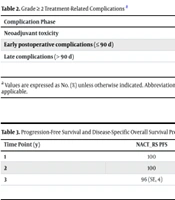
A comprehensive summary of grade ≥ 2 complications is presented in Table 2.
Table 2.
Grade ≥ 2 Treatment-Related Complications a
| Complication Phase | NACT_RS Group (n = 31) | CRT Group (n = 50) | P-Value |
|---|---|---|---|
| Neoadjuvant toxicity | 4 (12.9) | N/A | - |
| Early postoperative complications (≤ 90 d) | 6 (19.4) | N/A | - |
| Late complications (> 90 d) | 2 (6.5) | 32 (64.0) | < 0.001 |
a Values are expressed as No. (%). Abbreviations: CRT, chemoradiotherapy; NACT_RS, neoadjuvant chemotherapy followed by radical surgery; N/A, not applicable.
Neoadjuvant toxicity included grade 2 hematologic toxicity. No grade ≥ 3 toxicity was observed. Early postoperative complications consisted of surgical site infections. Late complications in the NACT_RS group included a vesicovaginal fistula (n = 1) and lymphedema (n = 1). Among the 12 NACT_RS patients who received adjuvant radiotherapy, only 2 (16.7%) developed late complications. Late complications in the CRT group were primarily sexual dysfunction (n = 38, 76%) and chronic gastrointestinal issues (n = 25, 50%).
4.2.1. Neoadjuvant Chemotherapy Toxicity
In the NACT_RS arm, grade 2 hematologic toxicity, defined according to the Common Terminology Criteria for Adverse Events version 5.0 as moderate anemia (hemoglobin 8.0 to < 10.0 g/dL) or neutropenia (absolute neutrophil count 1000 to < 1500/mm3), was observed in 4 patients (12.9%) during the neoadjuvant phase and was managed with supportive care without treatment delays. No grade ≥ 3 chemotherapy-related toxicities were recorded.
4.2.2. Posttreatment Complications
The overall rate of late complications was significantly higher in the CRT group (64.0%) than in the NACT_RS group (6.5%) (P < 0.001). In the CRT group, the most frequent late toxicities were sexual dysfunction, including vaginal stenosis and/or severe dyspareunia, affecting 38 patients (76%), and chronic grade 2 gastrointestinal issues, including proctitis or diarrhea, in 25 patients (50%). In the NACT_RS group, early postoperative complications were primarily surgical site infections (6 patients, 19.4%). Only 2 patients (6.5%) developed late grade ≥ 2 complications: 1 grade 3 vesicovaginal fistula and 1 grade 2 lymphedema.
4.2.3. Impact of Adjuvant Radiotherapy
In the NACT_RS arm, 12 patients (38.7%) received postoperative adjuvant radiotherapy. In this subgroup, 2 patients (16.7%) developed late complications: 1 grade 2 lymphedema and 1 grade 2 vaginal dryness. This rate was substantially lower than the 64.0% late complication rate observed in the definitive CRT group.
4.3. Progression-Free Survival
At a median follow-up of 36 months, PFS was significantly higher in the NACT_RS group (96%) than in the CRT group (74%). Survival analysis demonstrated a significant difference in favor of the NACT_RS approach (log-rank P = 0.013). Only 1 patient in the NACT_RS group experienced recurrence, compared with 13 patients in the CRT group. Survival probabilities are detailed in Table 3.
Table 3.
Progression-Free Survival and Disease-Specific Overall Survival Probabilities by Treatment Group a
| Time Point (y) | NACT_RS PFS | CRT PFS | NACT_RS OS | CRT OS |
|---|---|---|---|---|
| 1 | 100 | 100 | 100 | 100 |
| 2 | 100 | 86 (SE, 5) | 100 | 90 (SE, 4) |
| 3 | 96 (SE, 4) | 74 (SE, 6) | 100 | 81 (SE, 6) |
a Values are expressed as percentage. Abbreviations: CRT, chemoradiotherapy; NACT_RS, neoadjuvant chemotherapy followed by radical surgery; OS, overall survival; PFS, progression-free survival; SE, standard error.
4.4. Disease-Specific Overall Survival
Three-year disease-specific OS was 100% in the NACT_RS group and 81% in the CRT group, representing a statistically significant difference (log-rank P = 0.011). No disease-related deaths occurred in the NACT_RS group, whereas 9 disease-related deaths occurred in the CRT group (Table 4). Survival probabilities are detailed in Table 3.
Table 4.
Summary of Disease-Related Deaths by Cause and Treatment Group a
| Cause of Death | Treatment Group | Frequency (n) |
|---|---|---|
| Pelvic recurrence with complications | CRT | 3 |
| Distant metastasis (pulmonary) | CRT | 2 |
| Pelvic recurrence plus pulmonary metastasis | CRT | 1 |
| Pulmonary metastasis plus pulmonary embolism | CRT | 1 |
| Lymphatic recurrence with deep vein thrombosis | CRT | 1 |
| Pulmonary metastasis plus secondary lymphoma | CRT | 1 |
a No disease-related deaths occurred in the NACT_RS group. Abbreviation: CRT, chemoradiotherapy.
4.5. Summary of Mortality
During the follow-up period, no disease-related deaths occurred in the NACT_RS group, whereas 9 disease-related deaths (18.0%) occurred in the CRT group. In the separate RS cohort, 1 disease-related death (2.6%) was observed; this patient developed an isolated vaginal recurrence 18 months after surgery, was treated with definitive salvage CRT, and ultimately died of progressive disease. The difference in mortality between the primary comparison groups (CRT and NACT_RS) was statistically significant (P = 0.011).
In univariate analysis, increasing tumor size was associated with a higher risk of death (HR = 1.05 per mm; 95% CI, 1.01 - 1.10; P = 0.018). The specific causes of the 10 disease-related deaths observed across all cohorts during the 3-year follow-up period are summarized in Table 4.
5. Discussion
This study directly compared NACT_RS and definitive CRT in a well-matched cohort of patients with locally advanced cervical cancer, defined as tumors ≥ 4 cm. The key finding was that a surgery-based approach preceded by neoadjuvant chemotherapy was associated with significantly improved 3-year survival and a markedly lower rate of severe long-term morbidity compared with definitive CRT.
The most clinically important finding was the difference in long-term morbidity. This study identified a substantially higher rate of grade ≥ 2 late complications in the CRT group (64%). Although this rate may appear high, it reflects diligent long-term follow-up of patient-reported outcomes at our center. Furthermore, our analysis addressed a key confounding factor: the impact of adjuvant radiation on surgical patients. Even among the 38.7% of NACT_RS patients who required postoperative radiation, the rate of late complications was 16.7%, which was 4 times lower than that in the definitive CRT group. This finding underscores the potential benefit of avoiding high-dose definitive pelvic radiotherapy.
The debate regarding the optimal treatment for locally advanced cervical cancer is ongoing. Previous meta-analyses comparing NACT_RS with radiotherapy or CRT found no significant difference in overall short-term survival between treatments. However, subgroup analyses showed a significant long-term survival benefit for NACT_RS in studies with follow-up longer than 60 months (14). The present study, with 3-year follow-up, demonstrated a strong survival advantage for the surgical arm, reinforcing the conclusions of previous long-term analyses. Specifically, in univariate Cox regression analysis, CRT was associated with an 8.2-fold increased risk of recurrence compared with NACT_RS (HR = 8.16; 95% CI, 1.07 - 62.36; P = 0.043). This finding, in a cohort with similar baseline characteristics, provides compelling institutional evidence supporting the value of a surgery-based approach.
To place our findings in context, we compared our survival rates with those reported in other major trials. The 3-year PFS and OS rates in the NACT_RS arm in our study (96% and 100%, respectively) were exceptionally high and compared favorably with previously reported strong outcomes (14). Conversely, other studies have reported lower survival rates, highlighting variability in outcomes across different patient populations (15). This contextual comparison reinforces the validity of our institutional outcomes and strengthens the conclusion that a well-executed NACT_RS approach can yield favorable results.
From a patient-centered perspective, the difference in long-term morbidity is particularly important. The CRT group had a substantially higher rate of late complications (64%), and 75% of these patients experienced vaginal stenosis and dyspareunia. This finding aligns with the broader literature, which has consistently shown that quality of life in cervical cancer survivors is worse after radiation, with respect to sexual dysfunction, urinary symptoms, and lymphedema, than in survivors treated with surgery alone. Importantly, the NACT_RS strategy allowed nearly two-thirds of patients (61.3%) to completely avoid pelvic radiotherapy, thereby sparing them these significant and potentially life-altering complications (Table 2). The differing adverse-effect profiles of the 2 treatments highlight important clinical considerations. Chemoradiotherapy tends to cause more gastrointestinal complications, whereas the NACT_RS approach is more often associated with surgical site infections. Although both approaches carry risks, the long-term quality-of-life impact appears more substantial with CRT.
The profound selection bias in the RS cohort, in which patients had smaller and earlier-stage tumors, must be acknowledged. This reflects real-world clinical practice, in which upfront surgery is reserved for patients with more favorable disease characteristics. However, the more informative comparison in this study was between the NACT_RS and CRT cohorts, which were well matched at baseline. In this context, the NACT_RS strategy successfully rendered patients with larger tumors surgically manageable and achieved survival outcomes that were nearly identical to those of patients with small tumors undergoing primary RS, with 96% PFS and 100% OS at 3 years. This supports the role of NACT_RS not merely as an alternative to CRT but as an effective bridging strategy that may bring patients with more advanced disease into a lower-risk surgical category while sparing them the substantial late toxicities of radiation.
5.1. Study Limitations
This study has several limitations. It was a retrospective, single-center cohort study with a relatively small sample size. These limitations are common in institutional analyses and, as noted by Ye et al. (14), underscore the need for more multicenter studies with longer follow-up and integrated quality-of-life reporting to confirm these conclusions. The treatment groups were not randomized, and treatment decisions were based on clinical and pathological factors, which makes direct comparisons of treatment efficacy challenging. The statistical model could not fully account for all unmeasured confounding variables. In addition, the 3-year follow-up period may not capture all late events.
5.2. Conclusions
In our institutional experience with locally advanced FIGO IB3-IIA cervical cancer, NACT_RS was associated with significantly better 3-year survival and markedly lower rates of late pelvic toxicity compared with definitive CRT. These findings suggest that, for appropriately selected patients with larger tumors, NACT_RS is an effective strategy to improve resectability and achieve excellent oncological outcomes while avoiding the significant long-term morbidity of primary CRT. Future efforts to optimize patient selection and minimize overtreatment may increasingly rely on advanced predictive modeling and artificial intelligence, which can provide comprehensive frameworks for high-precision disease-severity stratification (16).